A place for LGBTQ spirituality and the arts. Home of the gay Jesus and queer saints. Uniting body, mind and spirit. Open to all. Renamed Q Spirit blog and moved to Qspirit.net in 2017.
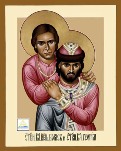
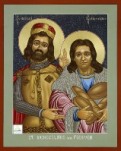
There’s good reason to believe that Good King Wenceslas was gay. Yes, the king in the Christmas carol. His feast day is today (Sept. 28).
Saint Wenceslaus I (907–935) was duke of Bohemia (now the Czech Republic). The carol "Good King Wenceslas" is based on a legend about Wenceslaus and his loyal page Podiven. According to the story, it was a bitterly cold night when they went out to give alms to the poor on the Feast of St. Stephen, Dec. 26. Podiven could not walk any farther on his bare, frozen feet, so Wenceslas urged him to follow in his footsteps. His footprints in the snow stayed miraculously warm, allowing the pair to continue safely together.
Many details in the Christmas carol are pious fiction, but the king and his page are both grounded in historical truth. The following is based partly on research from Dennis O’Neill, author of “Passionate Holiness.”
The earliest accounts of Wenceslaus’ life mention his page -- but not the woman who supposedly gave birth to his son in more recent versions. An account written in the late 10th or early 11th century describes the young man who was a “worthy page” and “chamber valet” to Wenceslaus.
It says that Wenceslaus used to wake his page in the middle of the night to join him in doing charitable works. The page is described as “a youth from among his valets who, of all his servants, was the most trustworthy in secret matters. The saint himself truly loved him during his lifetime.”
Wenceslaus was murdered in a coup by his brother at the door of a church on Sept. 28 in the year 935. The records say that Podiven “was often overcome by grief, sorrowing for days on end.” The brother also had Podiven killed to stop him from spreading stories of the saintly Wenceslaus. Both Wenceslaus and his beloved Podiven are buried at St. Vitus Cathedral in Prague.
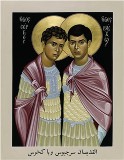
The icon above was painted by Colorado artist Lewis Williams of the Secular Franciscan Order (SFO). He studied with master iconographer Robert Lentz and has made social justice a theme of his icons. It is dedicated to the memory of Father Larry Craig, a Chicago priest known for service to the Latino community and prison ministry. Before his death in 2006, Father Craig used to stand outside the Cook County Jail at night, giving sandwiches and bus passes to surprised inmates who had just been released. He served as the model for Podiven’s face in this icon.
May these facts warm your heart whenever you hear or sing the Christmas carol “Good King Wenceslas.”
___
This post is part of the LGBTQ Saints series by Kittredge Cherry. Traditional and alternative saints, people in the Bible, LGBTQ martyrs, authors, theologians, religious leaders, artists, deities and other figures of special interest to lesbian, gay, bisexual and transgender and queer (LGBTQ) people and our allies are covered.
Christina Georgina Rossetti was a 19th-century English poet whose work ranged from Christmas carols to sensuous lesbian love poetry. A devout Christian who never married, she has been called a “queer virgin” and “gay mystic.” Her feast day is today (April 27) on the Episcopal and Church of England calendars.
Many consider her to be one of Britain’s greatest Victorian poets. Rossetti’s best-known works are the Christmas carol “In the Bleak Midwinter” and “Goblin Market,” a surprisingly erotic poem about the redemptive love between two sisters who overcome temptation by goblins. The homoeroticism is unmistakable in verses such as these:
She cried, “...Did you miss me?
Come and kiss me.
Never mind my bruises,
Hug me, kiss me, suck my juices
Squeez’d from goblin fruits for you,
Goblin pulp and goblin dew.
Eat me, drink me, love me…”
She clung about her sister,
Kiss’d and kiss’d and kiss’d her…
She kiss’d and kiss’d her with a hungry mouth.
Some of these verses were set to music in a choral piece commissioned by the Sydney Gay and Lesbian Choir: “Heartland” by Matthew Hindson.
There is no direct evidence that Rossetti was sexually involved with another woman, but historian Rictor Norton reports that her brother destroyed her love poems addressed to women when he edited her poetry for publication. Rossetti is included in “Essential Gay Mystics” by Andrew Harvey. A comprehensive chapter titled “Christina Rossetti: The Female Queer Virgin” appears in “Same Sex Desire in Victorian Religious Culture” by Frederick S. Roden. Rossetti is also important to feminist scholars who reclaimed her in the 1980s and 1990s as they sought women’s voices hidden in the church’s patriarchal past.
Rossetti (Dec. 5, 1830 - Dec. 29, 1894) was born in London as the youngest child in an artistic family. Her brother Dante Gabriel Rossetti became a famous Pre-Raphaelite poet and artist. Encouraged by her family, she began writing and dating her poems starting at age 12.
When Rossetti was 14 she started experiencing bouts of illness and depression and became deeply involved in the Anglo-Catholic Movement of the Church of England. The rest of her life would be shaped by prolonged illness and passionate religious devotion. She broke off marriage engagements with two different men on religious grounds. She stayed single, living with her mother and aunt for most of her life.
Christina posed
for this Annunciation
by Dante Gabriel Rossetti
During this period she served as the model for the Virgin Mary in a couple of her brother’s most famous paintings, including his 1850 vision of the Annunciation, “Ecce Ancilla Domini” (“Behold the Handmaid of God.”)
Starting in 1859, Rossetti worked for 10 years as a volunteer at the St. Mary Magdalene “house of charity” in Highgate, a shelter for unwed mothers and former prostitutes run by Anglican nuns. Some suggest that “Goblin Market” was inspired by and/or written for the “fallen women” she met there.
“Goblin Market” was published in 1862, when Rossetti was 31. The poem is about Laura and Lizzie, two sisters who live alone together and share one bed. They sleep as a couple, in Rossetti’s vivid words:
Cheek to cheek and breast to breast
Lock’d together in one nest.
But “goblin men” tempt them with luscious forbidden fruit and Laura succumbs. After one night of indulgence she can no longer find the goblins and begins wasting away. Desperate to help her sister, Lizzie tries to buy fruit from the goblins, but they refuse and try to make her eat the fruit. She resists even when they attack and try to force the fruit into her mouth. Lizzie, drenched in fruit juice and pulp, returns home and invites Laura to lick the juices from her in the verses quoted earlier. The juicy kisses revive Laura and the two sisters go on to lead long lives as wives and mothers.
“Goblin Market” can be read as an innocent childhood nursery rhyme, a warning about the dangers of sexuality, a feminist critique of marriage or a Christian allegory. Lizzie becomes a Christ figure who sacrifices to save her sister from sin and gives life with her Eucharistic invitation to “Eat me, drink me, love me…” The two sisters of “Goblin Market” are often interpreted as lesbian lovers, which means that Lizzie can justifiably be interpreted as a lesbian Christ.
In 1872 Rossetti was diagnosed with Graves Disease, an auto-immune thyroid disorder, which caused her to spend her last 15 years as a recluse in her home. She died of cancer on Dec. 29, 1894 at age 64.
She wrote the words to “In the Bleak Midwinter” in 1872 in response to a request from Scribner’s Magazine for a Christmas poem. It was published posthumously in 1904 and became a popular carol after composer Gustav Holst set it to music in 1906. Her poem “Love Came Down at Christmas” (1885) is also a well known carol. “In the Bleak Midwinter” continues to be sung frequently in churches, by choirs, and on recordings by artists such as Julie Andrews (video below), Sarah McLaughlin, Loreena McKennitt and James Taylor. The haunting song includes these verses:
In the bleak mid-winter
Frosty wind made moan,
Earth stood hard as iron,
Water like a stone;
Snow had fallen, snow on snow,
Snow on snow,
In the bleak mid-winter
Long ago.
Our God, Heaven cannot hold Him
Nor earth sustain;
Heaven and earth shall flee away
When He comes to reign:
In the bleak mid-winter
A stable-place sufficed
The Lord God Almighty,
Jesus Christ....
Enough for Him, whom cherubim
Worship night and day,
A breastful of milk,
And a mangerful of hay;
Enough for Him, whom angels
Fall down before,
The ox and ass and camel
Which adore.
Angels and archangels
May have gathered there,
Cherubim and seraphim
Thronged the air -
But only His mother
In her maiden bliss
Worshipped the Beloved
With a kiss.
What can I give Him,
Poor as I am?
If I were a shepherd
I would bring a lamb,
If I were a wise man
I would do my part,
Yet what I can I give Him,
Give my heart.
The Episcopal Church devotes a feast day to Christina Rossetti on April 27 with this official prayer:
O God, whom heaven cannot hold, you inspired Christina Rossetti to express the mystery of the Incarnation through her poems: Help us to follow her example in giving our hearts to Christ, who is love; and who is alive and reigns with you and the Holy Spirit, one God, in glory everlasting. Amen.
Rossetti herself may well have felt ambivalent about being honored by the church or outed as a queer. She shared her own thoughts for posterity in her poem “When I am dead, my dearest” (1862):
___
This post is part of the LGBTQ Saints series by Kittredge Cherry. Traditional and alternative saints, people in the Bible, LGBTQ martyrs, authors, theologians, religious leaders, artists, deities and other figures of special interest to lesbian, gay, bisexual and transgender and queer (LGBTQ) people and our allies are covered.
I bring you good tidings of great joy, which shall be to all people. For unto you is born this day in the city of David a Savior, which is Christ.
-- Luke 2:10-11
“Rainbow Baby Jesus” celebrates the birth of a child sent by God for the good of all, including the “rainbow tribe” of LGBTQ people.
When Jesus was born, God became flesh. It was a total, shocking identification with all people, including the whole rainbow spectrum of gender identities. Merry Christmas!
Rainbow Christ, you light up the world. You make rainbows as a promise to support all life on earth. In the rainbow space, we can see all the hidden connections between sexualities, genders and races. Like the rainbow, may we embody all the colors of the world! Amen.
--from the Rainbow Christ Prayer by Kittredge Cherry and Patrick Cheng:
____
This post is part of the Queer Christ series by Kittredge Cherry at the Jesus in Love Blog. The series gathers together visions of the queer Christ as presented by artists, writers, theologians and others.
“Make the Yuletide gay,” urges a popular Christmas song. In that spirit, click the headlines below to find queer cheer from Christmas highlights at the Jesus in Love Blog.
Chist is born in a way that liberates people from limitations of gender, race and sexual orientation in the minimalist “Color Nativity” by British artist Sebastian Bergne.
Reimagining the three kings as queer or female gives fresh meaning to story of the Magi. Biblical scholarship suggests that the Magi were eunuchs -- people who today would be called gay or transgender.
Nasty accusations of blasphemy were hurled when conservative bloggers discovered my gay and lesbian Nativity scenes. “Love..is NOT the criteria for making a ‘Family,’” said one critic.
There’s good reason to believe that Good King Wenceslas was gay. Yes, the king in the Christmas carol. Many details in the carol are pious fiction, but historical research documents the love between the king and his page Podiven.
Seven people from three countries sent images for the Queer Nativity project at the Jesus in Love Blog. They present Christ's birth in an amazing variety of liberating, loving new ways.
The Madonna and her female lover are portrayed by a real lesbian couple, seven months’ pregnant through artificial insemination in “Annunciation” by Elisabeth Ohlson Wallin.
Jesus’ angelic birth highlights the holiness of EVERY birth in a scene from the controversial new play “Jesus, Queen of Heaven” by transsexual Jo Clfford.
Conservatives attack an Episcopal bishop’s gender-bending Christmas card because it shows a multi-racial trio of female Magi visiting the baby Jesus and his mother (“Epiphany” by Janet McKenzie).
A nursing Madonna affirms the goodness of the human body, although some are shocked by her bare breasts.
___
Top image credit: “Rainbow Star” by Andrew Craig Williams, a queer artist in Wales.
___
This post is part of the LGBT Holidays series by Kittredge Cherry at the Jesus in Love Blog. The series celebrates religious and spiritual holidays, holy days, feast days, festivals, anniversaries, liturgical seasons and other occasions of special interest to lesbian, gay, bisexual, transgender and queer people of faith and our allies.
I create my own queer Nativity scenes for the Christmas season. One has two Marys at the manger with the baby Jesus, and the other features two Josephs with the Christ child.
I put Mary with Mary and Joseph with Joseph—just like putting two brides or two grooms on top of a wedding cake!
Obviously this is not about historical accuracy, but I believe my queer Nativity scenes are true to the spirit of the Christmas story in the Bible: God’s child conceived in an extraordinary way and born into disreputable circumstances. I also filmed a video about my gay and lesbian manger scenes and even made them available as Christmas cards.
Go ahead and imagine that Jesus has two mommies. According to the Bible story, Joseph was an adoptive father anyway. The Virgin Mary had Jesus without sex with a man, much like lesbian mothers who use artificial insemination.
Love makes a family—including the Holy Family.
I first got the idea for queering the crèche when I heard that a gay and lesbian Nativity scene was planned for the 2008 “Pink Christmas” festival in Amsterdam. Live actors were supposed to play a pair of Marys and a pair of Josephs. I had my own lesbian Christian spiritual awakening while waiting for the event.
I remembered going to a huge exhibit of Nativity scenes back when I was a young lesbian in seminary. They had hundreds of statues of Mary, Joseph and baby portrayed as every conceivable racial and ethnic identity. Not once did I consider that my own community was missing—there was no same-sex version with Mary and another woman. Nor was there a gay version with Joseph and another man.
Looking back some 20 years later, it finally occurred to me that LGBT families should be represented in the mix. I had a personal breakthrough as I realized that my mind was still trapped in heterosexual assumptions about the cast of characters at Jesus’ birth.
I imagined that the Amsterdam LGBT community would enact Nativity scenes of loving lesbian and gay families like those that I have known.
Scenes of a lesbian Madonna and her female partner with the baby Jesus have been created by artists such as Elisabeth Ohlson Wallin of Sweden and Becki Jayne Harrelson of Atlanta. But this was the first time that I’ve seen a gay Joseph and his male partner with the Christ child.
The Pink Christmas event turned out to be a disappointment to me. It featured a drag queen and a leather daddy who seemed like a parody of themselves, with no loving “family” connection to each other whatsoever. You can read my thoughts about the event in my previous post “Can you imagine? A gay Nativity scene.”
Fortunately, the Amsterdam event planted the idea in my mind for making the manger scene my own as a lesbian Christian. I bought two Nativity sets and let the Holy Spirit guide me.
I feel more connected to God every time I look at the loving lesbian and gay manger scenes in our living room. My partner and I even toyed with the idea of getting two sets of Nativity lawn decorations and turning our yard into a big old queer Christmas display. Maybe next year!
I also invite others to make their own queer Nativity scenes.
Rearranging the Holy Family is not as simple as it seems. Be sure to buy a set with freestanding figures. In many cases Mary, Joseph and Jesus are wedded together in one inseparable, three-headed blob. What does that say about our attachment to idealized, sanctified heterosexuality?
When you find freestanding figures, just get two standard Nativity sets, then mix and match. Please send me a photo of your creations to share the joy. I’d love to see dark-skinned and inter-racial queer couples too.
Everyone should be able to see themselves in the Christmas story, including the growing number of LGBT parents and their children.
___
All images are from the “Love Makes a Holy Family” series by Kittredge Cherry
___
This post is part of the LGBTQ Calendar series by Kittredge Cherry. The series celebrates religious and spiritual holidays, events in LGBTQ history, holy days, feast days, festivals, anniversaries, liturgical seasons and other occasions of special interest to lesbian, gay, bisexual, transgender and queer people of faith and our allies.
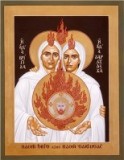
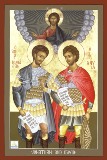
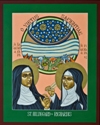
Want to give a Christmas present that expresses LGBTQ spirituality? Looking for just the right gift or card for a LGBTQ loved one or ally? You don’t even have to be queer to love the innovative icons at TrinityStores.com.
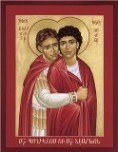
Icons of same-sex couples and queer saints from Trinity Stores appear all year long on the Jesus in Love Blog as part of the LGBT Saints series here at Jesus in Love. They have cards, plaques, T-shirts, mugs, candles, and framed prints with more than 850 images by world-class artists such as Robert Lentz and Lewis Williams. Nine favorites of Jesus in Love readers are shown here. There are many more, from Joan of Arc to We-Wha of Zuni. Click the titles or click here to visit TrinityStores.com.
____
This post is part of the LGBT Holidays series by Kittredge Cherry at the Jesus in Love Blog. The series celebrates religious and spiritual holidays, holy days, feast days, festivals, anniversaries, liturgical seasons and other occasions of special interest to lesbian, gay, bisexual, gegender and queer people of faith and our allies.

 .”
.”


 ” by Andrew Harvey. A comprehensive chapter titled “Christina Rossetti: The Female Queer Virgin” appears in “
 ” by Frederick S. Roden. Rossetti is also important to feminist scholars who reclaimed her in the 1980s and 1990s as they sought women’s voices hidden in the church’s patriarchal past.