A place for LGBTQ spirituality and the arts. Home of the gay Jesus and queer saints. Uniting body, mind and spirit. Open to all. Renamed Q Spirit blog and moved to Qspirit.net in 2017.
Vida Dutton Scudder is an American social reformer, professor, prominent lesbian author -- and an officially recognized saint in the Episcopal Church. Her feast day is Oct. 10.
Her ideas on economic inequality are especially relevant amid the financial crises of our times. Born in India to missionary parents in 1861, Scudder studied at Oxford and became a professor at Wellesley College, where she taught English literature for 41 years. All her primary relationships were with women. For 35 years from 1919 until her death in 1954, Scudder lived with author Florence Converse in a lesbian relationship.
Scudder’s spirituality went hand in hand with her social conscience and love of learning. She was active in the Social Gospel movement, co-founding a Boston settlement house to reduce poverty, promoting Christian socialism and backing trade unions. Scudder wrote 16 books, including her autobiography “On Journey,” plus numerous articles on religious, political, and literary subjects.
Converse (1871-1967), a New Orelans native and Wellesley graduate, served on the editorial staff of the Atlantic Monthly and The Churchman magazine. She wrote many novels with titles such as “The Story of Wellesley” and “The Holy Night.”
The two women are buried near each other at Newton Cemetery and Crematory in Newton, Massachusetts. The Internet makes it possible to visit to the graves of Scudder and Converse online.
The Episcopal Church added Scudder to its book of saints several years ago. She expressed her belief in the power of prayer when she wrote, “If prayer is the deep secret creative force that Jesus tells us it is, we should be very busy with it.” Here is the official prayer that the Episcopal Church offers in memory of this lesbian saint:
Most gracious God, you sent your beloved Son to preach peace to those who are far off and to those who are near: Raise up in your church witnesses who, after the example of your servant Vida Dutton Scudder, stand firm in proclaiming the power of the Gospel of Jesus Christ, who lives and reigns with you and the Holy Spirit, one God, now and for ever. Amen.
____
This post is part of the LGBTQ Saints series by Kittredge Cherry. Traditional and alternative saints, people in the Bible, LGBTQ martyrs, authors, theologians, religious leaders, artists, deities and other figures of special interest to lesbian, gay, bisexual and transgender and queer (LGBTQ) people and our allies are covered.
The Black Madonna of Czestochowa, one of the most famous Catholic icons, is the model for a Haitian Vodou goddess who protects lesbians.
Traditional images of Erzulie Dantor, the Vodou defender of lesbians, are based on the Black Madonna of Czestochowa, whose feast day is today (Aug. 26). They even share the same two scars on the dark skin of the right cheek.
Aug. 26 also happens to be Women’s Equality Day -- the date when women got the right to vote in the United States back in 1920.
Every year more than 100,000 people view the original Black Madonna of Czestochowa icon in Poland at one of the most popular Catholic shrines on the planet. John Paul II, the Polish pope, was devoted to her. Few suspect that the revered icon of the Blessed Virgin Mary has a lesbian connection.
Our Lady of Czestochowa is among dozens of Black Madonna icons remaining from medieval Europe. The reason for their dark skin is unknown, but people speculate that the images may have been created black to match the color of indigenous people or they turned black due to smoke and aging. Some see her dark skin as a metaphor for the earth or a reference to the lover in Song of Songs who declared, “I am black but beautiful.”
Black Madonnas are said to embody the shadow side of the Divine Feminine, the unconscious and unpredictable aspects that are usually buried or kept in darkness. Erzulie Dantor reveals Mary’s hidden bonds with lesbians.
Legend says that the Czestochowa portrait of Mary was painted by Saint Luke the Evangelist while she told him the stories about Jesus that he later wrote in his gospel. The icon traveled from Jerusalem through Turkey and Ukraine, ending up in Poland in 1382. The painting is considered so important that it even has its own feast day: Aug. 26, the date that it was installed at its current home. In the 15th century looters pried two jewels off her cheek, leaving a characteristic pair of marks.
Events in Haiti soon took Our Lady of Czestochowa in a new direction. In the 18th century hundreds of thousands of slaves were brought from Africa to Haiti, where they were forced to do heavy labor and convert to Christianity. Through the process of syncretism, they developed a hybrid form of Christianity mixed with Vodou, an ancestral folk religion from West Africa.
Copies of the Black Madonna of Czestochowa were brought to Haiti by about 5,000 Polish soldiers who fought on both sides of the Haitian Revolution starting in 1802. She was transformed into Erzulie Dantor when Haitians merged her with Vodou.
Erzulie Dantor is a loa or lwa (Vodou spirit) who is recognized as a patron of lesbians. Her name has many alternate spellings such as Ezili Danto. She fiercely loves and defends women and children, especially lesbians, independent businesswomen, unwed mothers, and those who experience domestic violence. She has a reputation for taking revenge on abusive husbands and unfaithful lovers. Scar-faced warrior Erzulie Dantor liberated slaves by helping to start and win the Haitian Revolution. She is fond of knives, rum and unfiltered cigarettes.
Like Our Lady of Czestochowa, she holds a child with a book. But instead of the infant Jesus with the gospels, the baby on her lap is her daughter Anais. The Catholic Church in Haiti identifies these images as neither Erzulie Dantor nor Mary, but “Saint Barbara Africana.” Erzulie Dantor is a single mother who has given birth, but some believe she is bisexual or lesbian herself.
The two scars on her cheek are explained either as tribal scarification or wounds from a fight with Erzulie Freda, her light-skinned and coquettishly feminine sister. Erzulie Freda, the goddess of love and sexuality, is the patron of gay men, especially drag queens and those who are effeminate. She is associated with images of the grieving Mary as Our Lady of Sorrows.
These queer Vodou deities include La Sirene, a pansexual mermaid who rules the seas; La Balen, her mysterious butch lesbian intimate companion who is often depicted as a whale; transgender divinity Mawu-Lisa, patron of artists and craftspeople; androgynous Legba, a Christ figure who mediates between the living and the dead; Ayido Wedo and Danbala, a married pair of queer rainbow serpents who bring prosperity, joy and peace; the sexually complex Gede family that oversees the transition to the afterlife; and many more. Each loa or spirit can possess or engage in spiritual marriage with Vodou practitioners of either gender, leading to many queer possibilities.
Black Madonna figures continue to inspire folk artists and fine artists such as Christie Freeman of Springfield, Illinois, who shares her painting here at the Jesus in Love Blog. One of the best known and most controversial contemporary versions is the 1996 painting “The Holy Virgin Mary” by British artist Chris Ofili. He surrounded a stylized black Madonna with mixed media including elephant dung and images from pornography and blaxploitation movies. While using shock value to critique definitions of sacred and profane, he enraged the religious right.
“Erzulie and Devotee” by Brandon Buehring
Artist Brandon Buehring sketched a contemporary “Erzulie and Devotee” in his “Legendary Love: A Queer History Project.” He uses pencil sketches and essays “to remind queer people and our allies of our sacred birthright as healers, educators, truth-tellers, spiritual leaders, warriors and artists.” The project features 20 sketches of queer historical and mythological figures from many cultures around the world. He has a M.Ed. degree in counseling with an LGBT emphasis from North Carolina State University in Raleigh. He works in higher education administration as well as being a freelance illustrator based in Northampton, Massachusetts.
Throughout history some church officials have attacked images such as Erzulie Dantor as illegitimate and incompatible with Christianity. But many Haitian Christians today see Vodou as a way to enhance their faith. Meanwhile Our Lady of Czestochowa is celebrated for revealing the dark face of God’s own mother.
___
Related links:
“Mother of God Similar to Fire” with icons by William Hart McNichols and reflections by Mirabai Starr presents a wide of variety of liberating icons of Mary, including a black Madonna. McNichols is a New Mexico artist and Catholic priest who has been rebuked by church leaders for making icons of LGBT-affirming martyrs and saints not approved by the church.
____
This post is part of the LGBTQ Saints series by Kittredge Cherry. Traditional and alternative saints, people in the Bible, LGBTQ martyrs, authors, theologians, religious leaders, artists, deities and other figures of special interest to lesbian, gay, bisexual and transgender and queer (LGBTQ) people and our allies are covered.
Midsummer feasts have celebrated the divine feminine on Aug. 15 since before the time of Christ. Now devoted to Mary, the holiday known as the Feast of the Assumption (or Dormition) carries the torch of lesbian spiritual power to a new generation on the same date.
Saint Mary, mother of Jesus, is honored by churches on Aug. 15 in a major feast day marking her death and entrance into heaven. Catholic and Orthodox churches call it the Feast of the Assumption or Dormition because they believe that Mary was “assumed” into heaven, body and soul.
The connections between Diana and Mary raise many questions. The concept of virginity has been used to control women, but sometimes it is a code word for lesbian. What shade of meaning is implied by the “virginity” of these two heavenly queens? Did the church patriarchs substitute wild lesbian Artemis with mild straight Mary -- or is Mary more versatile and dynamic than many thought?
The Virgin Mary’s holiday was adapted -- some would say appropriated -- from an ancient Roman festival for Diana, the virgin goddess of the moon and the hunt. Diana, or Artemis in Greek, is sometimes called a lesbian goddess because of her love for woman and her vow never to marry a man. The ancient Roman Festival of Torches (Nemoralia) was held from Aug. 13-15 as Diana’s chief festival.
According to mythology, Diana preferred the company of women and surrounded herself with female companions. They took an oath of virginity and lived as a group in the woods, where they hunted and danced together. Homoerotic art and speculations often focus on Diana’s relationship with the princess Callisto. The god Jupiter (Zeus) lusted after Callisto, so he disguised himself as Diana and seduced Callisto in a woman-to-woman embrace. The lesbian love scene is painted by artists such as Francois Boucher in “Jupiter and Callisto” (below).
“Jupiter (disguised as Diana) and Callisto” by Francois Boucher (Wikimedia Commons)
There are many more stories about Diana and the women, nymphs and goddesses whom she loved. The goddess Britomaris was another favorite of Diana. When the lustful king Minos pursued Britomaris, she escaped by leaping into the sea. Diana rescued her and, some say, fell in love with her. Diana also showed love for various princesses. She gave the princess Cyrene a pair of magical dogs and granted the princess Daphne the gift of shooting straight. The princess Atalanta almost died of exposure as a baby girl after her father abandoned her because he wanted a son. Diana saved her and, with the help of a she-bear, Atalanta grew up to become one of Diana’s beloved companions. And this is just the beginning.
Diana’s main holiday was the Festival of Torches or Nemoralia. Hundreds of women and girls carried torches and candles in a night-time procession through the woods. They wore wreaths of flowers -- and even put flowers on the hunting dogs who walked with them. The group hiked a few miles from Rome to a sacred site, the circle-shaped Lake Nemi. The dark waters reflected the moon and the torchlight of the pilgrims. There they left offerings of apples, garlic, statues and prayers handwritten on ribbons. Click here for a vivid description of the festival. Ovid, a Roman poet who lived before Christ, described the magic of the festival:
Often does a woman whose prayers Diana answered,
With a wreath of flowers crowning her head,
Walk from Rome carrying a burning torch...
Click here for a beautiful painting of “Diana Asleep in the Woods” by surrealist Giorgio de Chirico. Diana sleeps beside an offering of fruit, her bow and arrow, and her large black-and-white spotted dog.
Artemis of Ephesus
Aspects of Diana and Artemis were taken over by the church more than 1,300 years ago. The Festival of Torches became the Feast of the Assumption. The Temple of Artemis at Ephesus in Turkey was one of the seven wonders of the ancient world, with an awe-inspiring statue of the “many-breasted” Artemis. The temple was destroyed and replaced by the Church of Mary. The Virgin Mary even assumed some titles once given to Artemis, including Queen of Heaven.
Feminists praise Diana/Artemis as an archetype of female power, a triple goddess who represents all phases of womanhood. She is the maiden, wild and free, with no need for a man. She is the “many-breasted” mother who nurtures all life. She is the crone, the mature hunter who provides swift death with her arrows in harmony with the cycles of nature.
LGBTQ people and allies may be inspired by the queer origins of this midsummer holiday. May the Queen of Heaven, by whatever name, continue to bless those who remember her.
___
Related links: Are there any lesbian goddesseses?
___
Related books:
“Mother of God Similar to Fire” with icons by William Hart McNichols and reflections by Mirabai Starr presents a wide of variety of liberating icons of Mary, including a black Madonna. McNichols is a New Mexico artist and Catholic priest who has been rebuked by church leaders for making icons of LGBTQ-affirming martyrs and saints not approved by the church.
“Artemis of Ephesus,” 1st century CE Roman copy of the “many breasted” Artemis stattue of the Temple of Ephesus (Wikimedia Commons)
___
Icons of the Assumption of Mary and many others are available on cards, plaques, T-shirts, mugs, candles, mugs, and more at TrinityStores.com
This post is part of the LGBTQ Saints series by Kittredge Cherry. Traditional and alternative saints, people in the Bible, LGBTQ martyrs, authors, theologians, religious leaders, artists, deities and other figures of special interest to lesbian, gay, bisexual and transgender and queer (LGBTQ) people and our allies are covered.
Mary and Martha of Bethany were two of Jesus’ closest friends. The Bible calls them “sisters” who lived together, but reading the Bible with queer eyes raises another possibility. Maybe Mary and Martha were a lesbian couple. Their feast day is today (July 29).
Mary and Martha formed a nontraditional family at a time when there was huge pressure for heterosexual marriage.
“Jesus loved Lazarus, Mary and Martha. What drew Jesus to this very non-traditional family group of a bachelor brother living with two spinster sisters? Two barren women and a eunuch are Jesus’ adult family of choice. Are we to assume they were all celibate heterosexuals? What if Mary and Martha were not sisters but called each other ‘sister’ as did most lesbian couples throughout recorded history?”
Biblical patriarchs have also hidden their marriages by claiming their wives were their sisters. In the book of Genesis, Abraham claimed his wife Sarah was his sister on two different occasions (Genesis 12:10-20; 20:1-18) and once Isaac passed off his wife Rebekah as his sister (Genesis 26:1-16).
Mary and Martha are best known for the conflict they had when they hosted Jesus and his disciples. Mary sat at Jesus’ feet to listen, but Martha wanted her to help her serve. Jesus’ famous answer: “Martha, Martha, you are worried and upset about many things, but only one thing is needed. Mary has chosen what is better, and it will not be taken away from her.” (Luke 10:41-42).
In another major Bible story, Jesus talks with Mary and Martha in turn before raising their brother Lazarus from the dead. During the conversation, Martha speaks what is considered the first profession of faith in Jesus: “I believe that you are the Christ, the Son of God, who was to come into the world” (John 11:27).
Like with most Biblical figures, the truth about Mary and Martha is a mystery. The gospels references are brief and sometimes contradictory. As a result, Mary of Bethany is identified as Mary Magdalene in the Roman Catholic church, while in Protestant and Eastern Orthodox traditions they are considered separate persons.
The Orthodox Church also includes Mary and Martha among the “myrrh bearing women” who were faithfully present at his crucifixion and brought myrrh to his tomb, where they became the first to witness his resurrection. Christian feminists also honor the couple and say that they probably were leaders of a “house church.”
Artists provide some beautiful paintings of the “sisters,” including the one above by Italian Renaissance artist Bernardino Luini (1480 -1532). Magic realist painter Eileen Kennedy has done a new painting of them as contemporary women. Kennedy’s “In the House of Martha and Mary” is on view at the Episcopal Cafe Art Blog. Martha stands angrily with vacuum cleaner in hand as her sister listens to Jesus.
_________
This post is part of the LGBTQ Saints series by Kittredge Cherry. Traditional and alternative saints, people in the Bible, LGBTQ martyrs, authors, theologians, religious leaders, artists, deities and other figures of special interest to lesbian, gay, bisexual and transgender and queer (LGBTQ) people and our allies are covered.
A vision of equality that inspired people “through Seneca Falls, and Selma, and Stonewall” is celebrated as a holy feast day on July 20. Four 19th-century American women reformers -- Elizabeth Cady Stanton, Amelia Bloomer. Sojourner Truth, and Harriet Tubman -- are honored on this date in the Episcopal calendar of saints.
All advocated abolition of slavery as well as women’s rights. The first Women’s Rights Convention ended on July 20, in 1848 in Seneca Falls, NY.
President Obama made connections between women’s liberation, LGBT equality and African American civil rights in a famous line from his 2013 inaugural speech: “We, the people, declare today that the most evident of truths, that all of us are created equal, is the star that guides us still, just as it guided our forebears through Seneca Falls, and Selma, and Stonewall,” he said.
Stanton used similar language based on the Declaration of Independence when she wrote the American Declaration of Rights and Sentiments signed by attendees at Seneca Falls, including this line: “We hold these truths to be self-evident: that all men and women are created equal.”
“Elizabeth Cady Stanton” by Robert Lentz
A portrait of Elizabeth Cady Stanton is one of 40 icons featured in “Christ in the Margins” by Robert Lentz, is a Franciscan friar known for his innovative and LGBT-positive icons, and Edwina Gateley.
Stanton (1815–1902) was a leader of the early women’s rights movement and one of the organizers of the Seneca Falls conference. Her faith led her to critique the church itself for degrading and discriminating against women.
Raised in the Presbyterian Church, she was outraged by the exclusion of women Bible scholars in the 1870 revision of the King James Bible by an all-male committee, so she founded a committee of women to write the landmark 1895 commentary “The Woman’s Bible.” The controversial work uses book-by-book Bible commentary to challenge prevailing religious beliefs with a liberating theology of equality between the sexes. (A similar work for the LGBT community is “The Queer Bible Commentary,” although it uses many authors to do what Stanton did singlehandedly.) Her vision of equality between the sexes led her to ask genderbending questions such as, “If a heavenly father, why not a heavenly mother?”
Stanton is often remembered with Susan B. Anthony because the two women were close friends who collaborated for more than 50 years on women's rights and other reforms. They shared “one of the most productive working partnerships in U.S. history,” according to the documentary “Not for Ourselves Alone: The Story of Elizabeth Cady Stanton and Susan B. Anthony,” directed by Emmy Award-winning film maker Ken Burns.
Anthony has been called the “third person” in Stanton’s marriage to her husband. Stanton was a married mother of seven, but she and Anthony traveled together giving speeches over the course of three decades.
Anthony remained unmarried and her deepest relationships were with other women. Some historians, including Lillian Faderman, believe that Anthony was what today would be called a lesbian. In her book To Believe in Women: What Lesbians Have Done For America - A History, Faderman suggests that Anthony had long-term romantic relationships with other women.
Amelia Jenks Bloomer (1818-1894) was an advocate for temperance and women’s rights. Her name became associated with the loose trousers known as “bloomers” because of her advocacy of women’s dress reform in an era of tight-waisted corsets. She is the one who first introduced Stanton and Anthony to each other. Bloomer was raised Presbyterian and her activism was based on her faith. “The same Power that brought the slave out of bondage will, in His own good time and way, bring about the emancipation of women, and make her the equal in power and dominion that she was in the beginning,” she said.
Sojourner Truth (1797–8 to 1883) was an escaped slave who became a traveling preacher. She is best known for her speech “Ain’t I a Woman?” She delivered it at the Ohio Women’s Rights Convention in 1851 after listening for hours while clergy use Biblical justifications to attack women’s rights and abolition. For her prophetic witness, she was known as “the Miriam of the Latter Exodus,” after the biblical prophet Miriam.
Harriet Ross Tubman (1820–1913) escaped slavery to lead more than 300 others to freedom through the Underground Railroad and later served as a spy for the Union Army during the Civil War. She was deeply influenced by the Bible story of Moses following God's command to deliver the Israelites from slavery in Egypt. Tubman believed that God called upon her to oppose slavery and help deliver American slaves out of bondage. She became known as "the Moses of her People," which is the subtitle of her 1869 biography written by her friend Sarah Bradford.
All four women for freedom are pictured together with rainbow colors in an icon by Tobias Haller, iconographer, author, composer, and vicar of Saint James Episcopal Church in the Bronx.
“It came to me in a flash that this would be an appropriate symbol for this early Rainbow Coalition for Freedom. I also like to think of it as a Feminist Rushmore!” he said.
He is the author of “Reasonable and Holy: Engaging Same-Sexuality.” Haller enjoys expanding the diversity of icons available by creating icons of LGBTQ people and other progressive holy figures as well as traditional saints. He and his spouse were united in a church wedding more than 30 years ago and a civil ceremony after same-sex marriage became legal in New York.
Both Stanton and Bloomer attended Trinity Episcopal Church in Seneca Falls. Truth and Tubman were both involved in African Methodist Episcopal churches. Today the Episcopal Church honors these four female freedom fighters with the following prayer:
O God, whose Spirit guides us into all truth and makes us
free: Strengthen and sustain us as you did your servants
Elizabeth, Amelia, Sojourner, and Harriet. Give us vision
and courage to stand against oppression and injustice and
all that works against the glorious liberty to which you
call all your children;
through Jesus Christ our Savior, who
lives and reigns with you and the Holy Spirit, one God, for
ever and ever. Amen.
___
Top image:
“Four Women for Freedom” by Tobias Haller
Speak Its Name by Kathleen Jowitt
Reviewed by Audrey Lockwood
“Speak Its Name” by Kathleen Jowitt is the coming-of-age story of a lesbian who leads the Christian group at a British university.
During the many challenges of her freshman year, Lydia holds on to her faith even as she falls in love with an out-and-proud Methodist bisexual woman. It was her Great Awakening.
The novel is especially engagin for lesbian Christians to read. It’s uncommon in all of literature to have a lesbian character in a Christian context. Rarely since Radclyffe Hall has it been attempted. The connection between lesbians and gay men in the novel adds to its richness.
The author captures the excitement of being a new leader and the atmosphere of a university in an English town. I like the way it focuses on the human relationships of students working together. The Oxford atmosphere and British English are charming. It is fun reading terms like “freshers” instead of “freshmen.”
The writing quality is superior and literate. One flaw is that there are too many characters and not enough character development of each one.
The opposition faced by LGBTQ people in “Speak Its Name” shows that the religious right is not just an American phenomenon.
The LGBTQ group in the novel is saner than the LGBTQ religious communities I have known. During my own college years in the 1970s, I went to a Catholic guitar mass at a funky student center at a public Big-Ten university. Our liberal views were influenced by Vatican II and the anti-war movement. This book shows the backlash against liberalism, presenting the new generation whose college experience is more conventional and conservative with right-wing fanatics.
“Judith and Her Maidservant” by Artemisia Gentileschi
Baroque artist Artemisia Gentileschi inspires many with her paintings of strong Biblical women -- created despite the discrimination and sexual violence that she faced as a woman in 17th-century Italy. She was born more than 400 years ago today (July 8, 1593).
Gentileschi was apparently heterosexual, but lesbians have drawn energy from her life and art. Many queer people can relate to her battles against prejudice and sexual violence, documented in her rape trial in 1612. She can be considered the patron saint of lesbian artists, women artists, and everyone who breaks gender rules.
Gentileschi (1593–1652) was successful in her own day, but was mostly written out of art history until the 1970s, when feminist scholars rediscovered her work. Now she is celebrated in many books, films and plays, and her work is widely reproduced. Her greatest paintings include “Judith Beheading Holofernes” and “Susanna and the Elders.”
Lesbians who have created tributes to Gentileschi include painter Becki Jayne Harrelson and playwright Carolyn Gage. In the play “Artemisia and Hildegard,” Gage has two of history’s great women artists debate their contrasting survival strategies: Gentileschi battled to achieve in the male-dominated art world while Hildegard of Bingen found support for her art in the women-only community of a medieval German nunnery.
The daughter of a painter, Gentileschi was born in Rome and trained as a painter in her father’s workshop there. She was refused admission to the art academy because she was a woman, so her father arranged for her to have a private painting teacher -- who raped her when she was about 19. Gentileschi herself was tortured by thumbscrews during the seven-month rape trial, but she stuck to her testimony. The teacher was convicted, but received a suspended sentence.
“Judith Beheading Holofernes”
by Artemisia Gentileschi
Gentileschi used art to express her outrage. During the trial Artemisia began painting the Biblical scene of “Judith Beheading Holofernes” (left). Judith, a daring and beautiful Hebrew widow, saves Israel by cutting off the head of the invading general Holofernes. Judith and Holofernes became one of Gentileschi’s favorite subjects, and she painted several variations during her lifetime.
Her realistic style, influenced by the artist Caravaggio, shows dramatic contrasts between light and dark. But Gentileschi usually created her own unique interpretation expressing a strong female viewpoint. The violence of Judith beheading the male general Holofernes speaks for itself. Another example is her painting (below left) of the Biblical story of the Hebrew wife Susanna and the lustful elders who spied on her while she was bathing. Although her male contemporaries painted the scene as a voyeuristic fantasy, Gentileschi presents it as a violation of the vulnerable Susanna by the predatory elders.
“Susanna and the Elders”
by Artemisia Gentileschi
Soon after the rape trial Gentileschi married and moved to Florence, where she became the first woman accepted into the Accademia delle Arti del Disegno (Academy of the Arts of Drawing). She had a full career, producing many paintings of powerful women from Christianity, history and mythology. She worked in various Italian cities and even spent a few years painting in London, England. It is believed that she died when she was about 60 years old in a plague that swept Naples in 1656.
Today Gentileschi’s life and work are admired by many, including artist Becki Jayne Harrelson. She is best known for her LGBT-affirming version of “The Crucifixion of the Christ” with the word “faggot” above Jesus on the cross, but Harrelson has also honored Gentileschi in her art and blog.
Harrelson offers this tribute in celebration of Gentileschi’s birthday: “Artemisia Gentileschi’s talent and mastery was equal to her male counterparts, yet because of sexism and misogyny, she was denied the recognition she deserved as a master painter until many centuries later. She also suffered sexual violence and was treated unjustly for standing up against it. Her art and life inspires me to persevere despite adversity and prejudice.”
“Tribute to Artemisia’s Judith” by Becki Jayne Harrelson, www.beckijayne.com
Oil on canvas | 36”w X 48”h
Gentileschi's story is told in a variety of movies and novels, including "The Passion of Artemisia" by Susan Vreeland.
Artemisia Gentileschi is included in the LGBT saints series at the Jesus in Love Blog because she has inspired so many lesbians with her paintings of women and her success despite gender barriers and sexual violence.
This post is part of the LGBTQ Saints series by Kittredge Cherry. Traditional and alternative saints, people in the Bible, LGBTQ martyrs, authors, theologians, religious leaders, artists, deities and other figures of special interest to lesbian, gay, bisexual and transgender and queer (LGBTQ) people and our allies are covered.
Human rights champion and queer saint Pauli Murray is a renowned civil rights pioneer, feminist, author, lawyer and the first black woman ordained as an Episcopal priest. Her feast day is today (July 1).
Murray was arrested and jailed for refusing to sit in the back of a segregated bus in Virginia in 1938 -- 15 years before Rosa Parks became a national symbol for resisting bus segregation. In 1941 she organized restaurant sit-downs in the nation’s capital -- 20 years before the famous Greensboro sit-ins.
She was attracted to women and her longest relationships were with women, so she is justifiably considered a lesbian. But she also described herself as a man trapped in a woman’s body and took hormone treatments in her 20s and 30s, so she might even be called transgender man today.
Murray was approved for trial inclusion in the Episcopal Church’s book of saints, “Holy Women, Holy Men” in a 2012 vote. Usually the Episcopalians wait until 50 years after a person has died before making granting sainthood, but for Murray the church set aside the rule and approved “trial use” of materials commemorating her now.
Others have written extensively about her many accomplishments, but material on Murray’s sexuality is hard to find. She did not speak publicly about her sexual orientation or gender identity issues, but she left ample evidence of these struggles in her letters and personal writings.
Anna Pauline (Pauli) Murray (November 20, 1910 – July 1, 1985) was born in Baltimore, Maryland and raised in Durham, North Carolina. She became aware of her queer sexuality early in life. In Pauli Murray and Caroline Ware: Forty Years of Letters in Black and White, historian Anne Firor Scott explains:
“In adolescence Murray began to worry about her sexual nature. She later said that she was probably meant to be a man, but had by accident turned up in a woman’s body. She began to keep clippings about various experiments with hormones as a way of changing sexual identity…. In 1937, at the initiative of a friend, she had been admitted to Bellevue Hospital in New York, and during her stay there she examined her worries about her sexual nature in writing, and said that she hoped to move toward her masculine side... . She continued for years to discuss the developing medical literature about hormones, thinking they might help her. She discussed the possibility of homosexuality with doctors; she knew that she was attracted to very feminine, often white, women, and she knew as well that… she was not physically attracted to men. This conflict would continue for the rest of her life.”
A graduate of New York’s Hunter College, Murray was rejected from the University of North Carolina UNC Chapel Hill’s graduate school in 1938 because of her race. She became a civil rights activist. In the late 1930s Murray was also seeking psychological help and testosterone implants from doctors in an effort to “treat” her homosexuality by becoming more male.
Eager to become a civil rights lawyer, Murray was the only woman in her law school class at Howard University in Washington, DC. She graduated first in her class in 1944, but was rejected by Harvard because of her gender -- even though President Franklin Roosevelt wrote a letter of support for her after Murray contacted First Lady Eleanor Roosevelt. Instead Murray studied law at the University of California in Berkeley. She wrote numerous influential publications, and NAACP used her arguments in the landmark 1954 Brown v. Board of Education case that ended racial segregation in U.S. public schools.
In the early 1960s President John Kennedy appointed Murray to the Commission on the Status of Women Committee. She worked with Martin Luther King Jr. and Bayard Rustin on civil rights -- and criticized the 1963 March on Washington at the time for excluding women from leadership. In 1965 she became the first African American to receive a law doctorate from Yale. A year later she co-founded the National Organization for Women.
Instead of retiring, Murray launched a new career at age 62. She entered New York’s General Theological Seminary in 1973, before the Episcopal Church allowed women priests. She was ordained in 1977. She celebrated her first Holy Eucharist at the Chapel of the Cross in Chapel Hill, NC -- the same church where her grandmother, a slave, was baptized.
After a lifetime as a human rights activist, she drew on her own experience to preach a powerful vision of God’s justice. It can be difficult to locate Murray’s sermons in books. Eight of Murray’s sermons can be found in the readily available book “Daughters of Thunder: Black Women Preachers and Their Sermons, 1850-1979,” edited by Bettye Collier-Thomas. Sermons by Murray in the book are Male and Female He Created Them (1978), Women Seeking Admission to Holy Orders as Crucifers Carrying the Cross (1974), Mary Has Chosen the Best Part (1977), The Holy Spirit (1977), The Gift of the Holy Spirit (1977), The Dilemma of the Minority Christian (1974), Salvation and Liberation (1979), and Can These Bones Live Again (1978).
It was my destiny to be the descendant of slave owners as well as slaves, to be of mixed ancestry, to be biologically and psychologically integrated in a world where the separation of the races was upheld by the Supreme Court of the United States as the fundamental law of our Southland. My entire life’s quest has been for spiritual integration, and this quest has led me ultimately to Christ, in whom there is no East or West, no North or South, no Black or White, no Red or Yellow, no Jew or Gentile, no Islam or Buddhist, no Baptist, Methodist, Episcopalian, or Roman Catholic, no Male or Female. There is no Black Christ, no White Christ, no Red Christ – although these images may have transitory cultural value. There is only Christ, the Spirit of Love.
Murray died of cancer on July 1, 1985 at age 74. Her best known book is Proud Shoes: The Story of an American Family (1956), her memoir of growing up as a mixed-race person in the segregated South.
The image of Pauli Murray at the top of this post is part of the “In the Spirit of Those Who Led the Way” series by North Carolina artist Laurel Green. She creates digital artworks in conversation with more traditional media.
A new icon of Pauli Murray was painted for the "Holy Women Icons" series by Angela Yarber, an artist, scholar, dancer, minister and LGBT-rights activist based in North Carolina. It is one of nearly 50 color images of her folk feminist icons included in her 2014 book "Holy Women Icons." Her colorful icon shows Murray with a closed eyes and large heart inscribed with the words:
“When her throat grew weary,
Her heart pulsed a song of hope,
Of justice, of equality,
Unconstrained by the binaries
That bind.
Authentically free.”
The trial use commemorations of the Episcopal Church include this new prayer:
Liberating God, we thank you most heartily for the steadfast courage of your servant Pauli Murray, who fought long and well: Unshackle us from bonds of prejudice and fear so that we show forth your reconciling love and true freedom, which you revealed through your Son and Our Savior Jesus Christ.
Pauli Murray image from Holy Women, Holy Men on Facebook celebrating saints in the Episcopal Church, produced by the Paradoxy Center at St. Nicholas Church.
___
This post is part of the LGBTQ Saints series by Kittredge Cherry. Traditional and alternative saints, people in the Bible, LGBTQ martyrs, authors, theologians, religious leaders, artists, deities and other figures of special interest to lesbian, gay, bisexual and transgender and queer (LGBTQ) people and our allies are covered.
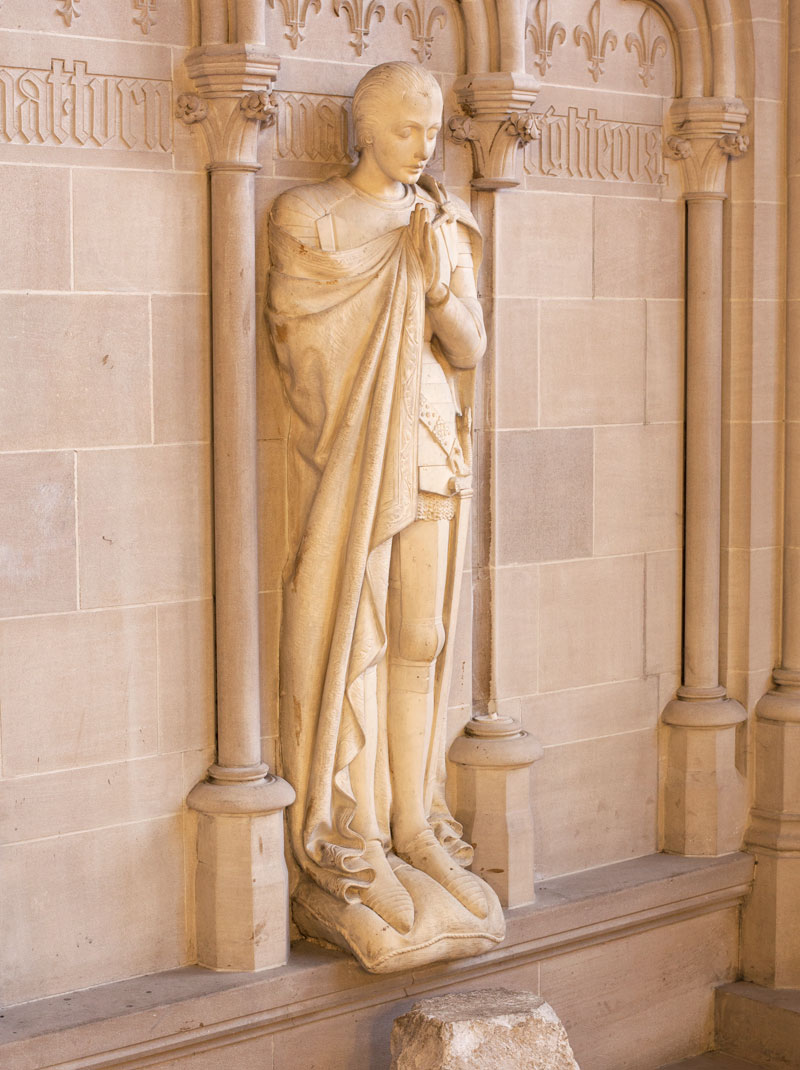
Joan of Arc was a tough cross-dressing teenage warrior who led the medieval French army to victory when she was 17. She is a queer icon, girl-power hero and patron saint of France. Her feast day is today (May 30).
Smart and courageous, Joan of Arc (c. 1412-1431) had visions of saints and angels who told her to cut her hair, put on men’s clothes and go to war. At age 18 she helped crown a king and at 19 she was killed by the church that later made her a saint. She died for her God-given right to wear men’s clothing, the crime for which she was executed on May 30, 1431.
Contemporary LGBT people recognize a kindred spirit in her stubborn defiance of gender rules. Queer writers tend to downplay Joan’s Christian faith, while the church covers up the importance of her cross-dressing. In truth, Joan believed strongly in God AND in cross-dressing. She insisted that God wanted her to wear men’s clothes, making her what today can be called “queer” or “transgender.” She fits the medieval archetype known as the “holy transvestite.” Cross-dressing was illegal, but what really upset the church authorities, then as now, was the audacity of someone being both proudly queer AND devoutly Christian. Her belief that God was the source of her gender-bending queerness makes her an especially inspiring role model for LGBT Christians and our allies.
Joan’s extraordinary life continues to fascinate all kinds of people. Many are eager to claim her as a symbol, from LGBT people and feminists to the Catholic Church and French nationalists. Joan is the subject of more than 10,000 books, plays, paintings and films, including recent works by transgender author Leslie Feinberg and lesbian playwright Carolyn Gage.
The extensive records of her trials by the Inquisition make Joan of Arc the best-documented person of 15th century. There are only hints that she may have been a lesbian, but the evidence is absolutely clear about her trans expression as a cross-dresser.
Joan of Arc, also known as Jeanne d’Arc, was born to peasants in an obscure village in eastern France around 1412, toward the end of the Hundred Years War. Much of France was occupied by England, so that Charles, the heir to the French throne, did not dare to be crowned. When Joan was 13, she began hearing voices that told her to help France drive out the English.
The visions continued for years, becoming more detailed and frequent. Once or twice a week she had visions of Michael the Archangel and two virgin saints: Catherine of Alexandria and Margaret of Antioch (another transvestite saint who refused to marry a man). They told her that God wanted her to meet Charles and lead an army to Reims for his coronation.
Joan’s family tried to convince her that her visions weren’t real, and her first attempt to visit the royal court was rejected. When she was 17 she put on male clothing and succeeded in meeting Charles. He agreed to outfit her as a knight and allowed her to lead a 5,000-man army against the English.
On Charles’ order, a full suit of armor was created to fit Joan. He had a banner made for her and assigned an entourage to help her: a squire, a page, two heralds, a chaplain and other servants.
Joan’s appearance awed the soldiers and peasants when she traveled with the army. Mounted on a fine warhorse, she rode past cheering crowds in a suit of armor. Her hair was “cropped short and round in the fashion of young men.” She carried an ancient sword in one hand and her banner in the other. Her sword was found, as Joan predicted, buried at the church of St. Catherine at Fierbois. The banner showed Christ sitting on a rainbow against a background of white with gold lilies and the motto “Jhesus-Maria.” Legend says that white butterflies followed Joan wherever she rode with her banner unfurled.
With Joan leading the way, the army won the battle at Orleans and continued to defeat English and pro-English troops until they reached Reims. She proudly stood beside Charles VII at his coronation there on July 17, 1429.
Joan soon resumed leading military campaigns. Even during her lifetime the peasants adored her as a saint, flocking around her to touch her body or clothing. Her cross-dressing didn’t disturb them. In fact, they seemed to honor her for her transgender expression. Perhaps, as some scholars say, the peasants saw Joan as part of a tradition that linked transvestites and priests in pre-modern Europe.
One of the first modern writers to raise the possibility of Joan’s lesbianism was English author Vita Sackville-West. She implied that Joan was a lesbian in her 1936 biography “Saint Joan of Arc.” The primary source for this idea was the fact, documented in her trials, that Joan shared her bed with other girls and young women. She followed the medieval custom of lodging each night in a local home. Joan always slept with the hostess or the girls of the household instead of with the men.
“Joan of Arc: Her Trial Transcripts” by Emilia Philomena Sanguinetti is a 2016 book that explores whether Joan was a lesbian or transgender person.
Extensive evidence that Joan of Arc was a lesbian or transgender person is presented in the epilogue of this groundbreaking book about the cross-dressing medieval saint. She explores how Joan shared her bed with another woman and insisted on wearing male clothing.
Nobody knows for sure whether Joan of Arc was sexually attracted to women or had lesbian encounters, but her abstinence from sex with men is well documented. Her physical virginity was confirmed by official examinations at least twice during her lifetime. Joan herself liked to be called La Pucelle, French for “the Maid,” a nickname that emphasized her virginity. Witnesses at her trial testified that Joan was chaste rather than sexually active.
Joan’s illustrious military career ended in May 1430. She was captured in battle by the Burgundians, the French allies of the English. During her captivity they called her “hommase,” a slur meaning “man-woman” or “masculine woman.”
In a stunning betrayal, Charles VII did nothing to rescue the warrior who helped win him the crown. It was normal to pay ransom for the release of knights and nobles caught in battle, but he abandoned Joan to her fate. Historians speculate that French aristocrats felt threatened by the peasant girl with such uncanny power to move the masses.
The Burgundians transferred Joan to the English, who then gave her to the Inquisition. She spent four torturous months in prison before her church trial began on Jan. 9, 1431 in Rouen, the seat of the English occupation government. She was charged with witchcraft and heresy.
The politically motivated church trial was rigged against her, and yet Joan was able to display her full intelligence as she answered the Inquisitors’ questions. Her subtle, witty answers and detailed memory even forced them to stop holding the trial in public.
Witchcraft was hard to prove, so the church dropped the charge. (Many of today’s Wiccans and pagans still honor Joan as one of their own.) The Inquisitors began to focus exclusively on the “heresy” of Joan’s claim that she was following God’s will when she dressed as a man. The judges told her that cross-dressing was “an abomination before God” according to church law and the Bible. (See Deuteronomy 22:5.)
They accused Joan of “leaving off the dress and clothing of the feminine sex, a thing contrary to divine law and abominable before God, and forbidden by all laws” and instead dressing in “clothing and armor such as is worn by man.”
Joan swore that God wanted her to wear men’s clothing. “For nothing in the world will I swear not to arm myself and put on a man’s dress; I must obey the orders of Our Lord,” she testified. She outraged the judges by continuing to appear in court wearing what they called “difformitate habitus” (“monstrous dress” or “degenerate apparel.”)
Today Joan’s conservative admirers claim that she wore men’s clothes only as way to avoid rape, but she said that it meant much more to her. Joan of Arc saw cross-dressing as a sacred duty.
The judges summarized Joan’s testimony by saying, “You have said that, by God’s command, you have continually worn man’s dress, wearing the short robe, doublet, and hose attached by points; that you have also worn your hair short, cut ‘en rond’ above your ears with nothing left that could show you to be a woman; and that on many occasions you received the Body of our Lord dressed in this fashion, although you have been frequently admonished to leave it off, which you have refused to do, saying that you would rather die than leave it off, save by God’s command.”
Joan refused to back down on the visions she received from God, and she was sentenced to death. She was burned at the stake on May 30, 1431 in Rouen. Twenty five years later she was retried and her conviction was overturned. Joan was declared innocent.
Her armor, that “monstrous dress,” became an object of veneration, sought after like the Holy Grail with various churches claiming to possess her true armor. Joan of Arc was canonized as a saint in 1920. Famous writers and composers who have done works about her include Shakespeare, Voltaire, Verdi, Tchaikovsky, Mark Twain, Bertolt Brecht and George Bernard Shaw. A stunning portrait of Joan kissing her sword (below) was painted by Pre-Raphaelite artist Dante Gabriel Rossetti, whose sister Christina Rossetti is also part of the LGBT Saints series at the Jesus in Love Blog.
“Joan of Arc Kisses the Sword of Liberation” by Dante Gabriel Rossetti, 1863 (WikiPaintings)
This post features contemporary portraits of Joan by Rowan Lewgalon, Robert Lentz and Tobias Haller. Lewgalon is a spiritual artist based in Germany and also a cleric in the Old Catholic Apostolic Church. Her work is online at tir-anam.weebly.com. Lentz is a Franciscan friar known for his innovative and LGBT-positive icons. He is stationed at Holy Name College in Silver Spring, Maryland. His icons are available at Trinitystores.com.
“Jeanne d’Arc” was sketched by Tobias Haller, an iconographer, author, composer, and vicar of Saint James Episcopal Church in the Bronx. He is the author of “Reasonable and Holy: Engaging Same-Sexuality.” Haller enjoys expanding the diversity of icons available by creating icons of LGBTQ people and other progressive holy figures as well as traditional saints. He and his husband were united in a church wedding more than 30 years ago and a civil ceremony after same-sex marriage became legal in New York.
A widely used prayer to Saint Joan of Arc makes a powerful statement that can inspire those who believe in equality for LGBT people, despite rejection by religion and society:
“In the face of your enemies, in the face of harassment, ridicule, and doubt, you held firm in your faith. Even in your abandonment, alone and without friends, you held firm in your faith. Even as you faced your own mortality, you held firm in your faith. I pray that I may be as bold in my beliefs as you, St. Joan. I ask that you ride alongside me in my own battles. Help me be mindful that what is worthwhile can be won when I persist. Help me hold firm in my faith. Help me believe in my ability to act well and wisely. Amen.”
Joan has a dialogue with the fire that is about to consume her in a haunting song written by award-winning Canandian poet Leonard Cohen and sung on July Collins video .
This post is part of the LGBTQ Saints series by Kittredge Cherry. Traditional and alternative saints, people in the Bible, LGBTQ martyrs, authors, theologians, religious leaders, artists, deities and other figures of special interest to lesbian, gay, bisexual and transgender and queer (LGBTQ) people and our allies are covered.


 by cultural historian Marina Warner shows how the figure of Mary was shaped by goddess legends and other historical circumstances, resulting in an inferior status for women.


 .
.


 , historian Anne Firor Scott explains:
 by Nancy Ordover and
  by Lillian Faderman, and in the play “
 , she said:
 (1956), her memoir of growing up as a mixed-race person in the segregated South.


 ” is an underground classic with Joan as “a cross-dressing, teenaged, runaway lesbian” confronting male-dominated institutions. Feinberg has a chapter on Joan as “a brilliant transgender peasant teenager leading an army of laborers into battle” in her history book “
 .”
.” 
 .” The primary source for this idea was the fact, documented in her trials, that Joan shared her bed with other girls and young women. She followed the medieval custom of lodging each night in a local home. Joan always slept with the hostess or the girls of the household instead of with the men.