Showing posts with label queer. Show all posts

Monday, May 30, 2016

Joan of Arc: Cross-dressing warrior-saint

“Jeanne D'Arc” by Rowan Lewgalon

"Saint Joan of Arc" by Brother Robert Lentz, OFM

Joan of Arc was a tough cross-dressing teenage warrior who led the medieval French army to victory when she was 17. She is a queer icon, girl-power hero and patron saint of France. Her feast day is today (May 30).

Smart and courageous, Joan of Arc (c. 1412-1431) had visions of saints and angels who told her to cut her hair, put on men’s clothes and go to war. At age 18 she helped crown a king and at 19 she was killed by the church that later made her a saint. She died for her God-given right to wear men’s clothing, the crime for which she was executed on May 30, 1431.

For a new version of this article, click this link to Qspirit.net:
Joan of Arc: Cross-dressing warrior-saint and LGBTQ role model


Joan of Arc portrait, c. 1485
Wikimedia Commons
Contemporary LGBT people recognize a kindred spirit in her stubborn defiance of gender rules. Queer writers tend to downplay Joan’s Christian faith, while the church covers up the importance of her cross-dressing. In truth, Joan believed strongly in God AND in cross-dressing. She insisted that God wanted her to wear men’s clothes, making her what today can be called “queer” or “transgender.” She fits the medieval archetype known as the “holy transvestite.” Cross-dressing was illegal, but what really upset the church authorities, then as now, was the audacity of someone being both proudly queer AND devoutly Christian. Her belief that God was the source of her gender-bending queerness makes her an especially inspiring role model for LGBT Christians and our allies.

Joan’s extraordinary life continues to fascinate all kinds of people. Many are eager to claim her as a symbol, from LGBT people and feminists to the Catholic Church and French nationalists. Joan is the subject of more than 10,000 books, plays, paintings and films, including recent works by transgender author Leslie Feinberg and lesbian playwright Carolyn Gage.

Gage’s one-woman show “The Second Coming of Joan of Arc” is an underground classic with Joan as “a cross-dressing, teenaged, runaway lesbian” confronting male-dominated institutions. Feinberg has a chapter on Joan as “a brilliant transgender peasant teenager leading an army of laborers into battle” in her history book “Transgender Warriors: Making History from Joan of Arc to Dennis Rodman.”

The extensive records of her trials by the Inquisition make Joan of Arc the best-documented person of 15th century. There are only hints that she may have been a lesbian, but the evidence is absolutely clear about her trans expression as a cross-dresser.

Joan of Arc, also known as Jeanne d’Arc, was born to peasants in an obscure village in eastern France around 1412, toward the end of the Hundred Years War. Much of France was occupied by England, so that Charles, the heir to the French throne, did not dare to be crowned. When Joan was 13, she began hearing voices that told her to help France drive out the English.

The visions continued for years, becoming more detailed and frequent. Once or twice a week she had visions of Michael the Archangel and two virgin saints: Catherine of Alexandria and Margaret of Antioch (another transvestite saint who refused to marry a man). They told her that God wanted her to meet Charles and lead an army to Reims for his coronation.

Joan’s family tried to convince her that her visions weren’t real, and her first attempt to visit the royal court was rejected. When she was 17 she put on male clothing and succeeded in meeting Charles. He agreed to outfit her as a knight and allowed her to lead a 5,000-man army against the English.

On Charles’ order, a full suit of armor was created to fit Joan. He had a banner made for her and assigned an entourage to help her: a squire, a page, two heralds, a chaplain and other servants.

Joan of Arc on Horseback, 1505
Wikimedia Commons
Joan’s appearance awed the soldiers and peasants when she traveled with the army. Mounted on a fine warhorse, she rode past cheering crowds in a suit of armor. Her hair was “cropped short and round in the fashion of young men.” She carried an ancient sword in one hand and her banner in the other. Her sword was found, as Joan predicted, buried at the church of St. Catherine at Fierbois. The banner showed Christ sitting on a rainbow against a background of white with gold lilies and the motto “Jhesus-Maria.” Legend says that white butterflies followed Joan wherever she rode with her banner unfurled.

With Joan leading the way, the army won the battle at Orleans and continued to defeat English and pro-English troops until they reached Reims. She proudly stood beside Charles VII at his coronation there on July 17, 1429.

Joan soon resumed leading military campaigns. Even during her lifetime the peasants adored her as a saint, flocking around her to touch her body or clothing. Her cross-dressing didn’t disturb them. In fact, they seemed to honor her for her transgender expression. Perhaps, as some scholars say, the peasants saw Joan as part of a tradition that linked transvestites and priests in pre-modern Europe.

One of the first modern writers to raise the possibility of Joan’s lesbianism was English author Vita Sackville-West. She implied that Joan was a lesbian in her 1936 biography “Saint Joan of Arc.” The primary source for this idea was the fact, documented in her trials, that Joan shared her bed with other girls and young women. She followed the medieval custom of lodging each night in a local home. Joan always slept with the hostess or the girls of the household instead of with the men.

Joan of Arc: Her Trial Transcripts” by Emilia Philomena Sanguinetti is a 2016 book that explores whether Joan was a lesbian or transgender person.
Extensive evidence that Joan of Arc was a lesbian or transgender person is presented in the epilogue of this groundbreaking book about the cross-dressing medieval saint. She explores how Joan shared her bed with another woman and insisted on wearing male clothing.

Nobody knows for sure whether Joan of Arc was sexually attracted to women or had lesbian encounters, but her abstinence from sex with men is well documented. Her physical virginity was confirmed by official examinations at least twice during her lifetime. Joan herself liked to be called La Pucelle, French for “the Maid,” a nickname that emphasized her virginity. Witnesses at her trial testified that Joan was chaste rather than sexually active.

Joan’s illustrious military career ended in May 1430. She was captured in battle by the Burgundians, the French allies of the English. During her captivity they called her “hommase,” a slur meaning “man-woman” or “masculine woman.”

In a stunning betrayal, Charles VII did nothing to rescue the warrior who helped win him the crown. It was normal to pay ransom for the release of knights and nobles caught in battle, but he abandoned Joan to her fate. Historians speculate that French aristocrats felt threatened by the peasant girl with such uncanny power to move the masses.

The Burgundians transferred Joan to the English, who then gave her to the Inquisition. She spent four torturous months in prison before her church trial began on Jan. 9, 1431 in Rouen, the seat of the English occupation government. She was charged with witchcraft and heresy.

The politically motivated church trial was rigged against her, and yet Joan was able to display her full intelligence as she answered the Inquisitors’ questions. Her subtle, witty answers and detailed memory even forced them to stop holding the trial in public.

Witchcraft was hard to prove, so the church dropped the charge. (Many of today’s Wiccans and pagans still honor Joan as one of their own.) The Inquisitors began to focus exclusively on the “heresy” of Joan’s claim that she was following God’s will when she dressed as a man. The judges told her that cross-dressing was “an abomination before God” according to church law and the Bible. (See Deuteronomy 22:5.)

They accused Joan of “leaving off the dress and clothing of the feminine sex, a thing contrary to divine law and abominable before God, and forbidden by all laws” and instead dressing in “clothing and armor such as is worn by man.”

Joan swore that God wanted her to wear men’s clothing. “For nothing in the world will I swear not to arm myself and put on a man’s dress; I must obey the orders of Our Lord,” she testified. She outraged the judges by continuing to appear in court wearing what they called “difformitate habitus” (“monstrous dress” or “degenerate apparel.”)

Today Joan’s conservative admirers claim that she wore men’s clothes only as way to avoid rape, but she said that it meant much more to her. Joan of Arc saw cross-dressing as a sacred duty.

The judges summarized Joan’s testimony by saying, “You have said that, by God’s command, you have continually worn man’s dress, wearing the short robe, doublet, and hose attached by points; that you have also worn your hair short, cut ‘en rond’ above your ears with nothing left that could show you to be a woman; and that on many occasions you received the Body of our Lord dressed in this fashion, although you have been frequently admonished to leave it off, which you have refused to do, saying that you would rather die than leave it off, save by God’s command.”

Joan refused to back down on the visions she received from God, and she was sentenced to death. She was burned at the stake on May 30, 1431 in Rouen. Twenty five years later she was retried and her conviction was overturned. Joan was declared innocent.

Her armor, that “monstrous dress,” became an object of veneration, sought after like the Holy Grail with various churches claiming to possess her true armor. Joan of Arc was canonized as a saint in 1920. Famous writers and composers who have done works about her include Shakespeare, Voltaire, Verdi, Tchaikovsky, Mark Twain, Bertolt Brecht and George Bernard Shaw. A stunning portrait of Joan kissing her sword (below) was painted by Pre-Raphaelite artist Dante Gabriel Rossetti, whose sister Christina Rossetti is also part of the LGBT Saints series at the Jesus in Love Blog.

“Joan of Arc Kisses the Sword of Liberation” by Dante Gabriel Rossetti, 1863 (WikiPaintings)

This post features contemporary portraits of Joan by Rowan Lewgalon, Robert Lentz and Tobias Haller. Lewgalon is a spiritual artist based in Germany and also a cleric in the Old Catholic Apostolic Church. Her work is online at tir-anam.weebly.com. Lentz is a Franciscan friar known for his innovative and LGBT-positive icons. He is stationed at Holy Name College in Silver Spring, Maryland. His icons are available at Trinitystores.com.

“Jeanne d’Arc” by Tobias Haller

“Jeanne d’Arc” was sketched by Tobias Haller, an iconographer, author, composer, and vicar of Saint James Episcopal Church in the Bronx. He is the author of “Reasonable and Holy: Engaging Same-Sexuality.” Haller enjoys expanding the diversity of icons available by creating icons of LGBTQ people and other progressive holy figures as well as traditional saints. He and his husband were united in a church wedding more than 30 years ago and a civil ceremony after same-sex marriage became legal in New York.

A widely used prayer to Saint Joan of Arc makes a powerful statement that can inspire those who believe in equality for LGBT people, despite rejection by religion and society:


“In the face of your enemies, in the face of harassment, ridicule, and doubt, you held firm in your faith. Even in your abandonment, alone and without friends, you held firm in your faith. Even as you faced your own mortality, you held firm in your faith. I pray that I may be as bold in my beliefs as you, St. Joan. I ask that you ride alongside me in my own battles. Help me be mindful that what is worthwhile can be won when I persist. Help me hold firm in my faith. Help me believe in my ability to act well and wisely. Amen.”

Joan has a dialogue with the fire that is about to consume her in a haunting song written by award-winning Canandian poet Leonard Cohen and sung on July Collins video .


___
Related links:

Wikipedia article on Cross-dressing, sexuality, and gender identity of Joan of Arc

Joan of Arc trial transcript online

Joan of Arc: Cross-dressing martyr at Queering the Church Blog

Jeanne-darc.info

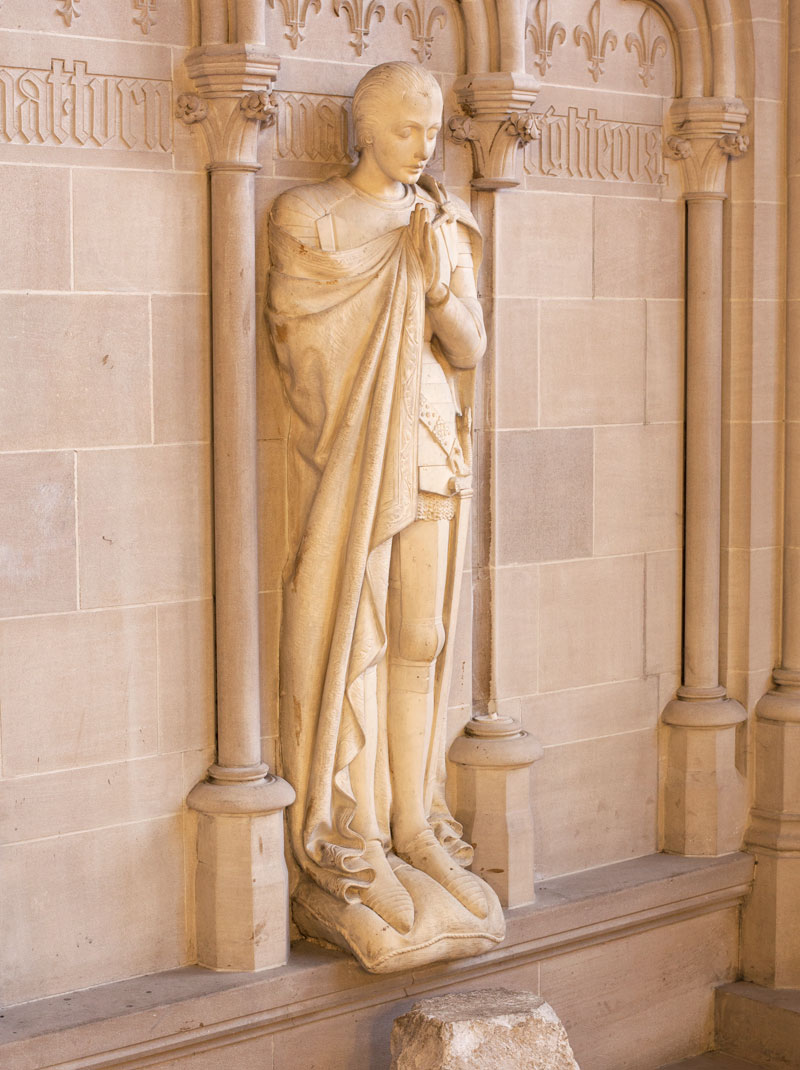
Joan of Arc sculpture by Anna Hyatt Huntington at the Cathedral of Saint John the Divine in New York City

To read this post in Spanish / en español, go to Santos Queer:
Juana de Arco: Santa Travesti

To read this post in Italian, go to Gionta.org:
Una guerriera genderbender. La favolosa vita di Giovanna d’Arco


This post is part of the LGBTQ Saints series by Kittredge Cherry. Traditional and alternative saints, people in the Bible, LGBTQ martyrs, authors, theologians, religious leaders, artists, deities and other figures of special interest to lesbian, gay, bisexual and transgender and queer (LGBTQ) people and our allies are covered.

Copyright © Kittredge Cherry. All rights reserved.
Qspirit.net presents the Jesus in Love Blog on LGBTQ spirituality.

Icons of Joan of Arc and many others are available on cards, plaques, T-shirts, mugs, candles, mugs, and more at Trinity Stores


Saturday, May 30, 2015

Joan of Arc: Cross-dressing warrior-saint

“Jeanne D'Arc” by Rowan Lewgalon

"Saint Joan of Arc" by Brother Robert Lentz, OFM

Joan of Arc was a tough cross-dressing teenage warrior who led the medieval French army to victory when she was 17. She is a queer icon, girl-power hero and patron saint of France. Her feast day is today (May 30).

Smart and courageous, Joan of Arc (c. 1412-1431) had visions of saints and angels who told her to cut her hair, put on men’s clothes and go to war. At age 18 she helped crown a king and at 19 she was killed by the church that later made her a saint. She died for her God-given right to wear men’s clothing, the crime for which she was executed on May 30, 1431.

For a new version of this article, click this link to Qspirit.net:
Joan of Arc: Cross-dressing warrior-saint and LGBTQ role model


Joan of Arc portrait, c. 1485
Wikimedia Commons
Contemporary LGBT people recognize a kindred spirit in her stubborn defiance of gender rules. Queer writers tend to downplay Joan’s Christian faith, while the church covers up the importance of her cross-dressing. In truth, Joan believed strongly in God AND in cross-dressing. She insisted that God wanted her to wear men’s clothes, making her what today can be called “queer” or “transgender.” She fits the medieval archetype known as the “holy transvestite.” Cross-dressing was illegal, but what really upset the church authorities, then as now, was the audacity of someone being both proudly queer AND devoutly Christian. Her belief that God was the source of her gender-bending queerness makes her an especially inspiring role model for LGBT Christians and our allies.

Joan’s extraordinary life continues to fascinate all kinds of people. Many are eager to claim her as a symbol, from LGBT people and feminists to the Catholic Church and French nationalists. Joan is the subject of more than 10,000 books, plays, paintings and films, including recent works by transgender author Leslie Feinberg and lesbian playwright Carolyn Gage.

Gage’s one-woman show “The Second Coming of Joan of Arc” is an underground classic with Joan as “a cross-dressing, teenaged, runaway lesbian” confronting male-dominated institutions. Feinberg has a chapter on Joan as “a brilliant transgender peasant teenager leading an army of laborers into battle” in her history book “Transgender Warriors: Making History from Joan of Arc to Dennis Rodman.”

The extensive records of her trials by the Inquisition make Joan of Arc the best-documented person of 15th century. There are only hints that she may have been a lesbian, but the evidence is absolutely clear about her trans expression as a cross-dresser.

Joan of Arc, also known as Jeanne d’Arc, was born to peasants in an obscure village in eastern France around 1412, toward the end of the Hundred Years War. Much of France was occupied by England, so that Charles, the heir to the French throne, did not dare to be crowned. When Joan was 13, she began hearing voices that told her to help France drive out the English.

The visions continued for years, becoming more detailed and frequent. Once or twice a week she had visions of Michael the Archangel and two virgin saints: Catherine of Alexandria and Margaret of Antioch (another transvestite saint who refused to marry a man). They told her that God wanted her to meet Charles and lead an army to Reims for his coronation.

Joan’s family tried to convince her that her visions weren’t real, and her first attempt to visit the royal court was rejected. When she was 17 she put on male clothing and succeeded in meeting Charles. He agreed to outfit her as a knight and allowed her to lead a 5,000-man army against the English.

On Charles’ order, a full suit of armor was created to fit Joan. He had a banner made for her and assigned an entourage to help her: a squire, a page, two heralds, a chaplain and other servants.

Joan of Arc on Horseback, 1505
Wikimedia Commons
Joan’s appearance awed the soldiers and peasants when she traveled with the army. Mounted on a fine warhorse, she rode past cheering crowds in a suit of armor. Her hair was “cropped short and round in the fashion of young men.” She carried an ancient sword in one hand and her banner in the other. Her sword was found, as Joan predicted, buried at the church of St. Catherine at Fierbois. The banner showed Christ sitting on a rainbow against a background of white with gold lilies and the motto “Jhesus-Maria.” Legend says that white butterflies followed Joan wherever she rode with her banner unfurled.

With Joan leading the way, the army won the battle at Orleans and continued to defeat English and pro-English troops until they reached Reims. She proudly stood beside Charles VII at his coronation there on July 17, 1429.

Joan soon resumed leading military campaigns. Even during her lifetime the peasants adored her as a saint, flocking around her to touch her body or clothing. Her cross-dressing didn’t disturb them. In fact, they seemed to honor her for her transgender expression. Perhaps, as some scholars say, the peasants saw Joan as part of a tradition that linked transvestites and priests in pre-modern Europe.

One of the first modern writers to raise the possibility of Joan’s lesbianism was English author Vita Sackville-West. She implied that Joan was a lesbian in her 1936 biography “Saint Joan of Arc.” The primary source for this idea was the fact, documented in her trials, that Joan shared her bed with other girls and young women. She followed the medieval custom of lodging each night in a local home. Joan always slept with the hostess or the girls of the household instead of with the men.

Joan of Arc: Her Trial Transcripts” by Emilia Philomena Sanguinetti is a 2016 book that explores whether Joan was a lesbian or transgender person.
Extensive evidence that Joan of Arc was a lesbian or transgender person is presented in the epilogue of this groundbreaking book about the cross-dressing medieval saint. She explores how Joan shared her bed with another woman and insisted on wearing male clothing.

Nobody knows for sure whether Joan of Arc was sexually attracted to women or had lesbian encounters, but her abstinence from sex with men is well documented. Her physical virginity was confirmed by official examinations at least twice during her lifetime. Joan herself liked to be called La Pucelle, French for “the Maid,” a nickname that emphasized her virginity. Witnesses at her trial testified that Joan was chaste rather than sexually active.

Joan’s illustrious military career ended in May 1430. She was captured in battle by the Burgundians, the French allies of the English. During her captivity they called her “hommase,” a slur meaning “man-woman” or “masculine woman.”

In a stunning betrayal, Charles VII did nothing to rescue the warrior who helped win him the crown. It was normal to pay ransom for the release of knights and nobles caught in battle, but he abandoned Joan to her fate. Historians speculate that French aristocrats felt threatened by the peasant girl with such uncanny power to move the masses.

The Burgundians transferred Joan to the English, who then gave her to the Inquisition. She spent four torturous months in prison before her church trial began on Jan. 9, 1431 in Rouen, the seat of the English occupation government. She was charged with witchcraft and heresy.

The politically motivated church trial was rigged against her, and yet Joan was able to display her full intelligence as she answered the Inquisitors’ questions. Her subtle, witty answers and detailed memory even forced them to stop holding the trial in public.

Witchcraft was hard to prove, so the church dropped the charge. (Many of today’s Wiccans and pagans still honor Joan as one of their own.) The Inquisitors began to focus exclusively on the “heresy” of Joan’s claim that she was following God’s will when she dressed as a man. The judges told her that cross-dressing was “an abomination before God” according to church law and the Bible. (See Deuteronomy 22:5.)

They accused Joan of “leaving off the dress and clothing of the feminine sex, a thing contrary to divine law and abominable before God, and forbidden by all laws” and instead dressing in “clothing and armor such as is worn by man.”

Joan swore that God wanted her to wear men’s clothing. “For nothing in the world will I swear not to arm myself and put on a man’s dress; I must obey the orders of Our Lord,” she testified. She outraged the judges by continuing to appear in court wearing what they called “difformitate habitus” (“monstrous dress” or “degenerate apparel.”)

Today Joan’s conservative admirers claim that she wore men’s clothes only as way to avoid rape, but she said that it meant much more to her. Joan of Arc saw cross-dressing as a sacred duty.

The judges summarized Joan’s testimony by saying, “You have said that, by God’s command, you have continually worn man’s dress, wearing the short robe, doublet, and hose attached by points; that you have also worn your hair short, cut ‘en rond’ above your ears with nothing left that could show you to be a woman; and that on many occasions you received the Body of our Lord dressed in this fashion, although you have been frequently admonished to leave it off, which you have refused to do, saying that you would rather die than leave it off, save by God’s command.”

Joan refused to back down on the visions she received from God, and she was sentenced to death. She was burned at the stake on May 30, 1431 in Rouen. Twenty five years later she was retried and her conviction was overturned. Joan was declared innocent.

Her armor, that “monstrous dress,” became an object of veneration, sought after like the Holy Grail with various churches claiming to possess her true armor. Joan of Arc was canonized as a saint in 1920. Famous writers and composers who have done works about her include Shakespeare, Voltaire, Verdi, Tchaikovsky, Mark Twain, Bertolt Brecht and George Bernard Shaw. A stunning portrait of Joan kissing her sword (below) was painted by Pre-Raphaelite artist Dante Gabriel Rossetti, whose sister Christina Rossetti is also part of the LGBT Saints series at the Jesus in Love Blog.

“Joan of Arc Kisses the Sword of Liberation” by Dante Gabriel Rossetti, 1863 (WikiPaintings)

This post features contemporary portraits of Joan by Rowan Lewgalon, Robert Lentz and Tobias Haller. Lewgalon is a spiritual artist based in Germany and also a cleric in the Old Catholic Apostolic Church. Her work is online at tir-anam.weebly.com. Lentz is a Franciscan friar known for his innovative and LGBT-positive icons. He is stationed at Holy Name College in Silver Spring, Maryland. His icons are available at Trinitystores.com.

“Jeanne d’Arc” by Tobias Haller

“Jeanne d’Arc” was sketched by Tobias Haller, an iconographer, author, composer, and vicar of Saint James Episcopal Church in the Bronx. He is the author of “Reasonable and Holy: Engaging Same-Sexuality.” Haller enjoys expanding the diversity of icons available by creating icons of LGBTQ people and other progressive holy figures as well as traditional saints. He and his husband were united in a church wedding more than 30 years ago and a civil ceremony after same-sex marriage became legal in New York.

A widely used prayer to Saint Joan of Arc makes a powerful statement that can inspire those who believe in equality for LGBT people, despite rejection by religion and society:


“In the face of your enemies, in the face of harassment, ridicule, and doubt, you held firm in your faith. Even in your abandonment, alone and without friends, you held firm in your faith. Even as you faced your own mortality, you held firm in your faith. I pray that I may be as bold in my beliefs as you, St. Joan. I ask that you ride alongside me in my own battles. Help me be mindful that what is worthwhile can be won when I persist. Help me hold firm in my faith. Help me believe in my ability to act well and wisely. Amen.”

Joan has a dialogue with the fire that is about to consume her in a haunting song written by award-winning Canandian poet Leonard Cohen and sung on July Collins video .


___
Related links:

Wikipedia article on Cross-dressing, sexuality, and gender identity of Joan of Arc

Joan of Arc trial transcript online

Joan of Arc: Cross-dressing martyr at Queering the Church Blog

Jeanne-darc.info

Joan of Arc sculpture by Anna Hyatt Huntington at the Cathedral of Saint John the Divine in New York City

To read this post in Spanish / en español, go to Santos Queer:
Juana de Arco: Santa Travesti

To read this post in Italian, go to Gionta.org:
Una guerriera genderbender. La favolosa vita di Giovanna d’Arco


This post is part of the LGBTQ Saints series by Kittredge Cherry. Traditional and alternative saints, people in the Bible, LGBTQ martyrs, authors, theologians, religious leaders, artists, deities and other figures of special interest to lesbian, gay, bisexual and transgender and queer (LGBTQ) people and our allies are covered.

Copyright © Kittredge Cherry. All rights reserved.
Qspirit.net presents the Jesus in Love Blog on LGBTQ spirituality.

Icons of Joan of Arc and many others are available on cards, plaques, T-shirts, mugs, candles, mugs, and more at Trinity Stores


Monday, May 25, 2015

Rosa Bonheur: Cross-dressing painter honored “androgyne Christ”

“Rosa Bonheur” by Ria Brodell

Rosa Bonheur, the most famous female painter of the 19th century, was a queer cross-dresser who honored what she called the “androgyne Christ.” She had two consecutive long-term relationships with women. She died on this date (May 25) in 1899.


For a new version of this article, click this link to Qspirit.net:
Rosa Bonheur: Cross-dressing painter honored “androgyne Christ”

Born in France in 1822, Bonheur received much acclaim in her lifetime for her paintings of animals. In recent decades she has been celebrated as a queer pioneer, feminist icon, and role model for the LGBT community. Her achievements grew out of an unusual religious upbringing in the proto-feminist Saint-Simonian sect, and the queer Christian ideals that she expressed in adulthood. Bonheur’s gender-bending lifestyle has been covered extensively by scholars, but her spirituality has received much less attention.

Her parents raised her in Saint-Simonianism, a French utopian Christian-socialist movement that advocated equality for women and prophesied the coming of a female messiah. Her father was an artist and an ardent apostle for the Saint-Simonian religion. Bonheur writes a whole chapter about growing up as a Saint-Simonian in the book “Rosa Bonheur: The Artist's (Auto)biography,” which she wrote with her companion Anna Klumpke.

The Saint-Simonian concept of gender equality paved the way for Bonheur’s father to train her as a painter -- and for her own defiance of gender norms. As she put it, “To his doctrines I owe my great and glorious ambition for the sex to which I proudly belong and whose independence I shall defend until my dying day.”

Rosa Bonheur's
Permission to cross-dress
(Wikimedia Commons)
Cross-dressing was illegal in France at that time, but she got permission from the police to wear men’s trousers so she could sketch at such male-dominated places as horse fairs and slaughterhouses. She broke rules of feminine behavior by smoking cigars and wearing her hair short. She was never arrested for wearing men’s clothes, but she was arrested once in female attire when a policeman thought she was a man pretending to be a woman!

Bonheur had two female companions in her lifetime. She spent 50 years living with her childhood sweetheart Nathalie Micas, who died in 1889. Bonheur grieved deeply and then shared the last years of her life with a new companion, American artist Anna Klumpke.

One of their joint projects was writing Bonheur’s autobiography. In it she discusses her religious beliefs, stating, “I get blamed for not going to church! I may have more religion than the folks who, instead of doing their best to lead a blameless life, go mutter prayers there every day in a language they don’t understand…. I’ve written my own versions of the most important Catholic prayers.”

Here are some excerpts from prayers written by Bonheur and published in her autobiography:

Bonheur’s version of the Hail Mary prayer:

Hail, O earth full of grace, the living God is with you. Blessed are you among all the planets, the fruit of your womb is our salvation. Holy earth, mother of love, pour out your grace on those who suffer, now and in our divine transformation.

From Bonheur’s Creed:

I believe in God the all-powerful, everlasting Father, creator of all things eternal. I believe in his beloved Son, the saving Two, androgyne Christ, the highest point of human transformation, the sublime manifestation of the living God who is in everything that is.

Bonheur died at age 77, and Klumpke went on to champion Bonheur’s work until she died in 1942. They are buried together in a grave in Paris. Bonheur’s most famous paintings are “The Horse Fair” and “Plowing in the Nivernais,” but she leaves a large legacy of art depicting horses, cattle, sheep, lions, dogs, and many other creatures. A selection of her work is posted below.

The portrait at the top of this post is part of the “Butch Heroes” series by Ria Brodell, a culturally Catholic gender-queer artist in the Boston area. For more about Brodell, see my previous post “Artist paints history’s butch heroes: Ria Brodell interview.”


"Royalty at Home" by Rosa Bonheur (Wikimedia Commons)


"The Horse Fair" by Rosa Bonheur (Wikimedia Commons)


"Relay Hunting" by Rosa Bonheur (Wikimedia Commons)


“Plowing in the Nivernais” by Rosa Bonheur (Wikimedia Commons)


"Sultan and Rosette" by Rosa Bonheur (Wikimedia Commons)
___
Related links:

Rosa Bonheur (Art History Archive)

____
This post is part of the Artists series by Kittredge Cherry at the Jesus in Love Blog. The series profiles artists who use lesbian, gay, bisexual, transgender (LGBT) and queer spiritual and religious imagery. It also highlights great queer artists from history, with an emphasis on their spiritual lives.

Copyright © Kittredge Cherry. All rights reserved.
http://www.jesusinlove.blogspot.com/
Jesus in Love Blog on LGBT spirituality and the arts

Monday, February 16, 2015

Queer Clergy Trading Cards feature Kittredge Cherry


Kittredge Cherry, founder of the Jesus in Love Blog, is featured on a new Queer Clergy Trading Card. It identifies her "super power" as "resurrectiong queer Christ."

The cards are a fun way to bring more visibility to LGBTQ ministers. Queer clergy look cool on these virtual “trading cards.”

Currently the Queer Clergy Trading Cards are shared on their Facebook, Instagram and Twitter accounts, but plans are underway to offer printed cards through the new website www.queerclergytradingcards.com.

Queer Clergy Trading Cards are created by Chris Davies, a United Church of Christ minister who studies queer theology at Andover Newton Theological School.

The process of becoming a Queer Clergy Trading Card includes answering a witty questionnaire from Davies. She described Cherry’s answers as “a thoughtful novel on the questions.” Highlights from their interview are posted here.

For more info on Queer Clergy Trading Cards, see the previous post “Queer Clergy Trading Cards bring visibility with humor.”


Queer Clergy Trading Cards: What are you so amazingly good at... that it might be your SUPER POWER!? Please give me a few different options, I'm going to pick one!

Kittredge Cherry: I am good at writing about LGBTQ spirituality and art. I have been called an “outsider god blogger” and a “living saint” for doing the Jesus in Love Blog  and Newsletter.

Before becoming a clergy in Metropolitan Community Churches, I was a newspaper reporter and author. My first book, “Womansword: What Japanese Language says about Women,” even got a good review in the New York Times! (They praised my “very graceful, erudite” style.) I bring a strong writing background into my queer ministry.

I am especially devoted to Jesus and I am known for promoting the idea of a queer Christ. Though my prayer life and study, I gained the insight that the historical Jesus may have been gay or queer… and that the living Christ is in everyone, including LGBTQI people. I often present this idea on my blog and in my books, and the response has been tremendous – both positive and negative. Hate groups keep warning me that hellfire awaits me! But many agree with me that the queer Christ is important now because conservatives are using Christianity to justify discrimination against LGBTQ people.

My “LGBT Saints” series is popular and well known. In fact, it led some people started calling me “Saint Kitt.” (Ha!) I started writing about queer saints because readers told me they were getting bored with my constant focus on Jesus. Now I have come to love doing historical search and writing about saints – broadly defined as anyone who creates more love in the world.

I love art -- looking at it, making it, and nurturing the rare artists who present the queer Christ and LGBTQ saints. My mother was an art teacher and I majored in art history (and journalism) at the University of Iowa.

I have a special gift for reaching queer people who are “unchurched” or “post-church” – those who never went to church or got fed up and left. The reason is because I myself grew up mostly unchurched and thinking that there was no God. I had a conversion experience in my mid-20s when I felt God reach out personally to me. Suddenly I knew there was a God, and that God loved me just as I am, even though I was a lesbian. I was baptized as an adult at an ecumenical church in Japan (where I was a graduate student at the time). I was living in the closet, afraid of social rejection. But knowing that God loved me gave me the strength to come out as a lesbian. When I took my clergy vows in MCC, I added outreach to the secular world in addition to the standard vows.

Another strength is my international, cross-cultural, interfaith and ecumenical background. I have lived abroad, traveled the world and worked as ecumenical officer at MCC international headquarters, advocating for LGBT rights at the World Council of Churches. At WCC conferences I used to wear a button that said, “Lesbian Christian.” Most people fled in terror, but I quickly identified a few supporters that way. One of my recent cross-cultural efforts is partnering with a queer theologian in Argentina to do Santos Queer, a Spanish-language version of my blog.

I have been called “a mystic on the Christ path” because I am devoted to Jesus and I lead a relatively simple, quiet life now. I feel strong love and connection to Jesus in particular, more than most Christians that I know. It feels like he is always with me, ready to help. I am officially “retired” now so I am a bit like a hermit or medieval monk, who preserves and illuminates the story of God while living apart from the world (and connecting over the Internet!) One of my friends marveled, “You could be happy just living in a cave!”


QCTC: What's your kryptonite?  People have taken this all sorts of different directions. Something you can't say "no" to... something that you have to work on, individually... or something that irks you about the church/system/world as a whole. You pick. and tell me which! And also, give me a few different options to pick from...

Kittredge Cherry: One of my “kryptonites” is – staircases! And any building without access ramps for the disabled! In recent years I have health problems that make it hard or impossible for me to go up and down steps, so they are real barriers for me. It’s especially sad when churches aren’t accessible, and even worse when they don’t care. Meanwhile I am working to build my health and muscle strength.

“Never lose your joy!” That’s what a stranger – a nun – said to me very early in my ministry after a worship service that I led. At the time, I thought, “I won’t lose my joy.” But over the decades I sometimes have lost my joy. When I’m feeling discouraged, I remember her words like a beacon.

In my preaching, I tend to stick to the message that God loves all people. For me, that idea is so powerful and transformative that it automatically leads to a solution for every dilemma. But I work to go beyond that basic messages because congregants have complained, “I already know God loves me, now what?!”


QCTC: What song would you walk out to preach to? Artist and song, please!
Oh! You Pretty Things” by David Bowie. David Bowie’s music and androgynous style got me through junior high and high school in the 1970s.


Anything else that might help me in design elements? (all the goofy stuff all around the cards)
Do you love cats? Are you obsessed with Gothic Style? Do you have a secret desire to be a firefighter? What's your favorite color?

Andy Warhol is my favorite artist. I love his art, his ideas, and his androgynous, counter-cultural style. My favorite style of art is contemporary.

My second homeland is Japan, where I lived for three years as a young adult. I still love Japanese culture.

My favorite color is -- Rainbow!

Wednesday, January 14, 2015

Queer Clergy Trading Cards bring visibility with humor


Queer Clergy Trading Cards bring visibility to LGBTQ ministers with humor and witty style.

The fun new online visual arts project has celebrated 50 ordained Christian clergy since it was launched in November 2015.

Update in 2018: Packs of Queer Clergy Trading Cards are now available on Amazon.com.

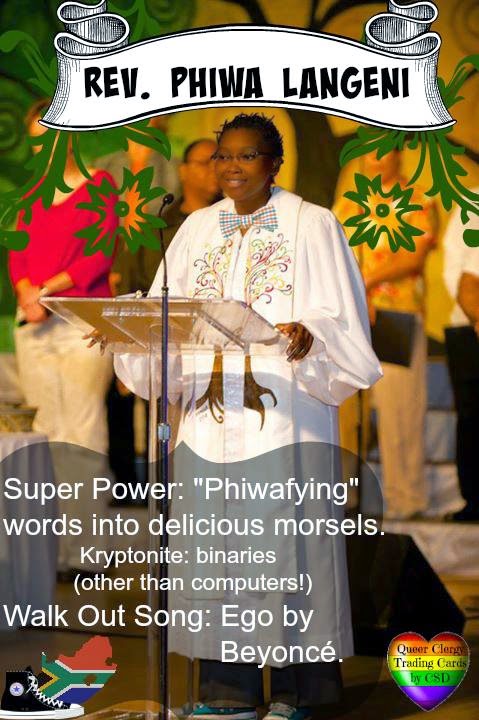
Queer clergy look cool on these virtual “trading cards.” Like the more familiar baseball trading cards, each card combines a portrait photo with written info about the individual.

Queer Clergy Trading Cards list each person’s strength (“super-power”), weakness (“kryptonite”) and their “walk-out song” for making a grand entrance. Some clergy are also given clever job titles such as “butch pastor,” ”femminster,” “renegade priest,” “spiritual directrix” and “inclusivator.”

Flipping through the pack of cards gives a welcome overview of the diversity and carefree spirit among today’s queer clergy. The multiracial group includes people of many ages and denominations. The cards showcase a huge variety of identities, including old-school butch dykes and liturgy queens; bisexual, transgender and genderqueer identities; and people who identify on other spectrums of gender.


“A friend was having a rough day and I wanted to help make them feel like a super hero. So I made a card! And then thought it would be fun to just... keep going,” says Rev. Chris Davies, creator of Queer Clergy Trading Cards. “The cards make queer clergy feel affirmed, and special. And it's networking us in an incredible way!”

Davies is a United Church of Christ minister who is working on her Doctor in Ministry degree in queer theology at Andover Newton Theological School in Massachusetts. Her ministry spills out over the church and into coffee shops, Pride celebrations, bars, queer spaces and the Internet.

Creator Chris Davies made a Queer Clergy Trading Card for herself too.

Queer Clergy Trading Cards are shared on their Facebook, Instagram and Twitter accounts. “While not in print-- YET-- the possibility seems firmer that they will be with each passing day,” according to their Facebook page.

“I've heard people who are not religious say that this has opened their eyes up to ministry in totally different ways than they imagined ministry could be... from youth to adults inside queer spaces and out. And for that I'm so grateful,” Davies told the Jesus in Love Blog.

New cards will continue to come out sporadically, and the project may move to an interfaith expansion in the future.

Queer Clergy Trading Card’s Facebook page addresses one more burning question:

Oh you want to be a card?
1.) Be Queer
2.) Be Christian clergy-- licensed/ordained
3.) Message us!

Other recent projects have taken a serious look at queer clergy, such as “We Have Faith,” a museum-quality traveling exhibit with photos of well-known LGBT and allied clergy, and the 2014 book “Queer Clergy: A History of Gay and Lesbian Ministry in American Protestantism” by R.W. Holmen.

But nobody has ever made our lives look as fun as the Queer Clergy Trading Cards!

Take a moment to view the following examples and go to the Queer Clergy Trading Cards Facebook page to see them all.


___
Related links:
Queer Clergy Trading Cards Give LGBTQ Faith Leaders Superhero Status (Hartford Courant)

___
Special thanks for the news tip to Kyle Lovett, “chaplain to the rainbow people."

Copyright © Kittredge Cherry. All rights reserved.
http://www.jesusinlove.blogspot.com/
Jesus in Love Blog on LGBT spirituality and the arts
___
This post is part of the Artists series by Kittredge Cherry at the Jesus in Love Blog. The series profiles artists who use lesbian, gay, bisexual, transgender (LGBT) and queer spiritual and religious imagery. It also highlights great queer artists from history, with an emphasis on their spiritual lives.

Friday, May 30, 2014

Joan of Arc: Cross-dressing warrior-saint

“Jeanne D'Arc” by Rowan Lewgalon

"Saint Joan of Arc" by Brother Robert Lentz, OFM

Joan of Arc was a tough cross-dressing teenage warrior who led the medieval French army to victory when she was 17. She is a queer icon, girl-power hero and patron saint of France. Her feast day is today (May 30).

Smart and courageous, Joan of Arc (c. 1412-1431) had visions of saints and angels who told her to cut her hair, put on men’s clothes and go to war. At age 18 she helped crown a king and at 19 she was killed by the church that later made her a saint. She died for her God-given right to wear men’s clothing, the crime for which she was executed on May 30, 1431.

For a new version of this article, click this link to Qspirit.net:
Joan of Arc: Cross-dressing warrior-saint and LGBTQ role model


Joan of Arc portrait, c. 1485
Wikimedia Commons
Contemporary LGBT people recognize a kindred spirit in her stubborn defiance of gender rules. Queer writers tend to downplay Joan’s Christian faith, while the church covers up the importance of her cross-dressing. In truth, Joan believed strongly in God AND in cross-dressing. She insisted that God wanted her to wear men’s clothes, making her what today can be called “queer” or “transgender.” She fits the medieval archetype known as the “holy transvestite.” Cross-dressing was illegal, but what really upset the church authorities, then as now, was the audacity of someone being both proudly queer AND devoutly Christian. Her belief that God was the source of her gender-bending queerness makes her an especially inspiring role model for LGBT Christians and our allies.

Joan’s extraordinary life continues to fascinate all kinds of people. Many are eager to claim her as a symbol, from LGBT people and feminists to the Catholic Church and French nationalists. Joan is the subject of more than 10,000 books, plays, paintings and films, including recent works by transgender author Leslie Feinberg and lesbian playwright Carolyn Gage.

Gage’s one-woman show “The Second Coming of Joan of Arc” is an underground classic with Joan as “a cross-dressing, teenaged, runaway lesbian” confronting male-dominated institutions. Feinberg has a chapter on Joan as “a brilliant transgender peasant teenager leading an army of laborers into battle” in her history book “Transgender Warriors: Making History from Joan of Arc to Dennis Rodman.”

The extensive records of her trials by the Inquisition make Joan of Arc the best-documented person of 15th century. There are only hints that she may have been a lesbian, but the evidence is absolutely clear about her trans expression as a cross-dresser.

Joan of Arc, also known as Jeanne d’Arc, was born to peasants in an obscure village in eastern France around 1412, toward the end of the Hundred Years War. Much of France was occupied by England, so that Charles, the heir to the French throne, did not dare to be crowned. When Joan was 13, she began hearing voices that told her to help France drive out the English.

The visions continued for years, becoming more detailed and frequent. Once or twice a week she had visions of Michael the Archangel and two virgin saints: Catherine of Alexandria and Margaret of Antioch (another transvestite saint who refused to marry a man). They told her that God wanted her to meet Charles and lead an army to Reims for his coronation.

Joan’s family tried to convince her that her visions weren’t real, and her first attempt to visit the royal court was rejected. When she was 17 she put on male clothing and succeeded in meeting Charles. He agreed to outfit her as a knight and allowed her to lead a 5,000-man army against the English.

On Charles’ order, a full suit of armor was created to fit Joan. He had a banner made for her and assigned an entourage to help her: a squire, a page, two heralds, a chaplain and other servants.

Joan of Arc on Horseback, 1505
Wikimedia Commons
Joan’s appearance awed the soldiers and peasants when she traveled with the army. Mounted on a fine warhorse, she rode past cheering crowds in a suit of armor. Her hair was “cropped short and round in the fashion of young men.” She carried an ancient sword in one hand and her banner in the other. Her sword was found, as Joan predicted, buried at the church of St. Catherine at Fierbois. The banner showed Christ sitting on a rainbow against a background of white with gold lilies and the motto “Jhesus-Maria.” Legend says that white butterflies followed Joan wherever she rode with her banner unfurled.

With Joan leading the way, the army won the battle at Orleans and continued to defeat English and pro-English troops until they reached Reims. She proudly stood beside Charles VII at his coronation there on July 17, 1429.

Joan soon resumed leading military campaigns. Even during her lifetime the peasants adored her as a saint, flocking around her to touch her body or clothing. Her cross-dressing didn’t disturb them. In fact, they seemed to honor her for her transgender expression. Perhaps, as some scholars say, the peasants saw Joan as part of a tradition that linked transvestites and priests in pre-modern Europe.

One of the first modern writers to raise the possibility of Joan’s lesbianism was English author Vita Sackville-West. She implied that Joan was a lesbian in her 1936 biography “Saint Joan of Arc.” The primary source for this idea was the fact, documented in her trials, that Joan shared her bed with other girls and young women. She followed the medieval custom of lodging each night in a local home. Joan always slept with the hostess or the girls of the household instead of with the men.

Joan of Arc: Her Trial Transcripts” by Emilia Philomena Sanguinetti is a 2016 book that explores whether Joan was a lesbian or transgender person.
Extensive evidence that Joan of Arc was a lesbian or transgender person is presented in the epilogue of this groundbreaking book about the cross-dressing medieval saint. She explores how Joan shared her bed with another woman and insisted on wearing male clothing.

Nobody knows for sure whether Joan of Arc was sexually attracted to women or had lesbian encounters, but her abstinence from sex with men is well documented. Her physical virginity was confirmed by official examinations at least twice during her lifetime. Joan herself liked to be called La Pucelle, French for “the Maid,” a nickname that emphasized her virginity. Witnesses at her trial testified that Joan was chaste rather than sexually active.

Joan’s illustrious military career ended in May 1430. She was captured in battle by the Burgundians, the French allies of the English. During her captivity they called her “hommase,” a slur meaning “man-woman” or “masculine woman.”

In a stunning betrayal, Charles VII did nothing to rescue the warrior who helped win him the crown. It was normal to pay ransom for the release of knights and nobles caught in battle, but he abandoned Joan to her fate. Historians speculate that French aristocrats felt threatened by the peasant girl with such uncanny power to move the masses.

The Burgundians transferred Joan to the English, who then gave her to the Inquisition. She spent four torturous months in prison before her church trial began on Jan. 9, 1431 in Rouen, the seat of the English occupation government. She was charged with witchcraft and heresy.

The politically motivated church trial was rigged against her, and yet Joan was able to display her full intelligence as she answered the Inquisitors’ questions. Her subtle, witty answers and detailed memory even forced them to stop holding the trial in public.

Witchcraft was hard to prove, so the church dropped the charge. (Many of today’s Wiccans and pagans still honor Joan as one of their own.) The Inquisitors began to focus exclusively on the “heresy” of Joan’s claim that she was following God’s will when she dressed as a man. The judges told her that cross-dressing was “an abomination before God” according to church law and the Bible. (See Deuteronomy 22:5.)

They accused Joan of “leaving off the dress and clothing of the feminine sex, a thing contrary to divine law and abominable before God, and forbidden by all laws” and instead dressing in “clothing and armor such as is worn by man.”

Joan swore that God wanted her to wear men’s clothing. “For nothing in the world will I swear not to arm myself and put on a man’s dress; I must obey the orders of Our Lord,” she testified. She outraged the judges by continuing to appear in court wearing what they called “difformitate habitus” (“monstrous dress” or “degenerate apparel.”)

Today Joan’s conservative admirers claim that she wore men’s clothes only as way to avoid rape, but she said that it meant much more to her. Joan of Arc saw cross-dressing as a sacred duty.

The judges summarized Joan’s testimony by saying, “You have said that, by God’s command, you have continually worn man’s dress, wearing the short robe, doublet, and hose attached by points; that you have also worn your hair short, cut ‘en rond’ above your ears with nothing left that could show you to be a woman; and that on many occasions you received the Body of our Lord dressed in this fashion, although you have been frequently admonished to leave it off, which you have refused to do, saying that you would rather die than leave it off, save by God’s command.”

Joan refused to back down on the visions she received from God, and she was sentenced to death. She was burned at the stake on May 30, 1431 in Rouen. Twenty five years later she was retried and her conviction was overturned. Joan was declared innocent.

Her armor, that “monstrous dress,” became an object of veneration, sought after like the Holy Grail with various churches claiming to possess her true armor. Joan of Arc was canonized as a saint in 1920. Famous writers and composers who have done works about her include Shakespeare, Voltaire, Verdi, Tchaikovsky, Mark Twain, Bertolt Brecht and George Bernard Shaw. A stunning portrait of Joan kissing her sword (below) was painted by Pre-Raphaelite artist Dante Gabriel Rossetti, whose sister Christina Rossetti is also part of the LGBT Saints series at the Jesus in Love Blog.

“Joan of Arc Kisses the Sword of Liberation” by Dante Gabriel Rossetti, 1863 (WikiPaintings)

This post features contemporary portraits of Joan by Rowan Lewgalon, Robert Lentz and Tobias Haller. Lewgalon is a spiritual artist based in Germany and also a cleric in the Old Catholic Apostolic Church. Her work is online at tir-anam.weebly.com. Lentz is a Franciscan friar known for his innovative and LGBT-positive icons. He is stationed at Holy Name College in Silver Spring, Maryland. His icons are available at Trinitystores.com.

“Jeanne d’Arc” by Tobias Haller

“Jeanne d’Arc” was sketched by Tobias Haller, an iconographer, author, composer, and vicar of Saint James Episcopal Church in the Bronx. He is the author of “Reasonable and Holy: Engaging Same-Sexuality.” Haller enjoys expanding the diversity of icons available by creating icons of LGBTQ people and other progressive holy figures as well as traditional saints. He and his husband were united in a church wedding more than 30 years ago and a civil ceremony after same-sex marriage became legal in New York.

A widely used prayer to Saint Joan of Arc makes a powerful statement that can inspire those who believe in equality for LGBT people, despite rejection by religion and society:


“In the face of your enemies, in the face of harassment, ridicule, and doubt, you held firm in your faith. Even in your abandonment, alone and without friends, you held firm in your faith. Even as you faced your own mortality, you held firm in your faith. I pray that I may be as bold in my beliefs as you, St. Joan. I ask that you ride alongside me in my own battles. Help me be mindful that what is worthwhile can be won when I persist. Help me hold firm in my faith. Help me believe in my ability to act well and wisely. Amen.”

Joan has a dialogue with the fire that is about to consume her in a haunting song written by award-winning Canandian poet Leonard Cohen and sung on July Collins video .


___
Related links:

Wikipedia article on Cross-dressing, sexuality, and gender identity of Joan of Arc

Joan of Arc trial transcript online

Joan of Arc: Cross-dressing martyr at Queering the Church Blog

Jeanne-darc.info

Joan of Arc sculpture by Anna Hyatt Huntington at the Cathedral of Saint John the Divine in New York City

To read this post in Spanish / en español, go to Santos Queer:
Juana de Arco: Santa Travesti

To read this post in Italian, go to Gionta.org:
Una guerriera genderbender. La favolosa vita di Giovanna d’Arco


This post is part of the LGBTQ Saints series by Kittredge Cherry. Traditional and alternative saints, people in the Bible, LGBTQ martyrs, authors, theologians, religious leaders, artists, deities and other figures of special interest to lesbian, gay, bisexual and transgender and queer (LGBTQ) people and our allies are covered.

Copyright © Kittredge Cherry. All rights reserved.
Qspirit.net presents the Jesus in Love Blog on LGBTQ spirituality.

Icons of Joan of Arc and many others are available on cards, plaques, T-shirts, mugs, candles, mugs, and more at Trinity Stores