Showing posts with label woman Christ. Show all posts

Friday, August 12, 2016

Radclyffe Hall: Queer Christian themes mark banned book "Well of Loneliness"


A queer Christ figure is the main character in the world’s best known lesbian novel, “The Well of Loneliness” by Radclyffe Hall. She was born on  this date (Aug. 12) in 1880.

The book was banned for obscenity in England in 1928, not just because it portrayed lesbian love, but also for using religious arguments to support “inverts” -- a 1920s term for LGBTQ people. Hall, a devoutly Catholic British lesbian, was herself pictured being nailed to the cross in a satirical cartoon from the era.

Radclyffe Hall
Hall (1880-1943) is widely recognized as a pioneering lesbian (or perhaps transgender) author. But her Christian side is often downplayed because of the conflict between Christianity and homosexuality -- what was then called “congenital sexual inversion.” Hall lived with those contradictions and tried to reconcile them in her books. Today the Jesus in Love Blog focuses on the role of Christianity in Hall’s life and work.

The Well of Loneliness” ends with a desperate prayer that has been echoed by countless LGBTQ people and still rings true now. The prayer is uttered by the novel’s protagonist, Stephen Gordon. She was born on Christmas Eve and named after the first Christian martyr. As a girl she had a dream “that in some queer way she was Jesus.” Like Hall, Stephen grows up to become a masculine woman who wears men’s clothes, has romantic relationships with women, and identifies as an “invert.”

At the climax of the novel Stephen has a vision of being thronged by millions of inverts from throughout time: living, dead and unborn. They beg her to speak with God for them, and then they possess her. She speaks for queer people from the past, present and future as she gives passionate voice to their collective prayer:

“God,” she gasped, “We believe; we have told You we believe…We have not denied You, then rise up and defend us. Acknowledge us, oh God, before the whole world. Give us also the right to our existence!”

Such themes led to obscenity trials for “The Well of Loneliness,” even though the novel is not sexually explicit. It gets no more risqué than saying, “She kissed her full on the lips, as a lover.” In Britain it was condemned and all copies were ordered destroyed. It was only published in America after a court battle.

British judge Chartres Biron was especially outraged that Hall defended LGBTQI people by affirming that they are part of God’s creation. In his decision Biron wrote::

“I confess that the way in which the Deity is introduced into this book seems to me singularly inappropriate and disgusting. There is a plea for existence at the end. That of course means a plea for existence in which the invert is to be recognized and tolerated, and not treated with condemnation, as they are at present, by all decent people. This being the tenor of the book, I have no hesitation whatever in saying that it is an obscene libel, that it would tend to corrupt those into whose hands it should fall, and that the publication of this book is an offence against public decency, and obscene libel, and I shall order it to be destroyed.”

Both sides of the controversy were satirized in “The Sink of Solitude,” a series of cartoons including “Saint Stephen” by Beresford Egan. One drawing shows Hall nailed to a cross wearing her trademark sombrero. A near-nude Sappho leaps in front of the martyred author and Cupid perches on the crossbeam. The crucifixion is witnessed by the evangelical Home Secretary William Joynson-Hicks, who helped enforce the censorship order.

Hall was upset to see herself portrayed in a way that she considered blasphemous. The drawing strengthened her resolve to write a modern version of Christ’s life as her next novel. Titled “The Master of the House,” it concerns Christophe, a compassionate carpenter born in Provence, France to a carpenter called Jouse and his wife Marie. He ends up being crucified during the First World War.

Writing the book was so spiritually intense that Hall developed stigmata on the palms of her hands during the two-year creative process. She believed it was her best book, but it got bad reviews and sales slumped. In America the book was seized not by police, but by creditors because her publisher went bankrupt.

Almost all references to “The Master of the House” describe it as a deeply religious book without further explanation. Actually it is an adaptation of Christ’s story for modern times. One of the only detailed summaries comes from the Delphi Classics edition of “The Complete Works of Radclyffe Hall.” It states:

“This 1932 novel concerns Christophe Benedict, a carpenter who lives in Provence. Almost saint-like, he is deeply spiritual, compassionate and experiences visions of a previous life as the Carpenter of Nazareth. He is attracted to girls, but refrains from having a relationship, held back by some unknown power -- his closest friend is his male cousin Jan, (but this is not a novel about homosexuality). When the 1914-1918 war begins, he enlists and is posted to Palestine. A close encounter with the enemy leads to a dramatic turn of events.”

Hall’s religious devotion dates back to 1912, when she was in her early 30s. She converted to the Roman Catholic Church under the influence of her first long-term lover, Mabel “Ladye” Batten. Her baptismal name was Antonia and she chose Anthony as her patron saint. Together they worshiped at London’s fashionable Church of the Immaculate Heart of Mary, known as the Brompton Oratory.

Hall and Batten made a pilgrimage to Rome, where a financial donation led Pope Pius X to bless them in a semi-private audience at the Vatican in 1913. “They went to confession and mass in St. Peter’s and bought triptychs, gilt angels and an alabaster Madonna,” biographer Diane Souhami reports in “The Trials of Radclyffe Hall.”

Batten, who died in 1916, was a Catholic convert too, as was Hall’s next lover, Una Troubridge (1887-1963). All three of them were part of a trend. A surprising number of upper-class English lesbians and intellectuals converted to Catholicism in the late 19th and early 20th centuries in a trend related to the Oxford Movement. Conversion was a way of rebelling against English society while maintaining connection with tradition. Hall was also interested in Spiritualism.

An independently wealthy heiress, Hall gave generously to the church. In the 1930s she and Troubridge made their home in Rye, a village in East Sussex where many writers lived. The Catholic Church of Saint Anthony of Padua was constructing a new building when they moved to Rye, and biographer Souhami reports that Hall “poured money into this church” to bring it to completion and furnish it.

“She paid for its roof, pews, paintings of the Stations of the Cross and a rood screen of Christ the King. A tribute to Ladye was engraved on a brass plaque set into the floor:
Of your charity
Pray for the soul of Mabel Veronica Batten
In memory of whom this rood was given.
She paid off all the outstanding debts of the church… Masses, benedictions, processions and venerations stemmed from her beneficence.

One source says that she and Troubridge left their money to the church after their deaths. Hall died of colon cancer at age 63 on October 7, 1943. She is buried with Ladye in London’s Highgate Cemetery.

At the time of her death, “The Well of Loneliness” had been translated into 14 languages and was selling more than 100,000 copies per year. It has never gone out of print. For decades it was the only lesbian book generally available, and therefore it made an enormous impact on generations of queer people. It remains on many lists of the top LGBT books.

Hall is the subject of several book-length biographies, including not only “The Trials of Radclyffe Hall” by Diana Souhami, but also “Our Three Selves: The Life of Radclyffe Hall” by Michael Baker, “Radclyffe Hall: A Woman Called John” by Sally Cline, and “Radclyffe Hall: A Life in the Writing” by Richard Dellamora.

“The Well of Loneliness” has sparked controversy not only from conservatives, but also among the LGBTQ community. The novel is often criticized for expressing shame and self-hatred, defining all lesbians as masculine, and presenting a stereotyped butch-femme lifestyle. Hall has long been classified as a lesbian, but now there is debate over whether she was a transgender man. Secular LGBT readers tend to dismiss the religious aspects as embarrassing and irrelevant relics of a bygone era.

One scholar who affirms the role of religion in Hall’s work is Ed Madden, English professor at the University of South Carolina. His article “The Well of Loneliness, or the Gospel According to Radclyffe Hall” is included in the 2003 book "Reclaiming the Sacred: The Bible in Gay and Lesbian Culture,” edited by Raymond-Jean Frontain. It was originally published in the Journal of Homosexuality, where the abstract summarizes it this way::

“Radclyffe Hall's 1928 novel, 'The Well of Loneliness,' is repeatedly described as a "bible" of lesbian literature. The novel itself repeatedly alludes to biblical stories, especially the story of Christ. Yet there has been little sustained analysis of the biblical language of the novel. Most feminist and lesbian critics have dismissed the biblical allusions and language as unfortunate and politically regressive; religious critics have ignored the novel. This essay reexamines the biblical nature of the novel, especially its portrayal of the lesbian Stephen Gordon as a Christ figure. The study further claims a creative and interventionary power in Hall's use of biblical narratives and tropes, a power traceable in public reception to the novel and in courtroom reactions to the use of spiritual language in a text about lesbianism. By writing the life of a lesbian as a kind of gospel of inversion, Hall turns a language of condemnation into a language of validation, making her use of biblical language a kind of Foucauldian "reverse discourse." The novel's power lies in its portrayal of a lesbian messiah, and in its joining of sexological and religious discourses.”

Another scholar who writes in depth about the queer Christian aspect of Hall’s work is Isabella Cooper. She was a Ph.D. candidate in the English department at the University of Maryland in College Park when she wrote “The Passion of Stephen Gordon: The Messianic Lesbian Artist in Radclyffe Hall’s 'The Well of Loneliness.'” The article appeared in the Transverse Journal in 2011. In the article she states:

“The Well’s readers have frequently noticed the deliberate parallels Hall draws between Stephen and Christ; they have also noticed Hall’s identification with both. Some readers have mocked the novel for precisely this reason. Hall’s strategy of creating an alter-ego/ protagonist and identifying her with Christ reflects her understanding of her role as a Christian lesbian artist. She attempts in this novel to perform a powerful work of redemption for those whose desires society and the Church label sinful. In order to combat the stigma of sinfulness, Hall fashions (and speaks through) a protagonist whose Christ-like suffering and self-sacrifice challenge her readers, and whose ability (by the novel’s end) to reconcile her commitments to her faith, her art, and her sexual identity enable her to take on a messianic role.”

Hall would probably be the first to insist that she was no saint, but she is included in the LGBT Saints series here at the Jesus in Love Blog because was a pioneer in the effort to reconcile Christianity and homosexuality. Thank you, Radclyffe, for voicing a prayer from queer people of all times: “Acknowledge us, oh God, before the whole world. Give us also the right to our existence!”

___
Related links:
Radclyffe Hall, E. Lynn Harris, and Franz Kafka: Christianity, Queerness, and the Politics of Normalcy” by Margaret Soenser Breen (International Journal of Sexuality and Gender Studies)

Joan of Arc and Radclyffe Hall: Inspiration and Influence” by Steven Macnamara

Full text of "The Well of Loneliness" free online (Gutenberg.net)

___
Top image credit:
Lesbian author Radclyffe Hall is a crucified Christ figure in a 1928 cartoon by Beresford Egan

____
This post is part of the LGBTQ Saints series by Kittredge Cherry. Traditional and alternative saints, people in the Bible, LGBTQ martyrs, authors, theologians, religious leaders, artists, deities and other figures of special interest to lesbian, gay, bisexual and transgender and queer (LGBTQ) people and our allies are covered.

Copyright © Kittredge Cherry. All rights reserved.
Qspirit.net presents the Jesus in Love Blog on LGBTQ spirituality.


Wednesday, August 12, 2015

Radclyffe Hall: Queer Christian themes mark banned book "Well of Loneliness"

Lesbian author Radclyffe Hall is a crucified Christ figure in a 1928 cartoon by Beresford Egan

A queer Christ figure is the main character in the world’s best known lesbian novel, “The Well of Loneliness” by Radclyffe Hall. She was born 135 years ago today on Aug. 12, 1880.

The book was banned for obscenity in England in 1928, not just because it portrayed lesbian love, but also for using religious arguments to support “inverts” -- a 1920s term for LGBTQ people. Hall, a devoutly Catholic British lesbian, was herself pictured being nailed to the cross in a satirical cartoon from the era.

Radclyffe Hall
Hall (1880-1943) is widely recognized as a pioneering lesbian (or perhaps transgender) author. But her Christian side is often downplayed because of the conflict between Christianity and homosexuality -- what was then called “congenital sexual inversion.” Hall lived with those contradictions and tried to reconcile them in her books. Today the Jesus in Love Blog focuses on the role of Christianity in Hall’s life and work.

The Well of Loneliness” ends with a desperate prayer that has been echoed by countless LGBTQ people and still rings true now. The prayer is uttered by the novel’s protagonist, Stephen Gordon. She was born on Christmas Eve and named after the first Christian martyr. As a girl she had a dream “that in some queer way she was Jesus.” Like Hall, Stephen grows up to become a masculine woman who wears men’s clothes, has romantic relationships with women, and identifies as an “invert.”

At the climax of the novel Stephen has a vision of being thronged by millions of inverts from throughout time: living, dead and unborn. They beg her to speak with God for them, and then they possess her. She speaks for queer people from the past, present and future as she gives passionate voice to their collective prayer:

“God,” she gasped, “We believe; we have told You we believe…We have not denied You, then rise up and defend us. Acknowledge us, oh God, before the whole world. Give us also the right to our existence!”

Such themes led to obscenity trials for “The Well of Loneliness,” even though the novel is not sexually explicit. It gets no more risqué than saying, “She kissed her full on the lips, as a lover.” In Britain it was condemned and all copies were ordered destroyed. It was only published in America after a court battle.

British judge Chartres Biron was especially outraged that Hall defended LGBTQI people by affirming that they are part of God’s creation. In his decision Biron wrote::

“I confess that the way in which the Deity is introduced into this book seems to me singularly inappropriate and disgusting. There is a plea for existence at the end. That of course means a plea for existence in which the invert is to be recognized and tolerated, and not treated with condemnation, as they are at present, by all decent people. This being the tenor of the book, I have no hesitation whatever in saying that it is an obscene libel, that it would tend to corrupt those into whose hands it should fall, and that the publication of this book is an offence against public decency, and obscene libel, and I shall order it to be destroyed.”

Both sides of the controversy were satirized in “The Sink of Solitude,” a series of cartoons including “Saint Stephen” by Beresford Egan. One drawing shows Hall nailed to a cross wearing her trademark sombrero. A near-nude Sappho leaps in front of the martyred author and Cupid perches on the crossbeam. The crucifixion is witnessed by the evangelical Home Secretary William Joynson-Hicks, who helped enforce the censorship order.

Hall was upset to see herself portrayed in a way that she considered blasphemous. The drawing strengthened her resolve to write a modern version of Christ’s life as her next novel. Titled “The Master of the House,” it concerns Christophe, a compassionate carpenter born in Provence, France to a carpenter called Jouse and his wife Marie. He ends up being crucified during the First World War.

Writing the book was so spiritually intense that Hall developed stigmata on the palms of her hands during the two-year creative process. She believed it was her best book, but it got bad reviews and sales slumped. In America the book was seized not by police, but by creditors because her publisher went bankrupt.

Almost all references to “The Master of the House” describe it as a deeply religious book without further explanation. Actually it is an adaptation of Christ’s story for modern times. One of the only detailed summaries comes from the Delphi Classics edition of “The Complete Works of Radclyffe Hall.” It states:

“This 1932 novel concerns Christophe Benedict, a carpenter who lives in Provence. Almost saint-like, he is deeply spiritual, compassionate and experiences visions of a previous life as the Carpenter of Nazareth. He is attracted to girls, but refrains from having a relationship, held back by some unknown power -- his closest friend is his male cousin Jan, (but this is not a novel about homosexuality). When the 1914-1918 war begins, he enlists and is posted to Palestine. A close encounter with the enemy leads to a dramatic turn of events.”

Hall’s religious devotion dates back to 1912, when she was in her early 30s. She converted to the Roman Catholic Church under the influence of her first long-term lover, Mabel “Ladye” Batten. Her baptismal name was Antonia and she chose Anthony as her patron saint. Together they worshiped at London’s fashionable Church of the Immaculate Heart of Mary, known as the Brompton Oratory.

Hall and Batten made a pilgrimage to Rome, where a financial donation led Pope Pius X to bless them in a semi-private audience at the Vatican in 1913. “They went to confession and mass in St. Peter’s and bought triptychs, gilt angels and an alabaster Madonna,” biographer Diane Souhami reports in “The Trials of Radclyffe Hall.”

Batten, who died in 1916, was a Catholic convert too, as was Hall’s next lover, Una Troubridge (1887-1963). All three of them were part of a trend. A surprising number of upper-class English lesbians and intellectuals converted to Catholicism in the late 19th and early 20th centuries in a trend related to the Oxford Movement. Conversion was a way of rebelling against English society while maintaining connection with tradition. Hall was also interested in Spiritualism.

An independently wealthy heiress, Hall gave generously to the church. In the 1930s she and Troubridge made their home in Rye, a village in East Sussex where many writers lived. The Catholic Church of Saint Anthony of Padua was constructing a new building when they moved to Rye, and biographer Souhami reports that Hall “poured money into this church” to bring it to completion and furnish it.

“She paid for its roof, pews, paintings of the Stations of the Cross and a rood screen of Christ the King. A tribute to Ladye was engraved on a brass plaque set into the floor:
Of your charity
Pray for the soul of Mabel Veronica Batten
In memory of whom this rood was given.
She paid off all the outstanding debts of the church… Masses, benedictions, processions and venerations stemmed from her beneficence.

One source says that she and Troubridge left their money to the church after their deaths. Hall died of colon cancer at age 63 on October 7, 1943. She is buried with Ladye in London’s Highgate Cemetery.

At the time of her death, “The Well of Loneliness” had been translated into 14 languages and was selling more than 100,000 copies per year. It has never gone out of print. For decades it was the only lesbian book generally available, and therefore it made an enormous impact on generations of queer people. It remains on many lists of the top LGBT books.

Hall is the subject of several book-length biographies, including not only “The Trials of Radclyffe Hall” by Diana Souhami, but also “Our Three Selves: The Life of Radclyffe Hall” by Michael Baker, “Radclyffe Hall: A Woman Called John” by Sally Cline, and “Radclyffe Hall: A Life in the Writing” by Richard Dellamora.

“The Well of Loneliness” has sparked controversy not only from conservatives, but also among the LGBTQ community. The novel is often criticized for expressing shame and self-hatred, defining all lesbians as masculine, and presenting a stereotyped butch-femme lifestyle. Hall has long been classified as a lesbian, but now there is debate over whether she was a transgender man. Secular LGBT readers tend to dismiss the religious aspects as embarrassing and irrelevant relics of a bygone era.

One scholar who affirms the role of religion in Hall’s work is Ed Madden, English professor at the University of South Carolina. His article “The Well of Loneliness, or the Gospel According to Radclyffe Hall” is included in the 2003 book "Reclaiming the Sacred: The Bible in Gay and Lesbian Culture,” edited by Raymond-Jean Frontain. It was originally published in the Journal of Homosexuality, where the abstract summarizes it this way::

“Radclyffe Hall's 1928 novel, 'The Well of Loneliness,' is repeatedly described as a "bible" of lesbian literature. The novel itself repeatedly alludes to biblical stories, especially the story of Christ. Yet there has been little sustained analysis of the biblical language of the novel. Most feminist and lesbian critics have dismissed the biblical allusions and language as unfortunate and politically regressive; religious critics have ignored the novel. This essay reexamines the biblical nature of the novel, especially its portrayal of the lesbian Stephen Gordon as a Christ figure. The study further claims a creative and interventionary power in Hall's use of biblical narratives and tropes, a power traceable in public reception to the novel and in courtroom reactions to the use of spiritual language in a text about lesbianism. By writing the life of a lesbian as a kind of gospel of inversion, Hall turns a language of condemnation into a language of validation, making her use of biblical language a kind of Foucauldian "reverse discourse." The novel's power lies in its portrayal of a lesbian messiah, and in its joining of sexological and religious discourses.”

Another scholar who writes in depth about the queer Christian aspect of Hall’s work is Isabella Cooper. She was a Ph.D. candidate in the English department at the University of Maryland in College Park when she wrote “The Passion of Stephen Gordon: The Messianic Lesbian Artist in Radclyffe Hall’s 'The Well of Loneliness.'” The article appeared in the Transverse Journal in 2011. In the article she states:

“The Well’s readers have frequently noticed the deliberate parallels Hall draws between Stephen and Christ; they have also noticed Hall’s identification with both. Some readers have mocked the novel for precisely this reason. Hall’s strategy of creating an alter-ego/ protagonist and identifying her with Christ reflects her understanding of her role as a Christian lesbian artist. She attempts in this novel to perform a powerful work of redemption for those whose desires society and the Church label sinful. In order to combat the stigma of sinfulness, Hall fashions (and speaks through) a protagonist whose Christ-like suffering and self-sacrifice challenge her readers, and whose ability (by the novel’s end) to reconcile her commitments to her faith, her art, and her sexual identity enable her to take on a messianic role.”

Hall would probably be the first to insist that she was no saint, but she is included in the LGBT Saints series here at the Jesus in Love Blog because was a pioneer in the effort to reconcile Christianity and homosexuality. Thank you, Radclyffe, for voicing a prayer from queer people of all times: “Acknowledge us, oh God, before the whole world. Give us also the right to our existence!”

___
Related links:
Radclyffe Hall, E. Lynn Harris, and Franz Kafka: Christianity, Queerness, and the Politics of Normalcy” by Margaret Soenser Breen (International Journal of Sexuality and Gender Studies)

Joan of Arc and Radclyffe Hall: Inspiration and Influence” by Steven Macnamara

Full text of "The Well of Loneliness" free online (Gutenberg.net)

____
This post is part of the GLBT Saints series by Kittredge Cherry at the Jesus in Love Blog. Saints, martyrs, mystics, prophets, witnesses, heroes, holy people, humanitarians, deities and religious figures of special interest to lesbian, gay, bisexual and transgender (LGBT) and queer people and our allies are covered on appropriate dates throughout the year. It is also part of the Queer Christ series,which gathers together visions of the queer Christ as presented by artists, writers, theologians and others.

Copyright © Kittredge Cherry. All rights reserved.
http://www.jesusinlove.blogspot.com/
Jesus in Love Blog on LGBT spirituality and the arts


Sunday, September 14, 2014

Radclyffe Hall: Queer Christian themes mark banned book "Well of Loneliness"

Lesbian author Radclyffe Hall is a crucified Christ figure in a 1928 cartoon by Beresford Egan

A queer Christ figure is the main character in the world’s best known lesbian novel, “The Well of Loneliness” by Radclyffe Hall. She was born 134 years ago today on Aug. 12, 1880.

The book was banned for obscenity in England in 1928, not just because it portrayed lesbian love, but also for using religious arguments to support “inverts” -- a 1920s term for LGBTQ people. Hall, a devoutly Catholic British lesbian, was herself pictured being nailed to the cross in a satirical cartoon from the era.

Radclyffe Hall
Hall (1880-1943) is widely recognized as a pioneering lesbian (or perhaps transgender) author. But her Christian side is often downplayed because of the conflict between Christianity and homosexuality -- what was then called “congenital sexual inversion.” Hall lived with those contradictions and tried to reconcile them in her books. Today the Jesus in Love Blog focuses on the role of Christianity in Hall’s life and work.

The Well of Loneliness” ends with a desperate prayer that has been echoed by countless LGBTQ people and still rings true now. The prayer is uttered by the novel’s protagonist, Stephen Gordon. She was born on Christmas Eve and named after the first Christian martyr. As a girl she had a dream “that in some queer way she was Jesus.” Like Hall, Stephen grows up to become a masculine woman who wears men’s clothes, has romantic relationships with women, and identifies as an “invert.”

At the climax of the novel Stephen has a vision of being thronged by millions of inverts from throughout time: living, dead and unborn. They beg her to speak with God for them, and then they possess her. She speaks for queer people from the past, present and future as she gives passionate voice to their collective prayer:

“God,” she gasped, “We believe; we have told You we believe…We have not denied You, then rise up and defend us. Acknowledge us, oh God, before the whole world. Give us also the right to our existence!”

Such themes led to obscenity trials for “The Well of Loneliness,” even though the novel is not sexually explicit. It gets no more risqué than saying, “She kissed her full on the lips, as a lover.” In Britain it was condemned and all copies were ordered destroyed. It was only published in America after a court battle.

British judge Chartres Biron was especially outraged that Hall defended LGBTQI people by affirming that they are part of God’s creation. In his decision Biron wrote::

“I confess that the way in which the Deity is introduced into this book seems to me singularly inappropriate and disgusting. There is a plea for existence at the end. That of course means a plea for existence in which the invert is to be recognized and tolerated, and not treated with condemnation, as they are at present, by all decent people. This being the tenor of the book, I have no hesitation whatever in saying that it is an obscene libel, that it would tend to corrupt those into whose hands it should fall, and that the publication of this book is an offence against public decency, and obscene libel, and I shall order it to be destroyed.”

Both sides of the controversy were satirized in “The Sink of Solitude,” a series of cartoons including “Saint Stephen” by Beresford Egan. One drawing shows Hall nailed to a cross wearing her trademark sombrero. A near-nude Sappho leaps in front of the martyred author and Cupid perches on the crossbeam. The crucifixion is witnessed by the evangelical Home Secretary William Joynson-Hicks, who helped enforce the censorship order.

Hall was upset to see herself portrayed in a way that she considered blasphemous. The drawing strengthened her resolve to write a modern version of Christ’s life as her next novel. Titled “The Master of the House,” it concerns Christophe, a compassionate carpenter born in Provence, France to a carpenter called Jouse and his wife Marie. He ends up being crucified during the First World War.

Writing the book was so spiritually intense that Hall developed stigmata on the palms of her hands during the two-year creative process. She believed it was her best book, but it got bad reviews and sales slumped. In America the book was seized not by police, but by creditors because her publisher went bankrupt.

Almost all references to “The Master of the House” describe it as a deeply religious book without further explanation. Actually it is an adaptation of Christ’s story for modern times. One of the only detailed summaries comes from the Delphi Classics edition of “The Complete Works of Radclyffe Hall.” It states:

“This 1932 novel concerns Christophe Benedict, a carpenter who lives in Provence. Almost saint-like, he is deeply spiritual, compassionate and experiences visions of a previous life as the Carpenter of Nazareth. He is attracted to girls, but refrains from having a relationship, held back by some unknown power -- his closest friend is his male cousin Jan, (but this is not a novel about homosexuality). When the 1914-1918 war begins, he enlists and is posted to Palestine. A close encounter with the enemy leads to a dramatic turn of events.”

Hall’s religious devotion dates back to 1912, when she was in her early 30s. She converted to the Roman Catholic Church under the influence of her first long-term lover, Mabel “Ladye” Batten. Her baptismal name was Antonia and she chose Anthony as her patron saint. Together they worshiped at London’s fashionable Church of the Immaculate Heart of Mary, known as the Brompton Oratory.

Hall and Batten made a pilgrimage to Rome, where a financial donation led Pope Pius X to bless them in a semi-private audience at the Vatican in 1913. “They went to confession and mass in St. Peter’s and bought triptychs, gilt angels and an alabaster Madonna,” biographer Diane Souhami reports in ““The Trials of Radclyffe Hall.”

Batten, who died in 1916, was a Catholic convert too, as was Hall’s next lover, Una Troubridge (1887-1963). All three of them were part of a trend. A surprising number of upper-class English lesbians and intellectuals converted to Catholicism in the late 19th and early 20th centuries in a trend related to the Oxford Movement. Conversion was a way of rebelling against English society while maintaining connection with tradition. Hall was also interested in Spiritualism.

An independently wealthy heiress, Hall gave generously to the church. In the 1930s she and Troubridge made their home in Rye, a village in East Sussex where many writers lived. The Catholic Church of Saint Anthony of Padua was constructing a new building when they moved to Rye, and biographer Souhami reports that Hall “poured money into this church” to bring it to completion and furnish it.

“She paid for its roof, pews, paintings of the Stations of the Cross and a rood screen of Christ the King. A tribute to Ladye was engraved on a brass plaque set into the floor:
Of your charity
Pray for the soul of Mabel Veronica Batten
In memory of whom this rood was given.
She paid off all the outstanding debts of the church… Masses, benedictions, processions and venerations stemmed from her beneficence.

One source says that she and Troubridge left their money to the church after their deaths. Hall died of colon cancer at age 63 on October 7, 1943. She is buried with Ladye in London’s Highgate Cemetery.

At the time of her death, “The Well of Loneliness” had been translated into 14 languages and was selling more than 100,000 copies per year. It has never gone out of print. For decades it was the only lesbian book generally available, and therefore it made an enormous impact on generations of queer people. It remains on many lists of the top LGBT books.

Hall is the subject of several book-length biographies, including not only “The Trials of Radclyffe Hall” by Diana Souhami, but also “Our Three Selves: The Life of Radclyffe Hall” by Michael Baker, “Radclyffe Hall: A Woman Called John” by Sally Cline, and “Radclyffe Hall: A Life in the Writing” by Richard Dellamora.

“The Well of Loneliness” has sparked controversy not only from conservatives, but also among the LGBTQ community. The novel is often criticized for expressing shame and self-hatred, defining all lesbians as masculine, and presenting a stereotyped butch-femme lifestyle. Hall has long been classified as a lesbian, but now there is debate over whether she was a transgender man. Secular LGBT readers tend to dismiss the religious aspects as embarrassing and irrelevant relics of a bygone era.

One scholar who affirms the role of religion in Hall’s work is Ed Madden, English professor at the University of South Carolina. His article “The Well of Loneliness, or the Gospel According to Radclyffe Hall” is included in the 2003 book "Reclaiming the Sacred: The Bible in Gay and Lesbian Culture,” edited by Raymond-Jean Frontain. It was originally published in the Journal of Homosexuality, where the abstract summarizes it this way::

“Radclyffe Hall's 1928 novel, 'The Well of Loneliness,' is repeatedly described as a "bible" of lesbian literature. The novel itself repeatedly alludes to biblical stories, especially the story of Christ. Yet there has been little sustained analysis of the biblical language of the novel. Most feminist and lesbian critics have dismissed the biblical allusions and language as unfortunate and politically regressive; religious critics have ignored the novel. This essay reexamines the biblical nature of the novel, especially its portrayal of the lesbian Stephen Gordon as a Christ figure. The study further claims a creative and interventionary power in Hall's use of biblical narratives and tropes, a power traceable in public reception to the novel and in courtroom reactions to the use of spiritual language in a text about lesbianism. By writing the life of a lesbian as a kind of gospel of inversion, Hall turns a language of condemnation into a language of validation, making her use of biblical language a kind of Foucauldian "reverse discourse." The novel's power lies in its portrayal of a lesbian messiah, and in its joining of sexological and religious discourses.”

Another scholar who writes in depth about the queer Christian aspect of Hall’s work is Isabella Cooper. She was a Ph.D. candidate in the English department at the University of Maryland in College Park when she wrote “The Passion of Stephen Gordon: The Messianic Lesbian Artist in Radclyffe Hall’s 'The Well of Loneliness.'” The article appeared in the Transverse Journal in 2011. In the article she states:

“The Well’s readers have frequently noticed the deliberate parallels Hall draws between Stephen and Christ; they have also noticed Hall’s identification with both. Some readers have mocked the novel for precisely this reason. Hall’s strategy of creating an alter-ego/ protagonist and identifying her with Christ reflects her understanding of her role as a Christian lesbian artist. She attempts in this novel to perform a powerful work of redemption for those whose desires society and the Church label sinful. In order to combat the stigma of sinfulness, Hall fashions (and speaks through) a protagonist whose Christ-like suffering and self-sacrifice challenge her readers, and whose ability (by the novel’s end) to reconcile her commitments to her faith, her art, and her sexual identity enable her to take on a messianic role.”

Hall would probably be the first to insist that she was no saint, but she is included in the LGBT Saints series here at the Jesus in Love Blog because was a pioneer in the effort to reconcile Christianity and homosexuality. Thank you, Radclyffe, for voicing a prayer from queer people of all times: “Acknowledge us, oh God, before the whole world. Give us also the right to our existence!”

___
Related links:
Radclyffe Hall, E. Lynn Harris, and Franz Kafka: Christianity, Queerness, and the Politics of Normalcy” by Margaret Soenser Breen (International Journal of Sexuality and Gender Studies)

Joan of Arc and Radclyffe Hall: Inspiration and Influence” by Steven Macnamara

Full text of "The Well of Loneliness" free online (Gutenberg.net)

____
This post is part of the GLBT Saints series by Kittredge Cherry at the Jesus in Love Blog. Saints, martyrs, mystics, prophets, witnesses, heroes, holy people, humanitarians, deities and religious figures of special interest to lesbian, gay, bisexual and transgender (LGBT) and queer people and our allies are covered on appropriate dates throughout the year. It is also part of the Queer Christ series,which gathers together visions of the queer Christ as presented by artists, writers, theologians and others.

Copyright © Kittredge Cherry. All rights reserved.
http://www.jesusinlove.blogspot.com/
Jesus in Love Blog on LGBT spirituality and the arts


Friday, July 25, 2014

Advocate.com features "Art That Dares: Gay Jesus, Woman Christ, and More"

Advocate.com posted a big article and slide show based on my book ‘Art That Dares’ today (July 25).

The article says:

“Kittredge Cherry's eye-opening book, ‘Art That Dares: Gay Jesus, Woman Christ, and More’ can be breathtaking, depending on how attached you are to your Christian orthodoxy. But an important function of art in society is to open our minds and help us see how rigid we can be in our perceptions.
‘Art That Dares’ was published in 2007, but the content still has the jolt of the revolutionary to it and bares reexamination. While respectful of the originals, the art by a diverse group of 11 contemporary artists recasts the stories of Christian teachings.”

I like the way that Advocate.com displays 16 images in a large-format slide show. It features art by Douglas Blanchard, Alex Donis, Becki Jayne Harrelson, William Hart McNichols, Janet McKenzie, Elisabeth Ohlson Wallin, Gary Speziale and Sandra Yagi.

Many of these images were censored or destroyed. I gathered them into a book to ensure that they would be available for people to see them.

Queer Christian images are needed now because conservatives are using religious rhetoric to justify discrimination against LGBT people. Jesus loved everyone, including sexual outcasts. The Jesus of scripture broke gender rules and gender roles, befriending prostitutes, lepers and other outsiders. In Christ, God became one with all humanity.

I worked hard behind the scenes this week getting permission from the artists. I’m grateful to Christopher Harrity of Advocate.com for writing the article and putting the slide show together -- and for giving me a reason to revisiting these powerful images.

See it at this link:
http://www.advocate.com/arts-entertainment/art/2014/07/25/art-gay-jesus-and-woman-christ

(Top image: “Jesus and Lord Rama” by Alex Donis from Advocate.com)


Copyright © Kittredge Cherry. All rights reserved.
http://www.jesusinlove.blogspot.com/
Jesus in Love Blog on LGBT spirituality and the arts


Thursday, March 01, 2012

Artist paints holy lesbians and other women: Interview with Angela Yarber

“Shulamite” by Angela Yarber

Holy women icons, including some lesbians, are painted in a lively contemporary style by the multi-talented Angela Yarber: artist, scholar, dancer and minister based in North Carolina.

“It is long overdue for LGBT persons to be affirmed and told their lives, bodies, and beings are holy and beloved,” she explains.

Voluptuous, vibrantly alive and life-giving women dance through her paintings. She sees her art as a “redemptive act” because it highlights people whose stories are rarely heard and affirms their alternative forms of holiness.

Yarber is the pastor for Preaching and Worship at Wake Forest Baptist Church at Wake Forest University in Winston-Salem, NC. She has a PhD in art and religion from the Graduate Theological Union in Berkeley, CA, and is author of Embodying the Feminine in the Dances of the World's Religions. Yarber has been a professional dancer, artist, and clergywoman since 1999.

(UPDATE: Yarber's book "Holy Women Icons" was published in spring 2016 with nearly 50 color images of her folk feminist icons, along with accompanying articles about the women portrayed. “Holy Women Icons Contemplative Coloring Book” was published in 2016.)

In 2010 she began painting an ongoing series titled “Holy Women: Icons.” It includes lesbians such as Sappho, Mary Daly and the Shulamite -- plus a wide variety of historical, Biblical, literary and mythological women. Most are uncanonized by the church, but Yarber’s paintbrush consecrates them to become unconventional saints whose lives inspire people with new models of holiness.

Her artistic style combines swirling patterns reminiscent of Van Gogh’s “Starry Night” with scintillating dots and hearts. Like Sister Corita Kent, she uses text as a visual element to reinforce her artistic statement.

Yarber discusses her life and work in the following interview with Kittredge Cherry, art historian and author of the Jesus in Love Blog.

Kittredge Cherry: Why did you decide to do the “Holy Women: Icons” series?

Angela Yarber
Angela Yarber: I was serving as Associate Pastor of Arts and Education at Shell Ridge Community Church in Walnut Creek, CA (2006-2010) while I was finishing my PhD in Berkeley. One of my responsibilities was curating our gallery space. I rotated shows between individual artists and group projects so that the entire congregation could be involved. Our 2010 Lenten theme was “The Many Faces of Jesus” and the gallery was going to host an array of triptychs. I was commissioned to create one triptych and opted to paint Sophia on three canvases. As I worked on the painting, I was also contemplating what I would personally do during Lent (give up chocolate, take on a new piece of choreography, etc). As I created Sophia as a triptych icon, I decided to take on painting more holy women as icons as a Lenten discipline. So, I brainstormed a list of women, created templates, and chose 6 of them to paint during the Lenten season (one each week). After that I was hooked and couldn’t stop creating icons. For my first exhibition of these icons (summer 2010), I opted to name the show “Holy Women: Icons.” I still have many more women I want to create, so I see it as a life-long project.

“Sophia” by Angela Yarber

(Text: “Because she looked into the eyes of fragile humanity and saw the face of Jesus, her heart shattered at the sight of oppression and injustice…so she committed herself to a lifetime of picking up the broken pieces by standing for peace and dancing for justice…And now when she looks into the mirror, she sees the face of Jesus once again.”

KC: How did you choose the particular women in the series?

AY: Some of them are women in my life that are particularly important to me, such as my partner, my mother, or my aunt. Others are women, dancers, scholars, artists, and historical, mythical, or biblical figures whose lives or stories have been influential in my life. A few are commissioned works for friends, students, and colleagues during special life events, such as an ordination, calling, or graduation. All of them would be considered feminists in some way or another.

KC: I read news reports about you with headlines such as “Historic NC Baptist Church Calls Lesbian Pastor.” How does being a lesbian inform and influence your art?

AY: As a sexual minority, I live in world where some of my rights are denied. Whether it is LGBT youth who are not protected from bullying, couples who cannot file for joint adoption, students who are not permitted to learn about their own LGBT history in school, couples who are not afforded the thousands of government privileges of straight married couples, or individuals who risk being fired from their jobs simply because of their sexual orientation, there are countless LGBT voices that are not being heard.

I am a strong believer in the sentiment: “if you can’t see it, you can’t be it.” It is for this reason that I am a preacher. It is for this reason that I earned a PhD. It is for this reason that I paint. I do these things because of the myriad LGBT persons who have never seen a preacher who was one of them, a scholar who was one of them, or a painting that depicted them.

Also, as a scholar and artist I think it is past time for feminist and queer theory to work together. My art is one way I put these theories into practice. It is my way of giving voice to persons and communities whose stories are rarely heard. In Saved From Silence Finding Women's Voice in Preaching, Mary Donovan Turner and Mary Lin Hudson propose that “When a person who has been oppressed and silenced stands and speaks, that person experiences redemption.” By painting these women—many of whom are lesbian or queer—and calling them “holy,” it is my hope that I am contributing to their redemption and to the redemption of the LGBT community. In these ways, I see my paintings, much like my preaching, as a redemptive act.

KC: Who is the Shulamite (pictured above) and what does she have to do with queer sexuality?

AY: The Shulamite is a dancer in Song of Songs 7, which says in part, “How beautiful are your sandaled feet, O prince’s daughter. The curves of your (quivering) thighs like jewels crafted by artist hands.”  I first discovered her when a dance historian mentioned her dance as a form of bellydance. This passing reference led me to translate, exegete, and publish an article about the Shulamite’s bellydance called “Undulating the Holy.” Since bellydance is historically a dance performed by women in the context women, men were rarely permitted to witness bellydance. In other words, it would be an anachronism to propose that the lover doting upon the Shulamite was male. Additionally, many of the women in all female harems performed bellydance and engaged in same-sex relations with other women in the harems. Consequently, the queer history of bellydance, combined with the absence of male pronouns in the poem describing the Shulamite in Song of Songs 7 led me to conclude that the Shulamite’s lover was likely another female.

What is more, the idea of homo and heterosexuality are not transhistorical essences, but instead are relatively recent socio-historical constructs. To say that there were strict sexual binaries in the ancient world in which the Shulamite lived would also be an anachronism. Sexuality was much more fluid. This dance and the poem describing the Shulamite are also very affirming of the female body. In these ways, the Shulamite is holy and empowering not just for women in general, but also for lesbians in particular.

“Sappho” by Angela Yarber

KC: It’s a delightful surprise to see lesbian poet Sappho among your “Holy Women.” She’s not usually known for her holiness, so why did you choose to include her?

AY: I created a Sappho icon for the same reasons I mentioned earlier: if you can’t see it, you can’t be it. It is long overdue for LGBT persons to be affirmed and told their lives, bodies, and beings are holy and beloved. Painting Sappho, in all her beautiful and bodily wisdom, was my way of affirming and redeeming the love and life she represents. There are many ways to be holy. Her life and poetry is an example of this.

“Mary Daly” by Angela Yarber

KC: Feminist philosopher Mary Daly is an especially unusual and inspired choice for an icon. How did your Mary Daly icon come into being? Daly wanted to replace the “masochistic martyrs of sadospiritual religion” in traditional hagiography with “Hag-ography” -- writing/living the real history of women. How does your “Holy Women” series relate to her vision of Hag-ography?

AY: I have a very distinct memory of my first encounter with Mary Daly. I’d learned about her in college and at first I just wasn’t ready for her radical philosophy; it scared me. The more I learned and grew in my understanding of feminism, however, the more I grew to love Mary Daly. Her Amazon Grace, The Church and the Second Sex, and Beyond God the Father were pivotal in my own formation as a scholar, activist, and preacher.

But I first encountered Daly when I attended the American Academy of Religion in Philadelphia in 2005. She was wearing green sweat pants and what looked like house slippers; she took one look at the table for panelists and the rows of chairs and scoffed. She announced that she and the panel wouldn’t use the table and we would put all the chairs in a circle for a more egalitarian discussion. It was both hilarious and meaningful at the same time.

I know that her work is not without its faults. She has a tendency to essentialize and sometimes ignores or sweeps over the voices of women of color. Because I created her as an icon does not mean I think she’s perfect or that I agree with everything she’s ever said or done. But she passed away at the beginning of 2010 when I started the Holy Women Icons project and her influence on my work kept coming to the forefront of my mind. So, I decided that she was a holy woman and deserved a painting in her honor.

There are other radical feminist and womanist scholars that I hope to create in the future. One example is Marcella Althaus-Reid.

KC: The historical Jesus was male, so why did you create a female Christ figure in your triptych “Sophia”?

AY: In Jacquelyn Grant’s White Women's Christ and Black Women's Jesus, she states, “It is my claim that there is a direct relationship between our perception of Jesus Christ and our perception of ourselves.” Many feminist and womanist theologians speak of how Jesus was male, but that the Christ could be female. Jesus was born into a particular socio-historical context. That context was patriarchal and androcentric; a woman’s voice was not valued. The message of Christ—inclusion, justice, peace, welcome, liberation, compassion, love—would not have been heard if it was proclaimed by a female during that time.

Since Sophia is the feminine Greek word for wisdom and often ascribed to the Christ by feminist and womanist theologians, I felt that painting Sophia-Christ-Wisdom was an appropriate embodiment of the theme, “The Many Faces of Jesus” that began this project. Additionally, the church has used the maleness of Jesus to oppress and silence women for centuries. Looking at an image of Christ and seeing yourself in that image (both as a woman and in the broken pieces of mirror that bear your reflection) is empowering. It emboldens us to be the presence of Christ in the world.

KC: How do viewers respond to your “Holy Women: Icons”? Was there any controversy or censorship?

AY: To my knowledge there has not been any major controversy or censorship. That is probably because of the supportive galleries where it was shown, though. My next showing will be at Gaia, a local shop in Winston-Salem, NC starting in April. Since Gaia is the name of the Earth Goddess and it’s a feminist and earth-friendly store, I’m not too worried about controversy there.

Viewers have responded in a myriad of ways. The primary response from people who do not know me is that they ask the gallery owners, “Is the artist an older black woman?” I absolutely love this! I’m actually a 30-something white woman. But I desire so much to be an anti-racist ally and to constantly be aware of my own white privilege. Many of my icons are women of color. Many are also biblical or mythological figures that are traditionally depicted as white in Renaissance paintings, but I find this likely inaccurate due to their historical locations. If our perception of these holy women impacts our perception of ourselves, it’s important for the holy women to portray that beautiful rainbow of diversity of our world. Holy women come in every color, shape, size, and from a diversity of religions. They aren’t just straight, white Christians.

Another common response is to ask about the hearts and the hair of the icons. The heart of each holy woman is essential. The idea of the giant hearts came from the sermon preached by Baby Suggs, holy, in Toni Morrison’s Beloved. She admonishes hearers to love their flesh and all their inside parts, but “more than these, love your heart,” she told them, “for this is the prize.” And the wild hair comes from the idea of Dionysian and Bacchanalian abandon where women are so filled with enthusiasm (literally meaning “having God within oneself” in Greek) that they wave their hair in wild abandon.

KC: Your website describes you as “unapologetically Baptist and unabashedly feminist.” It’s rare to find openly lesbian ministers in the Baptist church (or any church!). Were you raised Baptist? Why is it important for you to be in the Baptist church?

AY: I was not raised Baptist or in any particular religious tradition. I learned about Baptists in a church history course during college. The more I learned about historic Baptist principles—separation of church and state, the priesthood of all persons, local church autonomy, soul freedom—the more I realized that the core Baptist distinctives aligned with feminism. Baptists do not ascribe to any form of hierarchal structure that dictates beliefs or practices. Each individual is free to discern what to believe. And each local church is free to determine where they stand. It is for this reason that we see such extreme versions of Baptists in the media.

With churches like Westboro Baptist Church engaging in the most homophobic, anti-Christian, bigoted behavior, one would wonder why anyone would want to be Baptist! But their “church” isn’t affiliated with any Baptist organization. Because of Baptist polity, no hierarchy can tell them, “stop calling yourself Baptists; you’re giving us a bad reputation and you’re acting like jerks!” In the same way, no hierarchy can tell Wake Forest Baptist Church (where I am pastor) not to be the only Baptist church in the country with two lesbians as head pastors. We are each autonomous.

Wake Forest Baptist Church and I are affiliated with three welcoming and affirming Baptist organizations: the Alliance of Baptists, the Association of Welcoming and Affirming Baptists, and the Baptist Peace Fellowship of North America.

Historically, Baptists were complete radicals. They were inclusive. They challenged the status quo. I’m proud to be a part of this radical and inclusive tradition along with the likes of Martin Luther King, Jr., Alvin Ailey, Peter Gomes, and Jimmy Carter.

KC: Have you done any other paintings of special interest to LGBT people?

AY: In addition to the Holy Women you’ve displayed here (Sappho, Sophia, Mary Daly, and the Shulamite), I’ve also painted others that are LGBT. Isadora Duncan had female lovers and she is one of my icons. I’ve also been commissioned to paint other icons for some of my LGBT friends or colleagues for their ordinations.

And I’m hoping to continue and expand this Holy Women Icons project by painting the icons on old doors. One side of the door would be the icon as I currently have them on canvas and the other side of the door would include more written information about the particular woman. Ideally, I’d like door frames to hold each icon so that viewers can physically walk through the door, a metaphorical doorway to divinity, if you will. Doing this is a big (and likely expensive) project though! I’ll probably need to research and find a grant in order to complete it.

KC: Female Christ figures are close to my heart and I wrote about them in my book “Art That Dares: Gay Jesus, Woman Christ, and More.” Your Sophia moves me deeply with Her heart made of broken mirrors and your powerful text. How do the words connect to your own life, art and ministry?
AY: Yes, I love your book Art That Dares! The words certainly connect to my own life, art, and ministry. Since Sophia was my first official icon the text was much longer than on the rest, but I still find it fitting. When it was in the Lenten triptych show I had a couple in the congregation approach me and tell me that when they saw Sophia they saw me and all that I stand for. That was probably one of the greatest compliments I’ve received in my art and ministry!

The texts on all the icons embody who I want to be, but more than any of them Sophia is an embodiment of my calling as a woman, lesbian, artist, scholar, and preacher. It’s not descriptive so much as it is constructive. The words are constructing who I want to be in this world; painting and writing them is one step in the process of fulfilling and actualizing them.

(UPDATE in 2013: Yarber's book "The Gendered Pulpit" was published in spring 2013. t is divided into four sections—gender, sexuality, dance, and disorder—and the author’s entry point is personal narrative. She uses her experience as a lesbian Baptist minister, artist and scholar to provide theological reflections and practical methods for including women and LGBTQ people in worship and preaching.)

___
Related links:
Artist Angela Yarber paints portrait of Kittredge Cherry, lesbian Christian author (Jesus in Love)

For more on Angela Yarber, watch the video below and visit her website www.angelayarber.com. People can purchase or commission her paintings by contacting her through her website.


___
This post is part of the Artists series by Kittredge Cherry at the Jesus in Love Blog. The series profiles artists who use lesbian, gay, bisexual, transgender (LGBT) and queer spiritual and religious imagery.

March is Women's History Month, so women will be especially highlighted this month at the Jesus in Love Blog.

Wednesday, March 30, 2011

Crucified Christa embodies female Christ

“Christa” by © Edwina Sandys

Christa, the female Christ, is the theme of the following address by Nicola Slee, a feminist theologian and poet based at the Queen’s Foundation in Birmingham, England. She is the author of the new book “Seeking the Risen Christa.”

___
If you are anything like me, you will be conscious of an ambivalence about Good Friday. I can’t imagine being anywhere other than in church, yet I wonder what I’m doing here, fixing my attention and prayer on the horrible death of a man two thousand years ago. I’m both drawn to the cross yet repelled by it Somehow we are here, however we’ve got here and whoever we are, gathered around the cross, with all its strange fascination and its horror – with some kind of a sense that it is important to be here, that we need to be here, that we are doing something that is significant, even essential.

Yet we do well to proceed with care as we approach the cross, to bring what theologians call a hermeneutics of suspicion to bear on this place of violent death where Christians claim we see the love of God most powerfully at work. The cross can be, and has been used, as a tool of oppression to justify violence, bloodshed and abuse. The suffering of Jesus, the innocent, has been preached as a means of encouraging those who suffer to accept their burdens meekly, without complaint, as Jesus did – even when that suffering is unjust and cries out to heaven for restitution. Mary Daly, that arch feminist whose death this year marks a milestone in feminist theology, described Christianity as necrophiliac, death-fixated, addicted to violence. Mary Grey, a more moderate critic, ponders: ‘as Christianity has now had two thousand years of death symbolism, it is at least possible that the slaughter perpetrated in the name of Christendom is related to its symbols of death, blood-guilt and sacrifice’.  A number of feminist theologians argue that the cross should be displaced from the centre of Christianity and an entirely new (or perhaps old) religion of natality (birthing) and flourishing replace the death-fixation of patriarchal religion.

It is important to take such critiques seriously, and I for one have found such work both challenging and liberating, helping me to recognise ways in which I have succumbed to an unhealthy valorization of suffering in my own life – and, perhaps more importantly, helping me to see the ways in which the church uses the symbolism of the cross to shore up its own patriarchal power and to keep abusive systems in place.

So I can go a long way with those who want to deconstruct and decentre the cross. A long way, but not the whole way, because even if we try to remove all references to suffering, violence and death from our faith, these are daily realities for many in our world and can’t be easily airbrushed out. It’s not so much that we need to remove the cross from the centre of Christianity as find better ways of understanding it. And this is possible because the cross is capable of multiple readings and re-interpretations. As Elisabeth Moltmann-Wendell has said, ‘In the last analysis, the cross is a paradoxical symbol. It is not simply the guillotine or the gallows. It is also subconsciously the symbol of wholeness and life and it probably could only survive as a central Christian symbol because of this simultaneous subconscious meaning.’

In these addresses, then, I want to consider some different ways of ‘reading’ the cross, some different angles or perspectives on the cross, particularly some that have been developed by feminist and womanist theologians – some that don’t often find their way into churches, particularly on Good Friday, though if they do, it’s places like St James where I’d expect that to be happening – and I’m grateful for places like this, rare as they are, where it is possible to bring our critique, our ambivalence and our efforts to find new theologies.

One of the ‘fresh readings’ of the cross feminists offer us is the image or symbol of the female Christ, the so-called ‘Christa’. I say ‘fresh’, though in fact, it’s almost forty years old in its recent manifestation, and has roots that go way back into the ancient mystical tradition of Christianity. You have a few examples of artists’ depictions of a female Christ on your service sheet, although these represent just the tip of the iceberg, as there are literally dozens of such images to be found once one starts searching (and that in itself tells us something about the need for images of a feminine divine in a religion which has suppressed the feminine).

When presenting such images to Christians who have never seen them before, I can expect reactions of shock, confusion, even horror – though I imagine that at least some of you at St James will be familiar with such images and, even if you are not, will have a more sympathetic reaction. The Christa is not in any way a denial of the historical reality of Jesus’ masculinity, it is not an attempt to rewrite history and pretend that Jesus might have been a woman. Such images are trying to do something more profound. They are making a positive and visceral identification between the bodies and sufferings of women and the body and suffering of God. In doing so, they have the power to shock us into recognizing just how patriarchal and male our assumptions about God and Christ still are – and in that sense, as Marcella Althaus-Reid puts it, such images ‘undress’ or reveal, our own blasphemous idols of God. She speaks about the ‘obscene Christ’ – a black, or female, or lesbian or transgendered image of Christ – not that such a notion in itself is obscene, but it reveals to us our own obscenity when we recognize that we had assumed Christ to be white, male, heterosexual or whatever.

Nevertheless, the female Christ figure is, itself, controversial amongst feminist theologians. Some consider it merely reinforces, rather than challenges, the stereotype of women as powerless victims of abuse. Others find it immensely healing, enabling them to realize their own bodies as the site of the divine, even in their mortality, pain and abuse. I leave you to make your own response, as I share with you something of my own, in a poem I have written exploring the identity of the crucified Christa with us today:

Who is the Christa?

Every woman forced to have sex who didn’t want it
Every girl trafficked out of her own home country
trapped in some anonymous bedsit in someone else’s city
working all the hours men want to have her body
making a fast buck for her pimp

The woman you meet in the street with bruises all up her arm
which you don’t see because she covers them up in long sleeved blouses
and thick sweaters
(Harder to hide the gash on her face but make-up has its uses)
Every woman who is too frightened to go out alone because of what has happened to her in the past or what she imagines might happen to her

The woman sleeping in the underpass
in her makeshift room of cardboard
who wards off the unwanted attentions from the drunk two streets up

The smart young graduate climbing the career ladder
who can’t get through the day without shooting up
The anorexic teenager starving her young body
that is strange to her and she cannot seem to love
The classrooms of self-harming girls

The nine-year old orphan caring for three siblings all under five
in a shanty town in any African city
Her parents dead from AIDs

Every street girl and boy scavenging on rubbish tips
Every child working in sweatshops making cheap tee-shirts for Primark
All the women raped in war or, worse, forced to watch their daughters raped
Husbands shot in front of their eyes

Women who walk a thousand miles through a war-zone
with babies on their hips and children dragging along beside them
Desperate to make it to a refugee camp
where they might find food and shelter

Christa, our sister,
have mercy
Christa, God’s beloved,
show us your face
where we have not wanted to see it
where we resist your presence among us

___
The above reflection by Nicola Slee is the first of three addresses on Christa that she delivered on Good Friday in 2010 at St. James Piccadilly Church in London. Her other addresses look at the Corporate Christa and the Cosmic Christa. Click here for the full text of all three addresses.

Slee’s new book “Seeking the Risen Christa” was just released by SPCK Publishing, an Anglican press and Britain’s third oldest publisher. For more info on Slee, see our previous post “Female Christ conference planned.”

We usually focus on LGBT spirituality here at the Jesus in Love Blog, but the idea of Christ being female seems queer in the best sense of the word. We are also focusing on the woman Christ now in order to help balance the many gay male Christ figures that will appear here soon in a new series for Lent/Easter.

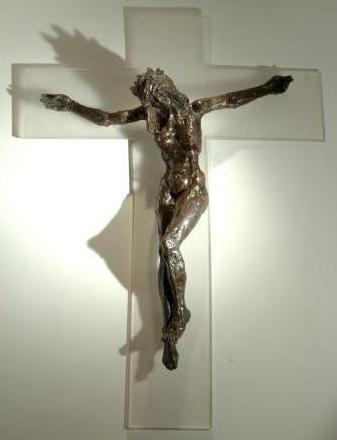
The illustration for this post is “Christa” by Edwina Sandys -- the most famous artwork of a female Christ. Sculpted in 1975, the magnificent bronze crucifix has graced the pages of the London Times, Time, Newsweek, Life, and other major publications. It has appeared at respected galleries and churches throughout Europe and North America, notably a controversial 1984 showing at the Episcopal Cathedral of St. John the Divine in New York City. Wherever Christa goes, the sculpture triggers debate about the nature of God and the role of women. Sandy’s “Christa” sculpture and the story behind it are included in “Art That Dares: Gay Jesus, Woman Christ, and More” by Kittredge Cherry.

Bookmark and Share