Showing posts with label cross. Show all posts

Thursday, April 10, 2014

Black Jesus appears in liberating new art book “The Way of the Cross”

“15. The Resurrection” by Janet McKenzie

A black Jesus lives, dies and rises again in “The Way of the Cross,” a new book with art by Janet McKenzie and text by Joan Chittister.

The book is wonderful for personal reflections, especially during Holy Week, which begins this Sunday. It strikes just the right chord for the Passion of Christ today. The optimistic undertone builds to a joyous yet solemn vision of the risen Christ, welcoming with wounded hands as he gazes lovingly at the viewer.

McKenzie, a Vermont artist, got international acclaim (and hate mail) for confronting stereotypes about race and gender when she painted the androgynous “Jesus of the People.” In 1999 it won the National Catholic Reporter’s contest to find an image of Jesus for the new millennium, judged by Sister Wendy Beckett.

The artist used an African American woman as model for “Jesus of the People,” but a mixed-race man modeled for Christ in her “Way of the Cross.” His African American and Caucasian roots are manifest in different ways in each painting.

Chittister, a Benedictine nun and popular author, gives a progressive interpretation to the Passion in her reflections, emphasizing that the cross is a symbol for the suffering of all people. She engages the reader with haunting questions such as: “What crosses do you yourself take on, knowing the risk, understanding the cost and being committed to the consequences?” (p. 25).

An odd omission is the lack of explanation about the book’s most radical aspect: Envisioning Jesus as black. Chittister says nothing about it, leaving it to the viewer make the connection expressed by theologian James Cone: “The blackness of God means that God has made the oppressed condition God's own condition” (quoted from the book “A Black Theology of Liberation.”)

McKenzie explained more in an interview with the Jesus in Love Blog: “There has been little mention of the racial identity of the subjects, unlike my painting ‘Jesus of the People,’ which created such controversy. This lack of commentary on the racial aspect makes me hopeful that finally it is accepted, even celebrated, that we are all created equally, lovingly and beautifully in God's likeness.”

Chittister includes LGBTQ people in her compassionate vision. Her commentary on the 6th station praises Veronica for reaching out to wipe the sweat and grime off the face of Jesus as he stumbles under the cross. She adds, “It’s a false zeal that focuses on the addiction but ignores the addict, that calls others to family values but gives no child beyond our own a helping hand, that deplores discrimination but ignores gays and lesbians.”

“12. Jesus Dies on the Cross” by Janet McKenzie

The book follows the Stations of the Cross, a set of artistic images developed by 4th-century pilgrims retracing Jesus’ footsteps in Jerusalem. Chittister takes pains to find a positive message in each of the 14 traditional Stations of the Cross, transforming what can be a grim subject into something “that reminds us again that there is new life at the end of every daily death.” (p. 13). Indeed the book is subtitled “The Path to New Life.” It concludes with the innovative 15th Station, which was added in recent decades to show the resurrection. In McKenzie’s version Jesus’ eyes are closed until the very last image.

McKenzie is known for her paintings of women, and some of the book’s strongest images show Jesus interacting with women: meeting his mother, engaging the weeping women of Jerusalem, being cradled by his mother in an understated modern pieta. “The subjects for Mary and Jesus are mother and son in life, and I believe their profound love for one another is visible, as the love between Mary and Jesus surely was,” McKenzie told the Jesus in Love Blog.

“4. Jesus Meets His Mother" by Janet McKenzie

The artist and writer seem to have worked independently, for the text makes no reference at all to the imagery in the paintings. The commentary could go with any Stations of the Cross, whether with these images, other images, or no images at all. It is up to the readers to create synergy between word and image in their own hearts and minds.

McKenzie builds luminous images by incorporating drawing and line into he oil paintings. All the backgrounds of her Stations are nondescript, giving them an eternal quality outside of ordinary space and time. Most are in meditative shades of mauve and lavender.

Each in their own ways the artist and author express a mature spirituality and a depth of understanding about the cross and its implications. It provides many insights about aspects of life that are not usually associated with the Passion of Christ.

The original paintings, each measuring 22 by 28 inches, will be displayed at the Cathedral Church of St. Paul in Boston during Holy Week, which coincides with the one-year anniversary of the Boston Marathon bombing. The first exhibition of the new Stations series took place earlier in 2014 with the Dominican Sisters of Sinsinawa, Wisconsin. Between April 1 and Holy Week, they are on view in Arlington, Massachusetts with the Sisters of St. Anne-Bethany.

A profile of McKenzie is included in my book “Art That Dares: Gay Jesus, Woman Christ, and More.” It is filled with color images by 11 contemporary artists from the United States and Europe. Many had their work censored or destroyed for daring to show Jesus in liberating new ways. The artists tell the stories behind the images, and my introduction puts them into political and historical context, exploring issues of blasphemy and artistic freedom.

My next book will also present contemporary art that takes a liberating look at the Way of the Cross. “The Passion of Christ: A Gay Vision” with paintings by Douglas Blanchard will be published in 2014 by Apocryphile Press. Click here to get updates on the gay Passion book.

___
Related links:
Janet McKenzie: Conservatives blast inclusive Christmas card

Copyright © Kittredge Cherry. All rights reserved.
http://www.jesusinlove.blogspot.com/
Jesus in Love Blog on LGBT spirituality and the arts


Saturday, March 09, 2013

LGBT Stations of the Cross shows struggle for equality

Jesus falls the first time as Nazis send LGBT people to concentration camps in Station 3 from “Stations of the Cross: The Struggle For LGBT Equality” by Mary Button, courtesy of Believe Out Loud

“Stations of the Cross: The Struggle for LGBT Equality” is a new set of 14 paintings that link the crucifixion of Jesus with the history of LGBT people.

“In the sacrifices of martyrs of the LGBT movement, we can come to a new understanding of the cross, and of what it means to be part of the body of Christ,” explains Tennessee artist Mary Button in her official artist statement.

Button painted the LGBT Stations series for Believe Out Loud, an online network empowering Christians to work for LGBT equality. They invite churches and faith groups to download and use the images for free.

The whole series will also be shown here at the Jesus in Love Blog starting tomorrow, with two images per day for a week. The original paintings will be displayed in Washington DC during Holy Week, which coincides with Supreme Court oral arguments on same-sex marriage.

Button matches each traditional Station of the Cross with a milestone from the past 100 years of LGBT history, including Nazi persecution of homosexuals, the Stonewall Rebellion, the assassination of gay politician Harvey Milk, the AIDS pandemic, ex-gay conversion therapy, the murder of transgender Rita Hester, the ban on same-sex marriage, and LGBT teen suicides.

The Stations of the Cross are a set of artistic images traditionally used for meditation on the Passion of Christ. They tell the story of his crucifixion from his sentencing until his body is laid in the tomb.

After Easter Button plans to paint Station 15 showing the resurrection. “I’m hopeful that the Supreme Court will rule DOMA unconstitutional and I'll be able to create a Resurrection piece about the ruling!” she told the Jesus in Love Blog.

Update: “Station 15: The Resurrection Of Christwas completed soon after the Supreme Court's June 26 ruling for marriage equality.

Button creates some startling images as she illustrates the LGBT struggle in chronological order beside the Jesus’ journey to Calvary. For example, when Jesus is nailed to the cross, queer people are hooked up for electroshock therapy meant to “cure” homosexuality.

The LGBT Stations are generating controversy. The conservative Lutheran website Exposing the ELCA denounced the series as “offensive”and “disgraceful” for associating Christ’s sacrifice with LGBT rights.

Button traces the origins of her LGBT Stations to a book that relocated the gospels into the African American civil rights movement, ending with Christ as a black man lynched in Georgia. Her life changed when she read “The Cotton Patch Version of Luke and Acts: Jesus’ Doings and the Happenings” by Clarence Jordan.

“I believe that we can only begin to understand the meaning of the crucifixion when we take away our polished and shiny crosses and look for the cross in our own time, in our own landscape,” she said in her artist statement.

For this reason, she committed to create a new Stations of the Cross series on social justice issues every year. “Last year, my stations took viewers on a journey through the beginnings of the Syrian uprising,” she told the Jesus in Love Blog. “This year I decided to do a series of stations related to LBGT equality when I learned that the Supreme Court will be hearing oral arguments on the Defense of Marriage Act during Holy Week.”

She makes bold, colorful line drawings with a folk art vibe and collage effect. LGBT historical documents became visual elements in her Stations. For example, the background for “Station 2: Jesus carries his cross” is the charter of the Society for Human rights, founded in 1924 as the first homosexual rights organization in America.

Button is minister of visual arts at First Congregational Church in Memphis. She has created artwork for the National Council of Churches, Ecumenical Women at the United Nations, and the Evangelical Lutheran Church in America. Daughter of a Lutheran minister, Button received a master of theological studies degree from Candler School of Theology after graduating from the Tisch School of the Arts at New York University. Her work has been exhibited across the United States including at the Museum of Biblical Art and the Church Center for the United Nations.

The original 12-by-12-inch LGBT Stations of the Cross paintings will be on exhibit this week at the Lutheran Church of the Reformation in Washington DC. The same church is also the location for the major Interfaith Prayer Service preceding the rally for marriage equality at the Supreme Court on Tuesday. The church will be open for visitors to see the LGBT Stations paintings from 5 - 7 p.m. Monday (March 25) and from 8:30 a.m. to 5 p.m. Tuesday and Wednesday (March 26-27). Each painting is mixed media on vellum, mounted on panel.

“We hope the stations inspire Christians to reflect on Christ’s presence in human suffering as we work together to promote the dignity of all people,” said Joseph Ward, director of Believe Out Loud. “We are impressed by the way Mary Button weaves Christian symbols and liturgy together with contemporary themes in her art, so we approached her to commission the series. This stations series is designed as a resource for congregations; we hope churches will download and use these stations during the Lenten season for prayer and reflection.”

The entire series is available now for free download from Believe Out Loud's Flickr site.

Here is a complete list of Button’s LGBT Stations of the Cross. All of them will be posted at the Jesus in Love Blog over the next week. Click the titles below to view individual paintings with text provided by Believe Out Loud, Mary Button and Wikipedia and mini-commentaries by Kittredge Cherry.

Station 1: Jesus is condemned to death
1913: The word "faggot" first appears in print

Station 2: Jesus carries his cross
1924: America's first homosexual rights group forms

Station 3: Jesus falls the first time
1933: Nazis ban homosexual groups

Station 4: Jesus meets his mother
1945: LGBT prisoners are kept in concentration camps after Allied liberation

Station 5: Simon of Cyrene helps Jesus carry the cross
1950: LGBT people fired from US government during Lavender Scare

Station 6: Veronica wipes the face of Jesus
1954: Gay computer scientist Alan Turing commits suicide

Station 7: Jesus falls the second time
1967: LGBT people protest police raid on Black Cat gay bar

Station 8: Jesus meets the women of Jerusalem
1969: Stonewall Rebellion

Station 9: Jesus falls the third time
1978: Gay politician Harvey Milk assassinated

Station 10: Jesus is stripped of his garments
1981: First official report on AIDS

Station 11: Crucifixion
1992: NARTH founded to promote ex-gay conversion therapy

Station 12: Jesus dies on the cross
1998: Transgender woman Rita Hester murdered

Station 13: Jesus is taken down from the cross
2004: Same-sex marriage banned in 15 states

Station 14: Jesus is laid in the tomb
2010: Suicides by LGBT youth make news

Station 15: The resurrection of Christ
2013: Supreme Court rules for marriage equality

LGBT Stations: Click to see whole series in order


___
Related links:

Artist Statement: LGBT Stations Of The Cross

The Passion of Christ: A Gay Vision” by Douglas Blanchard

Art That Dares: Gay Jesus, Woman Christ, and More by Kittredge Cherry

Timeline of LGBT history (Wikipedia)
___
Special thanks to Ann Fontaine and Colin for the news tip.

This post is part of the Artists series by Kittredge Cherry at the Jesus in Love Blog. The series profiles artists who use lesbian, gay, bisexual, transgender (LGBT) and queer spiritual and religious imagery. It is also included in thee Queer Christ that series gathers together visions of the queer Christ as presented by artists, writers, theologians and others.

Copyright © Kittredge Cherry. All rights reserved.
http://www.jesusinlove.blogspot.com/
Jesus in Love Blog on LGBT spirituality and the arts

Friday, April 22, 2011

15. Jesus Dies (Gay Passion of Christ series)

15. Jesus Dies (from The Passion of Christ: A Gay Vision) by Douglas Blanchard

“He said, ‘It is finished’; and he bowed his head and gave up his spirit.” -- John 19:30 (RSV)

As Jesus hung dying on the cross, the crowd mocked him. A few of his supporters watched from the distance. Among them were his mother and the man he loved. One of Jesus’ last wishes was to make them into a new kind of family. When he saw his mother and his beloved standing together at the cross, he used some of his last breath to call to his mother, Woman, behold your son! And to his beloved, he said, Behold your mother! They were helpless to stop the tragedy, but they chose to be present and keep on loving. All the suffering of a broken world seemed to come together at the crossroads of those terrible hours. After about three hours on the cross, Jesus shouted, My God, my God, why have you forsaken me? Nothing left, he emptied himself completely. With another loud cry, he died. His loving heart stopped beating. The death of Jesus was unique, and yet it was also terribly common. Whenever anyone commits violence against another, Christ is crucified.

God, help me find meaning in the brutal death of Jesus.
___
Bible background
John 19:26-27: “When Jesus saw his mother, and the disciple whom he loved standing near…”

More resources
The Crucifixion of Christ” painting and narrative by Becki Jayne Harrelson

Jesus dies on the cross (excerpt from “At the Cross” by Kittredge Cherry)

Next: 16. Jesus Is Buried
___
This is part of a series based on “The Passion of Christ: A Gay Vision,” a set of 24 paintings by Douglas Blanchard, with text by Kittredge Cherry

Click here for the whole Gay Passion series or click the titles below to view individual posts in the series.

Introduction
1. The Human One (Son of Man) with Job and Isaiah
2. Jesus Enters the City 
3. Jesus Drives Out the Money Changers
4. Jesus Preaches in the Temple
5. The Last Supper
6. Jesus Prays Alone
7. Jesus Is Arrested
8. Jesus Before the Priests
9. Jesus Before the Magistrate
10. Jesus Before the People
11. Jesus Before the Soldiers
12. Jesus Is Beaten
13. Jesus Goes to His Execution
14. Jesus Is Nailed to the Cross
15. Jesus Dies
16. Jesus Is Buried
17. Jesus Among the Dead
18. Jesus Rises
19. Jesus Appears to Mary
20. Jesus Appears at Emmaus
21. Jesus Appears to His Friends
22. Jesus Returns to God
23. The Holy Spirit Arrives
24. The Trinity

Please support the Gay Passion series by giving to our Easter offering.

Click here for more info about the Easter offering.

Scripture quotation is from Revised Standard Version of the Bible, copyright © 1946, 1952, and 1971 National Council of the Churches of Christ in the United States of America. Used by permission. All rights reserved.

Bookmark and Share

Thursday, April 21, 2011

14. Jesus is Nailed to the Cross (Gay Passion of Christ series)

14. Jesus is Nailed to the Cross (from The Passion of Christ: A Gay Vision) by Douglas Blanchard

“There they crucified him.” -- Luke 23:33 (RSV)

The soldiers nailed Jesus to the cross. It was high noon on Friday. The pounding of the hammer left no room for neutrality. People were forced to choose sides, us versus them. If you didn’t want to be a victim, you had to join the perpetrators. The psychic terror extended to everyone who watched. By abusing one person, the authorities intimidated everyone like him, everyone who was different in any way… religion, race, gender, sexual orientation, whatever. And what about the men who nailed him to the cross? Their actions were monstrous, but Jesus still saw their humanity. He prayed, God, forgive them, for they don’t know what they’re doing.

God, help me channel my outrage at wrongdoing into a creative force for good.
___
Next: 15. Jesus Dies

This is part of a series based on “The Passion of Christ: A Gay Vision,” a set of 24 paintings by Douglas Blanchard, with text by Kittredge Cherry

Click to go to the beginning
or view the whole series.

Scripture quotation is from Revised Standard Version of the Bible, copyright © 1946, 1952, and 1971 National Council of the Churches of Christ in the United States of America. Used by permission. All rights reserved.

Bookmark and Share

Wednesday, April 20, 2011

13. Jesus Goes to His Execution (Gay Passion of Christ series)

13. Jesus Goes to His Execution (from The Passion of Christ: A Gay Vision) by Douglas Blanchard

“So they took Jesus, and he went out, bearing his own cross, to the place called the place of a skull, which is called in Hebrew Golgotha.” -- John 19:17 (RSV)

The soldiers made Jesus walk to the execution grounds. They forced him to carry the cross on which he would be crucified. It was big news and crowds gathered along the road. They had watched Jesus rise to mass popularity, and now they wanted to see his fall. Almost everyone jeered at him. Surely some of the hecklers had been among his followers. Maybe they shouted louder than the rest to prove that they were not associated with Jesus -- like closeted lawmakers who loudly oppose LGBT rights. The crowd also included some women who wailed in grief. Jesus turned to them and said, don’t weep for me, but weep for yourselves.

God, my heart breaks when I remember how Jesus died. Create in me a new heart with greater ability to love.

___
Next: 14. Jesus Is Nailed to the Cross

This is part of a series based on “The Passion of Christ: A Gay Vision,” a set of 24 paintings by Douglas Blanchard, with text by Kittredge Cherry

Click to go to the beginning
or view the whole series.

Scripture quotation is from Revised Standard Version of the Bible, copyright © 1946, 1952, and 1971 National Council of the Churches of Christ in the United States of America. Used by permission. All rights reserved.

Bookmark and Share

Wednesday, March 30, 2011

Crucified Christa embodies female Christ

“Christa” by © Edwina Sandys

Christa, the female Christ, is the theme of the following address by Nicola Slee, a feminist theologian and poet based at the Queen’s Foundation in Birmingham, England. She is the author of the new book “Seeking the Risen Christa.”

___
If you are anything like me, you will be conscious of an ambivalence about Good Friday. I can’t imagine being anywhere other than in church, yet I wonder what I’m doing here, fixing my attention and prayer on the horrible death of a man two thousand years ago. I’m both drawn to the cross yet repelled by it Somehow we are here, however we’ve got here and whoever we are, gathered around the cross, with all its strange fascination and its horror – with some kind of a sense that it is important to be here, that we need to be here, that we are doing something that is significant, even essential.

Yet we do well to proceed with care as we approach the cross, to bring what theologians call a hermeneutics of suspicion to bear on this place of violent death where Christians claim we see the love of God most powerfully at work. The cross can be, and has been used, as a tool of oppression to justify violence, bloodshed and abuse. The suffering of Jesus, the innocent, has been preached as a means of encouraging those who suffer to accept their burdens meekly, without complaint, as Jesus did – even when that suffering is unjust and cries out to heaven for restitution. Mary Daly, that arch feminist whose death this year marks a milestone in feminist theology, described Christianity as necrophiliac, death-fixated, addicted to violence. Mary Grey, a more moderate critic, ponders: ‘as Christianity has now had two thousand years of death symbolism, it is at least possible that the slaughter perpetrated in the name of Christendom is related to its symbols of death, blood-guilt and sacrifice’.  A number of feminist theologians argue that the cross should be displaced from the centre of Christianity and an entirely new (or perhaps old) religion of natality (birthing) and flourishing replace the death-fixation of patriarchal religion.

It is important to take such critiques seriously, and I for one have found such work both challenging and liberating, helping me to recognise ways in which I have succumbed to an unhealthy valorization of suffering in my own life – and, perhaps more importantly, helping me to see the ways in which the church uses the symbolism of the cross to shore up its own patriarchal power and to keep abusive systems in place.

So I can go a long way with those who want to deconstruct and decentre the cross. A long way, but not the whole way, because even if we try to remove all references to suffering, violence and death from our faith, these are daily realities for many in our world and can’t be easily airbrushed out. It’s not so much that we need to remove the cross from the centre of Christianity as find better ways of understanding it. And this is possible because the cross is capable of multiple readings and re-interpretations. As Elisabeth Moltmann-Wendell has said, ‘In the last analysis, the cross is a paradoxical symbol. It is not simply the guillotine or the gallows. It is also subconsciously the symbol of wholeness and life and it probably could only survive as a central Christian symbol because of this simultaneous subconscious meaning.’

In these addresses, then, I want to consider some different ways of ‘reading’ the cross, some different angles or perspectives on the cross, particularly some that have been developed by feminist and womanist theologians – some that don’t often find their way into churches, particularly on Good Friday, though if they do, it’s places like St James where I’d expect that to be happening – and I’m grateful for places like this, rare as they are, where it is possible to bring our critique, our ambivalence and our efforts to find new theologies.

One of the ‘fresh readings’ of the cross feminists offer us is the image or symbol of the female Christ, the so-called ‘Christa’. I say ‘fresh’, though in fact, it’s almost forty years old in its recent manifestation, and has roots that go way back into the ancient mystical tradition of Christianity. You have a few examples of artists’ depictions of a female Christ on your service sheet, although these represent just the tip of the iceberg, as there are literally dozens of such images to be found once one starts searching (and that in itself tells us something about the need for images of a feminine divine in a religion which has suppressed the feminine).

When presenting such images to Christians who have never seen them before, I can expect reactions of shock, confusion, even horror – though I imagine that at least some of you at St James will be familiar with such images and, even if you are not, will have a more sympathetic reaction. The Christa is not in any way a denial of the historical reality of Jesus’ masculinity, it is not an attempt to rewrite history and pretend that Jesus might have been a woman. Such images are trying to do something more profound. They are making a positive and visceral identification between the bodies and sufferings of women and the body and suffering of God. In doing so, they have the power to shock us into recognizing just how patriarchal and male our assumptions about God and Christ still are – and in that sense, as Marcella Althaus-Reid puts it, such images ‘undress’ or reveal, our own blasphemous idols of God. She speaks about the ‘obscene Christ’ – a black, or female, or lesbian or transgendered image of Christ – not that such a notion in itself is obscene, but it reveals to us our own obscenity when we recognize that we had assumed Christ to be white, male, heterosexual or whatever.

Nevertheless, the female Christ figure is, itself, controversial amongst feminist theologians. Some consider it merely reinforces, rather than challenges, the stereotype of women as powerless victims of abuse. Others find it immensely healing, enabling them to realize their own bodies as the site of the divine, even in their mortality, pain and abuse. I leave you to make your own response, as I share with you something of my own, in a poem I have written exploring the identity of the crucified Christa with us today:

Who is the Christa?

Every woman forced to have sex who didn’t want it
Every girl trafficked out of her own home country
trapped in some anonymous bedsit in someone else’s city
working all the hours men want to have her body
making a fast buck for her pimp

The woman you meet in the street with bruises all up her arm
which you don’t see because she covers them up in long sleeved blouses
and thick sweaters
(Harder to hide the gash on her face but make-up has its uses)
Every woman who is too frightened to go out alone because of what has happened to her in the past or what she imagines might happen to her

The woman sleeping in the underpass
in her makeshift room of cardboard
who wards off the unwanted attentions from the drunk two streets up

The smart young graduate climbing the career ladder
who can’t get through the day without shooting up
The anorexic teenager starving her young body
that is strange to her and she cannot seem to love
The classrooms of self-harming girls

The nine-year old orphan caring for three siblings all under five
in a shanty town in any African city
Her parents dead from AIDs

Every street girl and boy scavenging on rubbish tips
Every child working in sweatshops making cheap tee-shirts for Primark
All the women raped in war or, worse, forced to watch their daughters raped
Husbands shot in front of their eyes

Women who walk a thousand miles through a war-zone
with babies on their hips and children dragging along beside them
Desperate to make it to a refugee camp
where they might find food and shelter

Christa, our sister,
have mercy
Christa, God’s beloved,
show us your face
where we have not wanted to see it
where we resist your presence among us

___
The above reflection by Nicola Slee is the first of three addresses on Christa that she delivered on Good Friday in 2010 at St. James Piccadilly Church in London. Her other addresses look at the Corporate Christa and the Cosmic Christa. Click here for the full text of all three addresses.

Slee’s new book “Seeking the Risen Christa” was just released by SPCK Publishing, an Anglican press and Britain’s third oldest publisher. For more info on Slee, see our previous post “Female Christ conference planned.”

We usually focus on LGBT spirituality here at the Jesus in Love Blog, but the idea of Christ being female seems queer in the best sense of the word. We are also focusing on the woman Christ now in order to help balance the many gay male Christ figures that will appear here soon in a new series for Lent/Easter.

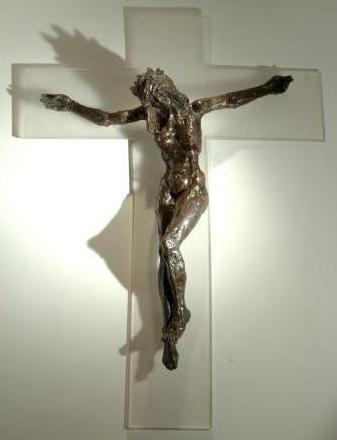
The illustration for this post is “Christa” by Edwina Sandys -- the most famous artwork of a female Christ. Sculpted in 1975, the magnificent bronze crucifix has graced the pages of the London Times, Time, Newsweek, Life, and other major publications. It has appeared at respected galleries and churches throughout Europe and North America, notably a controversial 1984 showing at the Episcopal Cathedral of St. John the Divine in New York City. Wherever Christa goes, the sculpture triggers debate about the nature of God and the role of women. Sandy’s “Christa” sculpture and the story behind it are included in “Art That Dares: Gay Jesus, Woman Christ, and More” by Kittredge Cherry.

Bookmark and Share

Wednesday, March 16, 2011

Rainbow cross lights the way for all

Reclaiming the cross is the theme of the following prayer from a spectacular Easter Eve service where rainbow lights were projected onto the 103-foot cross at Mt. Davidson, San Francisco’s highest point.

Metropolitan Community Church of San Francisco sponsored the cross-lighting worship services there from 1997-99. Longtime MCC-SF member Lynn Jordan still remembers how poignant it was for the LGBT community to reclaim the cross at that time, when the AIDS death toll was finally being reduced by new drugs introduced in 1997. Thank you, Lynn, for providing the prayer and photos from the MCC-SF archives.

Litany for Lighting the Cross
By Rev. Karen Foster and MCC-SF staff

On this Easter Eve we gather to commemorate the suffering and crucifixion of the Holy One, and to celebrate the rising of new life and

We light the cross as a sign of hope for all people.

There are those who would tell us that we have no place in the realm of God and the cross is not ours, but we hear God’s voice calling us for us and

We light the cross as a sign of hope for all people.

We call upon those preaching a rhetoric of hate to stop the violence, and tonight for all who have been battered, rejected, and alienated by churches and in the name of religion

We light the cross as a sign of hope for all people.

We have died many deaths and we have lived in many tombs, but deaths could not hold us down and this night

We light the cross as a sign of hope for all people.

Bringing our bright and beautiful selves like the colors of the rainbow, different as we are, we come together as one, and

We light the cross as a sign of hope for all people.

We pray for the day when in freedom and in peace, people of all ages, all races, all nationalities, and all sexual orientations will stand together and proclaim

We light the cross as a sign of hope for all people.
___
The prayer and picture come from the bulletin for the third annual Mount Davidson Easter Eve Service, held by MCC-SF on April 3, 1999.

Rainbow lights bathe the cross at the 1999 Easter Eve service at San Francisco’s Mt. Davidson. This vivid photo was reproduced on postcards sold by Metropolitan Community Church of San Francisco.

Bookmark and Share

Wednesday, January 19, 2011

Christ’s torment and queer suffering: More on Wojnarowicz censorship

Christ with Ants from the David Wojnarowicz video
“A Fire in My Belly”
Insightful essays continue to be written about the Smithsonian’s censorship of gay artist David Wojnarowicz’ video “Fire in the Belly” because of its controversial ant-covered crucifix.

I have come to believe that conservative Christians condemned the Wojnarowicz video precisely because it equates Christ’s torment with queer / LGBT suffering. They do NOT want Christ to be identified with lesbian, gay, bi and trans people at all.

Here are highlights from some of the best new essays on the controversy and its LGBT Christian meanings. Click the titles to see the whole essay:

X-Ray of Civilization: David Wojnarowicz and the Politics of Representation
“What seems to be truly unconscionable for critics of Wojnarowicz’s art is its forceful imputation of the analogy between the Biblical torment of Christ and the contemporary suffering of queer bodies and subjects.”
by Leon Hilton of bullybloggers: the queer bully pulpit

Sacrilege Or Censorship? Christians Enraged by Art with Gay, Religious Images by Stuart Wilber of thenewcivilrightsmovement.com
“This was not the first time that an exhibition that included LGBT or religious imagery had been censored and undoubtedly not the last.”

Art, Censorship, and the Scandal of the Cross
“God doesn’t need Christians to act as intellectual property watchdogs.”
by Patrick S Cheng, gay Asian American theologian and author of Radical Love: An Introduction to Queer Theology

Wojnarowicz’s Ant-Covered Jesus: Blasphemy or Religious Art?
“That Christ on the cross is actually dead, and the body so dead that ants might eat it, is both the most orthodox Christian statement, and the most scandalous.”
by S. Brent Plate, religion professor and author of Blasphemy: Art that Offends

For more info, see our previous posts: “Smithsonian censors gay artist when conservatives attack”.

Christ’s torment and queer suffering: More on Wojnarowicz censorship (Jesus in Love)

Tuesday, December 07, 2010

Smithsonian censors gay artist when conservatives attack

Christ with Ants from the David Wojnarowicz video “A Fire in My Belly”

In an outrageous and unprecedented act of censorship, the Smithsonian Institution recently removed a video by gay artist David Wojnarowicz from exhibition after a few hours of pressure from religious and political conservatives.

Titled “A Fire in My Belly,” the video combines various images of loss, pain and death as a metaphor for the suffering caused by AIDS. The four-minute video was denounced as anti-Christian “hate speech” by the Catholic League because it includes a scene of ants crawling over Jesus on a crucifix. Rep. John Boehner (R-Ohio), the incoming House speaker, called it a misuse of taxpayer dollars.

The video had been on display at the Smithsonian’s National Portrait Gallery in Washington, DC since Oct. 30 as part of the LGBT-themed show “Hide/Seek: Difference and Desire in American Portraiture,” the first national art exhibit about sexual orientation and gender identity in American art. Smithsonian president Wayne Clough decided to pull the video on Nov. 30, claiming that he didn’t want controversy to distract people from the rest of the exhibit.

People protest censorship
at the National Portrait Gallery.
Photo from Transformer Gallery.
A Smithsonian spokesperson said that this was the first time that the gallery has pulled an artwork from an exhibit because of complaints from the public. About 100 people protested the removal with a silent march to the Smithsonian on Dec. 2 organized by Washington’s Transformer Gallery.

The censorship of David Wojnarowicz is a hostile act against artists and the whole LGBT community. The attacks on the video seem to be based on homophobia more than religious sensibilities. I doubt that the religious right would have objected to those scenes of ants on the cross if they weren’t part of a major LGBT-affirming art exhibition.

The Smithsonian set a terrible precedent by caving in to pressure from conservatives. The gallery agreed to limit free speech in the name of protecting religious sensibilities. I worry that it signals renewed debate in Congress over federal funding of the arts. Another battle in the culture wars is brewing.

Criticism from conservative groups exploded after CNS News Service published a detailed report titled, “Smithsonian Christmas-Season Exhibit Features Ant-Covered Jesus, Naked Brothers Kissing, Genitalia, and Ellen DeGeneres Grabbing Her Breasts.” The CNS article quotes the Smithsonian-published exhibit catalog as saying, “Wojnarowicz earned a reputation for public, and for many, an utterly cathartic, portrait of rage.”

National Portrait Gallery director Mark Sullivan issued a statement saying, “I regret that some reports about the exhibit have created an impression that the video is intentionally sacrilegious. In fact, the artist’s intention was to depict the suffering of an AIDS victim. It was not the museum’s intention to offend.”

The video, nicknamed the “Anty Christ” by some jokers, is hard for me to watch, but not because of any blasphemy. It’s not sacrilegious. By putting ants on a crucifix, it fits into the respected Christian tradition of showing Jesus’ persecution and suffering on the cross in grisly detail. Angry critique of religious institutions is also a time-honored Christian tradition established by Jesus himself. For me, the ants on the cross are among the least upsetting images in the video.

Rather like Mel Gibson’s film “The Passion,” the Wojnarowicz video hammers home its point with horrific images of bloody violence. It shows the bloody mouth of a man having his lips sewn together (based on the ACT-UP slogan “Silence=Death”), a bowl of blood, mummified human remains and a man’s genitals.

Born in 1953, Wojnarowicz is recognized as the first American gay artist to respond to the AIDS crisis with angry moral outrage. His video is too gruesome for my taste. However, he makes an important statement about AIDS. Once the gallery decided to put it on display, they should have kept it there.

A differently edited version of the “Fire in My Belly” video can be seen at YouTube. (Warning: For mature audiences.) Unlike the Smithsonian version, the YouTube version also includes a scene of a man masturbating. Both short versions are edited from Wojnarowicz’ 13-minute original.

Wojnarowicz made the video in 1987 as a tribute to his lover Peter Hujar, who died of AIDS that year. The artist often used ants and other insects in his art to symbolize the interactions of human society. Wojnarowicz was an important part of the East Village art scene in New York City before dying of AIDS in 1992 at age 37.

“Hide/Seek: Difference and Desire in American Portraiture” is the largest and most expensive exhibit in the history of the National Portrait Gallery. The exhibit itself was privately funded, but tax money pays for general operations of the Smithsonian Institution, which got $636 million in federal funds in 2010. Located just seven blocks away from the White House, the National Portrait Gallery is a major tourist attraction because it houses famous portraits of presidents and first ladies.

The online version of “Hide/Seek: Difference and Desire in American Portraiture” is well worth a visit. It puts gay, lesbian, bisexual, transgender and queer portraits into historical context with a beautiful, professional presentation. The exhibit begins with 19th-century works by Thomas Eakins and John Singer Sargent. It arcs through the 20th century with such as major artists as Romaine Brooks, Marsden Hartley, Georgia O’Keeffe, David Hockney, Jasper Johns, Andy Warhol, Annie Leibowitz and Keith Haring, with special attention to the contemporary LGBT rights movement.

________
Update on Jan. 19, 2011:

Insightful essays continue to be written about the Smithsonian’s censorship of gay artist David Wojnarowicz’ video “Fire in the Belly” because of its controversial ant-covered crucifix.

I have come to believe that conservative Christians condemned the Wojnarowicz video precisely because it equates Christ’s torment with queer / LGBT suffering. They do NOT want Christ to be identified with lesbian, gay, bi and trans people at all.

Here are highlights from some of the best new essays on the controversy and its LGBT Christian meanings. Click the titles to see the whole essay:

X-Ray of Civilization: David Wojnarowicz and the Politics of Representation
“What seems to be truly unconscionable for critics of Wojnarowicz’s art is its forceful imputation of the analogy between the Biblical torment of Christ and the contemporary suffering of queer bodies and subjects.”
by Leon Hilton of bullybloggers: the queer bully pulpit

Art, Censorship, and the Scandal of the Cross
“God doesn’t need Christians to act as intellectual property watchdogs.”
by Patrick S Cheng, gay Asian American theologian and author of Radical Love: An Introduction to Queer Theology

Wojnarowicz’s Ant-Covered Jesus: Blasphemy or Religious Art?
“That Christ on the cross is actually dead, and the body so dead that ants might eat it, is both the most orthodox Christian statement, and the most scandalous.”
by S. Brent Plate, religion professor and author of Blasphemy: Art that Offends

___
Related links:

David Wojnarowicz books at Amazon.com

Fire in the Belly: The Life and Times of David Wojnarowicz by Cynthia Carr (2012 biography)
___
This post is part of the Artists series by Kittredge Cherry at the Jesus in Love Blog. The series profiles artists who use lesbian, gay, bisexual, transgender (LGBT) and queer spiritual and religious imagery. It is also part of the GLBT Saints series. Saints, martyrs, mystics, prophets, witnesses, heroes, holy people, deities and religious figures of special interest to lesbian, gay, bisexual and transgender (LGBT) and queer people and our allies are covered on appropriate dates throughout the year.


Sunday, November 14, 2010

Banned photo shows gay Christ figure

Cross Currents Fall 1972 cover with photo by Damon de Winters

A church magazine with a nude cover photo of a gay Christ figure with his friend was banned in 1972, but you can see it now at the Jesus in Love Blog. Almost 40 years later the photo is still risqué -- and beautiful.

The photo by Damon de Winters appeared on the cover of the fall 1972 issue of “Cross Currents,” the quarterly magazine of Metropolitan Community Church of San Francisco. The models, Todd and David Eric Charon, were positioned to discreetly hide any frontal nudity.

The photo seems to portray a gay Jesus with his Beloved Disciple. The bearded Christ figure offers a loving touch and a chalice of wine to his kneeling friend. Behind them stands a cross built from natural logs. The image echoes the Last Supper, when Jesus says, “Drink of it, all of you; for this is my blood of the covenant” (Matthew 26:27-28).

The MCC-SF board of directors banned the magazine for release because they felt that the cover was “inappropriate for a church publication,” recalls Lynn Jordan, who served as editor-in-chief of Cross Currents. Jordan recently celebrated 40 years of membership at MCC-SF.

“Senior pastor Reverend Jim Sandmire received a lot of criticism over this issue of the magazine,” Jordan says.

In response to the uproar, Rev. Sandmire wrote an open letter dated Nov. 15, 1972. “While I do not think the cover or other pictures of nudes are in any way obscene, I believe the nudity does not enhance the religious message intended, and may detract from it,” Rev. Sandmire wrote at the time..

A headline on the cover also brings up another subject that remains surprisingly contemporary: “Gay marriage.”

Thank you, Lynn Jordan, for providing this Cross Currents cover image so it can finally reach its audience. It is historically, spiritually and artistically significant.
______
P.S. I received this update today from Lynn Jordan: “I spoke with founding member Frank Howell (now 72) who said he thought the photo tried to convey that we bring with us both our sexuality and spirituality when we receive communion.”

Bookmark and Share

Thursday, July 15, 2010

Cartoon shows GLBT rights on the cross

Gay Jesus cartoon by Mike Ritter from Wipeout Homophobia on Facebook

Jesus embodies GLBT civil rights as he is crucified by Christian fanatics in a political cartoon from Wipeout Homophobia on Facebook.

The cartoon uses art and humor to support LGBT equality and poke fun at the rightwing Christians who oppose our civil rights.

“Quit squirming! You’re oppressing our religious freedom!” shouts the priest who nailed Jesus to the cross.

Jesus wears a shirt labeled “GLBT civil rights.” He’s not passively accepting crucifixion, but kicks at the angry mob carrying a torch, a pitchfork and Bibles.

The cartoon does a great job of illustrating how fundamentalists seem to feel threatened by the idea of equality for lesbian, gay, bisexual and transgender people. LGBT Christians really drive them crazy!

____
Update on Feb. 24, 2014: It took years to track down the name of the artist, but he was finally identified today by an anonymous source. I am in the process of contacting Mike Ritter for permission to share his cartoon here.

Friday, April 02, 2010

Day 6: Jesus dies on the cross


The Crucifixion of Christ by Becki Jayne Harrelson

A queer version of Christ’s Passion is running in daily installments this week from Palm Sunday through Easter. Each daily post features a queer Christian painting and an excerpt from the novel Jesus in Love: At the Cross by Kittredge Cherry.


I looked at John. His sorrow affirmed his love for me. Grief caused him to tighten his gnarled fingers into fists, screw up his wrinkled face, and raise those dark, wistful eyes toward heaven. I longed to comfort him and remind him of the new relationship I foresaw between us, something like my marriage to the Holy Spirit. I couldn’t say much, so I chose simple statements.

I fixed my eyes on Mom until I was sure that she and John both saw me looking at her. Then I nodded my head a little to indicate John and called out, “Woman, here is your son.”

To John I cried, “Here is your mother.” I hoped that he would understand the nuance behind my words. I wasn’t leaving them alone. We were a new kind of family.

“Yes, we’ll take care of each other,” Mom shouted to me.

Satan’s chilling laugh cut her off. “Not likely! Not tonight!”

… The next time that I looked down from the cross to Golgotha… My divine heart bled for them and for all human souls tangled across time. The rosy light flared out from my heart, so intense that it seemed like darkness to some.

My breath was sputtering out.

“It is finished,” I sighed.

(Continued here tomorrow)

___
[Note: For a woman’s version of the crucifixion, see “Christa” by Edwina Sandys at:
http://edwinasandys.com/sculpture/scultureChrista.html


AIDS Crucifixion by William Hart McNichols ©
www.fatherbill.org
___
Becki Jayne Harrelson is an Atlanta artist who challenges mainstream religious beliefs via art. Raised in a fundamentalist Christian family, she cares passionately about lesbian rights and other justice issues. Father William Hart McNichols is a renowned iconographer and Roman Catholic priest based in New Mexico. He worked at an AIDS hospice in New York City from 1983-90.

Thursday, March 18, 2010

Jesus suffers with GLBT people in “AIDS Crucifixion”


AIDS Crucifixion by William Hart McNichols © 1986
www.fatherbill.org

Christ hangs on the cross below a sign saying, “AIDS, homosexual, faggot, pervert, Sodomite” in a powerful drawing by Father William Hart McNichols.

A man waves a Bible at the dying Jesus, symbolizing the conservative Christians who claimed that AIDS was God’s punishment for being gay. Jesus identifies completely with the suffering of gay AIDS patients in the drawing.

McNichols is an iconographer and Roman Catholic priest based in New Mexico. “AIDS Crucifixion” grows out of his experience working at an AIDS hospice in New York City from 1983-90.

I am pleased to highlight this important drawing here at the Jesus in Love Blog. It may be the first artwork ever to link Christ on the cross with the word “faggot.” The point is not so much that Jesus is gay, but that Jesus is crucified again whenever anyone expresses hatred for LGBT people -- or other groups.

McNichols drew “AIDS Crucifixion” in 1986, but it is not widely available. In granting permission to post it here, even his agent reported that the high-quality digital file has been lost in the art studio computer storage.

When McNichols drew “AIDS Crucifixion,” there was no effective treatment for AIDS and many people were dying of the disease. New drugs can vastly extend the lives of people with AIDS, but not everyone has access to them. AIDS is still a life-threatening disease and it has grown into a global pandemic.

McNichols has also written and illustrated a moving “Stations of the Cross of a Person With AIDS.” See it online at:

http://puffin.creighton.edu/jesuit/andre/stations.html

Tuesday, January 26, 2010

Blasphemy charge aids queer Jesus project


Equal Means Equal Jesus by Bill Burch, 2009.
Photo, 8” x 10.” www.harepepol.com 


Below left: BFF Jesus by Bill Burch, 2009. Photo, 8” x 10.”


Accusations of blasphemy from an art school professor gave a big boost recently to an alternative Jesus photo project by Bill Burch, an art student at Adams State College in Alamosa, Colorado.

A conservative Christian professor harassed some of Burch’s models and threatened to “shut down” his project, which includes GLBT and female Jesus photos. The effort to stop the project had the opposite effect, inspiring many more students to volunteer as models!

“It seems the more biblical he gets, the more the student body reacts, like an equal and opposite reaction,” Burch reports. “Participation by his students has really increased, too.”

Now Burch is well on his way to completing his ambitious project of 64 alternative Jesus images. The flood of new models included the gay men pictured above in “Equal Means Equal Jesus” (above). Other queer images among the new photos are a female couple in “BFF Jesus” (left) and a man dressed as a woman in “Lady Liberty Jesus” (below).

The Alternative Jesus project is a concrete embodiment of Jesus’ own teaching that everybody is one with Christ. “If one believes in Jesus and accepts Jesus into their heart they become Christian, or Christ-like. They become Jesus, and Jesus them,” Burch explains.

The stated purpose of the project is to challenge traditional representations of the crucifixion by replacing the traditional Christ figure with other versions of the sacrificial lamb, archetypes usually repressed by conservative American Christianity. “If Jesus was a black lesbian would She be welcomed in Montgomery Alabama, or hung from a tree like strange fruit? It is this paradigm I question,” Burch says.

He plans to arrange the 64 unconventional Jesus images into a montage that looks like a traditional Jesus portrait from a distance. As the viewer approaches, the familiar face will disappear, revealing a multitude of different Christ figures. Each hangs on the cross, but they embody a variety of ages, races, body sizes, gender identities and sexual orientations.

Burch successfully defended his “Alternative Jesus” photos to a college committee including the conservative professor at a graduate review in December. ”Because of the depth of writing in my artist statement, my conservative professor’s arguments were totally defused,” Burch says. “The only question he asked was about the symbolism of two models on the cross. Previously, he had told me to ask my models what they would be willing to die for. I told him the two models said they would die for love, as simple as that. Amazing!”

The 2008 U.S. election inspired Burch to start the alternative Jesus project. He welcomed the “evolutionary leap” of America’s first black president, and decided use his art to counteract the “giant step backwards” of California’s Proposition 8. Conservative Christian groups were instrumental in passing Prop 8 to ban same-sex marriage.

“Many Christians are prejudiced against anything different, what they consider deviant. Jesus said, ‘What you do to the least of these you do to me,’” Burch says.

His own spiritual journey includes a Christian conversion followed by a religious phase, when he was so zealous that he was known as “Fireball Bill.” Eventually he became disillusioned by the hypocrisy of many Christians, and left the church.

Burch sees his Alternative Jesus project as “a post-modern iconoclastic reformation. It is a breaking and re-making of traditional religious iconographic representations.”

Sounds like what Jesus himself did!

For more Bill Burch photos, see my previous post “Transvestite Jesus appears in photo project.”


Lady Liberty Jesus, by Bill Burch, 2009.
Photo, 8” x 10.” www.harepepol.com