Showing posts with label painting. Show all posts

Thursday, September 12, 2013

Gay artist paints "Intimacy with Christ": Richard Stott reflects on sensual spirituality

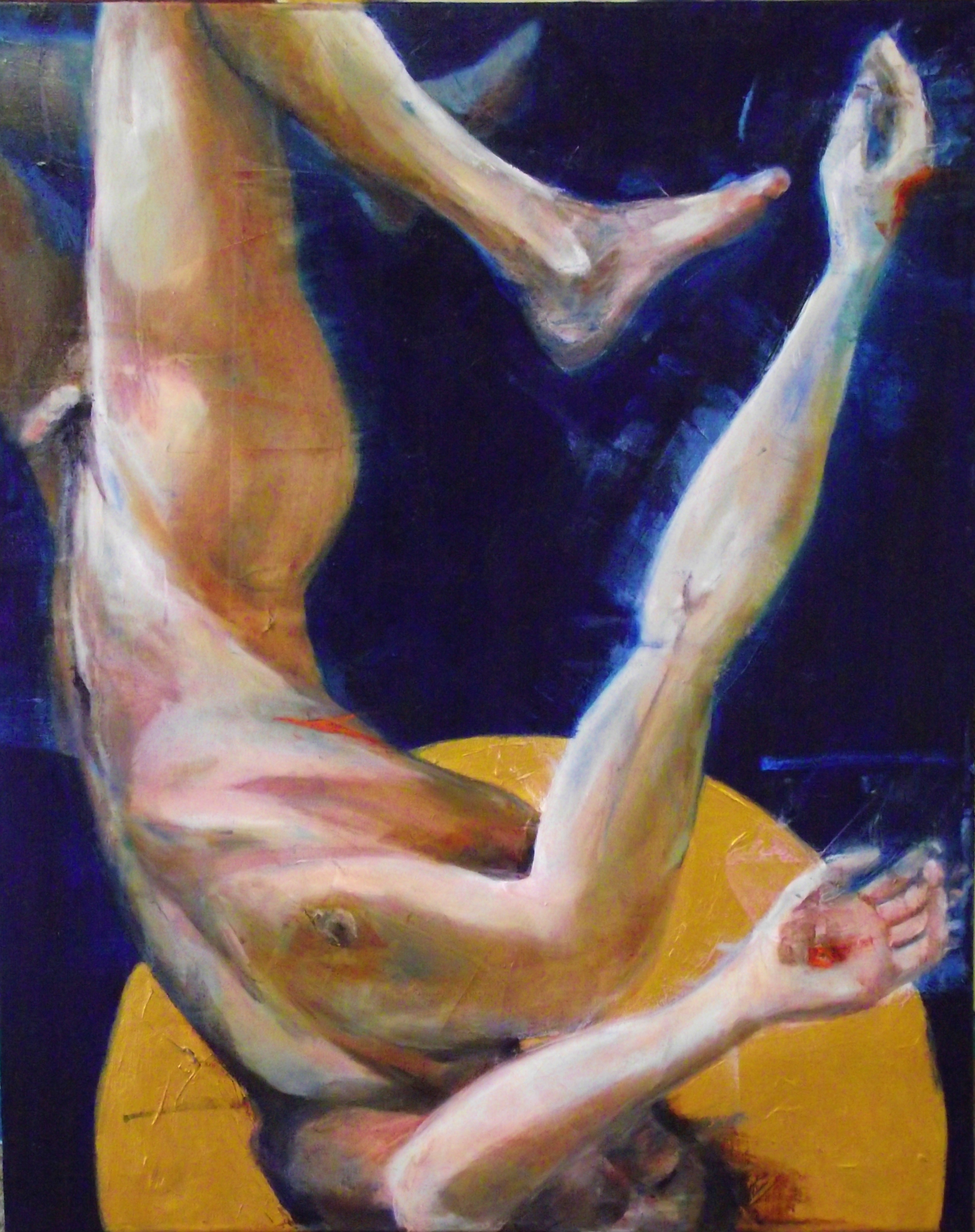
Detail from “Intimacy with Christ 3” by Richard Stott

A gay man’s intimacy with Christ is expressed in new art and writing by Richard Stott, a Methodist minister and art therapist in Sheffield, England.

Three large paintings that unite sexuality and spirituality emerged from Stott’s prayer life and meditations on the medieval Christian mystics, especially the poem “The Dark Night of the Soul” by Saint John of the Cross.

“They reach towards the experience of a deep and intimate engagement with Christ. They are not about sex per se but there is an erotic aspect to them. Sexual desire, our desire for the other, to be close to them and entwined with them is, to my mind, an echo of our desire for God and God’s desire for us. In the Christian tradition that is expressed in God coming close to us in the body of Christ,” Stott writes.

“Intimacy with Christ” triptych by Richard Stott on display

The triptych debuted in June at Hidden Perspectives, an arts festival for “bringing the Bible out of the closet” in Sheffield. Stott also posted reflections on each of the paintings at his blog, I Ask for Wonder: Exploring Art, Spirituality and Sacred Spaces in Sheffield and Beyond…. He agreed to share his work here at the Jesus in Love blog.

His first reflection is reprinted below in full, followed by summaries of his other two essays. Images have been cropped for a general audience. The paintings are oil and gold leaf on canvas, measuring approximately 24 by 31 inches.

Detail from “Intimacy with Christ 2” by Richard Stott (for full image click here)

“He touches my neck and all my senses are suspended”
By Richard Stott

Recently I have been stunned by a famous poem by St John of the Cross from his work ‘The Dark Night of the Soul’. In the poem he writes of a spiritual encounter that is deep, beyond words and expresses it in the sensual language of physical intimacy:

Wind blew down from the tower,
Parting the locks of his hair.
With his gentle hand
He wounded my neck
And all my senses were suspended.

I lost myself. Forgot myself.
I lay my face against the Beloved’s face.
Everything fell away and I left myself behind,
Abandoning my cares
Among the lilies, forgotten.

You can read a translation of the whole poem here.

When I read these words echoing down through the years from this 16th Century Spanish mystic I was cut to the heart as they resonate so strongly with my experience of Christ.

I need to take care here as I don’t want to universalise my experience, to imply that everyone should have the same kind of encounter. For some people the idea of relating to Christ at all is unhelpful. Furthermore, many people who do seek to engage with him may very well not do so in the same way as me and nor should they because we each need to work out our own way of engaging with the world and the transcendent. So take my reflections as what they are: the particular experience of a gay Christian using contemplative prayer to engage with Jesus.

One of the key ideas in Christianity, that the church often doesn’t realise the full implications of, is that Jesus had a body. This faith isn’t about some vague spiritual thing wafting around but is about material things and is expressed in a real human body (And whether the stories of Jesus are historically factual or not is irrelevant to me on this because the truth expressed in the myth* of the gospel stories is that the Christian faith is about a real body).

If Jesus had a body then he had blood, mucus, hormones and all kinds of dirty, messy and beautiful things that make us human. He had drives and desires and was a sexual being. When I first thought of this it seemed scandalous to me. I was in a little Catholic Church on the pilgrim road to Santiago de Compostela in Spain. I looked up at the sculpture of Jesus on the cross, his beautiful body twisted and taut in pain or ecstasy and I felt desire for him, a desire for the body of Christ. I wanted to touch his body and be touched by him, to possess him and be possessed by him and in that mutual possession be transformed. I had unwittingly stumbled on and tentatively touched that deep and sensuous spiritual experience expressed by St John of the Cross.

Over the last few months I have been working on some very personal paintings that explore this experience of Jesus and I will offer reflections on each of them over the next few weeks. I share them with some trepidation as it feels like I’m exposing something of my soul but it seems to me that the artists journey is a continual breaking oneself open as we seek to express truths that lie beyond the reach of words.

The golden numinous in each of the paintings is reminiscent of orthodox Christian icons. Icons are not used as idols or objects of worship but are windows to look through so that we may glimpse the divine. I hope these paintings may, in a small way, be windows that open up our horizons and the possibilities of understanding ourselves and of the beautiful transcendent reality that I find embodied in the person of Jesus.


*myth is not a pejorative term but means a story that expresses a truth – often universal truths about human nature and experience
_____________

That concludes Stott’s first essay. Use the following links for his reflections on the other two paintings in his “Intimacy with Christ” triptych.

You are in me and I am in you by Richard Stott explores how the risen Christ invited his friend Thomas to confirm the resurrection by touching his wounds. In another part of the Bible Christ promised “an intimate and passionate intertwining.” This embodied faith is also reflected in a prayer by Symeon the New Theologian.

Lover and beloved moved in unison” by Richard Stott looks at sexual desire as “one of the tributaries of the soul that leads to the wider desire for God.” This yearning is expressed in the Eucharist, the poetry of John of the Cross, and the ecstasy of Teresa of Avila.

Detail from “Intimacy with Christ 1” by Richard Stott (for full image click here)

___
Related links:

New Rainbow Crucifix and Rainbow Madonna unveiled by Richard Stott

Queer Creation by Richard Stott

An Erotic Encounter with the Divine by Eric Hays-Strom (Jesus in Love)

Erotic Christ teacher speaks: We are the erotic body of Christ (Hunter Flournoy at Jesus in Love)

Erotic Christ / Rethinking Sin and Grace for LGBT People (Patrick Cheng at Jesus in Love)
____
This post is part of the Queer Christ series by Kittredge Cherry at the Jesus in Love Blog. The series gathers together visions of the queer Christ as presented by artists, writers, theologians and others. More queer Christ images are compiled in my book Art That Dares: Gay Jesus, Woman Christ, and More.

Copyright © Kittredge Cherry. All rights reserved.
http://www.jesusinlove.blogspot.com/
Jesus in Love Blog on LGBT spirituality and the arts

Sunday, April 04, 2010

Day 8: Jesus rises on the first Easter

Take Away the Cross by Dirk Vanden

A queer version of Christ’s Passion is running in daily installments this week from Palm Sunday through Easter. Each daily post features a queer Christian painting and an excerpt from the novel Jesus in Love: At the Cross by Kittredge Cherry.


Mary was sobbing at the mouth of my tomb. Her long, luxurious hair hung loose and she had torn her robe as a sign of mourning. When I drew near, she turned and looked at me. I would have been embarrassed by my nakedness in the past, but I had left all that behind at the cross. “Why are you crying?” I asked.

“Sir, if you moved him, please tell me where you put him, and I will take him away,” she replied.

I could not believe it: She was looking right at me, completely nude, and she thought I was the gardener! Tears couldn’t have blurred her vision that much. I understood then that resurrection had transformed my body into something new. When Mary looked at me now, she no longer saw me. She saw what she expected to see. I hoped that I could awaken her faith so she could see me more clearly.

The waters of her soul had slowed to a sluggish ooze. I drew Mary’s soul to my divine heart and gave it a drink to get it flowing again. At the same time, I reached my hand out to her, aiming to comfort her. She recoiled in horror.

“Whoa! That is a serious wound! What happened? You need to see a doctor immediately. Or maybe I could heal you in the name of— No, no, we have to get you to a doctor now!”

I called her name out loud. “Mary. Mary Magdalene.”

She gasped as she recognized me. Her soul convulsed and she grabbed me. “Rabboni! My beloved Rabbi!”

She ran the palms of her hands over my arms and then my cheeks. We gazed at each other eye-to-eye, so close that our noses almost touched. “It’s really you,” she whispered. “You’re alive.”...

[Later Jesus reunites with his beloved disciple John]

…“Didn’t you hear me?” I half-shouted. “I said that you are forgiven!”

His eyes flew open and he jumped for fright. “Rabbi! How long have you been here?”

“Ever since you asked the Holy Spirit to come in my name. You heard my voice, didn’t you?”

“Yes,” he answered uncertainly. “But I thought it was all in my mind.”

He huddled in front of me, and his soul bowed before my divine heart. The curls on the back of his head shone like tarnished silver in the starlight. He began to blubber. “I ran away when they arrested you.”

I waited one moment before I spoke, so we could both fully experience the way that his body and soul lined up in relation to me. “You’re here for me now. Begin again.”

“But I failed you in so many ways….

I tried a different approach. “Do you know the Song of Songs?”

John became more rational as he tried to remember. “I don’t think so.”

“Well, ask Nicodemus to recite it for you sometime. It’s an ancient poem about erotic love, but it also symbolizes the love between God and each individual soul. Here’s how it starts: ‘Oh, if only you would kiss me with the kisses of your mouth!’”

I leaned back a little and smiled at him, feeling full of mischief. John’s fiery, bejeweled soul was so alluring that I tried not to look at it. His dark eyes searched mine until a look of wonder dawned on his face. “You’re still flirting with me!” he accused happily.


Jesus Rises (from The Passion of Christ: A Gay Vision)
by F. Douglas Blanchard


The Resurrection

___
Dirk Vanden is a gay artist based in California. In addition to painting, Vanden wrote early gay novels such as the classic “I Want It All,” originally published in 1969. F. Douglas Blanchard is a New York artist who teaches art at City University of New York and is active in the Episcopal Church.  Becki Jayne Harrelson is an Atlanta artist who challenges mainstream religious beliefs via art.

Happy Easter from author Kittredge Cherry and the Jesus in Love Blog!

Saturday, April 03, 2010

Day 7: Jesus visits hell

A queer version of Christ’s Passion is running in daily installments this week from Palm Sunday through Easter. Each daily post features a queer Christian painting and an excerpt from the novel Jesus in Love: At the Cross by Kittredge Cherry.


Whatever semi-disembodied state I was in, Satan was there, too. I was keenly aware of my body struggling against his. We were evenly matched in size and muscle. Judas’ corpse swung above us as we wrestled and punched each other. My lust for vengeance was an insatiable itch that made me want to scratch his eyes out and kill my enemy. I managed to pin Satan to the ground. He lay on his back with me on top, ready to strangle him. I wrapped my hands around his throat and squeezed. I was going to throttle the life out of Satan. That would stop him for good.

Just then he laughed with sheer delight. He wanted me to hit, hate, and kill him. He would never have come close enough to touch if he thought there would be any other outcome.

That ghastly laugh made me stop and remember who I was. Satisfying Satan horrified me. So did killing Satan, or killing anyone, even myself. In an extreme exercise of will, I relaxed my fist and stroked his leathery cheek and neck. Transcending myself like that required more strength than I thought I had.

Satan couldn’t help enjoying the touch. He turned his head and kissed my hand once shyly to let me know he wanted more. I caressed his invisible face again. He was hairy with a beard like mine. In fact, I noticed that his whole face was almost exactly like mine.

I found that I still had the power to whisper, “I forgive you, Brother. And I forgive myself.”

I broke the law of cause and effect that I myself had set up at creation, and a burst of energy was released. I was just as angry at Satan, but I gave him love anyway—something completely different from the worship that he had sought from me. My love was tough enough to withstand even the ongoing war between us. I reached a state of inner balance. If I was only human, I
would have been too weak to resist Satan, and yet without my humanity I would have lost, too, for my divine heart would not approach a sinner as vile as Satan. Loving in this way actually gave me more strength, although I found that I no longer needed to use it. Satan was resting peacefully beneath me.

“It is finished,” he announced.

I was confused. “Huh?”

“I release you. You win—this time.” He pushed me away.

The small amount of love that we exchanged was enough to topple his kingdom. I hurtled back toward the realm of solid light. I careened through a galaxy where the name of every human soul was spelled out in starlight, purging sin from human cellular memories as I went. The souls came untangled. In their newfound freedom, they looked to me like an omni-dimensional tapestry of stars shooting beams of energy, one to another. Each human soul chose to send its energy to every other soul, with the love between them lasting always.

In a flash, I comprehended a great truth: Once you love someone, that love lasts forever in the universe. Love never ends. Satan’s big lie was that hatred, fear, sin, and death can sometimes conquer love. No. Time makes them fade, while love endures forever. Love—love in any form whatsoever, any love that is ever loved—remains and is gradually filling the vast expanse of the universe.

(Continued here tomorrow)

Passio

___
Gary Speziale is an openly gay New York artist whose art flows naturally from his full-bodied Roman Catholicism and who experiences life as one holy, homoerotic whole. He did the cover art for the “Jesus in Love” novels by Kittredge Cherry.

Thursday, April 01, 2010

Day 5: Jesus is sentenced to death

Jesus Before the Priests (from The Passion of Christ: A Gay Vision)

by F. Douglas Blanchard

A queer version of Christ’s Passion is running in daily installments this week from Palm Sunday through Easter. Each daily post features a queer Christian painting and an excerpt from the novel Jesus in Love: At the Cross by Kittredge Cherry.


“We are gathered today to hear testimony on capital crimes committed by Jesus of Nazareth. Will the first witness please come forward?” Caiaphas tended to speak quickly, with an upper-class Jerusalem accent.

As the first witness swaggered to the front of the room, I saw that his soul had enchained itself by subjugating others, much like the soul of Annas.

“What’s your name?” Caiaphas asked.

“Reuben of Magdala.”

“Occupation?”

“Pimp.” He said it in the same offhand manner that he had used back when I liberated Mary from his brothel.

“What can you tell us about Jesus?”

Everyone leaned forward and pricked up their ears. They knew his testimony would go far beyond describing straight sex with a prostitute. That wasn’t even a minor crime for a bachelor like me.

“Jesus is queer,” Reuben stated. “It’s his duty to raise up children for the people of Israel, but he hasn’t even gotten married.”

Caiaphas frowned. “That’s certainly perverse, but there’s no law against it.”

“You misunderstand me. Jesus has lain with a man as with a woman.”

The level of fear in the room ratcheted up a notch, especially among the men who had experienced or fantasized about that forbidden pleasure.

Caiaphas pounced on the charge. “You have witnessed the abomination?” he asked, so eager that his mouth was watering.

Reuben slid his eyes over me in a calculating way without meeting my gaze. “Well, anyone can tell by the way that he looks at other men and greets them with hugs and long kisses.”

… Annas hissed at his son-in-law, “What do you think you’re doing? The charge is supposed to be blasphemy.”

“It’s not usually enforced, but there’s a law on the books that allows us to put a man to death for this kind of abomination,” Caiaphas explained in a hushed voice.

“Perhaps on the old Jewish law books!” Annas snorted. “Have you forgotten that Rome doesn’t allow us to impose the death penalty anymore? We can’t count on the Romans to crucify him for the abomination between men. Their own gods and emperors shamelessly commit the same indecent acts! Keep the focus on his claim to be Messiah. We can twist that into a treason charge.”

… “I order you to tell us under oath before the living God: Are you or are you not the Messiah, the Son of God?” Caiaphas demanded.

“I am, and you’ll see the Son of Man sitting at the right hand of the Almighty, and coming with the clouds of heaven,” I replied.

A shockwave passed through the room.

Caiaphas ripped his robes as if he were grievously offended, but he was grinning in triumph. “He has blasphemed! Why do we still need witnesses? You’ve heard his blasphemy now. What’s your verdict?” he cried.

“He deserves the death penalty,” the members of the Sanhedrin yelled back…. “Kill the blasphemer! Faggot! Leper lover!”

(Continued here tomorrow)
___
F. Douglas Blanchard is a New York artist who teaches art at City University of New York and is active in the Episcopal Church. Much of his art explores history, including gay experience.

Wednesday, March 31, 2010

Day 4: Naked Lazarus flees at Jesus’ arrest

Jesus is Arrested (from The Passion of Christ: A Gay Vision)
A queer version of Christ’s Passion is running in daily installments this week from Palm Sunday through Easter. Each daily post features a queer Christian painting and an excerpt from the novel Jesus in Love: At the Cross by Kittredge Cherry.


After supper all my disciples went with me to Gethsemane, even though it was late, the night was cold, and the olive garden was a long walk away… Lazarus was waiting for us inside the garden. He managed to look stylish even though he was wrapped in the kind of linen sheet worn during religious ritual. He spoke with unaccustomed seriousness. “I’ve been keeping a prayer vigil.”

“Good,” I answered. “I want all of you to stay here and continue the prayer vigil.”

“But—“ John caught himself and held his tongue. He and Lazarus fixed a pained, plaintive gaze at me.

“But what?” I spat out the words impatiently.

“I was going to baptize Lazarus tonight.”

“Baptism!” I snorted. “You want to drown your old self so you can unite with God? You want to lose your life so you can gain it? Do you think you can take the baptism that I’m about to get?”

“We can,” John and Lazarus chorused, as if my questions were just part of some ritual.

My lips tightened. “Don’t worry. You’ll have your chance at a real baptism tonight—and so will I.”

I looked around at the whole group. “I’m sick to death about what’s happening. Stay here and keep awake. I need to go pray by myself.” ...

[Jesus’ prayers end when a small army arrives and arrests him.]

My captors began goading me toward Jerusalem. We hadn’t gone far when we heard footsteps behind us. The soldiers and temple police tensed in alarm. I turned and saw Lazarus. Some of the men grabbed him, but Lazarus wriggled out of their grasp, leaving them holding only the ceremonial linen cloth. Lazarus sprinted away stark naked, his buttocks gleaming in the full moonlight.

The whole squadron burst into laughter. “Why, it’s just a boy-whore!”

“It looks like we spoiled the king’s evening entertainment!”

“Too bad—pervert!” The insult was directed at me, along with some blows.

(Continued here tomorrow)
___
F. Douglas Blanchard is a New York artist who teaches art at City University of New York and is active in the Episcopal Church. Much of his art explores history, including gay experience.

___
Note: Judas kissed Jesus to identify him to the soldiers for arrest. Click on the following titles to see art that explores the homoerotic aspect of Judas Kiss:

Judas Kiss by Robert Recker

Judas Kiss by Becki Jayne Harrelson

Tuesday, March 30, 2010

Day 3: Jesus shares a Last Supper

Study for The Last Supper
by Becki Jayne Harrelson

A queer version of Christ’s Passion is running in daily installments this week from Palm Sunday through Easter. Each daily post features a queer Christian painting and an excerpt from the novel Jesus in Love: At the Cross by Kittredge Cherry.


All of them, male and female, were seated around the table. They smiled at me eagerly when I took my seat. The air was filled with the inviting aroma of fresh-baked bread. John was on one side of me and Judas on the other. My disciples had been chatting and nibbling on olives and other appetizers, but now they all stopped in anticipation of the official start of the meal. …

I tore the bread in half with my human hands. In my mind I ripped a chunk out of my own divine heart. A spark of sacred energy exploded into infinity when the two pieces of my heart separated. It hurt! I was bleeding red light. Shafts of pink and scarlet now pierced the white light that poured from me.

“This is my body, given for you. Do this in remembrance of me,” I said. When I passed the bread to my friends, I also offered them chunks of my divine heart….

I took a sip of the wine. It was dry and delicious, mixed with just the right amount of water. I prepared to pass this cup of blessing around the table according to our Jewish custom, but first I said something that was not part of the standard ritual.

“Drink, all of you. This is my blood of the covenant, which is poured out for many for the forgiveness of sins.”

… I handed the cup to John. He looked in it warily and saw his own reflection on the surface of the liquid.

“Go ahead, drink up.” I touched his shoulder gently.

He sipped. The Holy Spirit sighed. Inside John’s soul, a piece of my divine heart started beating. Somehow it was able to receive the red light that was bleeding from the wound in my heart.

(Continued here tomorrow)
___
Becki Jayne Harrelson is an Atlanta artist who challenges mainstream religious beliefs via art. Raised in a fundamentalist Christian family, she cares passionately about lesbian rights and other justice issues.

Detail from Study for The Last Supper

Monday, March 29, 2010

Day 2: Jesus and his beloved disciple say goodbye

Jesus in Love
A queer version of Christ’s Passion is running in daily installments this week from Palm Sunday through Easter. Each daily post features a queer Christian painting and an excerpt from the novel Jesus in Love: At the Cross by Kittredge Cherry.


That night John asked me to go to the garden of Gethsemane with him. I welcomed the chance to say goodbye to him privately before I died. …

“It broke my heart when you cried over Jerusalem the other day,” he began. “I’m sorry that I’ve been ignoring you lately. When Lazarus died, I thought I had lost another lover. Then you brought him back to life and I got carried away.”

I didn’t say anything, so John added, “You know that you come first with me, don’t you?”

I knew. I paused, pondering how deeply he mourned his dead lovers. I wondered how he would manage to survive the grief of my death. No matter what I said, he refused to believe that I was going to die soon. I didn’t know if we could even say goodbye with his love for me blinding him to the hard truth of my future. …

“My hour is coming soon,” I confirmed. “Any day now. Probably tomorrow.” John and I spoke of my physical death in metaphor because he couldn’t bear it otherwise. I loved his capacity for understanding the multiple meanings in my most poetic, mystical language.

“I don’t want you to go.” He stifled a sob, for he knew from my group discussions with my disciples that there was no talking me out of it. I lay my head on his chest and listened to his heartbeat again while I let him hold and stroke my body as much as he wanted. We were both damp with sweat and tears. Our salty, musky smell evoked my compassion, like a low musical note purring where my womb would be.

I spoke from that place: “I won’t abandon you. I’ll be back. The world won’t see me anymore, but you will see me,” I promised. … “God will give you Someone to be on your side forever. This Someone is the Spirit of truth.”

He stretched against me, awed and awake. “Do you mean that you will be with me…forever?”

“Yes! We’ll be wed. You know what the prophet Isaiah said: ‘Your Creator is your husband, and God Omnipotent is his name.’”

(Continued here tomorrow)
___
Gary Speziale is an openly gay New York artist whose art flows naturally from his full-bodied Roman Catholicism and who experiences life as one holy, homoerotic whole. He did the cover art for the “Jesus in Love” novels by Kittredge Cherry.

Sunday, March 28, 2010

Day 1: Crowds greet Jesus with palm branches

Jesus Enters the City (from The Passion of Christ: A Gay Vision)
by F. Douglas Blanchard


A queer version of Christ’s Passion is running in daily installments this week from Palm Sunday through Easter. Each daily post features a queer Christian painting and an excerpt from the novel Jesus in Love: At the Cross by Kittredge Cherry.


After passing through the village of Bethany, we came to the place where the Mount of Olives starts descending into the Kidron Valley. I usually paused here to admire the panoramic view of Jerusalem on the other side of the valley, but today I saw something even more dramatic. Thousands of people thronged the road all the way to Jerusalem.

They roared when they first saw me. “Hosanna! Blessed is the one who comes in the name of God—the king of Israel!” They waved palm branches as they shouted. They covered the road with the leafy branches. Many people were even removing pieces of their own clothing and spreading them on the road….

Tears filled my eyes when I saw the city rising behind its walls, so close, yet so standoffish. My divine heart ached from the memory of all the violent rejections that God had suffered in this place, even though it was called the city of God.

I pulled the donkey to a halt and let my tears flow freely as I cried out to my city, “O Jerusalem, Jerusalem, killing the prophets who are sent! So many times I wanted to gather my people together like a hen nestling her chicks under her wings, and you refused! If only you knew even today what makes for peace! But you don’t see it.”

I sobbed, overcome by sorrow.

Most in the crowd interpreted my lament as the tactics and theatrics of a man with political aspirations. The one who was most keenly attuned to me in that moment was John, who came up and touched my foot in reverence and condolence. His dark eyes poured out the tragic sense of helplessness he felt in the face of my grief. He was blind to how much his gesture comforted me. The donkey twisted his head around and eyed me, wondering what to do. I urged him onward into Jerusalem.


(Continued here tomorrow)
___
F. Douglas Blanchard is a New York artist who teaches art at City University of New York and is active in the Episcopal Church. Much of his art explores history, including gay experience.

___
[Note: For a woman’s version of Christ’s Passion, see “A Women’s Way of the Cross” by Julie Lonneman at:
https://www.trinitystores.com/?collection=74

Thursday, March 25, 2010

Gay Holy Week series starts Sunday

A queer version of Christ’s Passion will run in daily installments from Palm Sunday (March 28) through Easter (April 4) here at the Jesus in Love Blog.

Each daily post features GLBT Christian art and an excerpt from “Jesus in Love: At the Cross,” a novel about a bisexual Christ by lesbian author Kittredge Cherry. Jesus is in love with his disciple John and faces religious homophobia in the selections from “At the Cross.”

The eight-day series covers Palm Sunday, the Last Supper, and Jesus’ arrest, trial, crucifixion and resurrection. The dramatic events of Christ’s Passion happen in the context of a gay love story between Jesus and John. Jesus has today’s queer sensibilities and psychological sophistication as he reveals experiences that may have led to the first Easter.

“I’m doing the Holy Week series to make Christ more accessible to gay, lesbian, bisexual and transgender people and our allies,” said Cherry, founder of JesusInLove.org. The website promotes artistic and religious freedom by supporting spirituality and the arts for GLBT people and their allies.

“Christ’s story is for everyone, but GLBT people often feel left out because conservatives use Christian rhetoric to justify hate and discrimination,” she said.

The online Holy Week series includes art by F. Douglas Blanchard, Becki Jayne Harrelson, William Hart McNichols, Corinne Quinones, Gary Speziale and Dirk Vanden.

Some conservatives labeled Cherry “a hyper-homosexual revisionist” because of the gay love story between Jesus and John. However, her books follow the Biblical text and standard Christian doctrine while speculating on Christ’s erotic inner life.

“I get hate mail with warnings such as, ‘Gays are not wanted in the kingdom of Christ!’ This kind of religious bigotry is exactly why the queer Christ is needed,” Cherry said.

Meanwhile, secular literary critics and progressive Christians affirm the Jesus in Love series as “profound,” “spiritually mature” and “beautifully written.” Gay spirituality author Toby Johnson praises it as “a real tour de force in transforming traditional myth to modern consciousness.”

The Bay Area Reporter called it “revolutionary religious fiction” and Mel White, founder of Soulforce, says, “Kittredge Cherry has broken through the stained-glass barrier… a classic re-telling of the greatest story ever told.”

“At the Cross” grows out of Cherry’s own spiritual journey and her experiences as a minister in the LGBT community. She was ordained by Metropolitan Community Churches and served as national ecumenical officer. One of her primary duties was promoting dialogue on homosexuality at the National Council of Churches (USA) and the World Council of Churches. Her previous books include “Art That Dares,” “Equal Rites” and “Hide and Speak.” The New York Times Book Review praised her “very graceful, erudite” writing style.

The Holy Week blog series includes art from “The Passion of Christ: A Gay Vision,” a compelling set of 24 paintings by New York artist F. Douglas Blanchard. The controversial “faggot crucifixion” by Atlanta artist Becki Jayne Harrelson is also featured, along with drawings by New York artist Gary Speziale. They are among 11 contemporary artists from the United States and Europe who are profiled in Cherry’s book “Art That Dares: Gay Jesus, Woman Christ, and More.”

___
Update: Click here to view the entire Holy Week series.

Tuesday, March 02, 2010

New paintings honor gay martyrs


The Murder of Matthew Shepard by Matthew Wettlaufer
Oil on canvas, 2006. 1-1/2 meters x 1 meter.

The Murder of Allen Schindler by Matthew Wettlaufer
Oil on canvas, 2006. 2 meters x 1-1/2 meters.


Men killed in gay-bashing murders are honored in powerful new paintings by gay artist-philosopher Matthew Wettlaufer.

He painted Matthew Shepard (1976-98), a university student who was killed in Wyoming, and Allen Schindler (1969-92), a naval officer who was killed by two of his shipmates in Japan. Both were brutally beaten to death for being gay.

Wettlaufer makes connections between the anti-gay hate crimes, other human-rights struggles and his own art in the following interview with Kittredge Cherry, founder of JesusInLove.org and author of “Art That Dares.”

Born and raised in America, Wettlaufer lived in El Salvador and South Africa before returning recently to California. He has a doctorate of philosophy from Germany’s Kassel University and moved to Capetown to teach philosophy at the University of Stellenbosch. He paints a variety of subjects, but his large political landscapes focus on issues of homophobia and political violence.

It is especially appropriate to reflect on gay martyrdom now during the season of Lent, when the suffering and death of Christ are remembered. In the following interview, Wettlaufer is especially eloquent at discussing the meaning of his art because he is a philosopher as well as an artist.


KC: You have a doctorate in philosophy and taught philosophy at the university level. That's unusual for an artist. So I am going to ask you some about the philosophy behind your art. Why did you decide to paint the difficult subject of the gay-bashing murders of Allen Schindler and Matthew Shepard?


MW: I was strongly affected by their murders, it was one of the reasons why I found myself leaving the United States, because of the entrenched homophobia in society which served as a foundation for these acts of brutality. In 2006 I saw the film Brokeback Mountain and it reawoke all these feelings of anguish and pain that I had managed to put aside after moving to South Africa. I walked around in a daze for a week. Then I painted the Matthew Shepard painting, which was my first political narrative. I was actually embarrassed about showing it to anyone, it was too personal and too private, but over time I grew out of that reticence as I started to get feedback from people about it.

I m not sure if this is related but I was at the March on Washington in 1993 and I saw Allen Schindler's mother address the crowds on the Washington Mall. I knew his story already because of an article I had read that described the events leading up to his murder and the murder itself, which the Navy initially tried to cover up. Hearing his mother speak brought me to tears.

All my life I have sought ways of recording the memory of people martyred under conditions of oppression, by working in El Salvador during the 1990s in health care, by teaching philosophy (critical theory) in El Salvador at the University in San Salvador, by activism in the gay community. Painting these people made sense to me as a way of creating an archive of what their deaths meant, so that they never be forgotten. It was in some ways easier to paint Salvadoran subjects as I am not Salvadoran, it was much harder to bring myself to paint gay subjects, especially the subjects of Shepard and Schindler, as this was so close to home and so personal.


KC: What did you experience during the process of painting these terrifying scenes of anti-gay violence? Maybe you felt fear or liberation or a connection with the past?


MW: I cried. I felt angry and exhausted. But mostly I was in tears. I hope that doesn't sound self-indulgent! I also felt a frustration at "not getting it right"--not really capturing what their deaths meant to me--but I think that must be the problem with all art--it never seems to "get" it--only an approximation. Still what I had in my mind was what I actually painted--I always have the picture formed in my mind before I paint, and it usually comes out the way I imagined it beforehand. But capturing the feeling of their loss is much harder to achieve.


KC: Matthew and Allen are sometimes considered to be gay martyrs or gay saints because they were killed for refusing to deny their own (God-given) sexual identity. What spiritual meaning, if any, do you see in their lives and deaths?


MW: As I had wanted to be a priest when I was a teenager, before I realized I was gay, I would not be surprised if spiritual elements enter into the way the paintings connect with a viewer. The cross-like character of the Shepard piece for example is completely intentional. He and Schindler were martyrs, and martyrdom has a spiritual level to it. Some of the strongest influences on me growing up were people who had been martyred for civil and human rights--Martin Luther King J., Robert Kennedy, Medgar Evers, Salvador Allende, Oscar Romero, and Jean Donovan (one of the four US Churchwomen killed in El Salvador).


KC: You described yourself as a "lapsed Catholic." What is your own spiritual journey?


MW: I joined the Church when I was 12. Before that I grew up in a small mountain town in Southern California--I was very fortunate to be around wilderness, mountains, streams--and to be able to hike and to escape into the wilds. I had I guess a pantheistic feeling about spirituality, an intimate connection with life around me. But when I turned 12 I felt I needed to exchange this vague experience for something more structured and organized, so I went to the Catholic Church. Part of the reason for that was seeing the events happening on television in El Salvador during the late 1970s. Oscar Romero's courage in standing up for the rights of the poor and persecuted made a strong impact on me.

I joined the Church though right at the time when things in our parish changed and we had our gay priest replaced with a straight and very rightwing one. I began to clash with him and with catechist classes over the issue of being gay. I went ahead and was confirmed but our priest told me that as I was gay I was psychologically ill and should seek aversion therapy to "cure" myself. I left the Church.

As a young adult I found myself in a 12 step program and it was there that I was able to reclaim much of my earliest feelings around spirituality. I draw on those when I paint. I don't know if I believe in a God--but I believe in a higher power--the universe in its massive incomprehensible vastness inspires me with respect and humility. I study currents in contemporary physics to educate myself more on these matters. I am also impressed with liberation theology, with buddhism and with the essence of what Christ taught, about unconditional love of others and about compassion and forgiveness.


KC: Are you an openly gay man? (If not, it's OK, I'll omit this question when I post the interview.) If yes, how does your sexual orientation affect your art? Do you have any other paintings on gay themes?


MW: I am openly gay :) I think it affects my art in the sense that I see things from the outside looking in. I have a few paintings that touch on gay topics--one of a man next to another man's hospital bed--an AIDS pieta. Also one of two soldiers sleeping with their arms around each other. And one of the two soldiers in the cage--it is titled “There's No Place for Us.” (All three are pictured below.)  It has been hard for me to paint "happy" or optimistic pictures dealing with gay subjects, but perhaps that will change with time. Ultimately I would like to create images that are hopeful and life-affirming with all the power and emotion that I have felt in making my martyrdom paintings.


KC: You've lived all over the world -- El Salvador, South Africa, United States. What have you learned about art, spirituality and gay/lesbian issues from your experiences living in such different cultures?


MW: Some places I have lived were more accepting of gay people than other places--at least on the surface and in terms of legal rights. In some places I found that people have an almost physical reaction to art which speaks to them, a strong and passionate accord with visual imagery. It hasn't been my experience that the most tolerant societies are also the most passionate artistically; in South Africa I found a rather lukewarm reception to my work (and to political or social work in general) in the art community--equally lukewarm was the South African reception of abstract and expressionist pieces by some of my teachers, attitudes which mystified me. Yet on the other hand the legal standing of gay people in that country is well ahead of most western countries. In Latin America on the other hand I find a more intense reaction to my work (and to the political painting of other people) yet my experience of El Salvador is that it is a deeply homophobic society but that there are growing pockets of inclusion and acceptance, especially in the cities. It is a struggle still.

___
For more info on Matthew Wettlaufer, visit www.capegallery.co.za or contact him directly at tahquitzpeakartist@gmail.com.


Pieta by Matthew Wettlaufer
Oil on canvas, 2007. 36 x 56 cm.

Two Soldiers on a Train by Matthew Wettlaufer
Oil on canvas, 2008. 32 x 44 cm.

There’s No Place For Us by Matthew Wettlaufer
Oil on canvas, 2007. 1 meter x 1 meter.

Wednesday, November 04, 2009

Noah’s gay wedding cruise pictured

Noah’s Gay Wedding Cruise” by Paul Richmond, 2009
Oil on canvas, 24” x 30”
www.paulrichmondstudio.com

Happy gay and lesbian animal couples mingle with today’s GLBT celebrities in “Noah’s Gay Wedding Cruise” by Ohio artist Paul Richmond.

His gay version of Noah’s ark even has drowning sinners -- opponents of gay rights such as Ann Coulter, Ken Starr, Pat Boone, Fred Phelps, and even Larry Craig with his toilet! Sesame Street’s Bert and Ernie come out of the closet to watch from a porthole as a “God hates fags” sign sinks beneath the waves. Elsewhere on the cruise ship, human couples include Ellen DeGeneres and Portia de Rossi, Elton John and David Furnish, and Rosie O’Donnell and Kelli Carpenter. Even the fictional cowboys of “Brokeback Mountain” get another chance at love.

“I chose to symbolize our inevitable victory in the fight for marriage equality by painting my own adaptation of the biblical flood,” Richmond says.

He was moved to create the work after California’s Proposition 8 banned same-sex marriage last fall. Demonstrations across the United States in support of marriage equality inspired Richmond to paint a wickedly funny satire on the classic Bible story.

In Genesis 6-9, God commands Noah to gather his family and heterosexual pairs of animals into a boat to rescue them from the global flood sent to destroy human evil and the violence of nature. After the flood, a rainbow appears as a symbol of God’s promise never again to destroy all life on earth.

How appropriate that the rainbow has become a symbol of GLBT pride! Richmond puts a fresh twist on the Biblical epic with his sweeping vision of a gay-positive new world. A rainbow flag flies high on the mast of Noah’s gay cruise ship. “As the clouds begin to part, a heavenly rainbow appears in the sky to remind hopeful voyagers that full legal recognition and acknowledgement of same-sex love is just over the horizon,” Richmond explains.

His vision is artistically beautiful, politically meaningful -- and packed with visual jokes and pop-culture references that are great fun to find.

One of my favorite scenes is Larry Craig clinging to a toilet for dear life (detail below). The former Idaho Senator voted against gay-rights laws… and then got arrested for soliciting gay sex in a men’s restroom.

“Larry Craig was the first part I painted because I just couldn’t wait to throw that toilet at him!” Richmond told me.

The painting also satisfies my longing for GLBT-positive images of animals. Richmond painted wonderful same-sex pairings of cuddling elephants, giraffes, penguins, chimps, and, of course, flamingos. (Another detail below.)

The painting was well received (except by religious conservatives) and was named “the gayest painting of our time” by towleroad.com.

Richmond, now 29, came out as gay after graduating from Columbus College of Art and Design in Ohio. “My work is an exploration of sexuality and identity through narrative painting,” he says. “I draw inspiration from my own experiences as a young gay man from a conservative environment to break down the social constructs that exist around sexual orientation and gender roles. Through colorful, illustrative, and sometimes humorous paintings, I expose the grey areas that become overshadowed by black and white moral codes.”

“Noah’s Gay Wedding Cruise” is available as a limited-edition giclee print from the artist’s online shop at etsy.com. I bought one for our collection and am delighted with its quality, artistry and message.

______
P.S. “Noah’s Gay Wedding Cruise” has been selected for inclusion in this year’s OUTAuction benefiting GLAAD and celebrating their Top 100 Artists of the Year on Nov. 15. The artist says, “I’m so excited to have been chosen, and especially to be able to contribute that particular painting. Noah’s Gay Wedding Cruise is getting ready to set sail for it’s last voyage! :)”
______

Update on Sept. 16, 2011: BW16 of the Objective Queer Bible Scholar blog offers another queer interpretation of the Noah’s Arc story: “This classic Sunday school tale includes a number of LGBT motifs, my favorite being the command from God to Noah to ‘take two of every kind’ on the ark (6:20), presumably this would include couplings of heterosexuals, homosexuals, bisexuals, and pan-sexuals.” For more info, see BW16’s post “Two of Every Kind” Intercourse Texture in Noah’s Ark.

Larry Craig hangs on to his toilet while other homophobes drown.


Ellen and Portia lead the way as lesbian elephants and gay flamingos snuggle.


Brokeback cowboys, Rosie and Kelli and gay giraffes all have a chance at love under the rainbow flag.


Ann Coulter sinks with a “God hates fags” sign.


The following links may be used to place an order:

12” x 15” giclee prints of “Noah’s Gay Wedding Cruise”:
http://www.etsy.com/view_listing.php?listing_id=21465325

16” x 20” giclee prints of “Noah’s Gay Wedding Cruise”:
http://www.etsy.com/view_listing.php?listing_id=23454918

Wednesday, July 15, 2009

Eros & Christ: Mary’s ecstasy in art

Annunciation by Trudie Barreras, 1970
Oil on canvas, 11” x 14”
(Collection of Rev. Emily Bel, Columbus, GA)

[First in a summer series on Eros and Christ]

Artistic and literary visions of Mary’s ecstasy at the moment of Jesus’ conception offer a new way to heal the split between sexuality and spirituality in Christian tradition.

Mary’s physical/mystical experience of God within her own sexual organs is the subject of artistic creations by two women of faith. Atlanta artist Trudie Barreras addressed it in art and a dramatic monologue, and I wrote about it in my novel “Jesus in Love.”

Working separately without knowing each other at the time, each of us dared to envision a new, sex-positive take on the Annunciation, one of the most common subjects in Christianity. The Annunciation has been painted by most of history’s great artists, including Leonardo Da Vinci. But the traditional version stops with the Angel Gabriel’s announcement to Mary that she will give birth to the son of God.

When Mary asks how this is possible since she is a virgin, the angel answers, “The Holy Spirit will come upon you, and the power of the Most High will overshadow you.” (Luke 1:35).

But what happened next? Did Mary go into erotic ecstasy when Jesus was conceived?
How did it feel to be touched by the Holy Spirit?

In her “Annunciation,” Barreras goes well beyond the standard announcement scene to paint a vibrant swirl of spiritual and erotic energy. She reveals the thrilling moment when Mary was overshadowed by the Holy Spirit to conceive Jesus Christ. Mary reaches ecstasy as the Holy Spirit embraces her in a heart of flames that merges with Mary’s own golden halo.

“Only a few people got my point that being ‘overshadowed by the Holy Spirit’ had to be the best orgasm going,” Barreras explains.

Barreras painted her “Annunciation” in 1970 after getting involved with the Catholic Charismatic Renewal, which emphasizes the Holy Spirit.

“It was painted before my husband came out to me as a gay man, since that occurred in 1973. Hence it was painted before I'd become anything other than a conscientiously Catholic woman,” Barreras says.

“However, since I was not a ‘cradle Catholic’ but rather a convert, I'd been having a great deal of difficulty ‘relating’ to the traditional devotion to (and perspective on) ‘the BVM.’* I was trying, even then, to relate to the mother of Jesus in a way that felt ‘real’ to me.”

Barreras, now a member of Metropolitan Community Church, went on to write a poetic meditation celebrating Mary’s ecstasy. It will be posted here next week as the Eros and Christ series continues.

Related post:
Mary’s ecstasy in drama
___
*BVM stands for the Blessed Virgin Mary

Wednesday, June 03, 2009

Love between women honored

“Whither Thou Goest” by Trudie Barreras, 2004 Acrylic, 18” x 14”
Love between two Biblical women is celebrated in “Whither Thou Goest” by Atlanta artist Trudie Barreras. The painting shows Ruth pledging her love to Naomi. Ruth’s famous vows to Naomi are often used in heterosexual weddings. Few people realize that these beautiful words were originally spoken by one woman to another:
“Entreat me not to leave thee, or to return from following after thee. For whither thou goest, I will go; and where thou lodgest, I will lodge. Thy people shall be my people, and thy God my God. Where thou diest, will I die, and there will I be buried. The Lord do so to me, and more also, if ought but death part thee and me.” (Ruth 1:16-17)
Now is a good time to reflect on Ruth and Naomi because same-sex marriage is in the news and June is Lesbian, Gay, Bisexual and Transgender (LGBT) Pride Month (even officially proclaimed by President Obama this week). The painting “Whither Thou Goest” was commissioned in 2004 by Rev. Paul Graetz, pastor of First Metropolitan Community Church of Atlanta, for a sermon series that he was doing on the Book of Ruth. It remains in the permanent collection of First MCC of Atlanta, where it hangs in the meditation chapel. First MCC of Atlanta is a progressive community of faith that welcomes people of all sexual orientations and gender identities. Naomi was the mother-in-law of Ruth and Orpah. After their husbands die, Naomi urges both of them to remarry. The painting shows Orpah leaving while Ruth stays with Naomi.

Sunday, April 12, 2009

Day 8: Jesus rises on the first Easter

The Resurrection
A queer version of Christ’s Passion is running in daily installments this week from Palm Sunday through Easter. Each daily post features a queer Christian painting and an excerpt from the novel Jesus in Love: At the Cross by Kittredge Cherry. Mary was sobbing at the mouth of my tomb. Her long, luxurious hair hung loose and she had torn her robe as a sign of mourning. When I drew near, she turned and looked at me. I would have been embarrassed by my nakedness in the past, but I had left all that behind at the cross. “Why are you crying?” I asked. “Sir, if you moved him, please tell me where you put him, and I will take him away,” she replied. I could not believe it: She was looking right at me, completely nude, and she thought I was the gardener! Tears couldn’t have blurred her vision that much. I understood then that resurrection had transformed my body into something new. When Mary looked at me now, she no longer saw me. She saw what she expected to see. I hoped that I could awaken her faith so she could see me more clearly. The waters of her soul had slowed to a sluggish ooze. I drew Mary’s soul to my divine heart and gave it a drink to get it flowing again. At the same time, I reached my hand out to her, aiming to comfort her. She recoiled in horror. “Whoa! That is a serious wound! What happened? You need to see a doctor immediately. Or maybe I could heal you in the name of— No, no, we have to get you to a doctor now!” I called her name out loud. “Mary. Mary Magdalene.” She gasped as she recognized me. Her soul convulsed and she grabbed me. “Rabboni! My beloved Rabbi!” She ran the palms of her hands over my arms and then my cheeks. We gazed at each other eye-to-eye, so close that our noses almost touched. “It’s really you,” she whispered. “You’re alive.”... [Later Jesus reunites with his beloved disciple John] …“Didn’t you hear me?” I half-shouted. “I said that you are forgiven!” His eyes flew open and he jumped for fright. “Rabbi! How long have you been here?” “Ever since you asked the Holy Spirit to come in my name. You heard my voice, didn’t you?” “Yes,” he answered uncertainly. “But I thought it was all in my mind.” He huddled in front of me, and his soul bowed before my divine heart. The curls on the back of his head shone like tarnished silver in the starlight. He began to blubber. “I ran away when they arrested you.” I waited one moment before I spoke, so we could both fully experience the way that his body and soul lined up in relation to me. “You’re here for me now. Begin again.” “But I failed you in so many ways…. I tried a different approach. “Do you know the Song of Songs?” John became more rational as he tried to remember. “I don’t think so.” “Well, ask Nicodemus to recite it for you sometime. It’s an ancient poem about erotic love, but it also symbolizes the love between God and each individual soul. Here’s how it starts: ‘Oh, if only you would kiss me with the kisses of your mouth!’” I leaned back a little and smiled at him, feeling full of mischief. John’s fiery, bejeweled soul was so alluring that I tried not to look at it. His dark eyes searched mine until a look of wonder dawned on his face. “You’re still flirting with me!” he accused happily.
Jesus Rises (from The Passion of Christ: A Gay Vision) by F. Douglas Blanchard (counterlight@earthlink.net)
(Happy Easter from author Kittredge Cherry and the Jesus in Love Blog.)