Showing posts with label homoerotic. Show all posts

Friday, August 07, 2015

Erotic gay soul explored in two new illustrated books: "HomoEros" and "Internal Landscapes"

“The beauty of his face could raise the dead” by John Waiblinger from “HomoEros

Male beauty, same-sex eroticism and the archetypal gay soul are explored with holy authenticity in two new illustrated books: “HomoEros” by John Waiblinger and Chad Mitchell, and “Internal Landscapes” by John Ollom. The most direct Christian symbolism is expressed by Mitchell, whose poetry in “HomoEros” celebrates Christ the Bridegroom, the Sacred Heart, and the Son of Man. A full poem is posted at the end of this article to illustrate the quality of the writing and the book’s blissful tone.

Both books feature photography of semi-nude men and nature, prose steeped in Jungian psychology, and first-person poetry about gay love. Each transforms and transcends mainstream Christianity as well as standard gay/queer identity. They create enlightening, sometimes mystical visions for readers who seek LGBTQ-friendly intimacy and inspiration.

In “HomoEros,” Mitchell’s poems echo the rich tradition of mystical marriage in the medieval church the Biblical Song of Songs, where the Lover and Beloved are metaphors for God and Israel or Christ and the church. His verse can be read as worldly love songs or as prayers to the cosmic Christ. He also puts Christ in a broader context with references to various mythological figures such as Apollo and the Sky Father.

John Ollom carries Matthew Stone in a photo from “Internal Landscapes.” The scene comes from the “Men in Love… with each other” video art project. Photographer: Jim Sable. Art direction: Emma McCagg.

“Internal Landscapes” is more about un-learning what Ollom calls “Judeo-Christian body shame surrounding sexual expression.” But both books are religious in the sense that Mitchell eloquently defines in his introduction to “HomoEros”:

“The real meaning and real work of religion is the actual “re-linking” (or religio) of our individual conscious awareness to the immaterial reality of the greater truth.”

The two books come from first-time authors working independently on opposite coasts, with no knowledge of each other’s efforts. Yet both books state specifically that they seek to express man-to-man “love and longing,” giving artistic form to “internal” realities based on Jungian-inspired archetypes. They even have similar covers with a nude man in shadow against a black background.

“HomoEros: Meditations on Gay Love and Longing” is a collaboration between two Los Angeles artists: Writer Chad Mitchell has spent many years in Jungian-based dream analysis. The odes and lamentations in the book come from his personal journal, which he has kept since his early years of studying history and language at California State University, Northridge. His writing draws on the language and symbolism of his Catholic upbringing. Digital artist John Waiblinger has exhibited his work at galleries in Los Angeles and elsewhere in the United States and United Kingdom. He began his artistic endeavors in midlife after discovering digital tools that enabled him to translate his ideas into visual form. Mitchell is described in the book as a Sufi Christian and Waiblinger calls himself an atheist. “While I am in no sense religious, there are so many aspects of the Christ mythos that I find quite moving and beautiful” Waiblinger writes.

In contrast, John Ollom is a New York dancer, choreographer and dance teacher. Since 2002 he has served as artistic director of Ollom Movement Art/Prismatic Productions, Inc., a non-profit organization. Raised Christian, he received a master of fine arts degree in interdisciplinary art in 2014 from Goddard College in rural Vermont and a bachelor of fine arts degree in ballet in 1998 from Texas Christian University. His dancing has taken him across the United States and to Europe, Africa and China. He even performed at the Metropolitan Opera House with the Bolshoi Ballet. Ollom has also worked with LGBT venues: His “M.U.D. (Men Under Dirt)” piece was performed at the Leslie-Lohman Museum of Gay and Lesbian Art in New York City, the Soulforce Anti-Heterosexism Conference in Florida and the Easton Mountain Retreat Center in upstate New York.

Each book takes a unique approach and will be discussed in separate sections here.


“HomoEros: Meditations on Gay Love and Longing”


HomoEros: Meditations on Gay Love and Longing” sexualizes the sacred and elevates eroticism to the realm of the divine.

At first glance Waiblinger’s pictures appear to be evocative, romanticized photos of conventionally handsome men, skillfully superimposed with flowers, leaves, planets, windows, and other images, mostly from nature. Reading his introductory remarks reveals that they come from his project “Art of Re-Envisioning Gay Pornography.”

Yes, “HomoEros” takes the startling approach of mixing gay porn with phrases from the Roman Catholic Mass. The juxtaposition of extremes results in an effective effort to reconcile gay sexuality and spirituality.

Waiblinger’s artistic process begins with collecting photos of men from “hard porn” websites. In the introdction he describes how he crops each image and layers it with his own original photos to “capture an internal moment… and present the reality of how I see it in my mind’s eye.”

Mitchell’s poems in “HomoEros” began as entries in his journal, chronicling his struggle as a gay man to become a whole person. They express his belief that the gay spiritual journey is a quest for union with “an archetypal Soul Figure of the same gender.” While he was journaling he became involved in gay-centered depth psychology and studied Carl Jung’s treatise “Transformation Symbolism in the Mass,” which is included in the Jung collection “Psychology and Western Religion.” He also began attending Mass regularly at a traditional Catholic church in his neighborhood. There it dawned on Mitchell that gay-male love and sexual union are archetypal expressions of the union with Christ that is celebrated in the Eucharist. These profound insights shine through his poetry.

Most of the images and text in “HomoEros” were created before Waiblinger and Mitchell met, but their work blends together seamlessly. In their conclusion they described working together as a “magical process” in which “these images and words established their own connections and ordering in an almost self-directed manner, full of synchronicity and unexpected rhythm.”

The large, 8-1/2-by-11-inch book is elegantly designed with lavish use of white space, as shown in this example.

.

Iconography meets pornography in a satisfying synthesis with “HomoEros,” but it also raises moral questions about adapting photos from an industry associated with sexual exploitation and human trafficking.

“My intent is to re-imagine the performers in the original pornographic image in a way that romanticizes and humanizes them and transforms my original connection with the image in a highly emotional manner,” Waiblinger explained in a statement that he shared with the Jesus in Love Blog.

Most images in “HomoEros” do not look pornographic, at least to the uninitiated eye. There are some man-to-man embraces and only a few images with obvious frontal nudity, tastefully presented. As Waiblinger puts it, there is much more “kiss” than “cock.” His kind of “transformative” use of copyrighted images is legal under the “fair use” doctrine, even as it blurs the boundaries that divide sanctity from obscenity and outlaw sex.

“Whenever possible, when I've used such an image or snip, I have made a paid subscription to the site in question, and verified the statement on the site that the models are verified to be over 18 years of age. Not using images of minors, or using images that are exploitive in the sense that the performers did not agree to be so captured, is of critical importance to me,” his statement says.

Waiblinger’s stated aim is to “humanize” the men in his photos, and yet they remain nameless, cut off from any identifying details. Porn is re-envisioned, but perhaps not fully redeemed. What would the men in his photos say if they knew about this re-purposing of their sex work?

Such soul-searching questions may be addressed indirectly by considering what Mitchell says in his introduction about “felix culpa,” the Latin term for the concept that unfortunate events can lead to a happy outcome:

In Christian theology the felix culpa is the “happy fault” or the “happy fall” and refers to Adam’s sin and the fall from grace that leads to redemption. In the Easter Praeconium it states: O happy fault that won for us so loving and so mighty a Redeemer. In my opinion the fall from grace describes the human condition by which I would like to emphasize that I am not referring to the traditional concept of original sin. But, rather, I am referring to the existential crisis of being which is an inherent part of the human condition. Or, to put it in other words, we as human being do not live in the Unity of the Garden. Rather, we live in the disunity of a fallen, broken world full of conflicting dualities and, within that world of conflicting dualities, we cannot escape the questions posed by our own existence and out own conscious awareness.


“Internal Landscapes”


Internal Landscapes” is an interdisciplinary book that aims to “go beyond traditional queer models of man to man relationships… but find imperfection, love and longing.” Author John Ollom combines memoir, manifesto, poetry, photography, drawings and background documentation on his dance and choreography performances.

The book is spiritual in the broad sense, but it also addresses the process of healing from toxic religion:

“I was raised to be a good Christian. When I was a child, I was told about sin and my separation from god and I need a savior to save me. Consequently, the more I felt my callings of homosexuality, the more separate and alone I felt. Later in life I felt a profound shift in myself when I could embrace my shadow. For me it was my homosexuality,” he writes.

Ollom writes with rare honesty about how he and his students have used the method to address homosexuality, rape and survival through trauma. He is especially compelling when he writes about his own personal journey to face his “shadow” and move beyond the gender binary that splits male from female. The book serves practical purposes for dance and theater practitioners, but it is also an inspirational resource for general readers.

The author states that he no longer believes in the need for an external savior.  But he helps others find saving grace by using movement to get in touch with their inner selves, sometimes in connection with talk therapy. The book describes the “Internal Landscapes” methodology that Ollom developed through 14 years of research, teaching and personal introspection. His method helps people turn emotions into dance and “archetypal movement.” Instead of letting an external source choreograph their movements, they are guided by their own “internal landscape” to move in ways that are artistic -- but also deeply healing.

“Internal Landscapes” includes many artistic photos of nature and (sometimes nude) dance performances organized by Ollom, but unlike “HomoEros,” the photos are all original and there are no speical digital effects. The poetry is written by Ollom and his students, including a memorable poem by theater professor Robert Gross about a man’s divine same-sex erotic encounters with various Greek gods.

Ultimately both “Internal Landscapes” and “HomoEros” grow out of the gay liberation movement’s Radical Faery branch, which sees gay people as members of a distinct culture with a unique anti-authoritarian spirituality that respects the earth and unites spirit-body and male-female dualities. One of the founders of the Radical Faeries is psychologist Mitch Walker, whom Mitchell credits in “HomoEros” as the first to propose that homoerotic love is its own archetype. Walker introduced the idea to a wide audience in his groundbreaking 1977 classic “Men Loving Men: A Gay Sex Guide and Consciousness Book.” The synchronicity of both “HomoEros” and “Internal Landscapes” emerging at the same time in spring 2015 points toward ongoing evolution of gay consciousness.


The beauty of his face
 could raise the dead
from “HomoEros”

The beauty of his face
could raise the dead
and his agony cause stones to bleed
the greatest mystery is he
shaped by mysteries upon mysteries
to look at him is a conversion of faith
to caress his cheek, one becomes betrothed
to kiss his lips, to know the unknown
the warmth of his beard, the comfort of home
his eyes reflect rapture and sacrifice
mirror pools where forever
does the dreamer dream of love
this mystic marriage of two men
the Lover and the Beloved in union again
the heavens open and the angels descend
upon the Son of Man and, us, the sons of men
so is our love a saving grace
that elevates us to the company of saints
“beneath the veil of earthly things”
our love for the beloved
we do Celebrate

___
Related links on the Jesus in Love Blog:
Sacred gay union with Christ evoked by music of New-Age “Passion of Mark”

Patrick Cheng: Erotic Christ / Rethinking sin and grace for LGBT people

Hunter Flournoy: Teacher says we are the erotic body of Christ

Eric Hays-Strom: An Erotic Encounter with the Divine

Richard Stott: Gay artist paints “Intimacy with Christ” and reflects on sensual spirituality

____
This post is part of the Queer Christ series by Kittredge Cherry at the Jesus in Love Blog. The series gathers together visions of the queer Christ as presented by artists, writers, theologians and others.

Copyright © Kittredge Cherry. All rights reserved.
http://www.jesusinlove.blogspot.com/
Jesus in Love Blog on LGBT spirituality and the arts

Saturday, August 02, 2014

Jacob and the angel: Wrestling to reconcile body and spirit

“Jacob Wrestling with the Angel” by Leon Bonnat (1876) via Wikimedia Commons

When Jacob wrestled with the angel in the Bible, they embodied the struggle between sexuality and spirituality. Artists have created many homoerotic images of the scene over the centuries. The story of Jacob wrestling (Genesis 32:24-31) is the Sunday lectionary reading for tomorrow (Aug 3).

Many have interpreted the story as a struggle between material and spiritual needs, but it is especially powerful for queer people who are trying to reconcile their sexuality and their faith. Jacob refused to give up the fight until he forced a blessing out of God. Like Jacob, LGBT people can also win God’s blessing by continuing to wrestle with our faith, regardless of those who condemn as sinners.

Jacob, ancestor and namesake of the Israelites, is alone one night when a mysterious stranger comes to him. Scripture refers to the stranger as a man, God, and an angel (Hosea 12:4). He wrestles with Jacob until dawn. Then the angel wants to leave, but Jacob insists, “I will not let you go, unless you bless me.”

The angel gives him a new name and identity as Israel, which can be translated as “one who has prevailed with God.” Jacob asks to know the angel’s name, but he just gives a blessing and leaves. Alone again, Jacob marvels, “I have seen God face to face and lived.”

Jacob is honored in Judaism, Christianity and Islam. For Christians, some see the pre-incarnate Christ himself as the mysterious stranger who wrestled with Jacob.

The story raises intriguing questions. What was the nature of the “wrestling” that went on all night long? Whether or not there was an erotic interaction, the friendly conclusion affirms that God wants to relate to human beings as equals. God rewards those who challenge God.

“Jacob and the Angel” by Hendrik Andersen, lover of Henry James. For the uncropped version (warning: full frontal nudity), visit Wikimedia Commons.
___
Related links:

Wrestling with God” at the Queering the Church Blog is a queer reflection on Jacob and the angel.

Click here for a gallery of art showing “Jacob Wrestling with the Angel” at Wikimedia Commons.

____
This post is part of the GLBT Saints series by Kittredge Cherry at the Jesus in Love Blog. Saints, martyrs, mystics, prophets, witnesses, heroes, holy people, humanitarians, deities and religious figures of special interest to lesbian, gay, bisexual and transgender (LGBT) and queer people and our allies are covered on appropriate dates throughout the year.

Copyright © Kittredge Cherry. All rights reserved.
http://www.jesusinlove.blogspot.com/
Jesus in Love Blog on LGBT spirituality and the arts

Tuesday, February 25, 2014

Homoerotic interfaith poetry book explores “lust for the holy”


Gay visions of Christ are part of a homoerotic interfaith adventure that awaits in “The Daring of Paradise,” the newest poetry book by Toronto teacher Brian Day.

He writes about what he calls “the lust for the holy” across the boundaries of Christianity, Judaism, Hinduism, Buddhism, and Islam.

His latest book features several new homoerotic poems about Jesus, including “Pursuing our Pleasure in the Body of Christ” (reprinted with permission below) and “Krishna and Jesus in Algonquin Park.” (reprinted in full in my previous post “What if Christ and Krishna made love?”) The new book also provides a glimpse of Jesus enjoying a naked interlude with Guru Nanak, founder of Sikhism.

Day blends gay and religious themes in a way that illuminates both queer experience and all spiritual expression. Visit Lambda Literary Review for my full review of the book.

__________________

Pursuing our Pleasure
 in the Body of Christ


There is no further body of Christ but this smoothed aggregate

of human flesh. We are the athletic limbs

of his swimming through the world, the hands of all

his practical acts. But hands and limbs are not all of a body,

and those parts of Christ we might conceal

must elicit from our mouths a particular esteem.

The body of Christ is built for delight, and not one

of its vivifying organs can be scorned. The kindling sites

of our communal body take part in our sacred

and carnal commission, this ignition of flesh in its knowledge

as flesh. We caress the completeness of our one body, explore it

with palms, alert it with fists. We lick a glistening

array of physiques, knowing the foreign and knowing

ourselves, knowing Christ in each of his tissues and hollows,

straining toward completer knowledge in this keen narcissistic

congregation of flesh. We train each finger, each muscle, each

follicle to take its place in the communion of Christ. And we,

so flooded with desire for the countless strong members

of the body of Christ, what should we in desire

strive for? We would strive to be those zones

of the holy within the common body of Christ, the seats

of pleasure where he excites himself

into vibrant and ever more electric being.

***
Biblical references:

1 Corinthians 12.27 and Romans 12.4-5


___
Related links:
Conjuring Jesus poems: Homoerotic taste of heaven
(review of the book “Conjuring Jesus” by Brian Day)

____
This post is part of the Queer Christ series by Kittredge Cherry at the Jesus in Love Blog. The series gathers together visions of the queer Christ as presented by artists, writers, theologians and others.

Copyright © Kittredge Cherry. All rights reserved.
http://www.jesusinlove.blogspot.com/
Jesus in Love Blog on LGBT spirituality and the arts

Tuesday, December 24, 2013

Christmas chant honors Christ the bridegroom: Cum ortus fuerit sol de Caelo

Face of Christ
from St. John’s Anglican Church, Ashfield, Australia (Wikimedia Commons)

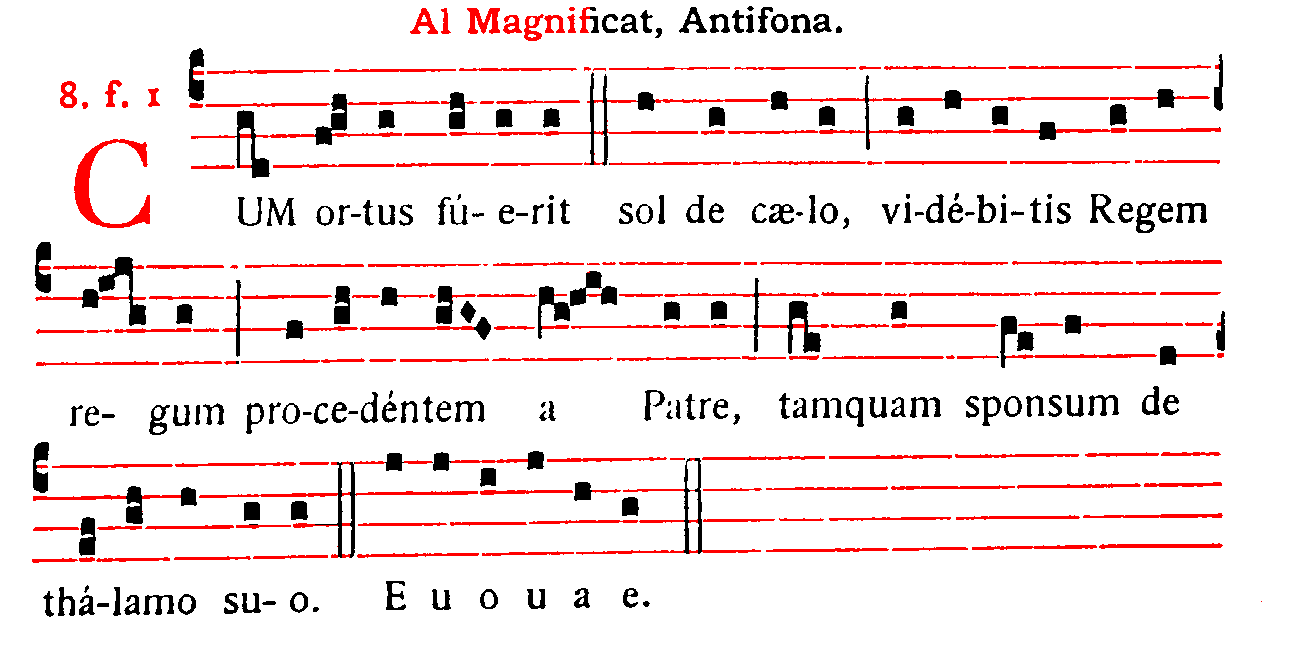
An ancient Gregorian chant compares sunrise on Christmas morning to Christ coming out of his bedroom to join in mystical marriage with people who love him:

“When the sun shall have risen in the heavens, ye shall see the King of Kings coming from the Father, as a Bridegroom from his bride-chamber.” *

The erotic, even homoerotic, words translate a Latin liturgical antiphon for First Vespers on Christmas Day: “Cum ortus fuerit sol de Caelo, videbitis Regem regum procedentem a Patre, tanquam sponsum de thalamo suo.”


“To start the Christmas season, the Church uses an image of the Son emerging from the marital bliss of the Godhead's bridal suite. It has God himself in a same-sex marriage! And in case we missed the antiphon, it is repeated in the liturgy the following day,” says Kevin Elphick, a Franciscan scholar and a supervisor on a suicide prevention hotline in New York.

The text is apparently a Christian adaptation of Psalm 19: 4-5: “In the heavens God has pitched a tent for the sun. It is like a bridegroom coming out of his chamber, like a champion rejoicing to run his course.”

Elphick points out that nuptial intimacy among the Persons of the Trinity might seem surprising, but is part of a long tradition about the Trinity. Sixteenth-century Spanish mystic John of the Cross expressed it well in his “Romance sobre el Evangelio,” where he describes the Trinity as Lover, Beloved and Love. Medieval Belgian theologian William of Saint-Thierry calls the Holy Spirit the “Kiss” and “Embrace” of the first two Persons of the Trinity. Medieval Dutch mystic Hadewijch of Brabant names the mutual unity of all three Persons as their common “Kiss” in her writings.

Episcopalian priest Robert Farrar Capon described the Holy Spirit as the magical marital “Bed” of the Trinity his book “Health, Money, and Love.” He writes: “Once before all time, there was a Lover, a Beloved, and a magical Bed in which they played out the unity of their love. The joy of the two of them in that Bed was complete: there was nothing besides their love, and there was nothing they needed to make their happiness more perfect.” His use of the word “Bed” parallels the “bridal chamber” in the ancient Christmas antiphon.

The Latin uses the word “thalamo” for the bridal chamber. Elphick reports that the Latin Vulgate Bible uses the same word in the marital chamber context in Psalm 18:6 and Joel 2:16. The word is related to the bedroom in both Latin and Greek (thálamos).

The chant is especially suitable for sunrise on Christmas morning because it draws on another ancient tradition connecting Christ with the sun. The lines in Psalm 19 about the sun being like a bridegroom were popular with early Christians. They associated it with the early Christian custom of praying while facing east, the direction of Christ’s ascension and second coming.  The star that led the Magi to the baby Jesus also rose in the east.

The text and plainsong melody of the chant are anonymous, but it was put into more elaborate musical settings by Renaissance composers whose names are known: Flemish composer Nicholas Gombert (c1490 - 1561) and English composer Thomas Tallis (c1505 - 1585). Gombert’s version is performed by the Tallis Singers on the album “Nicolas Gombert: Magnificats 1-4.” The Tallis version is on the album “Christmas Vespers at Westminster Cathedral.” (However the English text introducing the Westminster album conveniently deletes the erotic part of “Cum ortis”!)

Gombert, who was master of the children’s choir at the imperial chapel, was convicted of sexual contact with a boy in his care and was sentenced to hard labor in the galleys in 1540. It is said that during his years of punishment he wrote eight Magnificat settings, including the “Cum ortus fuerit” chant, as an offering to Holy Roman Emperor Charles V. The emperor was so moved by Gombert’s music that he pardoned the composer and granted him and early release.

___
* The chant is translated into contemporary English in “An Introduction to Gregorian Chant, Volume 1” by Richard L. Crocker:
When the sun has risen in the sky,
you will see the king of kings proceeding from the Father,
like a bridegroom out of his chamber.

____
This post is part of the Queer Christ series by Kittredge Cherry at the Jesus in Love Blog. The series gathers together visions of the queer Christ as presented by artists, writers, theologians and others.

Copyright © Kittredge Cherry. All rights reserved.
http://www.jesusinlove.blogspot.com/
Jesus in Love Blog on LGBT spirituality and the arts

Thursday, September 12, 2013

Gay artist paints "Intimacy with Christ": Richard Stott reflects on sensual spirituality

Detail from “Intimacy with Christ 3” by Richard Stott

A gay man’s intimacy with Christ is expressed in new art and writing by Richard Stott, a Methodist minister and art therapist in Sheffield, England.

Three large paintings that unite sexuality and spirituality emerged from Stott’s prayer life and meditations on the medieval Christian mystics, especially the poem “The Dark Night of the Soul” by Saint John of the Cross.

“They reach towards the experience of a deep and intimate engagement with Christ. They are not about sex per se but there is an erotic aspect to them. Sexual desire, our desire for the other, to be close to them and entwined with them is, to my mind, an echo of our desire for God and God’s desire for us. In the Christian tradition that is expressed in God coming close to us in the body of Christ,” Stott writes.

“Intimacy with Christ” triptych by Richard Stott on display

The triptych debuted in June at Hidden Perspectives, an arts festival for “bringing the Bible out of the closet” in Sheffield. Stott also posted reflections on each of the paintings at his blog, I Ask for Wonder: Exploring Art, Spirituality and Sacred Spaces in Sheffield and Beyond…. He agreed to share his work here at the Jesus in Love blog.

His first reflection is reprinted below in full, followed by summaries of his other two essays. Images have been cropped for a general audience. The paintings are oil and gold leaf on canvas, measuring approximately 24 by 31 inches.

Detail from “Intimacy with Christ 2” by Richard Stott (for full image click here)

“He touches my neck and all my senses are suspended”
By Richard Stott

Recently I have been stunned by a famous poem by St John of the Cross from his work ‘The Dark Night of the Soul’. In the poem he writes of a spiritual encounter that is deep, beyond words and expresses it in the sensual language of physical intimacy:

Wind blew down from the tower,
Parting the locks of his hair.
With his gentle hand
He wounded my neck
And all my senses were suspended.

I lost myself. Forgot myself.
I lay my face against the Beloved’s face.
Everything fell away and I left myself behind,
Abandoning my cares
Among the lilies, forgotten.

You can read a translation of the whole poem here.

When I read these words echoing down through the years from this 16th Century Spanish mystic I was cut to the heart as they resonate so strongly with my experience of Christ.

I need to take care here as I don’t want to universalise my experience, to imply that everyone should have the same kind of encounter. For some people the idea of relating to Christ at all is unhelpful. Furthermore, many people who do seek to engage with him may very well not do so in the same way as me and nor should they because we each need to work out our own way of engaging with the world and the transcendent. So take my reflections as what they are: the particular experience of a gay Christian using contemplative prayer to engage with Jesus.

One of the key ideas in Christianity, that the church often doesn’t realise the full implications of, is that Jesus had a body. This faith isn’t about some vague spiritual thing wafting around but is about material things and is expressed in a real human body (And whether the stories of Jesus are historically factual or not is irrelevant to me on this because the truth expressed in the myth* of the gospel stories is that the Christian faith is about a real body).

If Jesus had a body then he had blood, mucus, hormones and all kinds of dirty, messy and beautiful things that make us human. He had drives and desires and was a sexual being. When I first thought of this it seemed scandalous to me. I was in a little Catholic Church on the pilgrim road to Santiago de Compostela in Spain. I looked up at the sculpture of Jesus on the cross, his beautiful body twisted and taut in pain or ecstasy and I felt desire for him, a desire for the body of Christ. I wanted to touch his body and be touched by him, to possess him and be possessed by him and in that mutual possession be transformed. I had unwittingly stumbled on and tentatively touched that deep and sensuous spiritual experience expressed by St John of the Cross.

Over the last few months I have been working on some very personal paintings that explore this experience of Jesus and I will offer reflections on each of them over the next few weeks. I share them with some trepidation as it feels like I’m exposing something of my soul but it seems to me that the artists journey is a continual breaking oneself open as we seek to express truths that lie beyond the reach of words.

The golden numinous in each of the paintings is reminiscent of orthodox Christian icons. Icons are not used as idols or objects of worship but are windows to look through so that we may glimpse the divine. I hope these paintings may, in a small way, be windows that open up our horizons and the possibilities of understanding ourselves and of the beautiful transcendent reality that I find embodied in the person of Jesus.


*myth is not a pejorative term but means a story that expresses a truth – often universal truths about human nature and experience
_____________

That concludes Stott’s first essay. Use the following links for his reflections on the other two paintings in his “Intimacy with Christ” triptych.

You are in me and I am in you by Richard Stott explores how the risen Christ invited his friend Thomas to confirm the resurrection by touching his wounds. In another part of the Bible Christ promised “an intimate and passionate intertwining.” This embodied faith is also reflected in a prayer by Symeon the New Theologian.

Lover and beloved moved in unison” by Richard Stott looks at sexual desire as “one of the tributaries of the soul that leads to the wider desire for God.” This yearning is expressed in the Eucharist, the poetry of John of the Cross, and the ecstasy of Teresa of Avila.

Detail from “Intimacy with Christ 1” by Richard Stott (for full image click here)

___
Related links:

New Rainbow Crucifix and Rainbow Madonna unveiled by Richard Stott

Queer Creation by Richard Stott

An Erotic Encounter with the Divine by Eric Hays-Strom (Jesus in Love)

Erotic Christ teacher speaks: We are the erotic body of Christ (Hunter Flournoy at Jesus in Love)

Erotic Christ / Rethinking Sin and Grace for LGBT People (Patrick Cheng at Jesus in Love)
____
This post is part of the Queer Christ series by Kittredge Cherry at the Jesus in Love Blog. The series gathers together visions of the queer Christ as presented by artists, writers, theologians and others. More queer Christ images are compiled in my book Art That Dares: Gay Jesus, Woman Christ, and More.

Copyright © Kittredge Cherry. All rights reserved.
http://www.jesusinlove.blogspot.com/
Jesus in Love Blog on LGBT spirituality and the arts

Saturday, July 30, 2011

Jacob and the angel: Wrestling to reconcile body and spirit

“Jacob Wrestling with the Angel” by Leon Bonnat (1876) via Wikimedia Commons


When Jacob wrestled with the angel in the Bible, they embodied the struggle between sexuality and spirituality. Artists have created many homoerotic images of the scene over the centuries.

The story of Jacob wrestling (Genesis 32:24-31) is the Sunday lectionary reading for tomorrow (July 31).  It speaks to LGBT people and our allies.

Many have interpreted this story as a struggle between material and spiritual needs, but it is especially powerful for queer people who are trying to reconcile their sexuality and their faith. Jacob refused to give up the fight until he forced a blessing out of God. Like Jacob, LGBT people can also win God’s blessing by continuing to wrestle with our faith, regardless of those who condemn as sinners.

Jacob, ancestor and namesake of the Israelites, is alone one night when a mysterious stranger comes to him. Scripture refers to the stranger as a man, God, and an angel (Hosea 12:4). He wrestles with Jacob until dawn. Then the angel wants to leave, but Jacob insists, “I will not let you go, unless you bless me.”

The angel gives him a new name and identity as Israel, which can be translated as “one who has prevailed with God.” Jacob asks to know the angel’s name, but he just gives a blessing and leaves. Alone again, Jacob marvels, “I have seen God face to face and lived.”

Jacob is honored in Judaism, Christianity and Islam. For Christians, some see the pre-incarnate Christ himself as the mysterious stranger who wrestled with Jacob.

The story raises intriguing questions. What was the nature of the “wrestling” that went on all night long? Whether or not there was an erotic interaction, the friendly conclusion affirms that God wants to relate to human beings as equals. God rewards those who challenge God.

“Jacob and the Angel” by Hendrik Andersen, lover of Henry James. For the uncropped version (warning: full frontal nudity), visit Wikimedia Commons.
___
Related links:

Wrestling with God” at the Queering the Church Blog is a queer reflection on Jacob and the angel.

Click here for a gallery of art showing “Jacob Wrestling with the Angel” at Wikimedia Commons.

____
This post is part of the GLBT Saints series by Kittredge Cherry at the Jesus in Love Blog. Saints, martyrs, mystics, prophets, witnesses, heroes, holy people, humanitarians, deities and religious figures of special interest to lesbian, gay, bisexual and transgender (LGBT) and queer people and our allies are covered on appropriate dates throughout the year.

Copyright © Kittredge Cherry. All rights reserved.
http://www.jesusinlove.blogspot.com/
Jesus in Love Blog on LGBT spirituality and the arts
Wednesday, April 27, 2011

22. Jesus Returns to God (Gay Passion of Christ series)

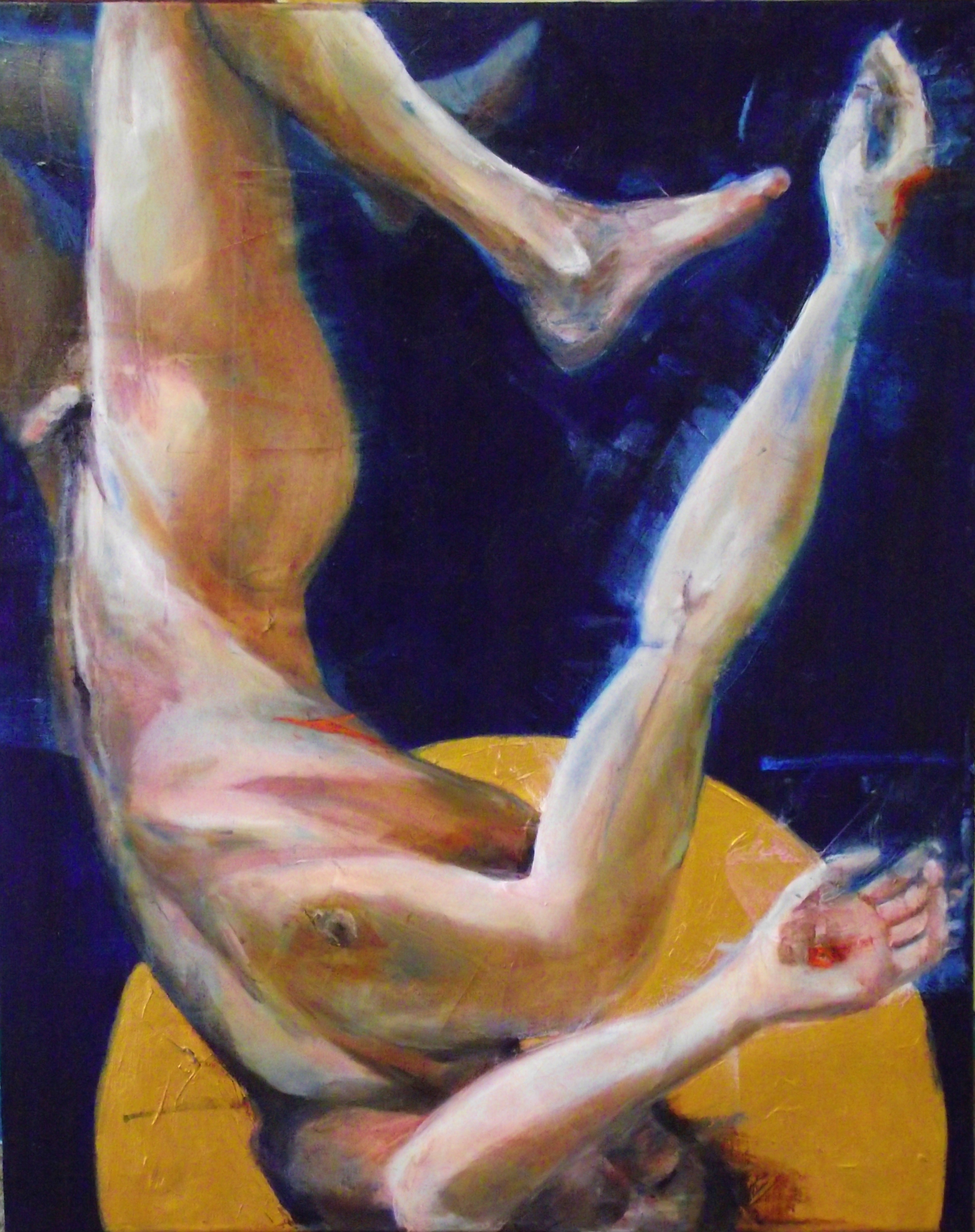
22. Jesus Returns to God (from The Passion of Christ: A Gay Vision) by Douglas Blanchard

“As the bridegroom rejoices over the bride, so shall your God rejoice over you.” -- Isaiah 62:5 (RSV)

We can only imagine the bliss that Jesus felt when he returned to God. No words or pictures can express all the joy of a soul’s union with the divine, but some have compared it to sexual ecstasy or marriage. Perhaps for Jesus, it was a same-sex marriage. Jesus drank in the nectar of God’s breath and surrendered to the divine embrace. They mixed male and female in ineffable ways. Jesus became both Lover and Beloved as everything in him found in God its complement, its reflection, its twin. When they kissed, Jesus let holy love flow through him to bless all beings throughout timeless time. Love and faith touched, justice and peace kissed. The boundaries between Jesus and God disappeared and they became whole: one Heart, one Breath, One. We are all part of Christ’s body in a wedding that welcomes everyone.

Jesus, congratulations on your wedding day! Thank you for inviting me!

___
Bible background
Psalm 85:10: “Righteousness and peace will kiss each other”

Song of Songs: “O that you would kiss me with the kisses of your mouth!”


Other resources
Jesus in Love: A Novel by Kittredge Cherry

EroticBodyOfChrist.org
___
Next: 23. The Holy Spirit Arrives

This is part of a series based on “The Passion of Christ: A Gay Vision,” a set of 24 paintings by Douglas Blanchard, with text by Kittredge Cherry

Click to go to the beginning
or view the whole series.

Scripture quotation is from Revised Standard Version of the Bible, copyright © 1946, 1952, and 1971 National Council of the Churches of Christ in the United States of America. Used by permission. All rights reserved.

Bookmark and Share

Thursday, August 26, 2010

Queer disciples in the Bible?

Detail from “The Last Supper” by Becki Jayne Harrelson, beckijayne.com

“Dandy Discipleship: A Queering of Mark’s Male Disciples” by New Zealand theologian Robert J. Myles was published recently in a scholarly journal.

The article appears in the June issue of “The Journal of Men, Masculinities and Spirituality,” an online scholarly, peer-reviewed journal.

Myles, a graduate student in the School of Theology at the University of Auckland, challenges the assumption of heterosexuality in the Bible and tries to liberate the scriptures from sex-negative misinterpretations. He does this by purposely rereading three Gospel stories in sexual (and homosexual) ways.

For example, he gives a homoerotic twist to the call of the disciples (Mark 1:16-20): “While cruising the seashores of Galilee, Jesus began his ministry by fetching a number of seemingly attached men to join his cohort of male admirers….Upon enticing them, they immediately left their father and their livelihood, to elope with the alluring Jesus.”

The article also offers queer versions of two other stories. Myles reexamines the disciples’ argument about “who is greatest” (Mark 9:33-37) in light of the male obsession with penis size. Then he looks at the arrest of Jesus (Mark 14:43-52) by focusing on “the erotic texture of the betraying embrace” -- the scandalous kiss between two men, Judas and Jesus -- and the possibility that the mysterious naked youth in the story was a prostitute.

Myles is not trying to prove that the historical disciples were gay, but instead to present queer disciples as one valid possibility. “The ultimate goal is for the reconstruction of the biblical text in order that it is a redeeming text for all, rather than just redeeming for some,” he states in the conclusion. By liberating the scriptures with his queer approach, Myles hopes that the Bible may continue to liberate its readers.

Throughout the article, Myles uses a method of queer and gender criticism pioneered by theologian Marcella Althaus-Reid, author of “The Queer God” and “Indecent Theology.”

Myles admits that “the queer imagination deliberately transgresses normalcy in order to destabilize.” But there’s a reason for it. He sums up the purpose -- and the human condition -- with eloquent clarity: “Normalcy, as an ideological means of control, obscures our perception of reality.”

The full article is available online at:
http://www.jmmsweb.org/issues/volume4/number2/pp66-81
___

The image above is a detail from “The Last Supper” by Becki Jayne Harrelson, an Atlanta artist who challenges mainstream religious beliefs via art. The painting is a tribute to Da Vinci and Caravaggio, but Harrelson’s multiracial version includes a drag king in the background! All Harrelson’s models are LGBT people in real life.

Bookmark and Share

Tuesday, February 09, 2010

Conjuring Jesus poems: Homoerotic taste of heaven


A vibrantly alive Jesus, complete with homoerotic desires, emerges from the poetry of Brian Day in his new book “Conjuring Jesus.”

From the very first poem, Day delves into the bisexuality that Jesus inherited from his ancestor King David. Some of the most wonderful poems present what I call a “gay Jesus.” He bonds with his male Beloved, sits beside a near-naked young man, gets trapped in gay love triangle with Judas, and endures the humiliation of being called “faggot.” In “Better Not to Marry” (reprinted below), Jesus praises the “unmarrying brand of men” that God created.

Day, a Toronto teacher, conjures up a Jesus who is both sexual and spiritual, “wholly versatile” and “an unscrupulous party boy” who eats and drinks with sinners. Day distills the essence of Jesus in a sensuous, playful way that remains true to the human spirit and to the spirit of the gospels. His poems liberate the soul with a fresh, unrestricted view of Jesus.

The 49 short poems in this slim volume work both as literature and as devotional reading for the open-minded. They are arranged to follow Jesus from his baptism through his death and resurrection, with parables and miracles sprinkled throughout.

Like Day, I wrote about a queer Christ in my “Jesus in Love” novels. I know how hard it is to “conjure” a Jesus who is erotically alive while transcending all categories of male or female, gay or straight, God or human. I appreciate the deft style with which Day accomplishes the task. For example, in “Jesus, Versatile” he manages to convey Jesus’ own ecstatic union with God, “entering, entered, everywhere at once.”

Day’s best poems, and there are many, focus on emotion and embodiment. Readers will either love or hate the few poems that stray into other territory, such as equating Jesus with Mohammad and Buddha. I personally enjoyed the poem where Jesus and Krishna “meet as bridegrooms long promised to each other.” I look forward to his next project, which will blend homoerotic and interfaith themes.

Since Day writes so well about men, perhaps it is inevitable that some of his poems about women are less satisfying. I do object to his repeated and distracting use of “man” to refer to all people.

I read “Conjuring Jesus” at bedtime, a few poems per night. They sweetly opened my heart before I closed my eyes for a good night’s sleep. It’s also suitable to read “Conjuring Jesus” right alongside the Bible, thanks to a list of Biblical references for each poem at the end of the book.

Day writes of a Jesus who offers “the pleasures of sliding into our own promised land -- this delicious, indiscriminate view of heaven.” I recommend that you taste heaven now by reading “Conjuring Jesus.”
___
Click here to read the poem “Better Not to Marry” from the new book.

___
Related links:
Brian Day: Homoerotic interfaith poetry book explores “lust for the holy”
(Jesus in Love review of Brian Day's 2013 book "The Daring of Paradise")

___
“Conjuring Jesus”
By Brian Day
Guernica Editions
ISBN: 1550712748
Paperback, $13, 96 pages

Poem: “Better Not to Marry” by Brian Day

Special thanks to Brian Day for permission to post the following poem from his new book “Conjuring Jesus.”

Better Not to Marry
by Brian Day

Jesus, speaking to his intimate
circle of friends, assures them
it’s better not to marry
but to wander unfamilied
in the company of men. He calls
his merry band to not-marry
with him, and conceives
of a Creator who, from the womb,
fashions this unmarrying brand of men
and calls them as prophets
in the birth of a kingdom.

Jesus extols the flexible eunuch
who sets aside his masculine habits
and surrenders himself to the wills
of men. He wishes all his followers
to be men and eunuchs, blessed
with that angelic ambiguity
of gender as they are entered
and enter the gates of heaven.

Jesus looks forward to that far
resurrection when marriage itself
will be finally moulted
and all will float freely
as bachelors and boys.
They’ll drift promiscuous
through heavenly forms,
their bodies as permeable
and as shimmering as words.

___
Biblical references: Matthew 19:10-12, 22:29-30

___
Related links:
Brian Day: Homoerotic interfaith poetry book explores “lust for the holy”
(Jesus in Love review of Brian Day's 2013 book "The Daring of Paradise")

___
“Better Not to Marry” appears in the book “Conjuring Jesus” by Brian Day. He studied at Trent University and the University of Toronto. Day is the author of “Love is Not Native to My Blood” (2000) and “Azure” (2004), both published by Guernica Editions. He teaches in Toronto.

Click here for Kittredge Cherry’s review of “Conjuring Jesus.

Thursday, July 24, 2008

Homoerotic Jesus T-shirt found -- what fun!


A homoerotic baptism of Christ T-shirt caught the eye of a New York blogger -- and made me laugh when I read his account. Here’s his story, reposted by permission from the fourfour blog.

“The fact stands that Wildwood, NJ, can still turn out a hell of a T-shirt. Witness the best T-shirt in the history of them. OMG, you are so jealous of me and my homoerotic baptism of Christ decal. I wanted this on black, and the girl was going to do it, but her Middle Eastern boss was like, "Will not show. For male, white or gray." I compromised with pink. No one seemed amused. Whatever. It's the best T-shirt in history. I dare you to present a better one. You have already failed. The Bible says it, I believe it, that settles it!”

Need we say more? As I wrote in the introduction to my book Art That Dares: Gay Jesus, Woman Christ, and More: “Certain scenes from the life of Jesus have fired queer imaginations, [including] the male-on-male water-play of Jesus’ baptism...”

A special thanks to Rich Juzwiak of the fourfour blog for sharing his story here. Visit his blog to read the many comments from others who admired the gay Jesus T-shirt, plus his truly scary photos of an amusement park not far from the T-shirt shop in south Jersey.

Close-up of the homoerotic baptism of Christ T-shirt