Showing posts with label Bible. Show all posts

Monday, June 06, 2016

Homosexuality of Jesus explored by 18th-century philosopher Jeremy Bentham


Biblical arguments for LGBT rights and a queer Jesus may seem like new ideas, but they were pioneered about 200 years ago by an influential British philosopher -- in writings that were never published until recently.

Philosopher Jeremy Bentham (1748 - 1832) presented Biblical evidence for Jesus’ homosexuality as part of his theological defense for same-sex love in “Not Paul, but Jesus Vol. III.” It was published for the first time in 2013 and is freely available to download or view online. He died on this date (June 6) in 1832.

For a new version of this article, click this link to Qspirit.net:
Homosexuality of Jesus explored by 18th-century philosopher Jeremy Bentham


Bentham didn’t dare publish it during his lifetime because he feared being labeled a “sodomite” himself. At the time “buggery” was punished with death by hanging in England.

This champion of sexual freedom was far, far ahead of his time. “Not Paul, but Jesus” lays out many of the same arguments that are still used today by LGBT Christians and our allies: debunking the scriptures typically used to condemn LGBT people and pointing out that Jesus never said anything about homosexuality. Bentham goes on to present an idea that many still consider blasphemous. He suggests that Jesus had male-male sexual relationships.

Bentham wrote the book so long ago that the word “homosexuality” had not been invented yet. Instead he has a chapter titled “The eccentric pleasures of the bed, whether partaken of by Jesus?” His language may sound quaint, but his ideas are right on target for today. Bentham himself struggled with words for what we call homosexuality, deliberately creating new vocabulary so he could avoid the negative connotations associated with the terminology of his day (sodomy, buggery, perversion, etc.).

Bentham is best known as the founder of Utilitarianism, a philosophy that advocates “the greatest happiness of the greatest number of people” A respected thinker during his lifetime, Bentham was also far advanced on a wide range of other legal, economic and political issues. He coined the word “international.” He was one of the first proponents of animal rights. He supported women’s equality and opposed slavery and capital punishment. He corresponded with various world leaders, including US presidents Jefferson and Madison. Several South and Central American nations sought his advice in creating their constitutions and legal codes. Born and raised in a devout Anglican family in London, he became an agnostic who believed that religion was an instrument of oppression. His solution was separation of church and state.

In the third volume of “Not Paul, but Jesus Vol. III,” Bentham corrects false interpretations of what would later come to be called the “clobber passages.” He identifies the sin of Sodom as gang-rape. He puts the sexual prohibitions of the Hebrew scriptures into historical context, pointing out that many of the other taboos are no longer enforced.

He dismisses Paul’s condemnations of homosexuality as an asceticism not shared by Jesus himself. He sees romantic love between Old Testament heroes Jonathan and David -- and possibly between Jesus and his beloved disciple John, noting that the Bible reports their loving touch without condemnation.

Bentham goes on to analyze the account in Mark’s gospel of “the stripling in the loose attire” (now usually known as “the naked young man”) at the arrest of Jesus -- a passage that continues to fuel 21st-century speculations in the LGBT community. He urges readers to consider the most “probable interpretation” for the nakedness. (In a different manuscript he made it clear that the youth was probably a male prostitute loyal to Jesus.) Bentham even hints that Jesus was killed for homosexuality, asking readers to consider what interaction with a naked man could be “so awful” that it leads to cruel execution.

Pro-LGBT Christians today often note that Jesus never said anything against homosexuality. Bentham makes the same point in his own elaborate way, with sentences such as: “In the acts or discourses of Jesus, had any such marks of reprobation towards the mode of sexuality in question been to be found as may be seen in such abundance in the epistles of Paul—in a word, had any one decided mark of reprobation been so to be found as pronounced upon it by Jesus, in the eyes [of] no believer in Jesus could any such body of evidence as hath here been seen [to] present itself be considered as worth regarding.”

Indeed Bentham's main purpose in all three volumes of “Not Paul, but Jesus” is to show the error in following the ascetic Paul instead of the true Christianity of the more tolerant Jesus, who accepted the human pursuit of pleasure. This concept is introduced in the first volume of “Not Paul, but Jesus” was published in 1823. Fearing hostile reactions, Bentham used the pseudonym Gamaliel Smith. The second volume, which deals with the early church, and the third volume, which focuses on sexual morality, remained unpublished.

Bentham wrote more than 500 pages explaining his liberal views on homosexuality during the last 50 years of his life.  Some of these documents may have circulated among his followers, but none of it was published during his lifetime.

The first Bentham writings on homosexuality to be published were primarily secular. His 1785 essay “Offences Against One's Self: Paederasty” is considered the first document arguing for decriminalization of homosexuality in England. He reasoned that consensual sex between same-sex partners should not be punished because it does not harm anyone. The essay was not published until 1931, when a fragment first appeared in print. The full essay was finally published in 1978.

Only now are Bentham’s writings on Jesus and homosexuality coming to light. The third volume of “Not Paul, but Jesus” was not published in any form until 2013. It was released last year by the Bentham Project at University College London, which counts him as its spiritual father.

In January 2014 Bentham’s own overview of the “Not Paul, but Jesus, Volume 3” appeared as a chapter in a book published by Oxford University Press: “Of Sexual Irregularities, and Other Writings on Sexual Morality” by Jeremy Bentham. (More info at: http://ukcatalogue.oup.com/product/9780199685189.do)

A section on “Jesus’s Sexuality” is also included in the 2012 article “Jeremy Bentham: Prophet of Secularism” by Philip Schofield, director of the Bentham Project. He draws on the “Not Paul” book and another set of manuscripts to draw powerful conclusions such as this:

Bentham claimed that, unlike Paul, Jesus did not, according to any account that appeared in the four Gospels, condemn either the pleasures of the table or the pleasures of the bed. On the contrary, Jesus’s opposition to asceticism was shown in his condemnation of the Mosaic law in Matthew 9: 9–17…. Bentham pointed out that Paul’s most forceful condemnation was directed towards homosexuality. Bentham responded that not only had Jesus never condemned homosexuality, but that he had probably engaged in it. There were, moreover, many females in Jesus’s immediate circle, and again Bentham saw no reason why Jesus might not have engaged in heterosexual activity as well.

Although Bentham doggedly defended consensual sexual activity between same-sex couples for half a century, his own love life remains a mystery. The son of a wealthy lawyer, he was a child prodigy who grew up to be a brilliant and eccentric recluse, living alone in London in what he called “a state of perpetual and unruffled gaiety.” He referred to his home as his “hermitage.” He lived there with a “sacred teapot” called Dicky, a favorite walking stick named Dapple, and a beloved tom cat addressed as the Reverend Doctor John Langborn. He declared, “I love everything that has four legs,” and allowed a colony of mice to share his office. One study concludes he had Asperger Syndrome, a high-functioning form of autism. Check this link for an 1827 description of Bentham’s eccentricities.

The philosopher’s influence continued to grow after his death as his supporters spread his ideas. Most of what is now known as liberalism is rooted in Bentham’s philosophy. His diverse followers included economist John Stuart Mill and feminist firebrand Frances “Fanny” Wright, who once exclaimed in a poem, “Oh had I but the Lesbyan's lyre, / Blue-eyed Sappho's fervid strain, / Then might I hope thy blood to fire…”.

Contemporary queer theologians such as Robert Shore-Goss have recognized him too. Shore-Goss writes a section about Bentham in the chapter on “Christian Homodevotion to Jesus” in his book “Queering Christ: Beyond Jesus Acted Up.”

During his 84 years Bentham wrote manuscripts totaling more than 5 million words, and many remain unstudied and unpublished. The Bentham Project is busy recruiting volunteers worldwide to transcribe them. More words of wisdom are likely to emerge from this prophet of LGBT rights who once summed up his approach to life by saying: “Create all the happiness you are able to create: remove all the misery you are able to remove.”

Not Paul, but Jesus Vol. III by Jeremy Bentham, edited by Philip Schofield, Michael Quinn and Catherine Pease-Watkin, is now freely available to download or view online at:
http://blogs.ucl.ac.uk/bentham-project/2013/04/30/not-paul-but-jesus-vol-iii/

___
Image credit: Jeremy Bentham engraving by J. Thomson, from a painting by W. Derby (courtesy of the Bentham Project)

___
Related links:
Top 20 Gay Jesus books (from Jesus in Love)

___

Special thanks for tips and background info from Mitch Gould, Walt Whitman scholar and curator of LeavesOfGrass.org

____
This post is part of the LGBTQ Saints series by Kittredge Cherry. Traditional and alternative saints, people in the Bible, LGBTQ martyrs, authors, theologians, religious leaders, artists, deities and other figures of special interest to lesbian, gay, bisexual and transgender and queer (LGBTQ) people and our allies are covered. It is also part of the Queer Christ series by Kittredge Cherry at the Jesus in Love Blog. The series gathers together visions of the queer Christ as presented by artists, writers, theologians and others.

Copyright © Kittredge Cherry. All rights reserved.
http://www.jesusinlove.blogspot.com/
Jesus in Love Blog on LGBT spirituality and the arts


Sunday, February 28, 2016

Peter Gomes: Gay black Harvard minister preached "scandalous gospel"


For a new version of this article, click this link to Qspirit.net:
Peter Gomes: Gay black Harvard minister preached "scandalous gospel"


“The Rev. Peter Gomes, of Plymouth, 1942 – 2011” by Jon Dorn

Peter Gomes was a gay black Baptist minister at Harvard and one of America’s most prominent spiritual voices for tolerance. He used his national celebrity as a “gay minister” to make the religious case for LGBT people, even though he reportedly disliked the label. He died at age 68 on this date (Feb. 28, 2011).

A man of many contradictions, Gomes became a Democrat in 2007 after decades as a conservative Republican. He even gave the benediction at President Ronald Reagan’s second inauguration in 1985 and preached at the National Cathedral for the inauguration of Reagan’s successor, George Bush.

Gomes (May 22, 1942 - Feb. 28, 2011) was born in Boston to a black African immigrant father and a mother from Boston’s African American upper middle class. He grew up in Plymouth, Massachusetts.  He studied at Bates College (where a chapel was named after him in 2012) , earned a divinity degree at Harvard University, and taught Western civilization at Tuskegee Institute in Alabama for two years before returning to work at Harvard in 1970. Four years later he became the first black person to serve as chief minister to Harvard. He held the positions of Pusey minister at Harvard’s Memorial Church and Plummer professor of Christian morals for the rest of his life.

He came out publicly as “a Christian who happens as well to be gay” at a student rally in 1991 after a conservative student magazine at Harvard published a condemnation of homosexuality.  “I now have an unambiguous vocation -- a mission -- to address the religious causes and roots of homophobia,” he later told the Washington Post. “I will devote the rest of my life to addressing the 'religious case' against gays.”

In his 1996 best-seller, “The Good Book: Reading the Bible with Mind and Heart,” he showed how the Bible was misused to defend homophobia, racism, anti-Semitism and sexism.

His 2007 book “The Scandalous Gospel of Jesus: What's So Good About the Good News?” went on to show that Jesus was a subversive whose radical gospel always overturns the status quo.

Among Gomes’s many admirers is artist Jon Dorn, who drew the portrait at the top of this post. Dorn is a cartoonist, filmmaker, and Master of Fine Arts student at Emerson College in Boston. He also serves on the Plymouth Cultural Council.


A musical tribute to Gomes is “I Beseech You Therefore, Brethren” by composer Craig Phillips, music director at All Saints’ Episcopal Church in Beverly Hills. It was originally commissioned by members of Harvard’s Class of 1978 to celebrate Gomes' retirement, but he died before its premiere so it was sung at his memorial. The anthem has become a memorial to Gomes' legacy. It is included on the 2014 album “Spring Bursts Today: A Celebration of Eastertide” by Harvard University Choir. Gomes himself selected the text, which was one of his favorite scriptures:

“I beseech you therefore, brethren, by the mercies of God that ye present your bodies a living sacrifice, holy, acceptable unto God, which is your reasonable service. And be not conformed to this world: but be ye transformed by the renewing of your mind, that ye may prove what is that good and acceptable and perfect will of God.” (Romans 12:1–2)

Gomes’ blend of scholarship, wisdom and accessibility is expressed in a few selected quotations:

“Hell is being defined by your circumstances, and believing that definition.” -- Peter Gomes

“The question should not be ‘What would Jesus do?’ but rather, more dangerously, 'What would Jesus have me do?'” -- Peter Gomes in The Scandalous Gospel of Jesus: What's So Good About the Good News?

“To some, the temporal triumph of the Christian community in the world is a sign of God's favor and the essential righteousness of the Christian position. The irony of the matter, though, is that whenever the Christian community gains worldly power, it nearly always loses its capacity to be the critic of the power and influence it so readily brokers.” --Peter J. Gomes in The Scandalous Gospel of Jesus: What's So Good About the Good News?

“The battle for the Bible, of which homosexuality is the last front, is really the battle for the prevailing culture, of which the Bible itself is a mere trophy and icon. Such a cadre of cultural conservatives would rather defend their ideology in the name of the authority of scripture than concede that their self-serving reading of that scripture might just be wrong, and that both the Bible and the God who inspires it may be more gracious, just and inclusive than they can presently afford to be.” -- Peter Gomes in The Good Book: Reading the Bible with Mind and Heart

___
Books by Peter Gomes include:

The Good Book: Reading the Bible with Mind and Heart

The Scandalous Gospel of Jesus: What's So Good About the Good News?

Sermons: Biblical Wisdom For Daily Living

The Good Life: Truths that Last in Times of Need

Strength for the Journey: Biblical Wisdom for Daily Living

___

Related links:

Peter Gomes at LGBT Religious Archives Network

Rev. Peter Gomes: The Accidental Gay Advocate (Irene Monroe at HuffPost)

Gay, Black, Republican, Baptist Preacher, Rev. Peter Gomes, 1942-2011 (Candace Chellew-Hodge at Religion Dispatches)

Rev. Peter J. Gomes Is Dead at 68; A Leading Voice Against Intolerance (New York Times)

Video: Peter Gomes discusses: Would Jesus Support Gay Marriage? (also posted below)


___
This post is part of the LGBTQ Saints series by Kittredge Cherry. Traditional and alternative saints, people in the Bible, LGBTQ martyrs, authors, theologians, religious leaders, artists, deities and other figures of special interest to lesbian, gay, bisexual and transgender and queer (LGBTQ) people and our allies are covered.

Copyright © Kittredge Cherry. All rights reserved.
Qspirit.net presents the Jesus in Love Blog on LGBTQ spirituality.

Tuesday, December 29, 2015

David and Jonathan: Love between men in the Bible


For a new version of this article, click this link at Qspirit.net:
David and Jonathan: Love between men in the Bible

David and Jonathan window (detail) from St. Mark's Portobello, Edinburgh, Scotland, 1882

Love between men is celebrated in the Bible with the story of David and Jonathan. They lived about 3,000 years ago, but they still inspire LGBT people of faith -- and many others. David’s feast day is today (Dec. 29).

The two men met when David was a ruddy young shepherd.  Jonathan, a courageous warrior, had returned victorious from battle.  Jonathan was the eldest son of Saul, Israel’s first king. David was taken to see King Saul right after beheading the Philistine giant Goliath. Scholars estimate that David was about 18 and Jonathan was at least 10 years older.

Jonathan fell in love at first sight of the handsome young hero. As the Bible says, “The soul of Jonathan was knit to the soul of David.” Their story gets more chapters in the Bible than any other human love story.

David, the second king of Israel, was an acclaimed warrior, musician and poet. He is credited with composing many of the psalms in the Bible. The gospel genealogies list David as an ancestor of Jesus.

The modern idea of sexual orientation didn’t exist in Biblical times, but the powerful love story of Jonathan and David in 1 and 2 Samuel suggests that same-sex couples are affirmed and blessed by God.

Sixteeenth-century Spanish mystic John of the Cross is one of the many writers who used their same-sex love as a model for divine love. “The love Jonathan bore for David was so intimate that it knitted his soul to David's. If the love of one man for another was that strong, what will be the tie caused through the soul's love for God, the Bridegroom?” John of the Cross asked in “The Spiritual Canticle.”

Artists throughout the ages have tried to capture the drama and passion of their story, beginning with the moment that David and Jonathan met.  A beautiful romantic version of their first meeting appears on their stained-glass window at St. Mark's Portobello, a Scottish Episcopal church in Edinburgh. The inscription states, “The soul of Jonathan was knit with the soul of David” (1 Samuel 18:1).

David and Jonathan window from St. Mark's Portobello, Edinburgh, Scotland, 1882

Created in 1882, the window has a dedication at the bottom: “In loving memory of George Frederick Paterson of Castle Huntly who died at Portobello, 30th Sept. 1890, aged 33.” All that is known about Paterson is that he was in the army and unmarried. The window was paid for by "a friend."

Another stained-glass window of David and Jonathan is located at Calvary Presbyterian Church in Indiana, Pennsylvania. It was created in the Tiffany style by Robert L. Dodge in 1906. The window is dedicated to the memory of John Sutton and A.W. Wilson, founders of Indiana University of Pennsylvania. It can be seen online at Stained Glass Resources Inc., which restored the window in 2000.


“Jonathan Greeting David, after David killed Goliath” by Gottfried Bernhard Goez, 1708-1774 (Wikimedia Commons)

Soon after David and Jonathan met, the two men expressed their commitment by making a covenant with each other. The dramatic moment is described in 1 Samuel 18:3-4: “Then Jonathan made a covenant with David, because he loved him as his own soul. Jonathan stripped himself of the robe that he was wearing, and gave it to David, and his armor, and even his sword and his bow and his belt.”

California artist Ryan Grant Long emphasizes the homoeroticism of the gesture as Jonathan strips off his robe and wraps it around David with a kiss on the neck in the image at the top of this post. For more about Long, see my previous post Artist paints history's gay couples.

“David and Jonathan” by Ryan Grant Long

Artist Brandon Buehring imagined both men stripped bare in a private encounter between Jonathan and David in his “Legendary Love: A Queer History Project.” He uses pencil sketches and essays “to remind queer people and our allies of our sacred birthright as healers, educators, truth-tellers, spiritual leaders, warriors and artists.” The project features 20 sketches of queer historical and mythological figures from many cultures around the world. He has a M.Ed. degree in counseling with an LGBT emphasis from North Carolina State University in Raleigh. He works in higher education administration as well as being a freelance illustrator based in Northampton, Massachusetts.

“Jonathan and David” by Brandon Buehring

A more traditional view is presented by 16th-century Italian painter Cima da Conegliano. In both images David is still carrying the head of Goliath as he bonds with his new friend Jonathan, hinting at the union of violence and eroticism.

“David and Jonathan” by Italian painter Cima da Conegliano, 1505-1510 (Wikimedia Commons)
“Jonathan Made
a Covenant with David”
by Trudie Barreras
Collection of
City of Light /
First Metropolitan
Community Church
of Atlanta

In contrast New Mexico artist Trudie Barreras shows the new friends both putting aside their armor to make a covenant with each other (left).

The Bible chronicles the ups and downs of David and Jonathan’s relationship over the next 15 years, including tears and kisses. King Saul is jealous of David's popularity and keeps trying to kill him, while his son Jonathan rescues his friend in various ways. An 18th-century German “friendship medal” (below) captures another highlight as Jonathan pledges to David, “I will do the desires of your heart” (“Ich will die thun was dein Herz begehrt”) from 1 Samuel 20:4.

German friendship medal of Jonathan and David by Philipp Heinrich Müller, c.1710 (Wikimedia Commons)

Other artists focus on a dramatic moment that came later when Jonathan met David at a pile (or "ezel") of stone to warn him that Saul intended to kill him. An 1860 woodcut by German artist Julius Schnorr von Carolsfeld illustrates that tearful farewell scene from 1 Samuel 20: 41-42:

"Then they kissed each other and wept together—but David wept the most. Jonathan said to David, “Go in peace, for we have sworn friendship with each other in the name of the Lord, saying, ‘The Lord is witness between you and me, and between your descendants and my descendants forever.’”

“David and Jonathan” woodcut for "Die Bibel in Bildern", 1860, by Julius Schnorr von Carolsfeld (Wikimedia Commons)

Detail from "David and Jonathan
at the Stone Ezel"
by Edward Hicks
Another version of the farewell scene was painted by American folk artist and Quaker minister Edward Hicks in 1847.  In both paintings a boy can be seen carrying away their weapons.  In the lower right Hicks places a scene of the Good Samaritan rescuing a downtrodden man.  Interestingly, the Jonathan and David window at St. Mark's Portobello is also paired with a window showing the Good Samaritan. Scholar Mitch Gould analyzes the painting for the Jesus in Love Blog in his article Biblical same-sex love found in “David and Jonathan” art by Edward Hicks.

"David and Jonathan at the Stone Ezel" by Edward Hicks, 1847

David and Jonathan became so close that it looked like someday they would rule Israel together. But that day never came because Jonathan was killed in battle. David mourned deeply for him with a famous lament.

There are many translations of 2 Samuel 1:26, each one expressing how the love between Jonathan and David was “greater than,” “more wonderful than,” “deeper than” or otherwise “surpassing the love of women.”

I grieve for you, Jonathan my brother;
you were very dear to me.
Your love for me was wonderful,
more wonderful than that of women.

The love between the two men is honored in a golden icon by Brother Robert Lentz. Unlike most images of Jonathan and David, the Lentz icon shows Christ above blessing their relationship. It is one of 10 Lentz icons that sparked a controversy in 2005 when conservative Roman Catholic leaders accused Lentz of glorifying sin.

Jonathan and David by Br. Robert Lentz, OFM
www.trinitystores.com

Contemporary gay Israeli artist Adi Nes gives shocking clarity to David and Jonathan by using images of homoeroticism and homelessness to subvert stereotypes about people in the Bible. The triumph of David over Goliath is often used to symbolize Israel’s military victories over its enemies, but Nes chooses to depict David as a vulnerable youth with a crutch, leaning on another young man for love and support. Dirty and unkempt, they embrace beneath an industrial overpass covered by graffiti. They look battered, perhaps from a gay bashing. The tender moment suggests the scenes when “the soul of Jonathan was knit to the soul of David” or when “they kissed each other and wept together.” (For more about Adi Nes, see my previous post “Gay Israeli artist Adi Nes humanizes Bible stories. “

“Untitled (David and Jonathan)” by Adi Nes

Gay-positive Bible scholars have written extensively about the relationship between David and Jonathan. The classic book on the subject is “Jonathan Loved David: Homosexuality in Biblical Times” by Thomas Horner.

Jonathan and David embrace.
Manuscript illustration, circa 1300
La Somme le roy
The love between the two men is also celebrated in literature, including the poem “The Meeting of David and Jonathan” by 19th-century English poet John Addington Symonds. He is known as an early advocate of male love (homosexuality) and wrote many poems inspired by his own homosexual affairs. In “The Meeting of David and Jonathan” he writes:

There by an ancient holm-oak huge and tough,
Clasping the firm rock with gnarled roots and rough,
He stayed their steps; and in his arms of strength
Took David, and for sore love found at length
Solace in speech, and pressure, and the breath
Wherewith the mouth of yearning winnoweth
Hearts overcharged for utterance. In that kiss
Soul unto soul was knit and bliss to bliss.

The full poem appears in “Many Moods: A Volume of Verse” by Symonds.

Epic same-sex love between David and Jonathan is fleshed out in the 2016 historical novel "The Prince's Psalm" by Eric Shaw Quinnby a New York Times-bestselling author. Beginning with young David slaying Goliath, the book shows how he won the heart of Prince Jonathan, heir to the throne of Israel. The star-crossed warrior-lovers face conflicts with King Saul and others as the Biblical story unfolds and David grows to become a king himself. The author uses artistry and restraint to present sex scenes between David and Jonathan (and each man with his own wife). With meticulous research and dynamic storytelling skills, he brings alive the dramatic same-sex love story at the core of religious tradition. The author is a celebrity ghostwriter who wrote novelizations of the TV series “Queer as Folk.”

It’s impossible to know whether David and Jonathan expressed their love sexually. Some consider David to be bisexual, since the Hebrew scriptures also recount how he committed adultery with Bathsheba and later made her one of his eight wives. There is no doubt that many people today do honor David and Jonathan as gay saints.

Their story is used by contemporary LGBT Christians to counteract conservatives who claim that the Bible condemns homosexuality. The “David loved Jonathan” billboard below is part of the Would Jesus Discriminate project sponsored by Metropolitan Community Churches. It states boldly, “David loved Jonathan more than women. II Samuel 1:26.” For more info on the billboards, see our previous post, “Billboards show gay-friendly Jesus.”

David loved Jonathan billboard from GLBT Christian billboards from WouldJesusDiscriminte.com and WouldJesusDiscriminte.org

___
Related links:

David and Jonathan: Why did God focus on their intimate partnership? (GayChristian101)

Homosexuality and Tradition: David and Jonathan (Pharsea’s World)

David the Prophet and Jonathan, His Lover (Queer Saints and Martyrs - And Others)

David y Jonatán: El amor entre hombres en la Biblia (Santos Queer)

Bible story of David and Jonathan’s first meeting: 1 Samuel 18

Bible story of Jonathan’s death: 2 Samuel 1

___
Related books:

The Love of David and Jonathan: Ideology, Text, Reception” by James E. Harding (2014)

Jonathan Loved David: Homosexuality in Biblical Times” by Tom M. Horner (1978)

The Prince's Psalm” by Eric Shaw Quinn (2016) (historical novel about the homosexual love between Jonathan and David)
___

Special thanks to Ruth Innes for the photo and info on the stained-glass window at St. Mark's Portobello.

Special thanks to Mitch Gould, curator of LeavesOfGrass.org, for introducing me to David and Jonathan at the Stone Ezel by Edward Hicks.  It is part of their project on LGBT Quaker history.

Special thanks to Kevin Elphick for pointing out the quote from John of the Cross.

________
This post is part of the LGBTQ Saints series by Kittredge Cherry. Traditional and alternative saints, people in the Bible, LGBTQ martyrs, authors, theologians, religious leaders, artists, deities and other figures of special interest to lesbian, gay, bisexual and transgender and queer (LGBTQ) people and our allies are covered.

Copyright © Kittredge Cherry. All rights reserved.
Qspirit.net presents the Jesus in Love Blog on LGBTQ spirituality.
___

Icons of Jonathan and David and many others are available on cards, plaques, T-shirts, mugs, candles, mugs, and more at Trinity Stores


Wednesday, November 18, 2015

2015 LGBTQ guide to AAR (American Academy of Religion) and SBL (Society of Biblical Literature) Annual Meeting


An amazing variety of 40 LGBT and queer events are planned for the annual meeting of the American Academy of Religion (AAR) and the Society of Biblical Literature (SBL) Nov. 20-23 in Atlanta, Georgia.

Presentations cover everything from Afro-cosmopolitan imagination to ex-gays in in the Dutch Bible Belt, from traditional topics such as Pauline Epistles to pop-culture phenomona like Comic-con and Conchita Wurst. Several presentation titles touch on the erotic with references to “divine enjoyment,” the “hard-body Christianity” behind body-building “muscle gods,” and “intimacy, ecstasy, and the lesbian relation of Annunciation.”

They present liberating new ideas about the Bible, the church, sexual ethics and the impact of Christianity on individuals. Scholars will also take a queer look at every major world religion from various racial, ethnic and cultural perspectives.

Reading the schedule provides a sneak-preview of the latest lesbian, gay, bisexual, transgender, interesex and queer religious scholarship, even for those who can’t be there. 

The joint annual meeting is the largest gathering of biblical and religion scholars in the world with more than 11,000 attendees.

Books that are up for major LGBTQ discussion this year include "Intersex, Theology, and the Bible: Troubling Bodies in Church, Text, and Society" by Susannah Cornwall, “Rescuing Jesus: How People of Color, Women, and Queer Christians are Reclaiming Evangelicalism by Deborah Jian Lee and "Pray the Gay Away: The Extraordinary Lives of Bible Belt Gays" by Bernadette Barton.

One session is of special interest to readers of the Jesus in Love Blog because it focuses on LGBT Christian art. Three scholars from Europe will deliver presentations on "Queering Christ in Controversial Art: The stagings, effects and subversive potential of the Other Jesus."

It’s possible to do LGBTQ religious events almost non-stop for five days! Sometimes multiple events even overlap.

Getting access to this information is not easy. The Jesus in Love AAR-SBL guide offers a rare glimpse into the fairly private world of scholarship-in-the-making. I hours searching the conference program books with a fine-toothed comb to create this list.

As one reader wrote in response to this guide in a previous year, “Wow - that is so great that you will be consolidating all the LGBTQ sessions - very helpful! Your blog is going to become my go-to site for choosing where to go next :)”

Best wishes to the many friends of the Jesus in Love Blog who will be attending and presenting at AAR-SBL!

If you appreciate this list, please donate to support the Jesus in Love Blog.

Note: Session numbers begin with "A" for AAR, "S" for SBL and "M" for additional meetings. These events are subject to change.

Friday, Nov. 20

A20-100 AAR Status of LGBTIQ Persons in the Profession Committee Meeting
Patrick S. Cheng, Chicago Theological Seminary, Presiding
Friday - 9:00 AM-5:00 PM

P20-316 Book Discussion: "Divine Enjoyment: A Theology of Passion and Exuberance" by Elaine Padilla.
Jacob Erickson, St. Olaf College, Presiding
Friday - 6:00 PM-8:30 PM
The book includes interpretations of God as a queer lover.

M20-407 Word Made Fresh: Full Acceptance of LGBTIQ Christians in the Church: Should Evangelicals Change Their Minds?
Thomas Oord, Northwest Nazarene University, Presiding
Friday - 7:00 PM-9:00 PM
The Word Made Fresh lectures seek to stimulate creative dialogue among evangelical Christian scholars from diverse backgrounds about pressing issues in contemporary theology. Sponsored by Azusa Pacific University and Point Loma Nazarene University.
Panelists:
David P. Gushee, Mercer University
Responding:
Ronald J. Sider, Eastern University

A20-404 Film: "Al Nisa: Black Muslim Women in Atlanta's Gay Mecca"
Friday - 8:00 PM-10:00 PM
In this documentary by Red Summer, women discuss their triple identity as black Muslim lesbians.

A20-402 Film: "Pariah" about a black lesbian in Brooklyn, NY.
Friday - 8:00 PM-10:00 PM

Saturday, Nov. 21

A21-115. Honoring the Scholarship of Randall Bailey, who has advocated for queer,feminist and contextual Bible interpretations.
Saturday - 9:00 AM-11:30 AM.

A21-124 Progress and Perils in the Queer-Evangelical Sea Change
Deborah Jian Lee, author of “Rescuing Jesus: How People of Color, Women, and Queer Christians are Reclaiming Evangelicalism," Presiding
Saturday - 9:00 AM-11:30 AM
Panelists:
David P. Gushee, Mercer University
Joshua Wolff, Adler UniversityHaven Herrin, Soulforce, Abilene, TX
Paul Southwick, On God's Campus

A21-146 Status of LGBTIQ Persons in the Profession Committee Roundtable Lunch
Patrick S. Cheng, Chicago Theological Seminary, Presiding
Saturday - 11:45 AM-12:45 PM

S21-230 Queering Canons
James Hoke, Drew University, Presiding
11/21/2015 - 1:00 PM to 3:30 PM
Eric A. Thomas, Drew University on When Eunuchs Read: Black Queer Ambi-veil-ence, Matt 19:12, and Others.
Lynne Gerber, University of California-Berkeley, on Queering the Sacred, Sacralizing the Queer: The Bible and/as Gay Literature at the Metropolitan Community Church of San Francisco, 1986–2001.
Teresa J. Hornsby, Drury University, on The Slender Man: A Trans Hermeneutic of the Apocalypse
LGBTI/Queer Hermeneutics Business Meeting

S21-252 Intersections of Gender, Race, and Class in Biblical Literature
11/21/2015 - 1:00 PM to 3:30 PM
Includes Caryn Tamber-Rosenau, Vanderbilt University, on Un-gendering Texts: A Queer Critique of Looking for “Male” and “Female” Voices

A21-227 Lesbians, Dykes, Feminists, and Queers: Who Really Is Part of the "L-Word" Today?
Jennifer Rycenga, San Jose State University, Presiding
Saturday - 1:00 PM-3:30 PM
Includes:
Raedorah Stewart, Washington, DC on Queer Femmes: Lipstick on My Dipstick and Other Womanist Feminist Lesbian Poems.
Amey Victoria Adkins, Duke University, on Hail, Mary: Intimacy, Ecstasy, and the Lesbian Relation of Annunciation
Sarah Bloesch, Southern Methodist University, on Lesbians in Space and Out of Time: Sexuality on Display from Museums to Prisons
Responding:
Amy Milligan, Elizabethtown College
Lesbian-Feminist Issues and Religion Group Business Meeting:
Marie Cartier, California State University, Northridge

A21-224 Unfamiliar Spaces: Critical Perspectives on Ethics, Sexuality, Pedagogy, and Erotics
Saturday - 1:00 PM-3:30 PM
Includes Jeremy Posadas, Austin College, on Queering and De-Protestantizing "Religion and Sex/uality” Courses

A21-222 Orthodoxy and Eros: Gender, Sexuality, and Embodiment in the Eastern Orthodox Tradition
Vera Shevzov, Smith College, Presiding
Saturday - 1:00 PM-3:30 PM
Includes Crystal Lubinsky, University of Massachusetts, Dartmouth, on What’s in a Name?: The Transvestite or Andromimetic Saints of Eastern Christendom

A21-308 Binding Practices: Relational Connection in Visual and Performing Art
Saturday - 4:00 PM-6:30 PM
Includes Anne-Marie Korte, Utrecht University, on Queer Iconoclasm and Queer Iconoclash: From the Christas to Madonna

A21-327 Book discussion: The Relevance of Lynne Huffer's Mad for Foucault (Columbia University Press, 2009) and Are the Lips a Grave? A Queer Feminist on the Ethics of Sex (Columbia University Press, 2013) for Theology and the Study of Religion
Mary Keller, University of Wyoming, Presiding
Saturday - 4:00 PM-6:30 PM
Includes Jason Frey, Chicago Theological Seminary, on A Queer Vulnerability: Body Ethics and Foucauldian Relationality

A21-341 From Tolerance to Recognition: Recognition and the Acceptance of Otherness
Risto Saarinen, University of Helsinki, Presiding
Saturday - 4:00 PM-6:30 PM
Includes Elina Hellqvist, University of Helsinki, on Recognition, Toleration and Identity: LGBTQ in the Lutheran Church

A21-339 Global Perspectives on Religion and HIV/AIDS Seminar
Lynne Gerber, University of California, Berkeley, Presiding
Saturday - 4:00 PM-6:30 PM

A21-312 Guns, Climate, Contraception, and Marriage: How Religion is Shaping American Politics Heading into 2016
Robert P. Jones, Public Religion Research Institute, Washington, D.C., Presiding
Saturday - 4:00 PM-6:30 PM
Includes Marie Cartier, California State University, Northridge, on Spouses for Life: How the Fight for Gay Marriage is Changing Religion and Politics

A21-306 Engaging Trans Studies in Religion: Scholarship, Teaching, and the Intersectionalities of Trans Lived Experience
Cameron Partridge, Harvard University, Presiding
Saturday - 4:00 PM-6:30 PM
Panelists:
Robyn Henderson-Espinoza, Pacific School of Religion
Jacob Lau, University of California, Los Angeles
Max Strassfeld, University of Arizona
Justin Tanis, Graduate Theological Union
Erin Swenson, Atlanta, GA

A21-408 LGBTIQ Scholars / Scholars of LGBTIQ Studies Reception
Saturday - 9:00 PM-11:00 PM


Sunday, Nov. 22

S22-130 Book discussion on "Intersex, Theology, and the Bible: Troubling Bodies in Church, Text, and Society" by Susannah Cornwall (Palgrave Macmillan, 2015)
11/22/2015 - 9:00 AM to 11:30 AM
Joseph Marchal, Ball State University, Presiding
Sean Burke, Luther College
Megan DeFranza, Boston University School of Theology
Teresa Hornsby, Drury University
Candida Moss, University of Notre Dame
Max Strassfeld, University of Arizona
Susannah Cornwall, University of Exeter, Respondent

A22-102 Queer Disability Theory and Theology
Leigh Ann Hildebrand, Graduate Theological Union, Presiding
Sunday - 9:00 AM-11:00 AM
Deborah Creamer, Association of Theological Schools, Pittsburgh, PA, and Heike Peckruhn, Daemen College on Cripping Religion.
Max Thornton, Drew University on Trans/Criptions: Gender, Disability, and Liturgical Experience.
Brian Blackmore, Temple University, on Towards a Crip Theology: Biblical Foundations of the Queer Disability Drive.
Cassie Houtz, Harvard University, on Saving the Unsavable: A Queer Redemption.
Karen Bray, Drew University, on Willfully Unredeemed: The Mad Cripping of Liberal Queerdom.

A22-101 Critical Analysis of Gender and Transgender in Indigenous Cultures
Suzanne Owen, Leeds Trinity University, University of Chester, Presiding
Sunday - 9:00 AM-11:00 AM

A22-142 Yoga and Nationalism: Identity and Destiny
Andrew J. Nicholson, Stony Brook University, Presiding
Sunday - 9:00 AM-11:30 AM
Includes Andrea Jain, Indiana University-Purdue University, Indianapolis, on Where Yoga, Homophobia, and Nationalism Intersect: Baba Ramdev and the Sexual Politics of Yoga

M22-102 Struggling in Good Faith
Sunday - 11:45 AM-12:45 PM
An opportunity to discuss the forthcoming book "Struggling in Good Faith: LGBTQI Inclusion from 13 American Religious Perspectives" with its editors Rabbi Mychal Copeland and Rabbi D'vorah Rose.

A22-212 Violence against Women in Africa: Politics, War, and Religion
Dianna Bell, Vanderbilt University, Presiding
Sunday - 1:00 PM-2:30 PM
Includes Michelle Wolff, Duke University, on The “Corrective” Rape of Black Lesbians in South Africa: Locating the Failure of Progressive Politics within Secular Democracy

S22-203 African-American Biblical Hermeneutics
Shively Smith, Wesley Theological Seminary, Presiding
11/22/2015 - 1:00 PM to 3:30 PM
Includes Stacy Davis, Saint Mary's College (Notre Dame) on Beyond Male and Female: Same-Sex Imagery in Malachi 2

A22-210 Contesting Authority, Reclaiming Traditions: Religion and Gender in Southeast Asia
Emma Tomalin, University of Leeds, Presiding
Sunday - 1:00 PM-2:30 PM
Includes David Brian Esch, Florida International Univerity, on The World's First Transgender Mosque: Javanese, Gendered, and Religious Embodiments

A22-230 Book discussion: Erin Runions's "The Babylon Complex: Theopolitical Fantasies of War, Sex, and Sovereignty" (Fordham University Press, 2014)
Edward Silver, Wellesley College, Presiding
Sunday - 1:00 PM-2:30 PM
Scholars look at the book based on queer theorizing.

A22-275 Reimagining Religion as Queer Resistance
Linn Tonstad, Yale University, Presiding
Sunday - 3:00 PM-4:30 PM
Sonia Crasnow, University of California, Riverside, on Talking About Transition: Addressing Transgender Inclusion in Judaism.
Drake Konow, Meriden, CT, on The Cathedral Project: Protest, Liturgy, and AIDS Activism at St. Patrick’s Cathedral.
Mara Block, Harvard University, on “Baudelaire’s Dream”: Queer Writing and Parodies of Clinical Discourse.
Responding:
Heather White, New College of Florida
Queer Studies in Religion Group Business Meeting:
Kent Brintnall, University of North Carolina, Charlotte
Thelathia Young, Bucknell University

A22-315 Male Aesthetics and Muscle Gods
Brett Krutzsch, College of Wooster, Presiding
Sunday - 5:00 PM-6:30 PM
This panel explores what the gym-built bodies such as bodybuilders known as "muscle gods" say about gay/hetero/bi men and religion.
Jeffrey F. Keuss, Seattle Pacific University, on Crossfit and Muscular Christianity Resurrected.
Jason Smith, Vanderbilt University, on Foucault for Heisman: Normalizing Power and the "Gym-Built" Amateur Athlete.
Scott Strednak Singer, Temple University, on From Muscular Christianity to Hard-Body Christianity: The Power Team and the Meaning of Muscle in Sports Evangelism.
Jared Vazquez, Iliff School of Theology, University of Denver, on When This Boy is Not a Bottom: Effeminate Men and the Failure of Masculine Performances.


Monday, Nov. 23

S23-117 Gender, Sexuality, and the Bible
11/23/2015 - 9:00 AM to 11:30 AM
Includes Katy E. Valentine, First Christian Church (Chico, CA) on Disrupting the Binary: Creating a GNC (Gender Non-Conforming) and Transgender Hermeneutic

A23-104 Queer Utopias and Dystopias
Roger A. Sneed, Furman University, Presiding
Monday - 9:00 AM-11:00 AM
Allison Covey, University of Toronto on Comic-Con International as Performance of Queer Utopia.
Christopher Ashley, Union Theological Seminary on A Kind Angel's Thesis: Religion, Technology, and Queer Humanism in Neon Genesis Evangelion.
Andrea Tucker, Vanderbilt University, on Desiring Earthseed: Teaching Octavia Butler’s Parable of the Sower behind the Gate.
Anthony Hoshaw, Chicago Theological Seminary, on Trash Animals, Queers, and the City.
Responding:
Marco Derks, Utrecht University
Gay Men and Religion Group Business Meeting:
W. Scott Haldeman, Chicago Theological Seminary

A23-101 Regulating Sexuality in Postwar American Jewish Communities: Navigating Queer Bodies, Heteronormativity, and Hegemonic Christianity
Laura S. Levitt, Temple University, Presiding
Monday - 9:00 AM-11:00 AM
Brett Krutzsch, College of Wooster on Jewish in Life, Christianized in Death: The Jewishness of Harvey Milk’s Gay Activism.
Gregg Drinkwater, University of Colorado, on AIDS Was Our Earthquake: American Judaism in the Age of AIDS.
Jonathan Jackson, Maxwell School of Syracuse University, on Useful and Inhuman: Inversions of Queer and Corrections of the Jewish Body.

A23-138 Sin, Suffering, and Spatiality: Exploring Culture, Caste, and Critique
Eboni Marshall Turman, Duke University, Presiding
Monday - 9:00 AM-11:30 AM
Includes:
Sailaja Krishnamurti, York University, on Hindu Religiosity at the Margins of Diaspora: Queer and Feminist Activism, South Asian Diaspora Communities, and the Critique of Caste.
Elyse Ambrose Minson, Drew University, on Liberative Ethics at "The Pier": Environmental Transphobia and the Christopher Street Pier, New York City.

S23-234 Queer Approaches to Pauline Epistles and Interpretations
Jeremia Punt, Universiteit van Stellenbosch - University of Stellenbosch, Presiding
11/23/2015 - 1:00 PM to 3:30 PM
Ben Dunning, Fordham University, on Romans 1, Queer Theory, and the History of Sexuality.
Robert Paul Seesengood, Albright College, on Queers, Jews, and Paul: Struggling with a Pauline "Universal Subjectivity."
Jay Twomey, University of Cincinnati, on Stranger in a Strange Pauline World.
Tyler M. Schwaller, Harvard University, on "A Slave to All": First Corinthians 9 and Paul's Performance in Slave Drag.
Timothy Luckritz Marquis, Moravian Theological Seminary, on Dionysus, Disidentifications, and Wandering Pauline Epiphanies.
Lynn Huber, Elon University, Respondent
Will Stockton, Clemson University, Respondent

A23-203 Latina/o Religious Iconoclasms
Chris Tirres, DePaul University, Presiding
Monday - 1:00 PM-3:00 PM
Includes Adrian Emmanuel Hernandez-Acosta, Harvard University, with On Queer Religion, Nationalism, and Sex: A Response by Caribbean (Theological) Bottoms.
Alejandro Escalante, Union Theological Seminary, on God in Drag: An Indecent Approach to the Sacrament of Protest.

A23-225 Book discussion: "Pray the Gay Away: The Extraordinary Lives of Bible Belt Gays" by Bernadette Barton (New York University Press, 2012)
Marie Cartier, California State University, Northridge, Presiding
Monday - 1:00 PM-3:30 PM
John Erickson, Claremont Graduate University, on The Power of Interview: Deconstructing the Geographical, Temporal, and Current Experiences of Gay Men and Lesbians in the Bible Belt.
Aaron Klink, Duke University, on Praying after the Gay Wouldn't Go: Ethnography, Theology, and Spiritual Practice.
Daniel Tidwell, Seattle University, on We Pray What Our Bodies Know: A Formational Response to Bernadette Barton's "Pray the Gay Away."
David Bos, University of Amsterdam, VU University, on Perseverance of the Saints: The Short but Meaningful Life of "the Ex-Gay" in the Dutch Bible Belt.
Responding:
Bernadette Barton, Morehead State University

A23-307 Protest, Performance, and Prophecy: Resisting Violence against Black Queer Bodies
Whitney Bond, Emory University, Presiding
Monday - 4:00 PM-6:00 PM
Adriaan van Klinken, University of Leeds, on Queer Prophecy and Afro-Cosmopolitan Imagination: Kenyan Writer Binyavanga Wainaina’s "Coming Out and Religious Critique."
Thelathia Young, Bucknell University, and Benae Beamon, Boston University, on "Dying" to Live: Protest and the Radical Performativity of Black Queer Bodies.
Jennifer Rycenga, San Jose State University, on Enraged Against Us: African-American Women Students Practicing Non-Violence at Prudence Crandall's Academy, 1833-34.
Indhira Udofia, Duke University, on Whoring the Madonna, Virginizing the Jezebel: Black Women’s Gender Performance.


Tuesday, Nov. 24

S24-130 Queering Christ in Controversial Art: The stagings, effects and subversive potential of the Other Jesus
David Stewart, California State University - Long Beach, presiding
11/24/2015 - 9:00 AM to 11:30 AM
This session investigates art in which iconic Christian imagery is deliberately queered.
Anne-Marie Korte, Universiteit Utrecht on Queer Iconoclasm and Queer Iconoclash: From the Christas to Madonna
Mariecke van den Berg, Vrije Universiteit Amsterdam, on Setting the Table for a Queer Jesus: Ecce Homo in Sweden and Serbia
Srdjan Sremac, Vrije Universiteit Amsterdam, on Conchita Wurst: A “Jesus-like Figure” Between Blasphemy and Religious Innovation
Susannah Cornwall, University of Exeter, Respondent (25 min)

___

Readers asked if the AAR-SBL presentations available in any way to people who can't attend?

The panels are usually not recorded or available in printed form, but abstracts of some of the papers are online now. Visit the AAR and SLB links below, go to the online program books and start searching. You can also try contacting the speakers directly.

For more info, visit:

American Academy of Religion
http://www.aarweb.org/

Society of Biblical Literature
http://www.sbl-site.org/default.aspx

Here’s another resource for those who want to follow the latest research and scholarship of various LGBT theologians (and others).
http://www.academia.edu/

Copyright © Kittredge Cherry. All rights reserved.
http://www.jesusinlove.blogspot.com/
Jesus in Love Blog on LGBT spirituality and the arts


Saturday, May 02, 2015

Ethiopian eunuch: Early church welcomed queers

Philip and the Ethiopian Eunuch, detail from 11th-century illuminated manuscript (Wikimedia Commons)

A queer black man was the first non-Jewish convert to Christianity, according to progressive interpretations of the Ethiopian eunuch’s story in the Bible. The term translated as “eunuch” probably included a variety of sexual minorities that today would be called LGBT or queer. The account of the eunuch’s conversion in Acts 8:26-40 will be read in many churches this Sunday (May 3).

Billboard by
WouldJesusDiscriminate.org
The nameless Ethiopian eunuch was a triple outsider -- a gender-variant foreigner from a racial minority -- and his experience shows that the early Christians welcomed all kinds of outcasts, regardless of race, gender identity or other differences.

Divine intervention plays a big role in the eunuch’s story from the start. It begins when an angel gives some surprising advice to Philip the deacon. He is in the midst of a successful evangelistic campaign in Samaria, but the angel interrupts with an order to leave and take a lonely desert road through the wilderness from Jerusalem to Gaza.

On the road Philip meets a stranger in a chariot reading aloud from the Book of Isaiah on his way home from worshiping in Jerusalem. The man is described as an Ethiopian eunuch (“eunouchos” in Greek), an important official in charge of all the treasury of Candace, queen of the Ethiopians.

Philip and the Ethiopian Eunuch from the Menologion of Basil II, an 11th-century illuminated manuscript (Wikimedia Commons)

In contemporary usage a “eunuch” is a castrated man, but it had a broader definition in ancient times. Literally meaning “the keepers of the bed,” the eunuchs served and guarded the women in royal palaces and wealthy households. Their employers had to be certain that the eunuchs would not get sexually involved with the women they were supposed to protect, so many eunuchs were castrated men, homosexual men, and intersex folk. Many, but not all, were both castrated and homosexual. Eunuchs were trusted officials who often rose to senior posts in government.

Billboard by
WouldJesusDiscriminate.org
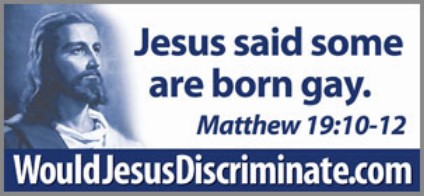
Jesus himself used eunuch as an ancient term for LGBTQ people when he declared in Matthew 19:12: “There are eunuchs who were born that way.” (The traditional interpretation of this scripture is that Jesus was speaking of voluntary celibacy.)

When Philip sees the eunuch on the road to Gaza, the Holy Spirit again takes the initiative, urging him to run to join him in his chariot. Soon the two men are absorbed in conversation about the scripture that the eunuch was reading: Isaiah 53:7-8. The passage describes the humiliation and injustice experienced by God’s suffering servant.

The eunuch probably chose this scripture because he had just faced rejection from religious leaders when he worshiped at the temple in Jerusalem. Eunuchs were sexual outcasts in Jewish religious society, much like LGBT people in the church today. First-century Jewish law condemned homosexual acts and forbid converting eunuchs to Judaism. Deuteronomy 23:1 says bluntly, “No one whose testicles are crushed or whose penis is cut off shall be admitted to the assembly of the Lord.”

Philip used the prophecy of God’s rejected servant to tell the eunuch about Jesus as they traveled together in the chariot. Maybe he pointed out Isaiah’s prophecy that comes a few chapters later:


  To the eunuchs who keep my Sabbaths,
  who choose what pleases me
  and hold fast to my covenant —
  to them I will give within my temple and its walls
  a memorial and a name
  better than sons and daughters;
  I will give them an everlasting name
  that will endure forever.
     --Isaiah 56-4-5


As the chariot passes by some water, the eunuch raises a question that LGBT people today ask as well: “What can stand in the way of my being baptized?”

There was no reason to prevent the eunuch from receiving full membership rights in the church. Philip shows no concern about the eunuch’s sexual orientation or race. Philip simply replies, “If you believe with all your heart, you may.”

The pair goes down into the water and Philip baptizes the eunuch then and there. Mission accomplished, the Holy Spirit suddenly takes Philip away. The men did not see each other again after that, but the Bible reports that the eunuch “went on his way rejoicing.”

“The Baptism of the Eunuch” by Rembrandt, 1626 (Wikimedia Commons)

Many authors explore the implications of the Ethiopian eunuch for LGBT people today in books such as:

Queering the Ethiopian Eunuch: Strategies of Ambiguity in Acts” (book) by Sean D. Burke

Sex Difference in Christian Theology: Male, Female, and Intersex in the Image of God” by Megan K. DeFranza.

The Children Are Free: Reexamining the Biblical Evidence on Same-sex Relationships by Jeff Miner and John Tyler Connoley

Jesus, the Bible, and Homosexuality, Revised and Expanded Edition: Explode the Myths, Heal the Church by Jack Rogers

The Man Jesus Loved: Homoerotic Narratives from the New Testament by Theodore Jennings

Outing the Bible: Queer Folks, God, Jesus, and the Christian Scriptures by Nancy Wilson

Freedom, Glorious Freedom: The Spiritual Journey to the Fullness of Life for Gays, Lesbians, and Everybody Else by John McNeill

The Queer Bible Commentary by Deryn Guest, Robert E. Goss, Mona West and Thomas Bohache

A literary look at the life of a gay eunuch in Biblical times is provided in “The Persian Boy,” a historical novel by Mary Renault.

Over the centuries many artists, including Rembrandt, have painted the Ethiopian eunuch’s conversion and baptism. The image of of Philip and the Ethiopian eunuch at the top of this post is from the Menologion of Basil II, an 11th-century Byzantine illuminated calendar manuscript now in the Vatican library.  It presents a beautiful image of harmony between men of different races and sexual orientations. Unfortunately a lot of other historical paintings of the Ethiopian eunuch have an undertone of racism, showing the Ethiopian as exotic or childlike.

Philip, the deacon in the story, is often confused with the apostle Philip whose feast day falls on May 1 or May 3. However St. Philip the Deacon (sometimes called Protodeacon) is honored on Oct. 11 in the Catholic and Episcopal churches and on June 6 in the Orthodox Church. Whatever the day, his example of unlimited welcome for a queer black man is an inspiration for today.
__
Related links:

The early church welcomed a gay man (WouldJesusDiscriminate.org)

The Ethiopian Eunuch - Did You Know God Saved A Gay Man In Acts 8:26-40? (GayChristian101)

A Reflection on the Story of the Ethiopian Eunuch in Acts (John McNeill)

Queer Eye for the Lectionary on Acts 8:26-40 (Louie Crew)

Sermon on Philip and the Ethiopian Eunuch (Queeremergent)

Can Size 14 Heels Keep You Out of Heaven? (Kathy Canyonwalker)

"Born Eunuchs": Homosexual Identity in the Ancient World (Faris Malik)
____
This post is part of the GLBT Saints series by Kittredge Cherry at the Jesus in Love Blog. Saints, martyrs, mystics, prophets, witnesses, heroes, holy people, deities and religious figures of special interest to lesbian, gay, bisexual and transgender (LGBT) and queer people and our allies are covered on appropriate dates throughout the year.

Copyright © Kittredge Cherry. All rights reserved.
http://www.jesusinlove.blogspot.com/
Jesus in Love Blog on LGBT spirituality and the arts