Showing posts with label transgender. Show all posts

Monday, October 10, 2016

Two-spirit Native Americans bridge genders on Columbus Day


Almost all Native American tribes traditionally recognized “two-spirit” people of mixed gender. Sometimes they played a spiritual role.  They appear as sacred figures in Native American rituals and myths. Two-spirit Native Americans are honored today for Columbus Day, which commemorates the arrival of European explorer Christopher Columbus in the Americas on Oct. 12, 1492.

Before Columbus arrived, most Native American societies valued people who mixed male and female roles or characteristics.  Their languages had words for third and sometimes even fourth genders. “Two spirit” is one of the many and varied Native American terms for alternative genders because one body housed both feminine and masculine spirits. Sometimes they served as spiritual guides who mediated between the realms of body and spirit, male and female. From a Western cultural viewpoint, the two-spirited people have been seen as lesbian, gay, bisexual, transgender (LGBT) or queer.

Contemporary artists have tried to re-envision the freedom of two-spirit people before the Europeans arrived. In the image above, Wisconsin artist Ryan Grant Long includes an unknown Mayan couple enjoying a playful moment together in his series “Fairy Tales” series of same-sex love throughout history. For more info, see my article Artist paints history’s gay couples: Interview with Ryan Grant Long.

“Employments of the Hermaphrodites,” engraving based on a watercolor by Jacques Le Moyne de Morgues (State Archives of Florida, Florida Memory)

The earliest known European depictions of Native Americans include two-spirit people. “Employments of the Hermaphrodites” is based on a watercolor made by Jacques Le Moyne de Morgues while exploring Florida in the 1560s. It illustrates his report that two-spirit people’s duties included caring for the sick and carrying the dead on stretchers.

Two-spirit people were not only accepted in many Native American societies, but also appear as sacred figures in Native American sacred rituals and mythology. For example the Zuni have a two-spirit god called Ko'lhamana, and Hopi and Acoma-Laguna myths tell about a whole tribe of two-spirit people called the Storoka.

“Dance to the Berdache” by George Catlin (Wikipedia)

George Catlin, famous artist who specialized in portraits of Native Americans in the Old West, sketched the “Dance to the Berdache” in the 19th century while on the Great Plains with the Sac and Fox Nation. He depicted a ceremonial dance to celebrate the Berdache, a European term for two-spirit people. But Catlin refused to give two-spirit people a place in his paintings of “traditional” Indian life.

“Jesus and the Beloved Disciple” by John Giuliani, 1996

While Europeans were mostly hostile to two-spirit people among the Native Americans whom they converted to Christianity, a contemporary icon offers hope of reconciliation by showing holy same-sex love with both Christian and Native American imagery. For example, John Giuliani's “Jesus and the Beloved Disciple” shows Jesus and his male beloved in the native dress of the Aymara Indians, descendants of the Incas who still live in the Andean regions of Chile, Peru and Bolivia. Giuliani is an Italian-American artist and Catholic priest who is known for making Christian icons with Native American symbols. He studied icon painting under a master in the Russian Orthodox style, but chose to expand the concept of holiness to include Native Americans, the original inhabitants of the Americas.

“Warharmi and Madkwahomai” by Brandon Buehring

Artist Brandon Buehring included several two-spirit groupings in his “Legendary Love: A Queer History Project.” In one sketch he portrays Warharmi, a “half-man, half-woman” and twins named Madkwahomai from the creaton myth of the Tipai tribe of the Kumeyaay people in California’s Imperial Valley.

Buehring uses pencil sketches and essays “to remind queer people and our allies of our sacred birthright as healers, educators, truth-tellers, spiritual leaders, warriors and artists.” The project features 20 sketches of queer historical and mythological figures from many cultures around the world. He has a M.Ed. degree in counseling with an LGBT emphasis from North Carolina State University in Raleigh. He works in higher education administration as well as being a freelance illustrator based in Northampton, Massachusetts.

Executions for homosexuality were common in Europe for centuries, and Europeans soon imported homophobic violence to the Americas. For example, the Spanish explorer Vasco Núñez de Balboa found homosexuality among the Native American chiefs in 1594 at Quarqua in Panama. He ordered 40 of these two-spirited people thrown to his war dogs to be torn apart and eaten alive to stop the “stinking abomination.”

Balboa executing two-spirit Native Americans for homosexuality in 1513 in Panama -- engraving by Théodore De Bry, 1594 (Wikimedia Commons).  

Despite the violence, some two-spirit individuals are still remembered in history and contemporary art. They include We’wha of Zuni and the Woman Chief known as Pine Leaf. Their portraits and stories are posted for Columbus Day on the Jesus in Love Blog.

“We’wha of Zuni” by Br. Robert Lentz OFM, TrinityStores.com

We’wha of Zuni

We’wha was a two-spirit Native American Zuni who served as a cultural ambassador for her people, including a visit with a U.S. president in 1886. We’wha (pronounced WAY-wah) was the most famous “lhamana,” the Zuni term for a male-bodied person who lived in part as a woman. Lhamanas chose to specialize in crafts instead of becoming warriors or hunters.

We’wha (1849-1896) was a skilled weaver and potter who helped Anglo-American scholars studying Zuni society. In 1886 We’wha traveled from her home in New Mexico to Washington DC, where she met president Grover Cleveland. She was welcomed as a celebrity during her six months in Washington. Everyone assumed that the 6-foot-tall “Indian princess” was female.

The spiritual side of We’wha is emphasized in the above icon by Brother Robert Lentz, is a Franciscan friar known for his innovative and LGBT-positive icons. She is dressed for a religious ceremony as she prepares to put on the sacred mask of the man-woman spirit Kolhamana.

We’wha is the subject of the book “The Zuni Man-Woman” by gay anthropologist Will Roscoe. He also wrote “Changing Ones: Third and Fourth Genders in Native North America” and “Jesus and the Shamanic Tradition of Same-Sex Love.” Roscoe’s website willsworld.org offers resources in the Native American two-spirit tradition, third genders in the ancient world, and studies in early Christianity.

“We’wha” by Jim Ru

Jim Ru painted We’Wha with a dramatic blue background  His icon was included in his show “Transcendent Faith: Gay, Lesbian and Transgendered Saints” in Bisbee Arizona in the 1990s.  He discusses it in a video.


“Biawacheeitche or Woman Chief aka Barcheeampe or Pine Leaf” by Ria Brodell

Pine Leaf or Woman Chief

“Woman Chief” is one of the names for the two-spirit tomboy born around 1800 to the Gros Ventre tribe. She was captured by the Crow nation when she was 10 and was so adept at hunting and warfare that she rose to become their chief.

Historical accounts say that she wore women’s clothes but had “all the style of a man and chief,” with “her guns, bows, lances, war horses, and even two or three young women as wives.”

“Pine Leaf, Indian Heroine” from “The Life and Adventures of James P. Beckwourth,” 1856 (Wikipedia)

She was killed in 1854 by the Gros Ventre tribe, but her story lived on in the popular memoirs of a freed slave and fur trader named James Beckwourth. He called her Pine Leaf because he refused his multiple marriage proposals by saying she would wed him “when the pine leaves turn yellow.” Later he figured out that pine leaves never turn yellow.

She is portrayed in the “Butch Heroes” series by genderqueer Boston artist Ria Brodell. For more on Brodell’s work, see my article “Artist paints history’s butch heroes.”
___
Related links:

Two Spirit People at the Legacy Walk

Kent Monkman (Canadian artist of Cree ancestry whose work has strong queer or gay male imagery dealing with sexuality and Christianity)

___
Top image credit: “Unknown Mayan Couple” by Ryan Grant Long

___
This post is part of the LGBTQ Calendar series by Kittredge Cherry. The series celebrates religious and spiritual holidays, events in LGBTQ history, holy days, feast days, festivals, anniversaries, liturgical seasons and other occasions of special interest to lesbian, gay, bisexual, transgender and queer people of faith and our allies.

Copyright © Kittredge Cherry. All rights reserved.
Qspirit.net presents the Jesus in Love Blog on LGBTQ spirituality.

Icons of We’wha and many others are available on cards, plaques, T-shirts, mugs, candles, mugs, and more at Trinity Stores


Saturday, July 02, 2016

Jemima Wilkinson: Queer preacher reborn in 1776 as “Publick Universal Friend”


Jemima Wilkinson (1752-1819) was a queer American preacher who woke from a near-death experience in 1776 believing she was neither male nor female. She changed her name to “the Publick Universal Friend,” fought for gender equality and founded an important religious community.

It’s appropriate to consider the Publick Universal Friend around July 4 for Independence Day. In 1776, the same year that America issued the Declaration of Independence, Wilkinson declared her own independence from gender. This fascinating person died almost 200 years ago today on July 1, 1819.

For a new version of this article, click this link to Qspirit.net:
Jemima Wilkinson: Queer preacher reborn in 1776 as “Publick Universal Friend”


Wilkinson is recognized as the first American-born woman to found a religious group, but is also called a “transgender evangelist.” The breakaway Quaker preacher spoke against slavery and gave medical care to both sides in the Revolutionary War.

Wilkinson was 24 when she had a severe fever leading to a near-death experience. Upon waking she confidently announced to her surprised family that Jemima Wilkinson had died and her body was now inhabited by a genderless “Spirit of Life from God” sent to preach to the world. She insisted on being called the Publick Universal Friend or simply “the Friend.” From then on, the Friend refused to respond to her birth name or use gendered pronouns.

Seal of the Universal Friend
(Wikimedia Commons)
The preacher and prophet known as “the Friend” defies categorization. The Friend has been labeled a “spiritual transvestite” and is on lists of “famous asexuals” and “a gender-variance Who’s Who.” As a gender nonconformist whose life was devoted to God, the Friend fits the definition of a queer saint. The androgynous Friend was many things to many people.

Jemima Wilkinson was born to a Quaker family in Rhode Island on Nov. 29, 1752. She showed a strong interest in religion while growing up. On Oct. 13, 1776, the Sunday after being reborn, the Friend gave a public sermon for the first time. Quaker officials rejected the Friend as a heretic, but s/he went on to preach throughout Rhode Island, Massachusetts, Connecticut, and Pennsylvania.

The Friend blended traditional Christian warnings about sin and redemption with Quaker pacifism, abolitionism, plain dress and peaceful relations with Native American Indians. Women had no legal rights in the United States, but the Friend advocated equality of the sexes. The Friend was a firm believer in sexual abstinence.

People were drawn not only to this progressive message, but also to the Friend’s forceful personality and genderbending appearance. S/he rejected standard women’s attire and hairdos for a unique blend of male and female. The Friend commonly wore a flowing black male clergy gown with female petticoats peeking out at the hem. The Friend’s long hair hung loose to the shoulder. The rest of the Friend’s outfit often included a man’s broad-brimmed hat and women’s colorful scarves.

The first recruits were family members, but the Friend soon attracted a diverse group of followers, including intellectual and economic elites as well as the poor and oppressed. Known as the Universal Friends, they upset some people by proclaiming that the Friend was “the Messiah Returned” or “Christ in Female Form.” The Friend did not make such claims directly.

The Friend founded the Society of Universal Friends in 1783. Members pooled their money and started a utopian communal settlement in the wilderness near Seneca Lake in upstate New York in 1788. As the first settlers in the region, they cleared the land and became the first white people to meet and trade with the Native Americans there. By 1790 the community had grown to a population of 260.

Hostile observers put the Friend on trial for blasphemy in 1800, but the court ruled that American courts could not try blasphemy cases due to the separation of church and state in the U.S. constitution. Thus the Friend was a pioneer in establishing freedom of speech and freedom of religion in American law.

Like other isolated utopian communities based on celibacy, the Society of Universal Friends dwindled. The Friend “left time,” as the Universal Friends put it, on July 1, 1819 at age 61. The organization disintegrated within a few years of the founder’s death.

The Publick Universal Friend continues to fascinate people today. One of the most authoritative biographies of this mysterious person is Pioneer Prophetess: Jemima Wilkinson, the Publick Universal Friend by Herbert A. Wisbey Jr. In recent years the life and work of the Friend has been examined by feminists and LGBTQ scholars, including gay historian Michael Bronski in his Lambda Literary Award-winning book, A Queer History of the United States.
___
Related links:
Chapter on Jemima Wilkinson from “Saints, Sinners and Reformers” by John H. Martin (Crooked Lake Review)

The Assumption of Jemima Wilkinson by Sharon V. Betcher (Journal of Millennial Studies)

Scherer Carriage House (permanent museum exhibit on Jemima Wilkinson)

___
Related links:
Books on LGBTQ American history:

“A Queer History of the United States” by Michael Bronski

“Stand by Me: The Forgotten History of Gay Liberation” by Jim Downs

“Gay American History: Lesbians and Gay Men in the U.S.A.” by Jonathan Katz


___
Top image credit: Jemima Wilkinson / Publick Universal Friend (Wikimedia Commons)

____
This post is part of the GLBT Saints series by Kittredge Cherry at the Jesus in Love Blog. Saints, martyrs, mystics, prophets, witnesses, heroes, holy people, deities and religious figures of special interest to lesbian, gay, bisexual and transgender (LGBT) and queer people and our allies are covered on appropriate dates throughout the year.

Copyright © Kittredge Cherry. All rights reserved.
http://www.jesusinlove.blogspot.com/
Jesus in Love Blog on LGBT spirituality and the arts

Friday, July 01, 2016

Pauli Murray: Queer saint who stood for racial and gender equality

Pauli Murray by Laurel Green

Human rights champion and queer saint Pauli Murray is a renowned civil rights pioneer, feminist, author, lawyer and the first black woman ordained as an Episcopal priest. Her feast day is today (July 1).

For a new version of this article, click this link to Qspirit.net:
Pauli Murray: Queer saint who stood for racial and gender equality


Murray was arrested and jailed for refusing to sit in the back of a segregated bus in Virginia in 1938 -- 15 years before Rosa Parks became a national symbol for resisting bus segregation. In 1941 she organized restaurant sit-downs in the nation’s capital -- 20 years before the famous Greensboro sit-ins.

She was attracted to women and her longest relationships were with women, so she is justifiably considered a lesbian. But she also described herself as a man trapped in a woman’s body and took hormone treatments in her 20s and 30s, so she might even be called transgender man today.

Murray was approved for trial inclusion in the Episcopal Church’s book of saints, “Holy Women, Holy Men” in a 2012 vote. Usually the Episcopalians wait until 50 years after a person has died before making granting sainthood, but for Murray the church set aside the rule and approved “trial use” of materials commemorating her now.

Others have written extensively about her many accomplishments, but material on Murray’s sexuality is hard to find. She did not speak publicly about her sexual orientation or gender identity issues, but she left ample evidence of these struggles in her letters and personal writings.

Pauli Murray (Wikipedia)

Anna Pauline (Pauli) Murray (November 20, 1910 – July 1, 1985) was born in Baltimore, Maryland and raised in Durham, North Carolina. She became aware of her queer sexuality early in life. In Pauli Murray and Caroline Ware: Forty Years of Letters in Black and White, historian Anne Firor Scott explains:

“In adolescence Murray began to worry about her sexual nature. She later said that she was probably meant to be a man, but had by accident turned up in a woman’s body. She began to keep clippings about various experiments with hormones as a way of changing sexual identity…. In 1937, at the initiative of a friend, she had been admitted to Bellevue Hospital in New York, and during her stay there she examined her worries about her sexual nature in writing, and said that she hoped to move toward her masculine side... . She continued for years to discuss the developing medical literature about hormones, thinking they might help her. She discussed the possibility of homosexuality with doctors; she knew that she was attracted to very feminine, often white, women, and she knew as well that… she was not physically attracted to men. This conflict would continue for the rest of her life.”

Murray’s queer side is discussed in many books, including American Eugenics: Race, Queer Anatomy, and the Science of Nationalism by Nancy Ordover and To Believe in Women: What Lesbians Have Done For America by Lillian Faderman, and in the play “To Buy the Sun: The Challenge of Pauli Murray” by Lynden Harris.

A graduate of New York’s Hunter College, Murray was rejected from the University of North Carolina UNC Chapel Hill’s graduate school in 1938 because of her race. She became a civil rights activist. In the late 1930s Murray was also seeking psychological help and testosterone implants from doctors in an effort to “treat” her homosexuality by becoming more male.

Eager to become a civil rights lawyer, Murray was the only woman in her law school class at Howard University in Washington, DC. She graduated first in her class in 1944, but was rejected by Harvard because of her gender -- even though President Franklin Roosevelt wrote a letter of support for her after Murray contacted First Lady Eleanor Roosevelt. Instead Murray studied law at the University of California in Berkeley. She wrote numerous influential publications, and NAACP used her arguments in the landmark 1954 Brown v. Board of Education case that ended racial segregation in U.S. public schools.

Her ongoing frienship with Roosevelt is described in the 2016 book, “The Firebrand and the First Lady: Portrait of a Friendship: Pauli Murray, Eleanor Roosevelt, and the Struggle for Social Justice” by women's studies professor Patricia Bell-Scott.

In the early 1960s President John Kennedy appointed Murray to the Commission on the Status of Women Committee. She worked with Martin Luther King Jr. and Bayard Rustin on civil rights -- and criticized the 1963 March on Washington at the time for excluding women from leadership. In 1965 she became the first African American to receive a law doctorate from Yale. A year later she co-founded the National Organization for Women.

Instead of retiring, Murray launched a new career at age 62. She entered New York’s General Theological Seminary in 1973, before the Episcopal Church allowed women priests. She was ordained in 1977. She celebrated her first Holy Eucharist at the Chapel of the Cross in Chapel Hill, NC -- the same church where her grandmother, a slave, was baptized.

After a lifetime as a human rights activist, she drew on her own experience to preach a powerful vision of God’s justice. It can be difficult to locate Murray’s sermons in books. Eight of Murray’s sermons can be found in the readily available book “Daughters of Thunder: Black Women Preachers and Their Sermons, 1850-1979,” edited by Bettye Collier-Thomas. Sermons by Murray in the book are Male and Female He Created Them (1978), Women Seeking Admission to Holy Orders as Crucifers Carrying the Cross (1974), Mary Has Chosen the Best Part (1977), The Holy Spirit (1977), The Gift of the Holy Spirit (1977), The Dilemma of the Minority Christian (1974), Salvation and Liberation (1979), and Can These Bones Live Again (1978).

In a 1977 sermon recorded in the hard-to-find Pauli Murray: Selected Sermons and Writings, she said:

It was my destiny to be the descendant of slave owners as well as slaves, to be of mixed ancestry, to be biologically and psychologically integrated in a world where the separation of the races was upheld by the Supreme Court of the United States as the fundamental law of our Southland. My entire life’s quest has been for spiritual integration, and this quest has led me ultimately to Christ, in whom there is no East or West, no North or South, no Black or White, no Red or Yellow, no Jew or Gentile, no Islam or Buddhist, no Baptist, Methodist, Episcopalian, or Roman Catholic, no Male or Female. There is no Black Christ, no White Christ, no Red Christ – although these images may have transitory cultural value. There is only Christ, the Spirit of Love.

Murray died of cancer on July 1, 1985 at age 74. Her best known book is Proud Shoes: The Story of an American Family (1956), her memoir of growing up as a mixed-race person in the segregated South.

The image of Pauli Murray at the top of this post is part of the “In the Spirit of Those Who Led the Way” series by North Carolina artist Laurel Green. She creates digital artworks in conversation with more traditional media.

“Pauli Murray” by Angela Yarber

A new icon of Pauli Murray was painted for the "Holy Women Icons" series by Angela Yarber, an artist, scholar, dancer, minister and LGBT-rights activist based in North Carolina. It is one of nearly 50 color images of her folk feminist icons included in her 2014 book "Holy Women Icons." Her colorful icon shows Murray with a closed eyes and large heart inscribed with the words:

“When her throat grew weary,
Her heart pulsed a song of hope,
Of justice, of equality,
Unconstrained by the binaries
That bind.
Authentically free.”

For more info on Yarber, see my previous post "Artist paints holy lesbians and other women."

The trial use commemorations of the Episcopal Church include this new prayer:

Liberating God, we thank you most heartily for the steadfast courage of your servant Pauli Murray, who fought long and well: Unshackle us from bonds of prejudice and fear so that we show forth your reconciling love and true freedom, which you revealed through your Son and Our Savior Jesus Christ.

Pauli Murray image from Holy Women, Holy Men on Facebook celebrating saints in the Episcopal Church, produced by the Paradoxy Center at St. Nicholas Church.

___
Related links:

Pauli Murray profile at LGBTHistoryMonth.com

www.paulimurrayproject.org

Pauli Murray Named to Episcopal Sainthood (duke.edu)

Paul Murray bio (Episcopal Diocese of North Carolina)

“Queering Iconography, Painting Pauli Murray” by Angela Yarber (Feminism and Religion Blog)

Convention OKs continued trial use of ‘Holy Women, Holy Men’ (Episcopal News Service)

___
This post is part of the LGBTQ Saints series by Kittredge Cherry. Traditional and alternative saints, people in the Bible, LGBTQ martyrs, authors, theologians, religious leaders, artists, deities and other figures of special interest to lesbian, gay, bisexual and transgender and queer (LGBTQ) people and our allies are covered.

Copyright © Kittredge Cherry. All rights reserved.
Qspirit.net presents the Jesus in Love Blog on LGBTQ spirituality.

Tuesday, June 28, 2016

Saints of Stonewall inspire LGBT justice -- and artists, authors and film makers


“It was Beautiful” by Douglas Blanchard shows the Stonewall Rebellion
Oil on canvas, 24" x 36," 1999.

Queer people fought back against police harassment at New York City’s Stonewall Inn launching the modern LGBT liberation movement on June 28, 1969.

Their bold rebellion against government persecution of homosexuality is commemorated around the world during June as LGBT Pride Month. The Stonewall Uprising continues to inspire a variety of art that is featured here today.

For a new version of this article, click this link to Qspirit.net:
Saints of Stonewall inspire LGBTQ justice -- and artists, authors and film makers

This year the site of the Stonewall Uprising was designated a national monument by President Obama. “I’m designating the Stonewall National Monument as the newest addition to America’s National Park System. Stonewall will be our first national monument to tell the story of the struggle for LGBT rights,” he said.

The White House also released a video about the Stonewall Uprising and how it sparked a movement for LGBT equality. The monument includes the Stonewall Inn and nearly eight acres around it in New York's Greenwich Village.


The LGBT people who resisted police at the Stonewall Rebellion (also known as the Stonewall Riots) are not saints in the traditional sense. But they are honored here as “saints of Stonewall” because they dared to battle an unjust system. They do not represent religious faith -- they stand for faith in ourselves as LGBT people. They performed the miracle of transforming self-hatred into pride. These “saints” began a process in which self-hating individuals were galvanized into a cohesive community. Their saintly courage inspired a justice movement that is still growing stronger after four decades.

Before Stonewall, homosexuality was illegal and police regularly raided gay bars, where customers submitted willingly to arrest. A couple of dozen acts of resistance pre-dated and paved the way for Stonewall, such as the 1967 demonstration at the Black Cat Tavern in Los Angeles.

A new but controversial effort to tell the story of the uprising is the 2015 film “Stonewall.” It is directed by Roland Emmerich, better known for directing the action movie “Independence Day.” The film is a drama, not a documentary, told through the eyes of a fictional young white man from Indiana. Many in the LGBT community objected that the film downplayed the importance of drag performers, trans and bi women, butch lesbians and people of color in the Stonewall rebellion. Boycotts were organized to protest the way the erasure of these real-life activists in favor of a fictional white man.

The Stonewall Inn catered to the poorest and most marginalized queer people: drag queens, transgender folk, hustlers and homeless youth. Witnesses disagree about who was the first to defy the police raid in the early morning hours of June 28, 1969. It was either a drag queen or a butch lesbian. Soon the crowd was pelting the officers with coins, bottles, bricks and the like. The police, caught by surprise, used nightsticks to beat some people before taking refuge in the bar itself. News of the uprising spread quickly. Hundreds gathered on the street and a riot-control police unit arrived. Violence continued as some chanted, “Gay power!”

Drag queens started spontaneous kick lines facing the police with clubs and helmets. That dramatic moment is captured in the painting “It was Beautiful” by Douglas Blanchard. The drag queens met violence with defiant humor by singing,

We are the Stonewall girls
We wear our hair in curls
We wear no underwear
We show our pubic hair
We wear our dungarees
Above our nelly knees!

That night 13 people were arrested and some hospitalized. The streets were mostly cleared by 4 a.m., but a major confrontation with police happened again the next night, and protests continued on a smaller scale for a week.

A month later the Gay Liberation Front was formed, one of many LGBT rights organizations sparked by the saints of Stonewall. LGBT religious groups are indebted to the saints of Stonewall for our very existence.

“Gay Liberation” by George Segal commemorates the Stonewall rebellion (Photo by Wally Gobetz)

One of the most significant Stonewall artworks is also the world’s first piece of public art honoring the struggle for LGBTQ equality. “Gay Liberation” was created in 1979 by famed pop sculptor George Segal. It consists of four statues, a gay couple and a lesbian couple, cast in bronze and painted white in Segal’s typical style. The figures are arranged realistically in casual poses, evoking the power of love with their ghostly presence.

The idea for a public sculpture honoring the 10th anniversary of Stonewall came from LGBT activist Bruce Voeller. His vision inspired the Mildred Andrews Fund of Cleveland to commission Segal to create the sculpture. After much controversy, vandalism and alternate locations, the sculpture was installed permanently across the street from the Stonewall Inn at Christopher Park, which also holds two monuments to Civil War heroes.

Artists usually choose between two approaches when addressing the Stonewall Uprising. Some focus on the action in the past while others highlight the present-day Stonewall Inn, which is still in operation as a bar for the LGBT community.

Artists who recreate the past include Doug Blanchard, a gay New York artist who teaches art at City University of New York and is active in the Episcopal Church. “It was Beautiful” and other Stonewall paintings by Blanchard were shown at the Lesbian and Gay Community Services Center of New York in 1999. His series “The Passion of Christ: A Gay Vision” has been featured here at the Jesus in Love Blog and in a 2014 book with text by Kittredge Cherry.

“The Battle of Stonewall - 1969” by Sandow Birk

California artist Sandow Birk put Stonewall history into heroic context in a big way. The oil paintings in his Stonewall series measure up to 10 feet wide. The crown jewel of the series is “The Battle of Stonewall - 1969.” It updates the classic painting “The Battle of Mons-en-Pévèle - 1304” by 19th-century French artist Charles Philippe Lariviere. In both cases, the physically superior side attacked those who were considered weaker, but the underdogs won and gained their freedom. Birk replaces swords with police batons and turns national flags into “Gay Power” banners. The knight in shining armor is replaced by a drag queen in mascara and high heels. For more about Birk’s Stonewall series, see my previous post: Sandow Birk: Stonewall's LGBT history painted.

The actual Stonewall riots weren’t as white as Birk's paintings make it appear: “On the first night of the Stonewall riots, African Americans and Latinos likely were the largest percentage of the protestors, because we heavily frequented the bar,” scholar-activist Irene Monroe writes in  Dis-membering Stonewall, her chapter in the book Love, Christopher Street. “For homeless black and Latino LGBTQ youth and young adults who slept in nearby Christopher Park, the Stonewall Inn was their stable domicile.”

“Stonewall Inn” by Trudie Barreras (Collection of Kittredge Cherry)

The location where history happened is emphasized in the colorful painting of the Stonewall Inn by Trudie Barreras, a long-time member of Metropolitan Community Churches. Her art and writing on queer religious themes have appeared frequently here at the Jesus in Love Blog. She also does personalized pet portraits as “donation incentives” for Jesus in Love.

“Prostrations at the Holy Places and Veneration to Our Martyrs (Stonewall Pilgrimage)” by Tony O’Connell

British artist Tony O’Connell paid homage to the power of Stonewall by photographing his own personal pilgrimage to the historic bar in New York City in 2013. He prayed with incense at the Stonewall Inn as part of his series on LGBT pilgrimages, which he does as performances recorded in photos. He travels to places of importance in LGBT history, treating the trip as a pilgrimage to the shrine of a saint. For more about O’Connell’s pilgrimages and other art, see my previous post Tony O’Connell reclaims sainthood: Gay artist finds holiness in LGBT people and places.

Jesus meets the women of Jerusalem and the Stonewall Riots happen in Station 8 from “Stations of the Cross: The Struggle For LGBT Equality” by Mary Button

Tennessee artist Mary Button weaves together the LGBT uprising at Stonewall with Christ’s journey to Calvary in Station 8 of her LGBT Stations of the Cross. She shows that a chain of oppression that stretches from the crucifixion of Christ to police harassment of LGBT people today, offering hope for resurrection. For more about Button’s Stations, see my previous post LGBT Stations of the Cross shows struggle for equality.

Despite the progress made, police raids of gay bars have continued in recent years, such as the notorious 2009 Rainbow Lounge raid in Forth Worth, Texas. June 28 is also the anniversary of the 2009 raid on the Rainbow Lounge, a newly opened gay bar in Fort Worth, Texas. Five customers were zip-tied and taken to jail, multiple others were arrested or detained, and one got a severe brain injury while in custody. The raid sparked an unprecedented public outcry that led to reforms.

The history of the Rainbow Lounge raid and reaction is told in the 2012 film “Raid of the Rainbow Lounge,” directed by Robert Camina. He says it has “haunting parallels” to Stonewall. Emmy-nominated actress Meredith Baxter narrates the documentary. A video trailer is posted online.


May the saints of Stonewall continue to inspire all who seek justice and equality!

___
Related links:

2015 book for teens: “Stonewall: Breaking Out in the Fight for Gay Rights” by Ann Bausum

Book: “Stonewall: The Riots That Sparked the Gay Revolution” by David Carter

Book: “Stonewall” by Martin Bauml Duberman

Video: “American Experience: Stonewall Uprising”


___
This post is part of the GLBT Saints series by Kittredge Cherry at the Jesus in Love Blog. Saints, martyrs, mystics, heroes and holy people of special interest to gay, lesbian, bisexual and transgender (GLBT) people and our allies are covered on appropriate dates throughout the year.

Copyright © Kittredge Cherry. All rights reserved.
http://www.jesusinlove.blogspot.com/
Jesus in Love Blog on LGBT spirituality and the arts


Monday, May 30, 2016

Joan of Arc: Cross-dressing warrior-saint

“Jeanne D'Arc” by Rowan Lewgalon

"Saint Joan of Arc" by Brother Robert Lentz, OFM

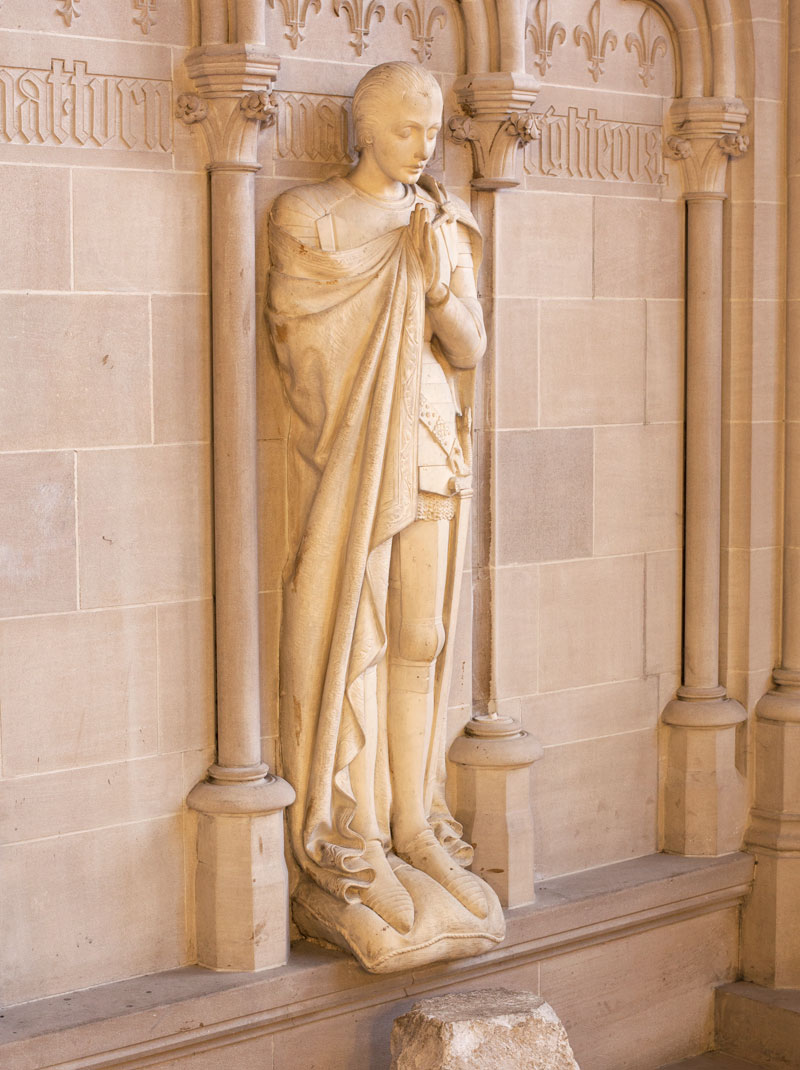
Joan of Arc was a tough cross-dressing teenage warrior who led the medieval French army to victory when she was 17. She is a queer icon, girl-power hero and patron saint of France. Her feast day is today (May 30).

Smart and courageous, Joan of Arc (c. 1412-1431) had visions of saints and angels who told her to cut her hair, put on men’s clothes and go to war. At age 18 she helped crown a king and at 19 she was killed by the church that later made her a saint. She died for her God-given right to wear men’s clothing, the crime for which she was executed on May 30, 1431.

For a new version of this article, click this link to Qspirit.net:
Joan of Arc: Cross-dressing warrior-saint and LGBTQ role model


Joan of Arc portrait, c. 1485
Wikimedia Commons
Contemporary LGBT people recognize a kindred spirit in her stubborn defiance of gender rules. Queer writers tend to downplay Joan’s Christian faith, while the church covers up the importance of her cross-dressing. In truth, Joan believed strongly in God AND in cross-dressing. She insisted that God wanted her to wear men’s clothes, making her what today can be called “queer” or “transgender.” She fits the medieval archetype known as the “holy transvestite.” Cross-dressing was illegal, but what really upset the church authorities, then as now, was the audacity of someone being both proudly queer AND devoutly Christian. Her belief that God was the source of her gender-bending queerness makes her an especially inspiring role model for LGBT Christians and our allies.

Joan’s extraordinary life continues to fascinate all kinds of people. Many are eager to claim her as a symbol, from LGBT people and feminists to the Catholic Church and French nationalists. Joan is the subject of more than 10,000 books, plays, paintings and films, including recent works by transgender author Leslie Feinberg and lesbian playwright Carolyn Gage.

Gage’s one-woman show “The Second Coming of Joan of Arc” is an underground classic with Joan as “a cross-dressing, teenaged, runaway lesbian” confronting male-dominated institutions. Feinberg has a chapter on Joan as “a brilliant transgender peasant teenager leading an army of laborers into battle” in her history book “Transgender Warriors: Making History from Joan of Arc to Dennis Rodman.”

The extensive records of her trials by the Inquisition make Joan of Arc the best-documented person of 15th century. There are only hints that she may have been a lesbian, but the evidence is absolutely clear about her trans expression as a cross-dresser.

Joan of Arc, also known as Jeanne d’Arc, was born to peasants in an obscure village in eastern France around 1412, toward the end of the Hundred Years War. Much of France was occupied by England, so that Charles, the heir to the French throne, did not dare to be crowned. When Joan was 13, she began hearing voices that told her to help France drive out the English.

The visions continued for years, becoming more detailed and frequent. Once or twice a week she had visions of Michael the Archangel and two virgin saints: Catherine of Alexandria and Margaret of Antioch (another transvestite saint who refused to marry a man). They told her that God wanted her to meet Charles and lead an army to Reims for his coronation.

Joan’s family tried to convince her that her visions weren’t real, and her first attempt to visit the royal court was rejected. When she was 17 she put on male clothing and succeeded in meeting Charles. He agreed to outfit her as a knight and allowed her to lead a 5,000-man army against the English.

On Charles’ order, a full suit of armor was created to fit Joan. He had a banner made for her and assigned an entourage to help her: a squire, a page, two heralds, a chaplain and other servants.

Joan of Arc on Horseback, 1505
Wikimedia Commons
Joan’s appearance awed the soldiers and peasants when she traveled with the army. Mounted on a fine warhorse, she rode past cheering crowds in a suit of armor. Her hair was “cropped short and round in the fashion of young men.” She carried an ancient sword in one hand and her banner in the other. Her sword was found, as Joan predicted, buried at the church of St. Catherine at Fierbois. The banner showed Christ sitting on a rainbow against a background of white with gold lilies and the motto “Jhesus-Maria.” Legend says that white butterflies followed Joan wherever she rode with her banner unfurled.

With Joan leading the way, the army won the battle at Orleans and continued to defeat English and pro-English troops until they reached Reims. She proudly stood beside Charles VII at his coronation there on July 17, 1429.

Joan soon resumed leading military campaigns. Even during her lifetime the peasants adored her as a saint, flocking around her to touch her body or clothing. Her cross-dressing didn’t disturb them. In fact, they seemed to honor her for her transgender expression. Perhaps, as some scholars say, the peasants saw Joan as part of a tradition that linked transvestites and priests in pre-modern Europe.

One of the first modern writers to raise the possibility of Joan’s lesbianism was English author Vita Sackville-West. She implied that Joan was a lesbian in her 1936 biography “Saint Joan of Arc.” The primary source for this idea was the fact, documented in her trials, that Joan shared her bed with other girls and young women. She followed the medieval custom of lodging each night in a local home. Joan always slept with the hostess or the girls of the household instead of with the men.

“Joan of Arc: Her Trial Transcripts” by Emilia Philomena Sanguinetti is a 2016 book that explores whether Joan was a lesbian or transgender person.
Extensive evidence that Joan of Arc was a lesbian or transgender person is presented in the epilogue of this groundbreaking book about the cross-dressing medieval saint. She explores how Joan shared her bed with another woman and insisted on wearing male clothing.

Nobody knows for sure whether Joan of Arc was sexually attracted to women or had lesbian encounters, but her abstinence from sex with men is well documented. Her physical virginity was confirmed by official examinations at least twice during her lifetime. Joan herself liked to be called La Pucelle, French for “the Maid,” a nickname that emphasized her virginity. Witnesses at her trial testified that Joan was chaste rather than sexually active.

Joan’s illustrious military career ended in May 1430. She was captured in battle by the Burgundians, the French allies of the English. During her captivity they called her “hommase,” a slur meaning “man-woman” or “masculine woman.”

In a stunning betrayal, Charles VII did nothing to rescue the warrior who helped win him the crown. It was normal to pay ransom for the release of knights and nobles caught in battle, but he abandoned Joan to her fate. Historians speculate that French aristocrats felt threatened by the peasant girl with such uncanny power to move the masses.

The Burgundians transferred Joan to the English, who then gave her to the Inquisition. She spent four torturous months in prison before her church trial began on Jan. 9, 1431 in Rouen, the seat of the English occupation government. She was charged with witchcraft and heresy.

The politically motivated church trial was rigged against her, and yet Joan was able to display her full intelligence as she answered the Inquisitors’ questions. Her subtle, witty answers and detailed memory even forced them to stop holding the trial in public.

Witchcraft was hard to prove, so the church dropped the charge. (Many of today’s Wiccans and pagans still honor Joan as one of their own.) The Inquisitors began to focus exclusively on the “heresy” of Joan’s claim that she was following God’s will when she dressed as a man. The judges told her that cross-dressing was “an abomination before God” according to church law and the Bible. (See Deuteronomy 22:5.)

They accused Joan of “leaving off the dress and clothing of the feminine sex, a thing contrary to divine law and abominable before God, and forbidden by all laws” and instead dressing in “clothing and armor such as is worn by man.”

Joan swore that God wanted her to wear men’s clothing. “For nothing in the world will I swear not to arm myself and put on a man’s dress; I must obey the orders of Our Lord,” she testified. She outraged the judges by continuing to appear in court wearing what they called “difformitate habitus” (“monstrous dress” or “degenerate apparel.”)

Today Joan’s conservative admirers claim that she wore men’s clothes only as way to avoid rape, but she said that it meant much more to her. Joan of Arc saw cross-dressing as a sacred duty.

The judges summarized Joan’s testimony by saying, “You have said that, by God’s command, you have continually worn man’s dress, wearing the short robe, doublet, and hose attached by points; that you have also worn your hair short, cut ‘en rond’ above your ears with nothing left that could show you to be a woman; and that on many occasions you received the Body of our Lord dressed in this fashion, although you have been frequently admonished to leave it off, which you have refused to do, saying that you would rather die than leave it off, save by God’s command.”

Joan refused to back down on the visions she received from God, and she was sentenced to death. She was burned at the stake on May 30, 1431 in Rouen. Twenty five years later she was retried and her conviction was overturned. Joan was declared innocent.

Her armor, that “monstrous dress,” became an object of veneration, sought after like the Holy Grail with various churches claiming to possess her true armor. Joan of Arc was canonized as a saint in 1920. Famous writers and composers who have done works about her include Shakespeare, Voltaire, Verdi, Tchaikovsky, Mark Twain, Bertolt Brecht and George Bernard Shaw. A stunning portrait of Joan kissing her sword (below) was painted by Pre-Raphaelite artist Dante Gabriel Rossetti, whose sister Christina Rossetti is also part of the LGBT Saints series at the Jesus in Love Blog.

“Joan of Arc Kisses the Sword of Liberation” by Dante Gabriel Rossetti, 1863 (WikiPaintings)

This post features contemporary portraits of Joan by Rowan Lewgalon, Robert Lentz and Tobias Haller. Lewgalon is a spiritual artist based in Germany and also a cleric in the Old Catholic Apostolic Church. Her work is online at tir-anam.weebly.com. Lentz is a Franciscan friar known for his innovative and LGBT-positive icons. He is stationed at Holy Name College in Silver Spring, Maryland. His icons are available at Trinitystores.com.

“Jeanne d’Arc” by Tobias Haller

“Jeanne d’Arc” was sketched by Tobias Haller, an iconographer, author, composer, and vicar of Saint James Episcopal Church in the Bronx. He is the author of “Reasonable and Holy: Engaging Same-Sexuality.” Haller enjoys expanding the diversity of icons available by creating icons of LGBTQ people and other progressive holy figures as well as traditional saints. He and his husband were united in a church wedding more than 30 years ago and a civil ceremony after same-sex marriage became legal in New York.

A widely used prayer to Saint Joan of Arc makes a powerful statement that can inspire those who believe in equality for LGBT people, despite rejection by religion and society:


“In the face of your enemies, in the face of harassment, ridicule, and doubt, you held firm in your faith. Even in your abandonment, alone and without friends, you held firm in your faith. Even as you faced your own mortality, you held firm in your faith. I pray that I may be as bold in my beliefs as you, St. Joan. I ask that you ride alongside me in my own battles. Help me be mindful that what is worthwhile can be won when I persist. Help me hold firm in my faith. Help me believe in my ability to act well and wisely. Amen.”

Joan has a dialogue with the fire that is about to consume her in a haunting song written by award-winning Canandian poet Leonard Cohen and sung on July Collins video .


___
Related links:

Wikipedia article on Cross-dressing, sexuality, and gender identity of Joan of Arc

Joan of Arc trial transcript online

Joan of Arc: Cross-dressing martyr at Queering the Church Blog

Jeanne-darc.info

Joan of Arc sculpture by Anna Hyatt Huntington at the Cathedral of Saint John the Divine in New York City

To read this post in Spanish / en español, go to Santos Queer:
Juana de Arco: Santa Travesti

To read this post in Italian, go to Gionta.org:
Una guerriera genderbender. La favolosa vita di Giovanna d’Arco


This post is part of the LGBTQ Saints series by Kittredge Cherry. Traditional and alternative saints, people in the Bible, LGBTQ martyrs, authors, theologians, religious leaders, artists, deities and other figures of special interest to lesbian, gay, bisexual and transgender and queer (LGBTQ) people and our allies are covered.

Copyright © Kittredge Cherry. All rights reserved.
Qspirit.net presents the Jesus in Love Blog on LGBTQ spirituality.

Icons of Joan of Arc and many others are available on cards, plaques, T-shirts, mugs, candles, mugs, and more at Trinity Stores


Friday, November 20, 2015

Transgender Day of Remembrance: Spiritual resources


For a new version of this article, click

Qspirit.net:
Transgender Day of Remembrance: Spiritual resources