Showing posts with label Eros and Christ. Show all posts

Saturday, August 20, 2016

Saints Bernard of Clairvaux and Malachy: Honey-tongued abbot and the archbishop he loved

“Bernard of Clairvaux” by Rowan Lewgalon

See how I yearn, and longing turn to Thee!
Yield to my love, and draw me unto Thee!
--Bernard of Clairvaux

Bernard of Clairvaux was a medieval French abbot who wrote homoerotic poetry about Jesus had a passionate same-sex friendship with the Irish archbishop Malachy of Armagh. Bernard is best known for founding 70 monasteries around Europe and for his mystical writings. His feast day is Aug. 20 (today).

For a new version of this article, click this link to Qspirit.net
Bernard of Clairvaux and Malachy: Abbot and the archbishop he loved

His first love was Jesus, but he showered Malachy with kisses during his lifetime. After Malachy died in his arms, they exchanged clothes. Malachy was buried in Bernard’s habit. Bernard put on Malachy’s habit to lead the funeral and wore it until his own death five years later. Bernard was buried beside Malachy, again in Malachy’s habit. Malachy (1094-1148) became the first native born Irish saint to be canonized.

Bernard (1090-1153) was advisor to five Popes and a monastic reformer who built the Cistercian order of monks and nuns. He is known as the last of the Church Fathers. The most famous saying attributed to him is: “The road to hell is paved with good intentions.”

He was a man of his time who engaged in rigorous ascetic practices and supported church teachings on celibacy. People today might say that he had a homosexual orientation while abstaining from sexual contact. Medieval mystics created alternative forms of sexuality that defy contemporary categories, but might be encompassed by the term “queer.” They directed their sexuality toward God and experienced God’s love through passionate friendship with another human being.

Monasteries and convents provided a social structure outside marriage, attracting many people that today would be defined as LGBT. Medieval monks and nuns who lived in same-sex communities under a vow of celibacy developed alternative ways of same-sex living and loving.

“Christ Embracing St. Bernard of Clairvaux” by Francisco Ribalta

Bernard’s strict asceticism was balanced by sweetly erotic visions that earned him the title Doctor Mellifluus (“honey-tongued doctor.”) He chose to use the Song of Songs, the most erotic book in the Bible, as a major vehicle for his teaching. He began his “Sermons on the Song of Songs” in 1135 and had completed 86 sermons when he died nearly 20 years later with the series still unfinished.

“Jesus to me is honey in the mouth, music in the ear, a song in the heart,” he wrote in his 15th sermon on the Song of Songs.

His lesser known works include “Life of Saint Malachy of Armagh,” which is his idealized tribute to the man he loved, and “Salve Mundi Salutare” (quoted below), a love poem to Jesus whose original homoeroticism has been suppressed. It became the basis for the popular English hymn “O Sacred Head, Now Wounded.”

Bernard of Clairvaux’s legacy is a mixed blessing for contemporary progressive readers because he also helped rally soldiers to kill Muslims in the Second Crusade and undermined the work of theologian Peter Abelard, a champion of reason. But he spoke out against Christian mistreatment of Jews and supported another queer mystic, Hildegard of Bingen, in her efforts to get her visions published.

Bernard was born to a noble family in 1090 on the outskirts of Dijon in Burgundy. According to legend, his mother had a dream during her pregnancy that a white puppy was barking in her womb. This was interpreted to mean that she would give birth to God’s watchdog. The white dog became one of Bernard’s attributes, a symbol used in images of the saint.

Bernard and a white dog, both with icy blue eyes, appear together in a striking contemporary portrait by Rowan Lewgalon. She is a spiritual artist based in Germany and a cleric in the Old Catholic Apostolic Church.

When Bernard was 19, his mother died and he decided to join a small new community that had just started in the area. They were called the Cistercians, and their aim was to reform monasticism with a return to the more austere rules of St. Benedict. Within three years Bernard was sent to found a monastery nearby in a place whose name has become part of his own: Clairvaux.

About 25 years later Bernard met Malachy (whose Irish name is Maelmhaedhoc O’Morgair). He was primate of all Ireland when he first visited Clairvaux around 1139. Bernard was nearly 50 years old and Malachy was four years younger. They soon became devoted, passionate friends. Malachy even asked the Pope for permission to become a Cistercian, but the Pope refused.

Malachy traveled to see Bernard again in 1142. They were so close that Bernard covered him with kisses in a scene that is described well by Orthodox priest Richard Cleaver in “Know My Name: A Gay Liberation Theology”: “Bernard's account makes deeply romantic reading for a modern gay man. “Oscula rui,” Bernard says of their reunion: “I showered him with kisses.”

Their relationship had lasted almost a decade when Malachy reunited with Bernard for the third and final time. Malachy fell sick when he arrived in Clairvaux in 1148. He died in Bernard’s arms on All Soul’s Day, Nov. 2. Again Cleaver tells the details based on accounts by Geoffrey, Bernard’s secretary and traveling companion:

“Geoffrey of Auxerre tells us what happened later. Bernard put on the habit taken from Malachy's body as it was being prepared for burial at Clairvaux, and we wore it to celebrate the funeral mass. He chose to sing not a requiem mass but the mass of a confessor bishop: a personal canonization and, incidentally, an example of using liturgy to do theology. Bernard himself was later buried next to Malachy, in Malachy’s habit. For Bernard, as for us today, this kind of passionate love for another human being was an indispensable channel for experiencing the God of love.”

After Malachy’s death Bernard lived on for another five years. He forbid sculptures and paintings at the monastery during his lifetime, but by the late 15th century the altarpiece at the Clairvaux Abbey had a painting of Christ’s baptism jointly witnessed by Bernard and Malachy.

Bernard died on Aug. 20, 1153 at age 63. He was buried at the Clairvaux Abbey next to Malachy, wearing Malachy’s habit. He had lived for 40 years in community with other men whose loving relations with each other brought them closer to God.

“Bernard of Clairvaux” by Tobias Haller

“Bernard of Clairvaux” was sketched as an intense man with a rusty beard by Tobias Haller, an iconographer, author, composer, and vicar of Saint James Episcopal Church in the Bronx. He is the author of “Reasonable and Holy: Engaging Same-Sexuality.” Haller enjoys expanding the diversity of icons available by creating icons of LGBTQ people and other progressive holy figures as well as traditional saints. He and his spouse were united in a church wedding more than 30 years ago and a civil ceremony after same-sex marriage became legal in New York.

A prayer written by Bernard’s secretary Geoffrey shows how the community at Clairvaux understood and celebrated the man-to-man love between Bernard and Malachy. He thanks God for these “two stars of such surpassing brightness” and “twofold treasure.”

As a monk, Bernard naturally directed much of his erotic energy toward Jesus Christ. This attitude is beautifully expressed in his poem “Salve Mundi Salutare” (Savior of the World, I Greet You). He wrote seven sections, each addressed to a different parts of Jesus’ crucified body: his feet, knees, hands, side, chest, face, and finally his heart.

The poem is traditionally attributed to Bernard of Clairvaux, although some modern scholars believe it may have been written by another Cistercian abbot, Arnulf of Leuven. It is also known as the “Oratio rhythmica ad singula membra Christi a cruce pendentis” (Rhythmical Prayer to the Sacred Members of Jesus Hanging on the Cross), or more simply as the Rhythmica oratio.

The original poem, in all its erotic glory, is generally not included in books that collect Bernard’s “essential writings.” It lives on in ancient, hard-to-find editions and heavily edited versions and translations that remove much of the homoeroticism and sometimes even add heterosexual references that are absent from Bernard’s original Latin. The original is also blessedly free from churchy terms like “Lord,” speaking only of the love between “I” and “thou.”

The poem is the basis for important musical works such as the hymn “O Sacred Head, Now Wounded” and the Baroque oratorio “Membra Jesu Nostri” (usually translated as “The Limbs of Our Jesus”) written by Baroque Danish composer Dieterich Buxtehude in 1680, more than 500 years after Bernard died. The cycle of seven cantatas is considered to be the first Lutheran oratorio. The entire oratorio can be heard on video at this link.

The rapture of this poem is expressed in the painting at the top of this post: “Christ Embracing St. Bernard” by Francisco Ribalta. The Spanish Baroque artist apparently painted this masterpiece for the Carthusian monastery of Porta Coeli in Valencia, Spain around 1625.

The website for Spain’s Prado Museum in Madrid, where it is now housed, states: “The scene is based on one of the saint’s mystical visions, drawn from one of the most popular religious books of the Baroque era: Pedro de Ribadeneyra’s ‘Flos Sanctorum’ or ‘Book of the Lives of the Saints,’ published in 1599.”

The whole poem contains 74 verses of five lines each -- way too many to reproduce here. But it is extremely hard to find, so a selection of the more erotic, lesser known verses are reproduced here in the original Latin with an English translation from by Emily Mary Shapcote. Her translation was published in the 1881 book “St. Bonaventure’s Life of our Lord and Saviour Jesus Christ.” The online version of that book contains the entire poem in its appendix.

In a few cases a computer-generated English translation is also included here because it captures the directness and immediacy of the original. Much of the homoeroticism is implicit in the fact that this love poem was written by one man to another -- from Bernard to Jesus with love.

References to this poem and numerous paintings of Bernard with Christ are included in a whole chapter devoted to Bernard in the 2013 book “Saintly Brides and Bridegrooms: The Mystic Marriage in Renaissance Art” by Carolyn D. Muir, art professor at the University of Hong Kong.

___

To the Hands
Ad Manus

IX.
O Jesus, place Thy sacred Hands on me,
With transport let me kiss them tenderly,
With groans and tears embrace them fervently;
And, O for these deep wounds I worship Thee;
And for the blessed drops that fall on me.

Manus sanctse vos amplector,
Et gemendo condelector,
Grates ago plangis tantis
Clavis duris, guttis sanctis,
Dans lacrymas cum osoulis


To the Side
Ad Latus

VII.
Lord, with my mouth I touch and worship Thee,
With all the strength I have I cling to Thee,
With all my love I plunge my heart in Thee,
My very life-blood would I draw from Thee,
Jesus, Jesus I draw me into Thee.

Google translate version:
You happen to my mouth,
And I ardently embrace
SOAK you in my heart,
And a warm heart, tongue,
Me all over you.

Ore meo te contingo,
Et ardenter ad me stringo
In te meum cor intingo,
Et ferventi corde lingo,
Me totum in te traiice.

To the Breast
Ad Pectus

VIII.
Abyss of wisdom from eternity,
The harmonies of angels worship Thee;
Entrancing sweetness flows, Breast, from Thee
John tasted it as he lay rapt on Thee;
Grant me thus that I may dwell in Thee.

Tu abyssus es sophise,
Angelorum harmonise
Te collaudant, ex te fluxit
Quod Joannes Cubans suxit,
In te fac ut iuliabitem.


To the Heart
Ad Cor

VI.
O sinner as I am, I come to Thee;
My very vitals throb and call for Thee;
O Love, sweet love, draw hither unto me!
O Heart of Love, my heart would ravished be,
And sicken with the wound of love for Thee!

Per medullam cordis mei,
Peccatoris atque rei,
Tuus amor transferatur,
Quo cor totum rapiatur,
Languens amoris vuluere.

VII.
Dilate and open, Heart of love, for me,
And like a rose of wond'rous fragrance be,
Sweet Heart of love, united unto me;
Anoint and pierce my heart, O Love, with Thee,
How can he suffer, Lord, who loveth Thee?

Google Translate version:
Spread, open,
Wonderfully smelling like a rose,
Join you in my heart,
MARK and anoint it,
Who does what he loves you!

Dilatare, aperire,
Tanquam rosa fragrans mire,
Cordi meo te conjunge,
Unge illud et compunge,
Qui amat te quid patitur!

IX.
Mv living heart, O Love, cries out for Thee;
With all its strength, O Love, my soul loves Thee;
O Heart of Love, incline Thou unto me,
That I with burning love may turn to Thee,
And with devoted breast recline on Thee.

Viva cordis voce clamo,
Dulce cor, te namque amo;
Ad cor meum inclinare,
Ut se possit applicare,
Devoto tibi pectore.

XI.
Thou Rose of wondrous fragrance, open wide,
And bring my heart into Thy wounded Side,
O sweet Heart, open! Draw Thy loving bride,
All panting with desires intensified,
And satisfy her love unsatisfied.

Rosa cordis aperire,
Cujus odor fragrat mire,
Te dignare dilitare,
Fac cor meum anhelare,
Flam ma desiderii.

[Note that the original Latin has absolutely no references to brides or any gender at all. This is the only verse quoted here that is also included in Buxtehude’s oratorio “Membra Jesu Nostri”.]

XIII.
O Jesus, draw my heart within Thy Breast,
That it may be by Thee alone possessed.
O Love, in that sweet pain it would find rest,
In that entrancing sorrow would be blest,
And lose itself in joy upon Thy Breast.

Google Translate version:
Put in your pocket
Heart, that you should take a neighbor,
Joyful in pain,
With ugly and beautiful
That hardly contain himself.

Infer tuum intra sinum
Cor, ut tibi sit vicinum,
In dolore gaudioso,
Cum deformi specioso,
Quod vix seipsum capiat.
___
*Quotation at the top is Shapekote's translation of:
Cordis mei Cor dilectum,
In te meum fer aflectum,
Hoc est quod opto plurimum.

Direct translation:
Heart of my heart, beloved,
You bring in my feelings,
This is what I love most.

___
To read this post in Spanish / en español, go to Santos Queer:
San Bernardo de Claraval y San Malaquías: "el doctor meloso" y el arzobispo a quien amaba
It includes an original Latin-to-Spanish translation of the poem exclusively for Santos Queer by an important professor in Argentina: Dr. Luis Angel Sanchez, Professor of Latin Language and Culture at the University of Cordoba.
___
Related links:
Catholic Queer Families: SS Bernard of Clairvaux and Malachy (Queering the Church)

St. Bernard of Clairvaux’s Life of Saint Malachy of Armagh (full text)

Rhythmical Prayer to the Sacred Members of Jesus Hanging Upon the Cross” by Bernard of Clairvaux. Full text in Latin and English. (scroll down to find is as an appendix of “St. Bonaventure's Life of our Lord and Saviour Jesus Christ”)

Life of St. Malachy by Bernard of Clairvaux

Malachy of Armagh: Same-sex soulmate to Bernard of Clairvaux (Jesus in Love)
____
This post is part of the LGBTQ Saints series by Kittredge Cherry. Traditional and alternative saints, people in the Bible, LGBTQ martyrs, authors, theologians, religious leaders, artists, deities and other figures of special interest to lesbian, gay, bisexual and transgender and queer (LGBTQ) people and our allies are covered.

Copyright © Kittredge Cherry. All rights reserved.
Qspirit.net presents the Jesus in Love Blog on LGBTQ spirituality.

Thursday, August 20, 2015

Saints Bernard of Clairvaux and Malachy: Honey-tongued abbot and the archbishop he loved

“Bernard of Clairvaux” by Rowan Lewgalon

See how I yearn, and longing turn to Thee!
Yield to my love, and draw me unto Thee!
--Bernard of Clairvaux

Bernard of Clairvaux was a medieval French abbot who wrote homoerotic poetry about Jesus had a passionate same-sex friendship with the Irish archbishop Malachy of Armagh. Bernard is best known for founding 70 monasteries around Europe and for his mystical writings. His feast day is Aug. 20 (today).

For a new version of this article, click this link to Qspirit.net
Bernard of Clairvaux and Malachy: Abbot and the archbishop he loved


His first love was Jesus, but he showered Malachy with kisses during his lifetime. After Malachy died in his arms, they exchanged clothes. Malachy was buried in Bernard’s habit. Bernard put on Malachy’s habit to lead the funeral and wore it until his own death five years later. Bernard was buried beside Malachy, again in Malachy’s habit. Malachy (1094-1148) became the first native born Irish saint to be canonized.

Bernard (1090-1153) was advisor to five Popes and a monastic reformer who built the Cistercian order of monks and nuns. He is known as the last of the Church Fathers. The most famous saying attributed to him is: “The road to hell is paved with good intentions.”

He was a man of his time who engaged in rigorous ascetic practices and supported church teachings on celibacy. People today might say that he had a homosexual orientation while abstaining from sexual contact. Medieval mystics created alternative forms of sexuality that defy contemporary categories, but might be encompassed by the term “queer.” They directed their sexuality toward God and experienced God’s love through passionate friendship with another human being.

Monasteries and convents provided a social structure outside marriage, attracting many people that today would be defined as LGBT. Medieval monks and nuns who lived in same-sex communities under a vow of celibacy developed alternative ways of same-sex living and loving.

“Christ Embracing St. Bernard of Clairvaux” by Francisco Ribalta

Bernard’s strict asceticism was balanced by sweetly erotic visions that earned him the title Doctor Mellifluus (“honey-tongued doctor.”) He chose to use the Song of Songs, the most erotic book in the Bible, as a major vehicle for his teaching. He began his “Sermons on the Song of Songs” in 1135 and had completed 86 sermons when he died nearly 20 years later with the series still unfinished.

“Jesus to me is honey in the mouth, music in the ear, a song in the heart,” he wrote in his 15th sermon on the Song of Songs.

His lesser known works include “Life of Saint Malachy of Armagh,” which is his idealized tribute to the man he loved, and “Salve Mundi Salutare” (quoted below), a love poem to Jesus whose original homoeroticism has been suppressed. It became the basis for the popular English hymn “O Sacred Head, Now Wounded.”

He was unfortunately associated with the Second Crusade, but he spoke out against Christian mistreatment of Jews and supported another queer mystic, Hildegard of Bingen, in her efforts to get her visions published.

Bernard was born to a noble family in 1090 on the outskirts of Dijon in Burgundy. According to legend, his mother had a dream during her pregnancy that a white puppy was barking in her womb. This was interpreted to mean that she would give birth to God’s watchdog. The white dog became one of Bernard’s attributes, a symbol used in images of the saint.

Bernard and a white dog, both with icy blue eyes, appear together in a striking contemporary portrait by Rowan Lewgalon. She is a spiritual artist based in Germany and a cleric in the Old Catholic Apostolic Church.

When Bernard was 19, his mother died and he decided to join a small new community that had just started in the area. They were called the Cistercians, and their aim was to reform monasticism with a return to the more austere rules of St. Benedict. Within three years Bernard was sent to found a monastery nearby in a place whose name has become part of his own: Clairvaux.

About 25 years later Bernard met Malachy (whose Irish name is Maelmhaedhoc O’Morgair). He was primate of all Ireland when he first visited Clairvaux around 1139. Bernard was nearly 50 years old and Malachy was four years younger. They soon became devoted, passionate friends. Malachy even asked the Pope for permission to become a Cistercian, but the Pope refused.

Malachy traveled to see Bernard again in 1142. They were so close that Bernard covered him with kisses in a scene that is described well by Orthodox priest Richard Cleaver in “Know My Name: A Gay Liberation Theology”: “Bernard's account makes deeply romantic reading for a modern gay man. “Oscula rui,” Bernard says of their reunion: “I showered him with kisses.”

Their relationship had lasted almost a decade when Malachy reunited with Bernard for the third and final time. Malachy fell sick when he arrived in Clairvaux in 1148. He died in Bernard’s arms on All Soul’s Day, Nov. 2. Again Cleaver tells the details based on accounts by Geoffrey, Bernard’s secretary and traveling companion:

“Geoffrey of Auxerre tells us what happened later. Bernard put on the habit taken from Malachy's body as it was being prepared for burial at Clairvaux, and we wore it to celebrate the funeral mass. He chose to sing not a requiem mass but the mass of a confessor bishop: a personal canonization and, incidentally, an example of using liturgy to do theology. Bernard himself was later buried next to Malachy, in Malachy’s habit. For Bernard, as for us today, this kind of passionate love for another human being was an indispensable channel for experiencing the God of love.”

After Malachy’s death Bernard lived on for another five years. He forbid sculptures and paintings at the monastery during his lifetime, but by the late 15th century the altarpiece at the Clairvaux Abbey had a painting of Christ’s baptism jointly witnessed by Bernard and Malachy.

Bernard died on Aug. 20, 1153 at age 63. He was buried at the Clairvaux Abbey next to Malachy, wearing Malachy’s habit. He had lived for 40 years in community with other men whose loving relations with each other brought them closer to God.

“Bernard of Clairvaux” by Tobias Haller

“Bernard of Clairvaux” was sketched as an intense man with a rusty beard by Tobias Haller, an iconographer, author, composer, and vicar of Saint James Episcopal Church in the Bronx. He is the author of “Reasonable and Holy: Engaging Same-Sexuality.” Haller enjoys expanding the diversity of icons available by creating icons of LGBTQ people and other progressive holy figures as well as traditional saints. He and his spouse were united in a church wedding more than 30 years ago and a civil ceremony after same-sex marriage became legal in New York.

A prayer written by Bernard’s secretary Geoffrey shows how the community at Clairvaux understood and celebrated the man-to-man love between Bernard and Malachy. He thanks God for these “two stars of such surpassing brightness” and “twofold treasure.”

As a monk, Bernard naturally directed much of his erotic energy toward Jesus Christ. This attitude is beautifully expressed in his poem “Salve Mundi Salutare” (Savior of the World, I Greet You). He wrote seven sections, each addressed to a different parts of Jesus’ crucified body: his feet, knees, hands, side, chest, face, and finally his heart.

The poem is traditionally attributed to Bernard of Clairvaux, although some modern scholars believe it may have been written by another Cistercian abbot, Arnulf of Leuven. It is also known as the “Oratio rhythmica ad singula membra Christi a cruce pendentis” (Rhythmical Prayer to the Sacred Members of Jesus Hanging on the Cross), or more simply as the Rhythmica oratio.

The original poem, in all its erotic glory, is generally not included in books that collect Bernard’s “essential writings.” It lives on in ancient, hard-to-find editions and heavily edited versions and translations that remove much of the homoeroticism and sometimes even add heterosexual references that are absent from Bernard’s original Latin. The original is also blessedly free from churchy terms like “Lord,” speaking only of the love between “I” and “thou.”

The poem is the basis for important musical works such as the hymn “O Sacred Head, Now Wounded” and the Baroque oratorio “Membra Jesu Nostri” (usually translated as “The Limbs of Our Jesus”) written by Baroque Danish composer Dieterich Buxtehude in 1680, more than 500 years after Bernard died. The cycle of seven cantatas is considered to be the first Lutheran oratorio. The entire oratorio can be heard on video at this link.

The rapture of this poem is expressed in the painting at the top of this post: “Christ Embracing St. Bernard” by Francisco Ribalta. The Spanish Baroque artist apparently painted this masterpiece for the Carthusian monastery of Porta Coeli in Valencia, Spain around 1625.

The website for Spain’s Prado Museum in Madrid, where it is now housed, states: “The scene is based on one of the saint’s mystical visions, drawn from one of the most popular religious books of the Baroque era: Pedro de Ribadeneyra’s ‘Flos Sanctorum’ or ‘Book of the Lives of the Saints,’ published in 1599.”

The whole poem contains 74 verses of five lines each -- way too many to reproduce here. But it is extremely hard to find, so a selection of the more erotic, lesser known verses are reproduced here in the original Latin with an English translation from by Emily Mary Shapcote. Her translation was published in the 1881 book “St. Bonaventure’s Life of our Lord and Saviour Jesus Christ.” The online version of that book contains the entire poem in its appendix.

In a few cases a computer-generated English translation is also included here because it captures the directness and immediacy of the original. Much of the homoeroticism is implicit in the fact that this love poem was written by one man to another -- from Bernard to Jesus with love.

References to this poem and numerous paintings of Bernard with Christ are included in a whole chapter devoted to Bernard in the 2013 book “Saintly Brides and Bridegrooms: The Mystic Marriage in Renaissance Art” by Carolyn D. Muir, art professor at the University of Hong Kong.

___

To the Hands
Ad Manus

IX.
O Jesus, place Thy sacred Hands on me,
With transport let me kiss them tenderly,
With groans and tears embrace them fervently;
And, O for these deep wounds I worship Thee;
And for the blessed drops that fall on me.

Manus sanctse vos amplector,
Et gemendo condelector,
Grates ago plangis tantis
Clavis duris, guttis sanctis,
Dans lacrymas cum osoulis


To the Side
Ad Latus

VII.
Lord, with my mouth I touch and worship Thee,
With all the strength I have I cling to Thee,
With all my love I plunge my heart in Thee,
My very life-blood would I draw from Thee,
Jesus, Jesus I draw me into Thee.

Google translate version:
You happen to my mouth,
And I ardently embrace
SOAK you in my heart,
And a warm heart, tongue,
Me all over you.

Ore meo te contingo,
Et ardenter ad me stringo
In te meum cor intingo,
Et ferventi corde lingo,
Me totum in te traiice.

To the Breast
Ad Pectus

VIII.
Abyss of wisdom from eternity,
The harmonies of angels worship Thee;
Entrancing sweetness flows, Breast, from Thee
John tasted it as he lay rapt on Thee;
Grant me thus that I may dwell in Thee.

Tu abyssus es sophise,
Angelorum harmonise
Te collaudant, ex te fluxit
Quod Joannes Cubans suxit,
In te fac ut iuliabitem.


To the Heart
Ad Cor

VI.
O sinner as I am, I come to Thee;
My very vitals throb and call for Thee;
O Love, sweet love, draw hither unto me!
O Heart of Love, my heart would ravished be,
And sicken with the wound of love for Thee!

Per medullam cordis mei,
Peccatoris atque rei,
Tuus amor transferatur,
Quo cor totum rapiatur,
Languens amoris vuluere.

VII.
Dilate and open, Heart of love, for me,
And like a rose of wond'rous fragrance be,
Sweet Heart of love, united unto me;
Anoint and pierce my heart, O Love, with Thee,
How can he suffer, Lord, who loveth Thee?

Google Translate version:
Spread, open,
Wonderfully smelling like a rose,
Join you in my heart,
MARK and anoint it,
Who does what he loves you!

Dilatare, aperire,
Tanquam rosa fragrans mire,
Cordi meo te conjunge,
Unge illud et compunge,
Qui amat te quid patitur!

IX.
Mv living heart, O Love, cries out for Thee;
With all its strength, O Love, my soul loves Thee;
O Heart of Love, incline Thou unto me,
That I with burning love may turn to Thee,
And with devoted breast recline on Thee.

Viva cordis voce clamo,
Dulce cor, te namque amo;
Ad cor meum inclinare,
Ut se possit applicare,
Devoto tibi pectore.

XI.
Thou Rose of wondrous fragrance, open wide,
And bring my heart into Thy wounded Side,
O sweet Heart, open! Draw Thy loving bride,
All panting with desires intensified,
And satisfy her love unsatisfied.

Rosa cordis aperire,
Cujus odor fragrat mire,
Te dignare dilitare,
Fac cor meum anhelare,
Flam ma desiderii.

[Note that the original Latin has absolutely no references to brides or any gender at all. This is the only verse quoted here that is also included in Buxtehude’s oratorio “Membra Jesu Nostri”.]

XIII.
O Jesus, draw my heart within Thy Breast,
That it may be by Thee alone possessed.
O Love, in that sweet pain it would find rest,
In that entrancing sorrow would be blest,
And lose itself in joy upon Thy Breast.

Google Translate version:
Put in your pocket
Heart, that you should take a neighbor,
Joyful in pain,
With ugly and beautiful
That hardly contain himself.

Infer tuum intra sinum
Cor, ut tibi sit vicinum,
In dolore gaudioso,
Cum deformi specioso,
Quod vix seipsum capiat.
___
*Quotation at the top is Shapekote's translation of:
Cordis mei Cor dilectum,
In te meum fer aflectum,
Hoc est quod opto plurimum.

Direct translation:
Heart of my heart, beloved,
You bring in my feelings,
This is what I love most.

___
To read this post in Spanish / en español, go to Santos Queer:
San Bernardo de Claraval y San Malaquías: "el doctor meloso" y el arzobispo a quien amaba
It includes an original Latin-to-Spanish translation of the poem exclusively for Santos Queer by an important professor in Argentina: Dr. Luis Angel Sanchez, Professor of Latin Language and Culture at the University of Cordoba.
___
Related links:
Catholic Queer Families: SS Bernard of Clairvaux and Malachy (Queering the Church)

St. Bernard of Clairvaux’s Life of Saint Malachy of Armagh (full text)

Rhythmical Prayer to the Sacred Members of Jesus Hanging Upon the Cross” by Bernard of Clairvaux. Full text in Latin and English. (scroll down to find is as an appendix of “St. Bonaventure's Life of our Lord and Saviour Jesus Christ”)

Life of St. Malachy by Bernard of Clairvaux

Malachy of Armagh: Same-sex soulmate to Bernard of Clairvaux (Jesus in Love)
____
This post is part of the GLBT Saints series by Kittredge Cherry at the Jesus in Love Blog. Saints, martyrs, mystics, prophets, witnesses, heroes, holy people, humanitarians, deities and religious figures of special interest to lesbian, gay, bisexual and transgender (LGBT) and queer people and our allies are covered on appropriate dates throughout the year.

Copyright © Kittredge Cherry. All rights reserved.
http://www.jesusinlove.blogspot.com/
Jesus in Love Blog on LGBT spirituality and the arts

Wednesday, August 20, 2014

Saints Bernard of Clairvaux and Malachy: Honey-tongued abbot and the archbishop he loved

“Christ Embracing St. Bernard of Clairvaux” by Francisco Ribalta

See how I yearn, and longing turn to Thee!
Yield to my love, and draw me unto Thee!
--Bernard of Clairvaux

Bernard of Clairvaux was a medieval French abbot who wrote homoerotic poetry about Jesus had a passionate same-sex friendship with the Irish archbishop Malachy of Armagh. Bernard is best known for founding 70 monasteries around Europe and for his mystical writings. His feast day is Aug. 20 (today).

For a new version of this article, click this link to Qspirit.net
Bernard of Clairvaux and Malachy: Abbot and the archbishop he loved


His first love was Jesus, but he showered Malachy with kisses during his lifetime. After Malachy died in his arms, they exchanged clothes. Malachy was buried in Bernard’s habit. Bernard put on Malachy’s habit to lead the funeral and wore it until his own death five years later. Bernard was buried beside Malachy, again in Malachy’s habit. Malachy (1094-1148) became the first native born Irish saint to be canonized.

Bernard (1090-1153) was advisor to five Popes and a monastic reformer who built the Cistercian order of monks and nuns. He is known as the last of the Church Fathers. The most famous saying attributed to him is: “The road to hell is paved with good intentions.”

He was a man of his time who engaged in rigorous ascetic practices and supported church teachings on celibacy. People today might say that he had a homosexual orientation while abstaining from sexual contact. Medieval mystics created alternative forms of sexuality that defy contemporary categories, but might be encompassed by the term “queer.” They directed their sexuality toward God and experienced God’s love through passionate friendship with another human being.

Monasteries and convents provided a social structure outside marriage, attracting many people that today would be defined as LGBT. Medieval monks and nuns who lived in same-sex communities under a vow of celibacy developed alternative ways of same-sex living and loving.

Bernard’s strict asceticism was balanced by sweetly erotic visions that earned him the title Doctor Mellifluus (“honey-tongued doctor.”) He chose to use the Song of Songs, the most erotic book in the Bible, as a major vehicle for his teaching. He began his “Sermons on the Song of Songs” in 1135 and had completed 86 sermons when he died nearly 20 years later with the series still unfinished.

“Jesus to me is honey in the mouth, music in the ear, a song in the heart,” he wrote in his 15th sermon on the Song of Songs.

His lesser known works include “Life of Saint Malachy of Armagh,” which is his idealized tribute to the man he loved, and “Salve Mundi Salutare” (quoted below), a love poem to Jesus whose original homoeroticism has been suppressed. It became the basis for the popular English hymn “O Sacred Head, Now Wounded.”

He was unfortunately associated with the Second Crusade, but he spoke out against Christian mistreatment of Jews and supported another queer mystic, Hildegard of Bingen, in her efforts to get her visions published.

Bernard was born to a noble family in 1090 on the outskirts of Dijon in Burgundy. According to legend, his mother had a dream during her pregnancy that a white puppy was barking in her womb. This was interpreted to mean that she would give birth to God’s watchdog. The white dog became one of Bernard’s attributes, a symbol used in images of the saint.

“Bernard of Clairvaux” by Rowan Lewgalon

Bernard and a white dog, both with icy blue eyes, appear together in a striking contemporary portrait by Rowan Lewgalon. She is a spiritual artist based in Germany and a cleric in the Old Catholic Apostolic Church.

When Bernard was 19, his mother died and he decided to join a small new community that had just started in the area. They were called the Cistercians, and their aim was to reform monasticism with a return to the more austere rules of St. Benedict. Within three years Bernard was sent to found a monastery nearby in a place whose name has become part of his own: Clairvaux.

About 25 years later Bernard met Malachy (whose Irish name is Maelmhaedhoc O’Morgair). He was primate of all Ireland when he first visited Clairvaux around 1139. Bernard was nearly 50 years old and Malachy was four years younger. They soon became devoted, passionate friends. Malachy even asked the Pope for permission to become a Cistercian, but the Pope refused.

Malachy traveled to see Bernard again in 1142. They were so close that Bernard covered him with kisses in a scene that is described well by Orthodox priest Richard Cleaver in “Know My Name: A Gay Liberation Theology”: “Bernard's account makes deeply romantic reading for a modern gay man. “Oscula rui,” Bernard says of their reunion: “I showered him with kisses.”

Their relationship had lasted almost a decade when Malachy reunited with Bernard for the third and final time. Malachy fell sick when he arrived in Clairvaux in 1148. He died in Bernard’s arms on All Soul’s Day, Nov. 2. Again Cleaver tells the details based on accounts by Geoffrey, Bernard’s secretary and traveling companion:

“Geoffrey of Auxerre tells us what happened later. Bernard put on the habit taken from Malachy's body as it was being prepared for burial at Clairvaux, and we wore it to celebrate the funeral mass. He chose to sing not a requiem mass but the mass of a confessor bishop: a personal canonization and, incidentally, an example of using liturgy to do theology. Bernard himself was later buried next to Malachy, in Malachy’s habit. For Bernard, as for us today, this kind of passionate love for another human being was an indispensable channel for experiencing the God of love.”

After Malachy’s death Bernard lived on for another five years. He forbid sculptures and paintings at the monastery during his lifetime, but by the late 15th century the altarpiece at the Clairvaux Abbey had a painting of Christ’s baptism jointly witnessed by Bernard and Malachy.

Bernard died on Aug. 20, 1153 at age 63. He was buried at the Clairvaux Abbey next to Malachy, wearing Malachy’s habit. He had lived for 40 years in community with other men whose loving relations with each other brought them closer to God.

“Bernard of Clairvaux” by Tobias Haller

“Bernard of Clairvaux” was sketched as an intense man with a rusty beard by Tobias Haller, an iconographer, author, composer, and vicar of Saint James Episcopal Church in the Bronx. He is the author of “Reasonable and Holy: Engaging Same-Sexuality.” Haller enjoys expanding the diversity of icons available by creating icons of LGBTQ people and other progressive holy figures as well as traditional saints. He and his spouse were united in a church wedding more than 30 years ago and a civil ceremony after same-sex marriage became legal in New York.

A prayer written by Bernard’s secretary Geoffrey shows how the community at Clairvaux understood and celebrated the man-to-man love between Bernard and Malachy. He thanks God for these “two stars of such surpassing brightness” and “twofold treasure.”

As a monk, Bernard naturally directed much of his erotic energy toward Jesus Christ. This attitude is beautifully expressed in his poem “Salve Mundi Salutare” (Savior of the World, I Greet You). He wrote seven sections, each addressed to a different parts of Jesus’ crucified body: his feet, knees, hands, side, chest, face, and finally his heart.

The poem is traditionally attributed to Bernard of Clairvaux, although some modern scholars believe it may have been written by another Cistercian abbot, Arnulf of Leuven. It is also known as the “Oratio rhythmica ad singula membra Christi a cruce pendentis” (Rhythmical Prayer to the Sacred Members of Jesus Hanging on the Cross), or more simply as the Rhythmica oratio.

The original poem, in all its erotic glory, is generally not included in books that collect Bernard’s “essential writings.” It lives on in ancient, hard-to-find editions and heavily edited versions and translations that remove much of the homoeroticism and sometimes even add heterosexual references that are absent from Bernard’s original Latin. The original is also blessedly free from churchy terms like “Lord,” speaking only of the love between “I” and “thou.”

The poem is the basis for important musical works such as the hymn “O Sacred Head, Now Wounded” and the Baroque oratorio “Membra Jesu Nostri” (usually translated as “The Limbs of Our Jesus”) written by Baroque Danish composer Dieterich Buxtehude in 1680, more than 500 years after Bernard died. The cycle of seven cantatas is considered to be the first Lutheran oratorio. The entire oratorio can be heard on video at this link.

The rapture of this poem is expressed in the painting at the top of this post: “Christ Embracing St. Bernard” by Francisco Ribalta. The Spanish Baroque artist apparently painted this masterpiece for the Carthusian monastery of Porta Coeli in Valencia, Spain around 1625.

The website for Spain’s Prado Museum in Madrid, where it is now housed, states: “The scene is based on one of the saint’s mystical visions, drawn from one of the most popular religious books of the Baroque era: Pedro de Ribadeneyra’s ‘Flos Sanctorum’ or ‘Book of the Lives of the Saints,’ published in 1599.”

The whole poem contains 74 verses of five lines each -- way too many to reproduce here. But it is extremely hard to find, so a selection of the more erotic, lesser known verses are reproduced here in the original Latin with an English translation from by Emily Mary Shapcote. Her translation was published in the 1881 book “St. Bonaventure’s Life of our Lord and Saviour Jesus Christ.” The online version of that book contains the entire poem in its appendix.

In a few cases a computer-generated English translation is also included here because it captures the directness and immediacy of the original. Much of the homoeroticism is implicit in the fact that this love poem was written by one man to another -- from Bernard to Jesus with love.

References to this poem and numerous paintings of Bernard with Christ are included in a whole chapter devoted to Bernard in the 2013 book “Saintly Brides and Bridegrooms: The Mystic Marriage in Renaissance Art” by Carolyn D. Muir, art professor at the University of Hong Kong.

___

To the Hands
Ad Manus

IX.
O Jesus, place Thy sacred Hands on me,
With transport let me kiss them tenderly,
With groans and tears embrace them fervently;
And, O for these deep wounds I worship Thee;
And for the blessed drops that fall on me.

Manus sanctse vos amplector,
Et gemendo condelector,
Grates ago plangis tantis
Clavis duris, guttis sanctis,
Dans lacrymas cum osoulis


To the Side
Ad Latus

VII.
Lord, with my mouth I touch and worship Thee,
With all the strength I have I cling to Thee,
With all my love I plunge my heart in Thee,
My very life-blood would I draw from Thee,
Jesus, Jesus I draw me into Thee.

Google translate version:
You happen to my mouth,
And I ardently embrace
SOAK you in my heart,
And a warm heart, tongue,
Me all over you.

Ore meo te contingo,
Et ardenter ad me stringo
In te meum cor intingo,
Et ferventi corde lingo,
Me totum in te traiice.

To the Breast
Ad Pectus

VIII.
Abyss of wisdom from eternity,
The harmonies of angels worship Thee;
Entrancing sweetness flows, Breast, from Thee
John tasted it as he lay rapt on Thee;
Grant me thus that I may dwell in Thee.

Tu abyssus es sophise,
Angelorum harmonise
Te collaudant, ex te fluxit
Quod Joannes Cubans suxit,
In te fac ut iuliabitem.


To the Heart
Ad Cor

VI.
O sinner as I am, I come to Thee;
My very vitals throb and call for Thee;
O Love, sweet love, draw hither unto me!
O Heart of Love, my heart would ravished be,
And sicken with the wound of love for Thee!

Per medullam cordis mei,
Peccatoris atque rei,
Tuus amor transferatur,
Quo cor totum rapiatur,
Languens amoris vuluere.

VII.
Dilate and open, Heart of love, for me,
And like a rose of wond'rous fragrance be,
Sweet Heart of love, united unto me;
Anoint and pierce my heart, O Love, with Thee,
How can he suffer, Lord, who loveth Thee?

Google Translate version:
Spread, open,
Wonderfully smelling like a rose,
Join you in my heart,
MARK and anoint it,
Who does what he loves you!

Dilatare, aperire,
Tanquam rosa fragrans mire,
Cordi meo te conjunge,
Unge illud et compunge,
Qui amat te quid patitur!

IX.
Mv living heart, O Love, cries out for Thee;
With all its strength, O Love, my soul loves Thee;
O Heart of Love, incline Thou unto me,
That I with burning love may turn to Thee,
And with devoted breast recline on Thee.

Viva cordis voce clamo,
Dulce cor, te namque amo;
Ad cor meum inclinare,
Ut se possit applicare,
Devoto tibi pectore.

XI.
Thou Rose of wondrous fragrance, open wide,
And bring my heart into Thy wounded Side,
O sweet Heart, open! Draw Thy loving bride,
All panting with desires intensified,
And satisfy her love unsatisfied.

Rosa cordis aperire,
Cujus odor fragrat mire,
Te dignare dilitare,
Fac cor meum anhelare,
Flam ma desiderii.

[Note that the original Latin has absolutely no references to brides or any gender at all. This is the only verse quoted here that is also included in Buxtehude’s oratorio “Membra Jesu Nostri”.]

XIII.
O Jesus, draw my heart within Thy Breast,
That it may be by Thee alone possessed.
O Love, in that sweet pain it would find rest,
In that entrancing sorrow would be blest,
And lose itself in joy upon Thy Breast.

Google Translate version:
Put in your pocket
Heart, that you should take a neighbor,
Joyful in pain,
With ugly and beautiful
That hardly contain himself.

Infer tuum intra sinum
Cor, ut tibi sit vicinum,
In dolore gaudioso,
Cum deformi specioso,
Quod vix seipsum capiat.
___
*Quotation at the top is Shapekote's translation of:
Cordis mei Cor dilectum,
In te meum fer aflectum,
Hoc est quod opto plurimum.

Direct translation:
Heart of my heart, beloved,
You bring in my feelings,
This is what I love most.

___
To read this post in Spanish / en español, go to Santos Queer:
San Bernardo de Claraval y San Malaquías: "el doctor meloso" y el arzobispo a quien amaba
It includes an original Latin-to-Spanish translation of the poem exclusively for Santos Queer by an important professor in Argentina: Dr. Luis Angel Sanchez, Professor of Latin Language and Culture at the University of Cordoba.
___
Related links:
Catholic Queer Families: SS Bernard of Clairvaux and Malachy (Queering the Church)

St. Bernard of Clairvaux’s Life of Saint Malachy of Armagh (full text)

Rhythmical Prayer to the Sacred Members of Jesus Hanging Upon the Cross” by Bernard of Clairvaux. Full text in Latin and English. (scroll down to find is as an appendix of “St. Bonaventure's Life of our Lord and Saviour Jesus Christ”)

Life of St. Malachy by Bernard of Clairvaux

Malachy of Armagh: Same-sex soulmate to Bernard of Clairvaux (Jesus in Love)
____
This post is part of the GLBT Saints series by Kittredge Cherry at the Jesus in Love Blog. Saints, martyrs, mystics, prophets, witnesses, heroes, holy people, humanitarians, deities and religious figures of special interest to lesbian, gay, bisexual and transgender (LGBT) and queer people and our allies are covered on appropriate dates throughout the year.

Copyright © Kittredge Cherry. All rights reserved.
http://www.jesusinlove.blogspot.com/
Jesus in Love Blog on LGBT spirituality and the arts


Wednesday, March 12, 2014

Art museums explore queer Christian themes in new exhibits

“The Resurrection” by Eny Roland (Courtesy of ArtCenter/South Florida)

Queer new visions of Jesus and the saints are explored by Latino artists in two major art exhibits at museums on both coasts in March:

* “In His Own Likeness” illuminates divinity and its relationship with gender, including sexuality “expressed beyond the hetero norm.” It runs through March 16 at ArtCenter/South Florida in Miami Beach. Tonight (Wed., March 12) a conversation with the curator and special guests will be presented there. The exhibit features four artists from Guatemala, Mexico and Cuba.

* “Sinful Saints and Saintly Sinners at the Margins of the Americas” examines sacred figures who walk the fine line between sinfulness and sanctity, including Catholic saints reworked from a lesbian Chicana perspective. It will be on display at the Fowler Museum at the University of California, Los Angeles (UCLA) from March 30 to July 20. The show features work by more than 20 artists from Mexico, Brazil, Guatemala, Argentina, and the United States.

Details about each exhibit are presented below, along with an exclusive interview with the curator of the Florida show.

In His Own Likeness
“In His Own Likeness” aims to reaffirm all existence as equally divine through its diversity. The exhibit uses the concept of a male God to take a fresh look at men’s power, explore male sexuality and eroticize men as objects of desire for both men and women in the sacred union of the body and spirit.

The exhibit draws its name from the creation story in Genesis 1:27: “God created humankind in his own image, in the image of God he created them; male and female he created them.”  The scripture itself contains complexities about gender and sexuality..

"The photographs, video, painting and sculpture work together -- and individually -- to show how male sexuality can be expressed beyond the hetero norm that has traditionally defined the 'rules' of gender roles," says curator Marivi Véliz, a contemporary art lecturer specializing in Central and Latin American Art who moved to Miami last year. This is her first exhibition in the United States. Véliz is originally from Cuba with experience curating and lecturing throughout Guatemala, Nicaragua, Brazil, El Salvador and Honduras. In recent years, her focus has been gender studies.

In an interview with Jesus in Love, the curator identified the most frankly homoerotic works in the show as “The Resurrection” and the “Sweet Mortification” series by Guatemalan photographer Eny Roland and “Very, Very Light… and Very Dark: A Police Officer with Alzheimer’s” by Cuban painter Rocio Garcia.

“Bleeding Heart (Sangrado Corazon)” by Eny Roland (Courtesy of ArtCenter/South Florida)

In his 2013 “Sweet Mortifications” series, Roland redefines the standard “Sacred Heart” iconography in which Jesus reveals his physical heart burning in his chest. The artist photographs a Christ figure in a business suit, opening his shirt almost seductively to unveil a heart tattooed on his supple skin. The title “Sangrado Corazon” (Bleeding Heart) is a play on the Spanish phrase Sagrado Corazon (Sacred Heart).

Roland eroticizes Christian imagery in line with the exhibit’s stated purpose of revealing the divinity within the sensual side of human nature. He also critiques Catholicism for imposing a culture of death by celebrating Christ’s Passion and suffering instead of his resurrection, thereby inflicting a sense of sinful guilt that serves as spiritual and social control.

The Christ figure in Roland’s “The Resurrection” is embodied, attractive and alive on every level, uniting sexuality and spirituality. The photo comes from his 2013 “Fabrica de Santos” (Factory of Saints) series.

Eny Roland is a self-taught artist who began his career in Guatemala City as a photojournalist and progressively found himself working with portraiture and urban photography. His photos combine kitsch, pop, religion, and eroticism.

“Very, Very Light… and Very Dark: A Police Officer with Alzheimer’s” by Rocio Garcia. (Courtesy of ArtCenter/South Florida)

Rocio Garcia shows male nudes in a style that echoes ancient Greek pottery in “Very, Very Light… and Very Dark: A Police Officer with Alzheimer’s.” García was born in Santa Clara, Cuba. She received a Master in Fine Arts degree at the Repin Academy of Fine Arts in St. Petersburg, Russia. Internationally acclaimed, Garcia began working with erotic themes in the early 1990s and mostly paints men in sexual tensions.

As curator Véliz drew together a variety of art to examine divinity, gender and power. She discusses the exhibit in an exclusive interview for the Jesus in Love Blog with Kittredge Cherry, art historian and author of “Art That Dares: Gay Jesus, Woman Christ, and More.”

Kittredge Cherry: You say that you wanted the exhibit "to show how male sexuality can be expressed beyond the hetero norm." Please explain more. The focus of the Jesus in Love Blog is LGBTQ spirituality and art, so my readers will want to know: How does this exhibit express the homoerotic?

Marivi Véliz: In many ways, especially the work “Very, Very Light… and Very Dark: A Police Officer with Alzheimer’s” by Rocio Garcia, and the photos in the series “Sweet Mortification” and “The Resurrection” by Eny Roland. In Rocio’s case, it’s very clear because there are no women represented, only men in sexual situations. For Roland, the men (chosen as models in the photos) almost always follow Greco-Roman standards of beauty, and seek to puncture the delicate line between sexual ecstasy and religious ecstasy.

KC: How does the exhibit change the traditional image of Jesus Christ to affirm the whole spectrum of human sexuality?

MV: The exhibition uses the concept of God as man (masculine-macho) to discuss the power that has been bestowed upon males in society, the power from which has been constructed a history of what is beautiful and what is erotic. I wanted to steal this primary power and take hold of it, identifying it, and then proceeding to eroticize the males in the imagery as objects of desire not only for women, but also for men, without instilling any sexual labels, but instead in communion between the erotic and the Divine.

KC: Do any of the artists identify as gay or queer?

MV: Yes, some of them are.

KC: What special insights do Latin American artists bring to the theme of sexuality and spirituality, especially the Christian tradition?

MV: A deep Catholic tradition exists at the very foundation of Latin American culture in general, especially as part of the primary education system in the early years of life and as a tool of repression of the body and sexuality in general. This might help explain the various reinterpretations of martyrdom, resurrection, etc., that are most notable in Roland’s artwork.

Sinful Saints and Saintly Sinners at the Margins of the Americas
“Sinful Saints and Saintly Sinners at the Margins of the Americas” examines a series of crucial and often counter-cultural spirits at the border between sin and sanctity. In worship and artistic representation alike, these entities both reflect and affect the lives of people who regularly struggle with harsh and frequently dangerous economic, political, legal, geographic, gender, and racial realities.

The exhibit includes three paintings by Los Angeles-based artist Alma López from her ongoing series Queer Santas (Queer Saints): Santa Liberata, Saint Wilgefortis and Santa Lucia. All three of these "virgin saints" resorted to extreme methods to avoid heterosexual marriage.

Santa Wilgefortis” from “Queer Santas” series by Alma Lopez

Power and womanhood are addressed in the exhibit by works such as López’s Queer Santas and Judithe Hernandez’s Luchadores (Mexican female masked wrestlers). They will discuss their artistic practices, their interest in these figures, and feminism at an “Outspoken Conversation” lecture April 5 at the Fowler Museum.

Lopez is married to author Alicia Gaspar de Alba, who contributed an essay to exhibition catalog. The book will be distributed by the University of Washington Press this spring. Gaspar de Alba’s essay focuses on the work of Lopez, Hernandez, Liliana Wilson and Delilah Montoya.
___

To read this post in Spanish / en español, go to Santos Queer:
Los museos de arte exploran temas cristianos queer en nuevas exposiciones
___
Special thanks to Terence Weldon of Queering the Church for the news tip about “In His Own Likeness.”

This post is part of the Artists series by Kittredge Cherry at the Jesus in Love Blog. The series profiles artists who use lesbian, gay, bisexual, transgender (LGBT) and queer spiritual and religious imagery.

Copyright © Kittredge Cherry. All rights reserved.
http://www.jesusinlove.blogspot.com/
Jesus in Love Blog on LGBT spirituality and the arts

Tuesday, December 24, 2013

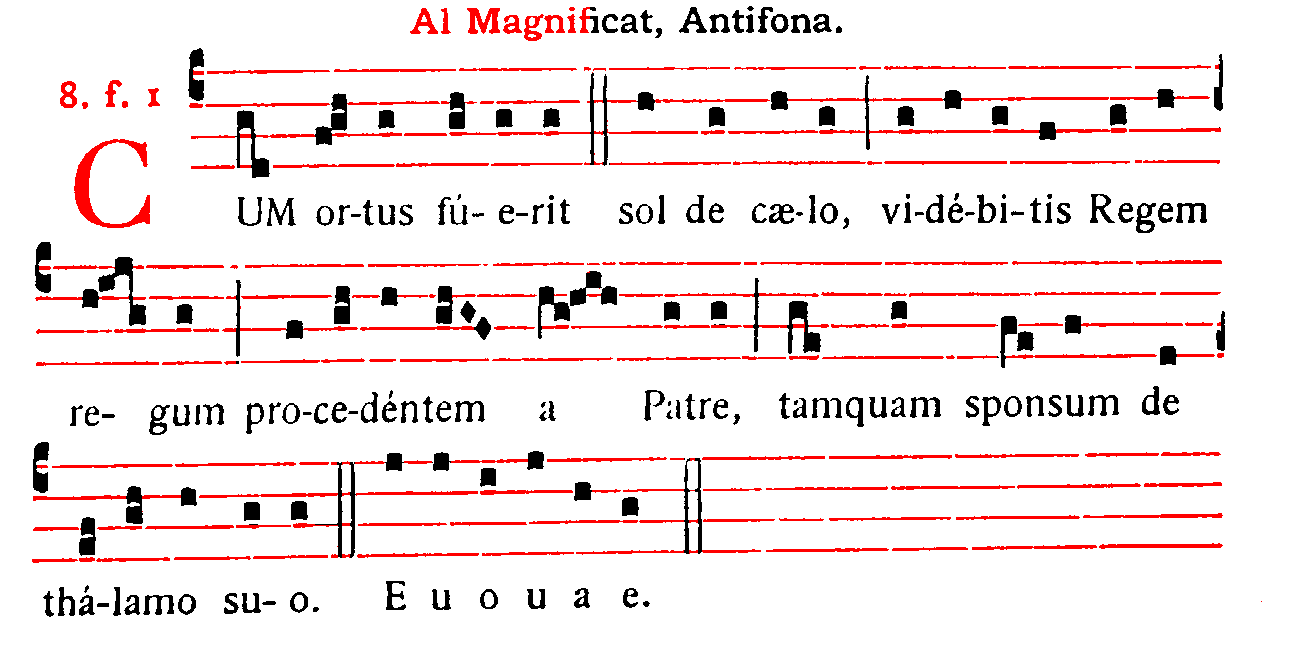
Christmas chant honors Christ the bridegroom: Cum ortus fuerit sol de Caelo

Face of Christ
from St. John’s Anglican Church, Ashfield, Australia (Wikimedia Commons)

An ancient Gregorian chant compares sunrise on Christmas morning to Christ coming out of his bedroom to join in mystical marriage with people who love him:

“When the sun shall have risen in the heavens, ye shall see the King of Kings coming from the Father, as a Bridegroom from his bride-chamber.” *

The erotic, even homoerotic, words translate a Latin liturgical antiphon for First Vespers on Christmas Day: “Cum ortus fuerit sol de Caelo, videbitis Regem regum procedentem a Patre, tanquam sponsum de thalamo suo.”


“To start the Christmas season, the Church uses an image of the Son emerging from the marital bliss of the Godhead's bridal suite. It has God himself in a same-sex marriage! And in case we missed the antiphon, it is repeated in the liturgy the following day,” says Kevin Elphick, a Franciscan scholar and a supervisor on a suicide prevention hotline in New York.

The text is apparently a Christian adaptation of Psalm 19: 4-5: “In the heavens God has pitched a tent for the sun. It is like a bridegroom coming out of his chamber, like a champion rejoicing to run his course.”

Elphick points out that nuptial intimacy among the Persons of the Trinity might seem surprising, but is part of a long tradition about the Trinity. Sixteenth-century Spanish mystic John of the Cross expressed it well in his “Romance sobre el Evangelio,” where he describes the Trinity as Lover, Beloved and Love. Medieval Belgian theologian William of Saint-Thierry calls the Holy Spirit the “Kiss” and “Embrace” of the first two Persons of the Trinity. Medieval Dutch mystic Hadewijch of Brabant names the mutual unity of all three Persons as their common “Kiss” in her writings.

Episcopalian priest Robert Farrar Capon described the Holy Spirit as the magical marital “Bed” of the Trinity his book “Health, Money, and Love.” He writes: “Once before all time, there was a Lover, a Beloved, and a magical Bed in which they played out the unity of their love. The joy of the two of them in that Bed was complete: there was nothing besides their love, and there was nothing they needed to make their happiness more perfect.” His use of the word “Bed” parallels the “bridal chamber” in the ancient Christmas antiphon.

The Latin uses the word “thalamo” for the bridal chamber. Elphick reports that the Latin Vulgate Bible uses the same word in the marital chamber context in Psalm 18:6 and Joel 2:16. The word is related to the bedroom in both Latin and Greek (thálamos).

The chant is especially suitable for sunrise on Christmas morning because it draws on another ancient tradition connecting Christ with the sun. The lines in Psalm 19 about the sun being like a bridegroom were popular with early Christians. They associated it with the early Christian custom of praying while facing east, the direction of Christ’s ascension and second coming.  The star that led the Magi to the baby Jesus also rose in the east.

The text and plainsong melody of the chant are anonymous, but it was put into more elaborate musical settings by Renaissance composers whose names are known: Flemish composer Nicholas Gombert (c1490 - 1561) and English composer Thomas Tallis (c1505 - 1585). Gombert’s version is performed by the Tallis Singers on the album “Nicolas Gombert: Magnificats 1-4.” The Tallis version is on the album “Christmas Vespers at Westminster Cathedral.” (However the English text introducing the Westminster album conveniently deletes the erotic part of “Cum ortis”!)

Gombert, who was master of the children’s choir at the imperial chapel, was convicted of sexual contact with a boy in his care and was sentenced to hard labor in the galleys in 1540. It is said that during his years of punishment he wrote eight Magnificat settings, including the “Cum ortus fuerit” chant, as an offering to Holy Roman Emperor Charles V. The emperor was so moved by Gombert’s music that he pardoned the composer and granted him and early release.

___
* The chant is translated into contemporary English in “An Introduction to Gregorian Chant, Volume 1” by Richard L. Crocker:
When the sun has risen in the sky,
you will see the king of kings proceeding from the Father,
like a bridegroom out of his chamber.

____
This post is part of the Queer Christ series by Kittredge Cherry at the Jesus in Love Blog. The series gathers together visions of the queer Christ as presented by artists, writers, theologians and others.

Copyright © Kittredge Cherry. All rights reserved.
http://www.jesusinlove.blogspot.com/
Jesus in Love Blog on LGBT spirituality and the arts

Thursday, September 12, 2013

Gay artist paints "Intimacy with Christ": Richard Stott reflects on sensual spirituality

Detail from “Intimacy with Christ 3” by Richard Stott

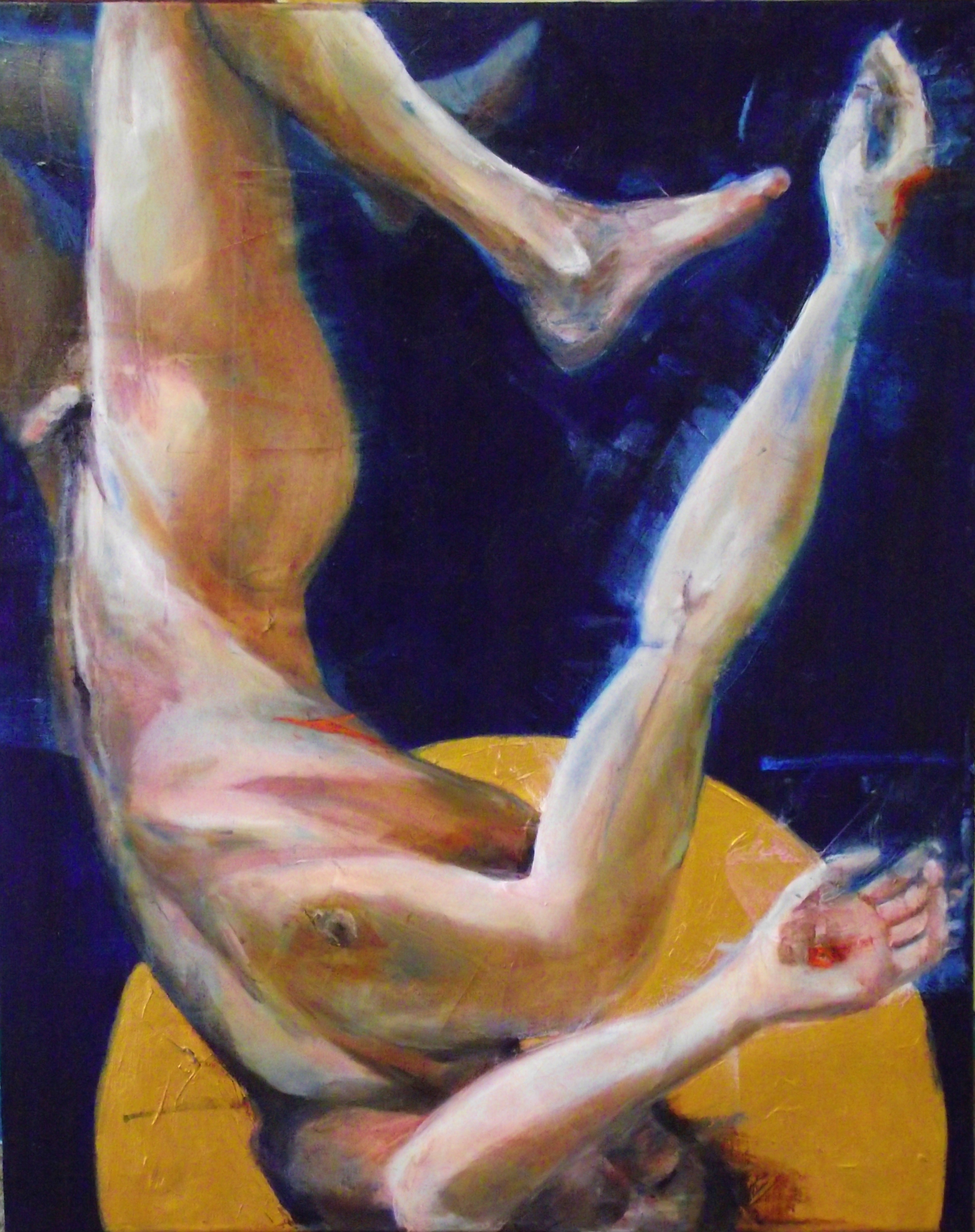
A gay man’s intimacy with Christ is expressed in new art and writing by Richard Stott, a Methodist minister and art therapist in Sheffield, England.

Three large paintings that unite sexuality and spirituality emerged from Stott’s prayer life and meditations on the medieval Christian mystics, especially the poem “The Dark Night of the Soul” by Saint John of the Cross.

“They reach towards the experience of a deep and intimate engagement with Christ. They are not about sex per se but there is an erotic aspect to them. Sexual desire, our desire for the other, to be close to them and entwined with them is, to my mind, an echo of our desire for God and God’s desire for us. In the Christian tradition that is expressed in God coming close to us in the body of Christ,” Stott writes.

“Intimacy with Christ” triptych by Richard Stott on display

The triptych debuted in June at Hidden Perspectives, an arts festival for “bringing the Bible out of the closet” in Sheffield. Stott also posted reflections on each of the paintings at his blog, I Ask for Wonder: Exploring Art, Spirituality and Sacred Spaces in Sheffield and Beyond…. He agreed to share his work here at the Jesus in Love blog.

His first reflection is reprinted below in full, followed by summaries of his other two essays. Images have been cropped for a general audience. The paintings are oil and gold leaf on canvas, measuring approximately 24 by 31 inches.

Detail from “Intimacy with Christ 2” by Richard Stott (for full image click here)

“He touches my neck and all my senses are suspended”
By Richard Stott

Recently I have been stunned by a famous poem by St John of the Cross from his work ‘The Dark Night of the Soul’. In the poem he writes of a spiritual encounter that is deep, beyond words and expresses it in the sensual language of physical intimacy:

Wind blew down from the tower,
Parting the locks of his hair.
With his gentle hand
He wounded my neck
And all my senses were suspended.

I lost myself. Forgot myself.
I lay my face against the Beloved’s face.
Everything fell away and I left myself behind,
Abandoning my cares
Among the lilies, forgotten.

You can read a translation of the whole poem here.

When I read these words echoing down through the years from this 16th Century Spanish mystic I was cut to the heart as they resonate so strongly with my experience of Christ.

I need to take care here as I don’t want to universalise my experience, to imply that everyone should have the same kind of encounter. For some people the idea of relating to Christ at all is unhelpful. Furthermore, many people who do seek to engage with him may very well not do so in the same way as me and nor should they because we each need to work out our own way of engaging with the world and the transcendent. So take my reflections as what they are: the particular experience of a gay Christian using contemplative prayer to engage with Jesus.

One of the key ideas in Christianity, that the church often doesn’t realise the full implications of, is that Jesus had a body. This faith isn’t about some vague spiritual thing wafting around but is about material things and is expressed in a real human body (And whether the stories of Jesus are historically factual or not is irrelevant to me on this because the truth expressed in the myth* of the gospel stories is that the Christian faith is about a real body).

If Jesus had a body then he had blood, mucus, hormones and all kinds of dirty, messy and beautiful things that make us human. He had drives and desires and was a sexual being. When I first thought of this it seemed scandalous to me. I was in a little Catholic Church on the pilgrim road to Santiago de Compostela in Spain. I looked up at the sculpture of Jesus on the cross, his beautiful body twisted and taut in pain or ecstasy and I felt desire for him, a desire for the body of Christ. I wanted to touch his body and be touched by him, to possess him and be possessed by him and in that mutual possession be transformed. I had unwittingly stumbled on and tentatively touched that deep and sensuous spiritual experience expressed by St John of the Cross.

Over the last few months I have been working on some very personal paintings that explore this experience of Jesus and I will offer reflections on each of them over the next few weeks. I share them with some trepidation as it feels like I’m exposing something of my soul but it seems to me that the artists journey is a continual breaking oneself open as we seek to express truths that lie beyond the reach of words.

The golden numinous in each of the paintings is reminiscent of orthodox Christian icons. Icons are not used as idols or objects of worship but are windows to look through so that we may glimpse the divine. I hope these paintings may, in a small way, be windows that open up our horizons and the possibilities of understanding ourselves and of the beautiful transcendent reality that I find embodied in the person of Jesus.


*myth is not a pejorative term but means a story that expresses a truth – often universal truths about human nature and experience
_____________

That concludes Stott’s first essay. Use the following links for his reflections on the other two paintings in his “Intimacy with Christ” triptych.

You are in me and I am in you by Richard Stott explores how the risen Christ invited his friend Thomas to confirm the resurrection by touching his wounds. In another part of the Bible Christ promised “an intimate and passionate intertwining.” This embodied faith is also reflected in a prayer by Symeon the New Theologian.

Lover and beloved moved in unison” by Richard Stott looks at sexual desire as “one of the tributaries of the soul that leads to the wider desire for God.” This yearning is expressed in the Eucharist, the poetry of John of the Cross, and the ecstasy of Teresa of Avila.

Detail from “Intimacy with Christ 1” by Richard Stott (for full image click here)

___
Related links:

New Rainbow Crucifix and Rainbow Madonna unveiled by Richard Stott

Queer Creation by Richard Stott

An Erotic Encounter with the Divine by Eric Hays-Strom (Jesus in Love)

Erotic Christ teacher speaks: We are the erotic body of Christ (Hunter Flournoy at Jesus in Love)

Erotic Christ / Rethinking Sin and Grace for LGBT People (Patrick Cheng at Jesus in Love)
____
This post is part of the Queer Christ series by Kittredge Cherry at the Jesus in Love Blog. The series gathers together visions of the queer Christ as presented by artists, writers, theologians and others. More queer Christ images are compiled in my book Art That Dares: Gay Jesus, Woman Christ, and More.

Copyright © Kittredge Cherry. All rights reserved.
http://www.jesusinlove.blogspot.com/
Jesus in Love Blog on LGBT spirituality and the arts