Showing posts with label Trinity. Show all posts

Thursday, October 29, 2015

Icons honor queer saints for All Saints Day

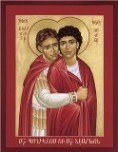
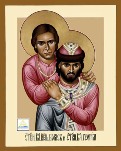
“Saints Polyeuct and Nearchus” by Robert Lentz

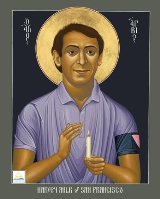
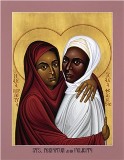
   Harvey Milk icon by Robert Lentz    Saints Perpetua and Felicity by Robert Lentz  

Innovative Religious Art
from TrinityStores.com

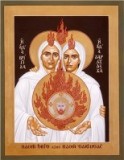
It’s fun and enlightening to look at icons of queer saints as All Saints Day (Nov. 1) approaches. Reader favorites are posted today at the Jesus in Love Blog. All are available from TrinityStores.com.

Click the icons to browse and buy cards, plaques, T-shirts, mugs, candles, and framed prints with these images and many more at TrinityStores.com. 


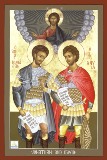
       Sts. Polyeuct and Nearchus by Robert Lentz    Sts. Brigid & Darlughdach by Robert Lentz    St. Boris and George by Robert Lentz  

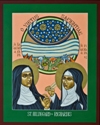
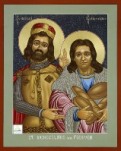
       Jonathan & David by Robert Lentz    Hildegard of Bingen and Richardis by Lewis Williams    St. Wencelaus and Podiven by Lewis Williams
All icons from TrinityStores.com by Robert Lentz or Lewis Williams


Robert Lentz is a Franciscan friar based in New York. Known for his innovative icons, he was rebuked by the church for making icons of LGBT saints and female images of God. Colorado artist Lewis Williams of the Secular Franciscan Order (SFO) studied with Lentz and has made social justice a theme of his icons.

Saturday, November 01, 2014

Icons honor queer saints for All Saints Day

“Saints Polyeuct and Nearchus” by Robert Lentz

   Harvey Milk icon by Robert Lentz    Saints Perpetua and Felicity by Robert Lentz  

Innovative Religious Art
Buy now at TrinityStores.com
Icons of queer saints are available from TrinityStores.com. Favorites of Jesus in Love readers are pictured here for All Saints Day.

Click the images to browse and buy cards, plaques, T-shirts, mugs, candles, and framed prints with these images and many more at TrinityStores.com.  New icons by the same artists are listed at the end of this post.


       Sts. Polyeuct and Nearchus by Robert Lentz    Sts. Brigid & Darlughdach by Robert Lentz    St. Boris and George by Robert Lentz  

       Jonathan & David by Robert Lentz    Hildegard of Bingen and Richardis by Lewis Williams    St. Wencelaus and Podiven by Lewis Williams
All icons from TrinityStores.com by Robert Lentz or Lewis Williams

"Daniel in the Lion's Den"
by Lewis Williams

Robert Lentz is a Franciscan friar based in New York. Known for his innovative icons, he was rebuked by the church for making icons of LGBT saints and God as female. Colorado artist Lewis Williams of the Secular Franciscan Order (SFO) studied with Lentz and has made social justice a theme of his icons.

Lentz and Williams artists created a variety of new icons over the past year, including at least one queer saint: the Biblical prophet Daniel, a eunuch famous for surviving the lion's den. (Click here for more on the queer side of Daniel).

The following icons are so new that I haven't had time to look into whether they qualify as queer. But they do represent the diversity of God's people, so explore for yourself:

New icons by Brother Robert Lentz, OFM

Click the names or visit TrinityStores.com to view:

Josephine Bakhita (19th century, Sudan)

Katharine Drexel (1858-1935, American)

Faustina Kowalska (20th century, Poland)

Andrew Dung-Lac (1785-1839, Vietnam)

Martin de Porres (1579-1639, Peru)

Pedro Betancur

Toribio Romo

Pio of Pietrelcina (1887 -1968

Simone Weil (1909 -1943, France)

New icons by Lewis Williams, SFO

Daniel in the Lion's Den

Peruvian Nativity

Columba and Ernan (521-597, Ireland)

Christmas Scene: Montrose, Colorado

Tuesday, December 24, 2013

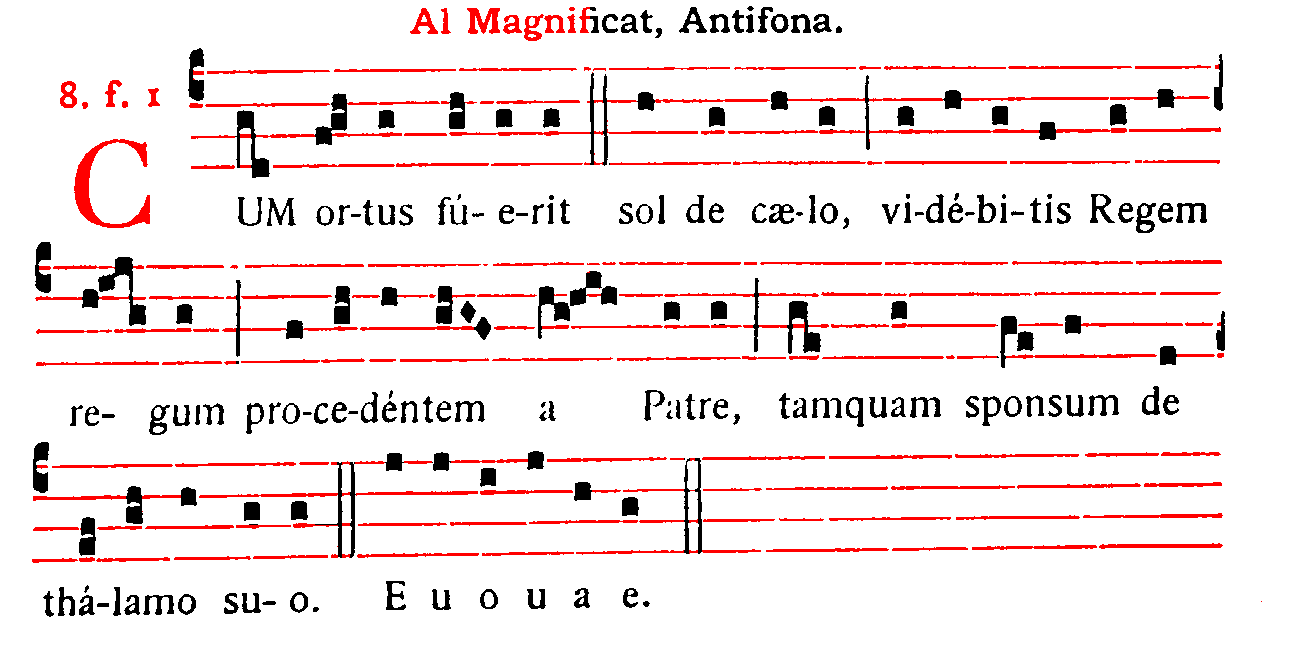
Christmas chant honors Christ the bridegroom: Cum ortus fuerit sol de Caelo

Face of Christ
from St. John’s Anglican Church, Ashfield, Australia (Wikimedia Commons)

An ancient Gregorian chant compares sunrise on Christmas morning to Christ coming out of his bedroom to join in mystical marriage with people who love him:

“When the sun shall have risen in the heavens, ye shall see the King of Kings coming from the Father, as a Bridegroom from his bride-chamber.” *

The erotic, even homoerotic, words translate a Latin liturgical antiphon for First Vespers on Christmas Day: “Cum ortus fuerit sol de Caelo, videbitis Regem regum procedentem a Patre, tanquam sponsum de thalamo suo.”


“To start the Christmas season, the Church uses an image of the Son emerging from the marital bliss of the Godhead's bridal suite. It has God himself in a same-sex marriage! And in case we missed the antiphon, it is repeated in the liturgy the following day,” says Kevin Elphick, a Franciscan scholar and a supervisor on a suicide prevention hotline in New York.

The text is apparently a Christian adaptation of Psalm 19: 4-5: “In the heavens God has pitched a tent for the sun. It is like a bridegroom coming out of his chamber, like a champion rejoicing to run his course.”

Elphick points out that nuptial intimacy among the Persons of the Trinity might seem surprising, but is part of a long tradition about the Trinity. Sixteenth-century Spanish mystic John of the Cross expressed it well in his “Romance sobre el Evangelio,” where he describes the Trinity as Lover, Beloved and Love. Medieval Belgian theologian William of Saint-Thierry calls the Holy Spirit the “Kiss” and “Embrace” of the first two Persons of the Trinity. Medieval Dutch mystic Hadewijch of Brabant names the mutual unity of all three Persons as their common “Kiss” in her writings.

Episcopalian priest Robert Farrar Capon described the Holy Spirit as the magical marital “Bed” of the Trinity his book “Health, Money, and Love.” He writes: “Once before all time, there was a Lover, a Beloved, and a magical Bed in which they played out the unity of their love. The joy of the two of them in that Bed was complete: there was nothing besides their love, and there was nothing they needed to make their happiness more perfect.” His use of the word “Bed” parallels the “bridal chamber” in the ancient Christmas antiphon.

The Latin uses the word “thalamo” for the bridal chamber. Elphick reports that the Latin Vulgate Bible uses the same word in the marital chamber context in Psalm 18:6 and Joel 2:16. The word is related to the bedroom in both Latin and Greek (thálamos).

The chant is especially suitable for sunrise on Christmas morning because it draws on another ancient tradition connecting Christ with the sun. The lines in Psalm 19 about the sun being like a bridegroom were popular with early Christians. They associated it with the early Christian custom of praying while facing east, the direction of Christ’s ascension and second coming.  The star that led the Magi to the baby Jesus also rose in the east.

The text and plainsong melody of the chant are anonymous, but it was put into more elaborate musical settings by Renaissance composers whose names are known: Flemish composer Nicholas Gombert (c1490 - 1561) and English composer Thomas Tallis (c1505 - 1585). Gombert’s version is performed by the Tallis Singers on the album “Nicolas Gombert: Magnificats 1-4.” The Tallis version is on the album “Christmas Vespers at Westminster Cathedral.” (However the English text introducing the Westminster album conveniently deletes the erotic part of “Cum ortis”!)

Gombert, who was master of the children’s choir at the imperial chapel, was convicted of sexual contact with a boy in his care and was sentenced to hard labor in the galleys in 1540. It is said that during his years of punishment he wrote eight Magnificat settings, including the “Cum ortus fuerit” chant, as an offering to Holy Roman Emperor Charles V. The emperor was so moved by Gombert’s music that he pardoned the composer and granted him and early release.

___
* The chant is translated into contemporary English in “An Introduction to Gregorian Chant, Volume 1” by Richard L. Crocker:
When the sun has risen in the sky,
you will see the king of kings proceeding from the Father,
like a bridegroom out of his chamber.

____
This post is part of the Queer Christ series by Kittredge Cherry at the Jesus in Love Blog. The series gathers together visions of the queer Christ as presented by artists, writers, theologians and others.

Copyright © Kittredge Cherry. All rights reserved.
http://www.jesusinlove.blogspot.com/
Jesus in Love Blog on LGBT spirituality and the arts

Sunday, May 26, 2013

Trinity Sunday: Holy Spirit blesses same-sex couple as Gay Passion of Christ series ends

24. The Trinity (from The Passion of Christ: A Gay Vision) by Douglas Blanchard

“Truly, I say to you, today you will be with me in Paradise.”-- Luke 23:43 (RSV)

An angelic figure blesses a gay couple in “The Trinity,” the final, climactic image in Blanchard’s Passion of Christ. The painting can stand alone to affirm the holiness of gay couples, but it also serves as a meditation on the Christian Trinity: one God in three persons. Churches celebrate the concept on Trinity Sunday, which is today (May 26) this year.

For a new version of this article, click this link to Qspirit.net:
Trinity Sunday: Holy Spirit blesses same-sex couple as Gay Passion of Christ series ends


The couple holds hands before a table set with milk, honey, and fruit -- references to the Promised Land. The man draped in red reaches toward out, coaxing the viewer to join them in the sunny garden. The winged woman in the golden robe is the same Holy Spirit who arrived in the previous painting. An arch in the background hints at the gate of heaven. Indeed viewers are welcome to imagine themselves seated in paradise with Christ as their bridegroom.

“The Trinity” shows how Jesus has been transformed by his experience of the Passion. He moved from the dark prison of the first painting to a bright land of promise, out of the closet, into the streets, and on to holy bliss. He completed the mythic hero’s journey: martyred and reborn with power to redeem the world. The painting can stand alone to affirm the goodness of same-sex couples, but it also serves as a foretaste of paradise and a meditation on the Christian Trinity: one God in three persons. The artist has said that he intended this image to be “a little glimpse of salvation, of the reward of the faithful.”

The Bible often says that Jesus will ascend to heaven and sit at the right hand of God. By that reckoning, the man in blue must be God, but he is not the usual Father figure of traditional Trinitarian imagery. He doesn’t look like “the Lord” and certainly not old enough to be Jesus’ father. In Blanchard’s universe, God’s identification with humanity is so complete that God and Jesus are identical young lovers in a mystic same-sex marriage, both sharing the same crucifixion wounds. Mission accomplished, they sit together side by side in radical equality. As the historical Christian creeds say, they are “of one substance” and “coeternal, and coequal.”

The Trinity concept is reinforced by the colors of their clothing. The red, blue, and yellow robes are the three primary colors that, when mixed, create the full spectrum of white light. Red, yellow, and blue flowers blossom around them. These are common, garden-variety plants: irises, geraniums -- and dandelions! Even weeds are welcome at the feet of Christ. Blanchard’s heaven is just not a faraway, immaterial afterlife, but an earthly garden in this present paradise. The natural setting and robes give it a timeless quality, but there are hints of contemporary life in the glass pitcher and honey jar. The man on the right wears a modern t-shirt under his blue robe.

The term “Trinity” is never used in the Bible, although it is implied in references to Jesus, God, and the Holy Spirit, who is often represented as female. Viewers will be forgiven for wondering which man is Jesus. Blanchard, who is so adept at painting individual faces, gives the same face to all three, even the female Holy Spirit. The artist does this on purpose to emphasize the three-in-one nature of God. BOTH men have haloes and marks of crucifixion on their wrists.

One clue to their identities comes from the way the figures direct their attention. The Holy Spirit and the man in blue focus on the man in red. Their body language suggests that he is Jesus, the center of this series, the one who just completed his heroic Passion journey. Like Christ in Blanchard’s first painting, the man in red gazes straight ahead, meeting the eyes of the viewer. His upper torso is naked, revealing the wound in his side and a radiant, muscular body. Surely this man is Jesus.

The holy gay wedding imagery is especially revolutionary because of its placement in Blanchard’s Passion sequence. After the Ascension and Pentecost, the final position in a Passion cycle normally goes to the Last Judgment. Traditional images show Jesus condemning sinners to hell and sending the righteous to heaven. Conservative Christians like to imagine homosexuals among the damned. But Blanchard rejects the crime-based model. Jesus and God are not on thrones nor do they judge anybody. Indeed Blanchard reverses the whole Christian view of history as presented by countless artists, including his acknowledged inspiration, Albrecht Durer. In his 16th-century Small Passion, Durer began with Adam and Eve eating forbidden fruit and being expelled from Eden as punishment. He ended with the Last Judgment. By contrast Blanchard starts with punishment in prison, and then finds a way to paradise. He chose a prototype for this painting in a separate branch of art history: Andrei Rublev’s great Byzantine icon “Trinity,” which shows the three angels at Abraham’s table. Blanchard’s Passion concludes not with judgment, but with love as its crowning glory.

The symbolism of this image can be better understood in comparison with the first painting, “Son of Man with Job and Isaiah.” The opening picture also forms a kind of Trinity. The two paintings that start and end the series have a lot in common. Unlike the rest of the series, their titles are theological concepts. Both have interrupted the flow of time, mixing modern and ancient dress. Both show Jesus gazing directly into the eyes of the viewer. The first and last images are like brackets that enclose and uphold the events in Christ’s life.

A lot of LGBT people (and others) just plain like “The Trinity,” without seeing it as Christian at all. It was chosen to illustrate the concept of gay friendship on the cover of “White Crane Journal: Gay Wisdom and Culture” in summer 2007. Blanchard’s Trinity is queer in other ways. The whole concept of a three-in-one God with male and female aspects means that that God does not fit the standard “male” and “female” binary, but may be transgender, omnigender, or genderqueer. Most artists throughout history have not used couples to symbolize the joys of heaven, but some contemporary LGBT artists do. Both Blanchard and Swedish photographer Elisabeth Ohlson Wallin envision same-sex pairs in the afterlife. Ohlson Wallin closes her “Ecce Homo” series with a vision of heaven in which Jesus and his boyfriend are surrounded by a crowd of loving lesbian and gay couples, all clad in white.

After progressing through the whole Passion series, viewers have witnessed God’s solidarity with humankind and seen the power of love to transcend personal suffering, human history, and even death itself. Preconceptions have been shaken by the encounter with Jesus, the wounded healer, the hated lover, the crucified creator, the liberator in chains, the all-too-human child of God. From this post-resurrection space, Christ has regained his complexity. The gay vision of Christ’s Passion leaves viewers with an invitation to rise to a new life where everyone can reach out to others with love as Jesus does. The painting ends the series as a visual benediction, encouraging viewers to carry the vision onward and live with passion in every sense of the word.


“Blessed are those who are persecuted for righteousness’ sake, for theirs is the realm of heaven.” -- -- Matthew 5:10 (Inclusive Language Lectionary)

What is the gay vision of heaven? The Holy Spirit inspires each person to see visions of God in his or her own way. Look, the Holy Spirit celebrates two men who love each other! She looks like an angel as She protects the male couple. Are the men Jesus and God? No names can fully express the omnigendered Trinity of Love, Lover, and Beloved… or Mind, Body, and Spirit. God is madly in love with everybody. God promises to lead people out of injustice and into a good land flowing with milk and honey. We can travel in the same paths where Jesus journeyed. Opening to the joy and pain of the world, we can experience all of creation as our body -- the body of Christ. As queer as it sounds, we can create our own land of milk and honey. As Jesus often said, heaven is among us and within us. Now that we have seen a gay vision of Christ’s Passion, we are free to move forward with passion.

Jesus, thank you for giving me a new vision!


___
This is part of the series “The Passion of Christ: A Gay Vision.”

The Passion series features 24 paintings by Douglas Blanchard, with text by Kittredge Cherry. It is also available as a book and prints.

Copyright © Kittredge Cherry. All rights reserved.
Qspirit.net presents the Jesus in Love Blog on LGBTQ spirituality.

___
Related links:

The Genderqueer Trinity (Queering the Church)

Scripture quotations are from the Inclusive Language Lectionary, copyright © 1985-88 National Council of the Churches of Christ in the United States of America.


Sunday, June 03, 2012

Trinity Sunday: Gay Passion of Christ series ends

24. The Trinity (from The Passion of Christ: A Gay Vision) by Douglas Blanchard

“The grace of the Sovereign Jesus Christ and the love of God and the communion of the Holy Spirit be with you all.” -- 2 Corinthians 13:14 (Inclusive Language Lectionary)

An angelic figure blesses two men holding hands in “The Trinity,” the last image of 24 paintings in “The Passion of Christ: A Gay Vision” by Douglas Blanchard. The painting can stand alone to affirm the holiness of gay couples, but it also serves as a meditation on the Christian Trinity: one God in three persons. Churches celebrate the Trinity on Trinity Sunday, which is today (June 3) this year. The trio gathers around a table set with milk, honey, and fruit, references to the Promised Land. The man draped in red reaches toward the viewer, inviting us to join them in the sunny garden. An arch in the background hints at the gate of heaven.


For a new version of this article, click this link to Qspirit.net:
Trinity Sunday: Holy Spirit blesses same-sex couple as Gay Passion of Christ series ends

“The Trinity” shows the transformation in Jesus (and the viewer) after experiencing Christ’s Passion. We move from the dark prison of the first painting to a bright land of promise, out of the closet, into the streets, and on to holy bliss. The artist has said that he intended this to be “a little glimpse of salvation, of the reward of the faithful.”

The winged woman in the golden robe is the same Holy Spirit who arrived in the previous painting. Viewers will be forgiven for wondering which man is Jesus. Blanchard, who is so adept at painting individual faces, gives the same face to all three, even the female Holy Spirit. The artist does this on purpose to emphasize the three-in-one nature of God. BOTH men have haloes and marks of crucifixion on their wrists.

One clue to their identities comes from the way the figures direct their attention. Both the Holy Spirit and the man in blue turn to look at the man in red. Their body language suggests that he is Jesus, the focus of this series, the one who just completed his heroic Passion journey. Like Jesus in the first painting of this series, the man in red gazes straight out from the image, meeting the eyes of the viewer His upper torso is naked, revealing the wound in his side and a radiant, muscular body. Surely this man is Jesus.

The Bible often says that Jesus will ascend to heaven and sit at the right hand of God. By that reckoning, the man in blue must be God, but he is not the usual Father figure of traditional Trinitarian imagery. He doesn’t look like “the Lord” and certainly not like Jesus’ father. In Blanchard’s universe, God’s identification with humanity is so complete that he and Jesus both share the crucifixion wounds. God and Jesus are identical young lovers in a mystic same-sex marriage. Mission accomplished, they sit together side by side in radical equality. As the historical Christian creeds say, they are “of one substance” and “coeternal, and coequal.”

They wear colors that reinforce the Trinity concept. Their red, blue and yellow robes are the three primary colors that, when mixed, create the full spectrum of white light. Red, blue and yellow flowers blossom around them. These are common, garden-variety plants: geraniums, irises -- and dandelions! Even weeds are welcome at the feet of Christ. The natural setting and generic robes give it a timeless quality, but there are hints of contemporary life in the glass pitcher and honey jar. The man on the right wears a modern t-shirt under his blue robe.

The holy gay wedding imagery is especially revolutionary because of its placement in the Blanchard’s Passion sequence. After the Ascension and Pentecost, the final position normally goes to the Last Judgment. Traditional images show Jesus sending sinners to hell and the righteous to heaven. Conservative Christians like to imagine homosexuals among the damned. But Blanchard eschews the crime-based model. He found a model for this painting in a separate branch of art history: Andrei Rublev’s great Byzantine icon “Trinity,” which shows the three angels at Abraham’s table. Blanchard’s Passion ends not with judgment, but with love. Jesus and God are not on thrones and they are not judging anybody. This too has a Biblical foundation. Roman 8:34 says, “Who then will condemn us? No one -- for Christ Jesus died for us and was raised to life for us, and he is sitting in the place of honor at God’s right hand, pleading for us” (New Living Translation).

The symbolism of this painting can be better understood by considering it as a pair with the first painting, Son of Man. The opening image is also a kind of Trinity. The two paintings that start and end the series have much in common. Unlike the rest of the series, their titles are theological concepts. Both have a disjointed sense of time, mixing modern and ancient dress. Both show Jesus gazing directly into the eyes of the viewer. The first and last images are brackets or bookends that enclose and uphold the thrilling account of events in Christ’s life.

The term “Trinity” is never used in the Bible, although it is implied. The Trinity is admittedly a mystery, which naturally makes it rather queer. The Trinity has inspired queer theologians to reflect on the omnigendered or genderqueer nature of God, encompassing both male and female as in Blanchard’s paintings.

Understanding of Christian symbolism is not necessary to enjoy this painting. Any group of three can be a trinity. A lot of LGBT people (and others) just plain like “The Trinity,” without seeing it as Christian at all. For example, it was chosen to illustrate the concept of gay friendship on the cover of White Crane Journal: Gay Wisdom and Culture in summer 2007. The painting ends the series as a kind of blessing or benediction, encouraging viewers to carry the vision onward and live with passion in every sense of the word.


“So then the Sovereign Jesus, after speaking to them, was taken up into heaven, and sat down at the right hand of God.” -- Mark 16:19 (Inclusive Language Lectionary)

What is the gay vision of heaven? The Holy Spirit inspires each person to see visions of God in his or her own way. Look, the Holy Spirit celebrates two men who love each other! She looks like an angel as She protects the male couple. Are the men Jesus and God? No names can fully express the omnigendered Trinity of Love, Lover, and Beloved… or Mind, Body, and Spirit. God is madly in love with everybody. God promised to lead people out of injustice and into a good land flowing with milk and honey. We can travel the same journey that Christ traveled. Opening to the joy and pain of the world, we can experience all of creation as our body -- the body of Christ. As queer as it sounds, we can create our own land of milk and honey. As Jesus often said, heaven is among us and within us. Now that we have seen a gay vision of Christ’s Passion, we are free to move forward with love.

Jesus, thank you for giving me a new vision!

___
Related links:

Celebrate the Feast of the (Queer) Holy Trinity (Queering the Church)

The Genderqueer Trinity (Queering the Church)

___
This is part of a series based on “The Passion of Christ: A Gay Vision,” a set of 24 paintings by Douglas Blanchard, with text by Kittredge Cherry. For the whole series, click here.

Scripture quotations are from the Inclusive Language Lectionary, copyright © 1985-88 National Council of the Churches of Christ in the United States of America.

Sunday, June 19, 2011

Reimagining God the Father

Did the artist intend to show a gay Father God? God’s halo is a pink triangle, an LGBT symbol, in “Heavenly Father,” a stained glass window at St. Virgil Church, Morris Plains, NJ. Photo by Loci B. Lenar © 2010. 

Reimagining God the Father may lift the spirits of some LGBT people and our allies today (June 19), which happens to be both Father’s Day and Trinity Sunday.

Can God the Father be as gentle and caring as a mother? Is He like a gay father? Do LGBT people have unique ways of redefining fatherhood that can enlighten others? I have no definite answers, but I share the following resources on alternative and even queer ways to re-envision God the Father.

Today, on Father’s Day, I dare to consider the fatherhood of God again -- by reimagining what it means to be God the Father. I seek a Father God who is as warm and nurturing as a mother… or a gay father. Trinity Sunday is also a good time to re-evaluate God the Father because it celebrates the doctrine of God as Father, Son and Holy Spirit (or, in inclusive terms, Creator, Christ and Holy Spirit.)

Many people, myself included, have turned away from the traditionally masculine Father God who is cold, distant, strict and domineering. The concept of God the Father may be hopelessly poisoned for some people who were abused by fathers or father figures. I honor the need to find other images to build a loving relationship with the divine… and the need to find empowering new models of sacred fatherhood.

I came to spiritual maturity at a time when “God the Father” was a dirty word in my church. We needed liberation from the old male-dominated, top-down religion that oppressed women and LGBT people. We read feminist theologians such as Mary Daly, who wrote in Beyond God the Father, “If God is male, then male is God. The divine patriarch castrates women as long as he is allowed to live on in the human imagination.”

At my church we took the offensive and cut out the Father God from our Bibles and hymnals. Instead we used “inclusive language.” Male words were replaced with neutral words, so “Father” became “Parent” or “Creator.” Once in a while we allowed “Father” to return, but only if He was balanced by “Mother.”

After more than a decade of inclusive language, I find myself intrigued by God the Father for several reasons. First, the genderless Creator God has begun to seem cold and distant too. Female images of God or Goddess aren’t enough for me. And there are still plenty of flesh-and-blood fathers in need of spiritual role models.

Then there’s Jesus, my inspiration in so many ways. He often spoke of God as his father. When he prayed he called God “Abba,” an intimate, affectionate Aramaic word that is more like “Daddy” than “Father.” His loving father-son connection with God encourages me to look for new ways of understanding God the Father in hopes of deepening my own relationship with God.

Along the way I found the following materials that reimagine God the Father:
Family photos of gay fathers with their children
New Hymn: Warm Father God
Ancient Hymn: Milk of Father God
Native American Father Spirit art
and queer visions from literature, art and theology.

Gay fathers
Gay fathers are on the forefront of redefining fatherhood. I hope that their photos here will inspire people to see God the Father in liberating new ways.

I had a terrible time finding images to illustrate a nurturing God the Father. It proved to me the need to “reimagine” fatherhood itself, regardless of religious beliefs about God the Father. Finally I remembered the family photos of some loving gay fathers who are friends of the Jesus in Love Blog. They are two different a gay couples that adopted children. I contacted them and both families agreed to share their photos here.

A South African family with two dads! Michael Worsnip, left, and Leon Putzier are the fathers of Gabriel, 7, and Joshua, 9. They adopted their sons at the ages of 3 months and 5 months respectively. Michael has posted the story of their adoption on his blog Hell’s Teeth, where he also writes about LGBT religious art and much more.

Father-son bonding with Michael Worsnip, Gabriel and Joshua.

An Iowa family with two dads! Jon Trouten, back center, and his husband Mark Holbrook with their sons D’Angelo and Leslie. They are adoptive parents of one son and legal guardians of the other son. Jon writes about family life at Jon’s Blog. Among my favorite posts are:

Coming out to my son (This will make you laugh.)
Mother’s Day when you have no mother

Hymn: Warm Father God
Gender stereotypes about God are broken in “Bring Many Names,” a hymn by Brian Wren, one of the world’s best known contemporary hymn writers. This verse presents a fresh view of God the Father:

Warm father God, hugging every child,
Feeling all the strains of human living,
Caring and forgiving, till we’re reconciled:
Hail and Hosanna, warm father God!

Bonus: Other verses shatter age and gender stereotypes by singing the praises of “strong mother God” and my personal favorite, “old, aching God.” Click here for all the lyrics. Click here to hear it on video.

“Bring Many Names” appears in many modern hymnals. Wren is the author of “Hymns for Today.”

Hymn: Milk of Father God
God the Father is explicitly male AND female in a second-century hymn. Check out this mind-blowing excerpt from Ode 19 of the Odes to Solomon:

A cup of milk was offered to me,
and I drank it in the sweetness of the Lord’s kindness.
The Son is the cup,
and the Father is He who was milked;
and the Holy Spirit is She who milked him;
Because His breasts were full,
and it was undesirable that His milk should be ineffectually released.
The Holy Spirit opened Her bosom,
and mixed the milk of the two breasts of the Father…
The womb of the Virgin took it,
and she received conception and gave birth.

This appears in The Earliest Christian Hymnbook: The Odes of Solomon, translated by James Charlesworth, or online at this link.

Native American Great Father

The Trinity
by Father John Giuliani
What if God the Father is Native American, Black, Asian or Latino? If the Creator is going to be an old man, I’d rather see him as dark-skinned sometimes.

I especially like the Native American visions of the Creator as the Great Spirit, Wakan Tanka, Keeper of the Sky, and so on. Somehow they bring out a wiser, gentler side of the Father.

Father John Giuliani unites indigenous American and Christian imagery in “The Trinity,” shown here by permission The Great Father appears with a full headdress of falcon feathers in a halo of light. His open hands deliver the Son, a Christ figure who is a Sioux warrior. The Holy Spirit hovers between them in the form of a falcon, completing the Trinity. The Father, with his long, white hair flowing, seems androgynous and humble… a much-needed vision for our time.

Giuliani is known for creating Christian icons with Native American symbols, expanding the concept of holiness and honoring Native American Indians as the original spiritual presence on this land. His work is a prophetic sign celebrating the reconciliation of native and Christian peoples. Giuliani is also a Catholic priest and founder of the Benedictine Grange, a contemplative monastic community in Connecticut.

Charles Frizzell is another artist who does Native American spiritual art, including a Father-God figure called “Keeper of the Sky.” Click here and scroll down to see it on his website.

Father as Twin
In my “Jesus in Love” novels, Jesus starts out perceiving God the Father as an old man, but as Jesus ages they become identical. Here is an excerpt from Jesus in Love: At the Cross in which Jesus describes his prayer time in Gethsemane, shortly before his arrest:

“I raised my head and saw my Father sitting on a nearby log. When I was a child I thought He looked ancient and care-worn. He didn’t change, but I did. I had grown to look just like Him. We looked more like twins than a father and son. I went over and knelt at His feet. He steadied me with his kind gaze, then handed me the now-familiar gold cup….”

Queer Trinity?
The Trinity
by Douglas Blanchard
Jesus and God also appear to be the same age in “The Trinity” (at left) from “The Passion of Christ: A Gay Vision” by Douglas Blanchard.  Instead of Father and Son, they seem more like Lover and Beloved, which is another interpretation of the Trinity.  Click here for more about this painting.

The Trinity has inspired queer theologians to question God’s gender. The Holy Spirit is often presented as the female person of the Trinity, so that seems to make God into a transgender, omnigender or genderqueer -- not fitting the standard “male” and “female” duality. The following resources offer more queer theological reflections on the Trinity:

Celebrate the Feast of the (Queer) Holy Trinity at queeringthechurch.com

Gavin D’Costa’s chapter “The Queer Trinity” in Queer Theology: Rethinking the Western Body

The Queer God by Marcella Althaus-Reid.

The prayer formerly known as
“Our Father”
I close this reflection with a new version of the prayer that’s usually called the “Lord’s Prayer” or the “Our Father,” based on the first words of the standard translation. In inclusive language, we called it “the prayer that Jesus taught.” This refreshing version was written by Yvonne Aburrow (also known as Yewtree), a friend of the Jesus in Love Blog. She is a Unitarian and a Wiccan who blogs on spirituality at The Dance of the Elements.

O Genderless Engenderer,
Flame of life at the heart of all things,
Holy, holy, holy are your names.
Your republic of informed hearts is always within us and around us.
Your mysterious way unfolds before us
as matter and spirit dance together to create life.
May the finite tell its stories to the infinite
and may the infinite lend its everlasting peace to the finite.
May our hearts be open to forgiveness given and received,
and may we move accurately in harmony with all
and remain present in the now.
The republic of heaven on earth is all and each of us
reverberating with glory and power
in infinite space-time.
Amen.

Friday, April 29, 2011

24. The Trinity (Gay Passion of Christ series)

24. The Trinity (from The Passion of Christ: A Gay Vision) by Douglas Blanchard

“So then the Sovereign Jesus, after speaking to them, was taken up into heaven, and sat down at the right hand of God.” -- Mark 16:19

What is the gay vision of heaven? The Holy Spirit inspires each person to see visions of God in his or her own way. Look, the Holy Spirit celebrates two men who love each other! She looks like an angel as She protects the male couple. Are the men Jesus and God? No names can fully express the omnigendered Trinity of Love, Lover, and Beloved… or Mind, Body, and Spirit. God is madly in love with everybody. God promised to lead people out of injustice and into a good land flowing with milk and honey. We can travel the same journey that Christ traveled. Opening to the joy and pain of the world, we can experience all of creation as our body -- the body of Christ. As queer as it sounds, we can create our own land of milk and honey. As Jesus often said, heaven is among us and within us. Now that we have seen a gay vision of Christ’s Passion, we are free to move forward with love.

Jesus, thank you for giving me a new vision!
___
This concludes a series based on “The Passion of Christ: A Gay Vision,” a set of 24 paintings by Douglas Blanchard, with text by Kittredge Cherry. 

Questions to readers: Do you want to see the Gay Passion series again next year on this blog? Did you like seeing 1 painting per day for 3 weeks, or is it better to show them all during Holy Week? Should we make this series into a book?  Please leave a comment or contact me with your answers.

Here is a list of the whole series. Click the titles to go to each post.
Introduction
1. The Human One (Son of Man) with Job and Isaiah
2. Jesus Enters the City 
3. Jesus Drives Out the Money Changers
4. Jesus Preaches in the Temple
5. The Last Supper
6. Jesus Prays Alone
7. Jesus Is Arrested
8. Jesus Before the Priests
9. Jesus Before the Magistrate
10. Jesus Before the People
11. Jesus Before the Soldiers
12. Jesus Is Beaten
13. Jesus Goes to His Execution
14. Jesus Is Nailed to the Cross
15. Jesus Dies
16. Jesus Is Buried
17. Jesus Among the Dead
18. Jesus Rises
19. Jesus Appears to Mary
20. Jesus Appears at Emmaus
21. Jesus Appears to His Friends
22. Jesus Returns to God
23. The Holy Spirit Arrives
24. The Trinity

Scripture quotation is from the Inclusive Language Lectionary (Year C), copyright © 1985-88 National Council of the Churches of Christ in the United States of America.

Bookmark and Share

Sunday, June 13, 2010

LGBT Pride Prayer: O wildly inclusive God


“Peace” stained glass window at Metropolitan Community Church of San Francisco. Designed by Ken Scott, 1993

O wildly inclusive God, who loves all of the beautiful rainbow of human sexual orientation, remind us that we have a very practical Trinity--one who gives life, one who redeems life, one who stays with us forever. Hear our groans, Holy Spirit, particularly to make a home in all churches that call themselves the body of Christ: for bisexuals, gay man, heterosexuals, lesbian women, and transgendered persons. At times we are overwhelmed and hurt by this angry exclusion. At these times let us realize how much more hurt you are. (Pause for silent prayer.) Come,Holy Spirit, come! Free your people Alleluia! Amen.
___
This prayer appears in “Equal Rites: Lesbian and Gay Worship, Ceremonies, and Celebrations. It comes from “A Service of Worship and Empowerment,” a collaborative liturgy that was celebrated in more than 50 communities across the Presbyterian Church (USA) in 1993 in solidarity with the commissioning as evangelist of lesbian minister Rev. Jane Spahr by Downtown United Presbyterian Church in Rochester, NY.
___
June is Lesbian, Gay, Bisexual and Transgender Pride Month. A new LGBT pride prayer will be posted here every Sunday in June. Click here for the whole series.
___
About the image: A descending dove symbolizes the Holy Spirit in “Peace,” one of 12 stained glass windows designed by Honolulu artist Ken Scott for MCC San Francisco. It was commissioned by Kevin Larrabee.

The 12-window project is called “Heavenly Wind” and is an abstraction representing God's breath flowing through the sanctuary and congregation. Each pair of windows incorporates a color from the rainbow which is a symbol of pride, unity, and celebration in the LGBT Communities. A service of dedication was held in the MCC-SF sanctuary on Nov. 21, 1993. Click here for an online gallery of MCC-SF’s stained glass windows. Special thanks to Lynn Jordan of MCC-SF for background info on the windows.

Bookmark and Share