Showing posts with label clergy. Show all posts

Thursday, September 22, 2016

John McNeill: Pioneering gay priest and patron saint of LGBTQ Catholics


John J. McNeill was a pioneering gay priest, psychotherapist, author, theologian and Jesuit scholar who inspired countless LGBTQ people of faith and their allies. He died one year ago today on Sept. 22, 2015 in a hospice in Fort Lauderdale, Florida, with his partner of 49 years, Charles Chiarelli, at his bedside. He was 90.

For a new version of this article, click this link to Qspirit.net:
John McNeill: Pioneering gay priest who inspired LGBTQ people of faith


The National Catholic Reporter called him a “patron saint of LGBT Catholics” in the headline for his obituary.

McNeill began ministering to lesbian and gay Catholics in the 1970s, helped give birth to the LGBT Catholic organization Dignity in 1974, and wrote the groundbreaking 1976 book “The Church and the Homosexual.” He was silenced by the Vatican and expelled from the Jesuit order for coming out and promoting LBGT rights in church and society.

I first met McNeill in 1987, soon after he ended his silence. He came to preach at Metropolitan Community Church of San Francisco, where I was serving on the clergy staff. He filled the church with a large and adoring crowd, and yet when I had the chance to greet him personally he seemed grounded and ready to focus his warmth on each individual interaction. I was impressed by his powerful-yet-gentle presence and the intellectual force behind his liberating theology.

McNeill became a colleague, inspiration and friend who supported virtually all my book projects over the next 28 years. He spent hours on the phone providing me with background material for my coming-out guide “Hide and Speak,” and eagerly wrote endorsements for my other books.

He went on to write more books on LGBT spirituality, including “Taking A Chance on God,” “Sex as God Intended,” “Freedom, Glorious Freedom” and “Both Feet Firmly Planted in Midair.”

Conflicts between McNeill and the Vatican spanned decades, including a 2011 trip to Rome where he delivered a letter addressed to Pope Benedict XVI asking the church to condemn violence against LGBT people.

So it seems like no coincidence that McNeill died on the same day that Pope Francis arrived on his first visit to the United States. The timing of his death spared McNeill the pain of seeing the US media glorify the Pope while he slighted the suffering and needs of LGBT people. In another sense, McNeill's timely death passed the baton for the Pope to carry the holy effort to bring love and justice for all.

His life story is told in 2012 film “Taking A Chance on God.” It was directed by Brendan Brendan Fay, who co-produced “Saint of 9/11” about Father Mychal Judge. A trailer is online at YouTube.


McNeill is survived by Chiarelli and nephew Timothy J. McNeill. Funeral arrangements are pending.

Memorial gifts can be made to the John J. McNeill Legacy Fund, established by his family to provide support for the preservation and dissemination of his writings, lectures, and teachings.

May Father John McNeill join Christ and all the saints in heaven who provide a continual source of inspiration and assistance for LGBTQ people of faith. Rest in power, Father John!
___
Related links

The Rev. John J. McNeill, Jesuit priest who became famed LGBT activist, dies at 90 (Miami Herald)

John McNeill, Priest Who Pushed Catholic Church to Welcome Gays, Dies at 90 (New York Times)

Both Feet Firmly Planted in Midair by Chris Glaser (Huff Post)

John J. McNeill Memorial page on Facebook

___
For more info, see previous posts at Jesus in Love:

Gay priest McNeill shakes up Rome with new moves and new movie

Update: Gay priest McNeill’s premiere succeeds despite rain in Rome at EuroPride

LGBT Christians to Pope: Stop homophobia! (plus photos of EuroPride & John McNeill)


___
This post is part of the LGBTQ Saints series by Kittredge Cherry. Traditional and alternative saints, people in the Bible, LGBTQ martyrs, authors, theologians, religious leaders, artists, deities and other figures of special interest to lesbian, gay, bisexual and transgender and queer (LGBTQ) people and our allies are covered.

Copyright © Kittredge Cherry. All rights reserved.
Qspirit.net presents the Jesus in Love Blog on LGBTQ spirituality.

Monday, July 04, 2016

LGBT religious history meets Independence Day: Clergy picketed for LGBT equality in 1965-69 Annual Reminder protests


Early LGBT rights protests happened every Fourth of July from 1965 to 1969 in front of Independence Hall in Philadelphia. Among the protestors was Robert W. Wood, the first member of the clergy to picket for LGBT rights.

The events were called Annual Reminders because they aimed to remind the public that “homosexual Americans” were denied the rights to “"life, liberty, and the pursuit of happiness” as guaranteed in the U.S. Declaration of Independence.

Robert W. Wood
Wood, an ordained Congregational minister, wore his clergy collar while picketing for LGBT equality. This gay-right pioneer also wrote America’s first book on homosexuality and Christianity.

Christ and the Homosexual” was published in 1960 under Wood’s own name with his photo on the dust jacket, even though friends and colleagues warned him that this would damage his reputation. The book calls for the church to welcome homosexuals, recognize same-sex marriage and ordain homosexual clergy.

In 1962 Wood met his life partner Hugh M. Coulter, an abstract artist, cowboy and a fellow World War II veteran. They lived together as a couple while Wood served as pastor of three different parishes over the next 27 years until Coulter’s death. Now age 93, Wood is retired and living in New Hampshire.

American patriotism mixed with LGBT rights at the Annual Reminders, which preceded and paved the way for the Stonewall Uprising. The date and location were strategically planned to connect LGBT rights with other American freedoms.

Jack Nichols at the first Annual Reminder in 1965
The demonstrations happened on Independence Day at Independence Hall, where the Declaration of Independence and the Constitution were written. It was also the home of the Liberty Bell, the iconic symbol of American independence inscribed with the message, “Proclaim liberty throughout all the land unto all the inhabitants thereof.” Abolitionists and suffragettes also used the Liberty Bell as a logo.

The Annual Reminders were a collaboration of the East Coast Homophile Organizations (ECHO). The primary organizers were LGBT rights pioneers Frank Kameny and Barbara Gittings.

Forty gay men and lesbians from Washington, D.C., Philadelphia and New York picketed at the first Annual Reminder in 1965. At the time it was the largest demonstration for LGBT rights in world history. From then on, the demonstrations grew bigger. The rest is history.

Wood’s LGBT Christian message is still powerful today. As he wrote in “The Church and the Homosexual” in 1960:

The Church has done much to keep the homosexual from Christ. Society, often under the influence of the Church, has also thrown roadblocks in the pathway of the homosexual who seeks a higher purpose in life beyond the sexual plane of pleasurable existence.

But the struggle is difficult, the motives misunderstood, the behavior pattern considered perverted. Yet Jesus Christ, whose struggle was also difficult, whose motives were also misunderstood, whose behavior pattern was revolutionary, awaits all men — even the overt homosexual.

___
Related links:

Rev. Robert W. Wood: Gay Pioneer (lgbt50.org)

Annual Reminder (Wikipedia)


Books on LGBTQ American history:

A Queer History of the United States” by Michael Bronski

Stand by Me: The Forgotten History of Gay Liberation” by Jim Downs

Gay American History: Lesbians and Gay Men in the U.S.A.” by Jonathan Katz

___
Top image: Barbara Gittings at the Annual Reminder in 1966

Copyright © Kittredge Cherry. All rights reserved.
http://www.jesusinlove.blogspot.com/
Jesus in Love Blog on LGBT spirituality and the arts

____
This post is part of the LGBT Calendar series by Kittredge Cherry at the Jesus in Love Blog. The series celebrates religious and spiritual holidays, holy days, feast days, festivals, anniversaries, liturgical seasons and other occasions of special interest to lesbian, gay, bisexual, transgender and queer people of faith and allies.

Thursday, September 24, 2015

RIP John McNeill: Pioneering gay priest and patron saint of LGBT Catholics


In memory of
Rev. John J. McNeill

Pioneering gay priest, psychotherapist, author, theologian
and patron saint of LGBT Catholics


Sept. 2, 1925 - Sept. 22, 2015


white candle Pictures, Images and Photos


I light a memorial candle for Father John J. McNeill, pioneering gay priest, psychotherapist, author, theologian and Jesuit scholar who inspired countless LGBTQ people of faith and their allies. He died Tuesday night, Sept. 22, in a hospice in Fort Lauderdale, Florida, with his partner of 49 years, Charles Chiarelli, at his bedside. He was 90.

The National Catholic Reporter called him a “patron saint of LGBT Catholics” in the headline for his obituary.


For a new version of this article, click this link to Qspirit.net
John McNeill: Pioneering gay priest who inspired LGBTQ people of faith


McNeill began ministering to lesbian and gay Catholics in the 1970s, helped give birth to the LGBT Catholic organization Dignity in 1974, and wrote the groundbreaking 1976 book “The Church and the Homosexual.” He was silenced by the Vatican and expelled from the Jesuit order for coming out and promoting LBGT rights in church and society.

I first met McNeill in 1987, soon after he ended his silence. He came to preach at Metropolitan Community Church of San Francisco, where I was serving on the clergy staff. He filled the church with a large and adoring crowd, and yet when I had the chance to greet him personally he seemed grounded and ready to focus his warmth on each individual interaction. I was impressed by his powerful-yet-gentle presence and the intellectual force behind his liberating theology.

McNeill became a colleague, inspiration and friend who supported virtually all my book projects over the next 28 years. He spent hours on the phone providing me with background material for my coming-out guide “Hide and Speak,” and eagerly wrote endorsements for my other books.

He went on to write more books on LGBT spirituality, including “Taking A Chance on God,” “Sex as God Intended,” “Freedom, Glorious Freedom” and “Both Feet Firmly Planted in Midair.”

Conflicts between McNeill and the Vatican spanned decades, including a 2011 trip to Rome where he delivered a letter addressed to Pope Benedict XVI asking the church to condemn violence against LGBT people.

So it seems like no coincidence that McNeill died on the same day that Pope Francis arrived on his first visit to the United States. The timing of his death spared McNeill the pain of seeing the US media glorify the Pope while he slighted the suffering and needs of LGBT people. In another sense, McNeill's timely death passed the baton for the Pope to carry the holy effort to bring love and justice for all.

His life story is told in 2012 film “Taking A Chance on God.” It was directed by Brendan Brendan Fay, who co-produced “Saint of 9/11” about Father Mychal Judge. A trailer is online at YouTube.


McNeill is survived by Chiarelli and nephew Timothy J. McNeill. Funeral arrangements are pending.

Memorial gifts can be made to the John J. McNeill Legacy Fund, established by his family to provide support for the preservation and dissemination of his writings, lectures, and teachings.

May Father John McNeill join Christ and all the saints in heaven who provide a continual source of inspiration and assistance for LGBTQ people of faith. Rest in power, Father John!
___
Related links

The Rev. John J. McNeill, Jesuit priest who became famed LGBT activist, dies at 90 (Miami Herald)

John McNeill, Priest Who Pushed Catholic Church to Welcome Gays, Dies at 90 (New York Times)

Both Feet Firmly Planted in Midair by Chris Glaser (Huff Post)

John J. McNeill Memorial page on Facebook

___
For more info, see previous posts at Jesus in Love:

Gay priest McNeill shakes up Rome with new moves and new movie

Update: Gay priest McNeill’s premiere succeeds despite rain in Rome at EuroPride

LGBT Christians to Pope: Stop homophobia! (plus photos of EuroPride & John McNeill)


____
This post is part of the GLBT Saints series by Kittredge Cherry at the Jesus in Love Blog. Saints, martyrs, mystics, prophets, witnesses, heroes, holy people, humanitarians, deities and religious figures of special interest to lesbian, gay, bisexual and transgender (LGBT) and queer people and our allies are covered on appropriate dates throughout the year.

Copyright © Kittredge Cherry. All rights reserved.
http://www.jesusinlove.blogspot.com/
Jesus in Love Blog on LGBT spirituality and the arts

Monday, February 16, 2015

Queer Clergy Trading Cards feature Kittredge Cherry


Kittredge Cherry, founder of the Jesus in Love Blog, is featured on a new Queer Clergy Trading Card. It identifies her "super power" as "resurrectiong queer Christ."

The cards are a fun way to bring more visibility to LGBTQ ministers. Queer clergy look cool on these virtual “trading cards.”

Currently the Queer Clergy Trading Cards are shared on their Facebook, Instagram and Twitter accounts, but plans are underway to offer printed cards through the new website www.queerclergytradingcards.com.

Queer Clergy Trading Cards are created by Chris Davies, a United Church of Christ minister who studies queer theology at Andover Newton Theological School.

The process of becoming a Queer Clergy Trading Card includes answering a witty questionnaire from Davies. She described Cherry’s answers as “a thoughtful novel on the questions.” Highlights from their interview are posted here.

For more info on Queer Clergy Trading Cards, see the previous post “Queer Clergy Trading Cards bring visibility with humor.”


Queer Clergy Trading Cards: What are you so amazingly good at... that it might be your SUPER POWER!? Please give me a few different options, I'm going to pick one!

Kittredge Cherry: I am good at writing about LGBTQ spirituality and art. I have been called an “outsider god blogger” and a “living saint” for doing the Jesus in Love Blog  and Newsletter.

Before becoming a clergy in Metropolitan Community Churches, I was a newspaper reporter and author. My first book, “Womansword: What Japanese Language says about Women,” even got a good review in the New York Times! (They praised my “very graceful, erudite” style.) I bring a strong writing background into my queer ministry.

I am especially devoted to Jesus and I am known for promoting the idea of a queer Christ. Though my prayer life and study, I gained the insight that the historical Jesus may have been gay or queer… and that the living Christ is in everyone, including LGBTQI people. I often present this idea on my blog and in my books, and the response has been tremendous – both positive and negative. Hate groups keep warning me that hellfire awaits me! But many agree with me that the queer Christ is important now because conservatives are using Christianity to justify discrimination against LGBTQ people.

My “LGBT Saints” series is popular and well known. In fact, it led some people started calling me “Saint Kitt.” (Ha!) I started writing about queer saints because readers told me they were getting bored with my constant focus on Jesus. Now I have come to love doing historical search and writing about saints – broadly defined as anyone who creates more love in the world.

I love art -- looking at it, making it, and nurturing the rare artists who present the queer Christ and LGBTQ saints. My mother was an art teacher and I majored in art history (and journalism) at the University of Iowa.

I have a special gift for reaching queer people who are “unchurched” or “post-church” – those who never went to church or got fed up and left. The reason is because I myself grew up mostly unchurched and thinking that there was no God. I had a conversion experience in my mid-20s when I felt God reach out personally to me. Suddenly I knew there was a God, and that God loved me just as I am, even though I was a lesbian. I was baptized as an adult at an ecumenical church in Japan (where I was a graduate student at the time). I was living in the closet, afraid of social rejection. But knowing that God loved me gave me the strength to come out as a lesbian. When I took my clergy vows in MCC, I added outreach to the secular world in addition to the standard vows.

Another strength is my international, cross-cultural, interfaith and ecumenical background. I have lived abroad, traveled the world and worked as ecumenical officer at MCC international headquarters, advocating for LGBT rights at the World Council of Churches. At WCC conferences I used to wear a button that said, “Lesbian Christian.” Most people fled in terror, but I quickly identified a few supporters that way. One of my recent cross-cultural efforts is partnering with a queer theologian in Argentina to do Santos Queer, a Spanish-language version of my blog.

I have been called “a mystic on the Christ path” because I am devoted to Jesus and I lead a relatively simple, quiet life now. I feel strong love and connection to Jesus in particular, more than most Christians that I know. It feels like he is always with me, ready to help. I am officially “retired” now so I am a bit like a hermit or medieval monk, who preserves and illuminates the story of God while living apart from the world (and connecting over the Internet!) One of my friends marveled, “You could be happy just living in a cave!”


QCTC: What's your kryptonite?  People have taken this all sorts of different directions. Something you can't say "no" to... something that you have to work on, individually... or something that irks you about the church/system/world as a whole. You pick. and tell me which! And also, give me a few different options to pick from...

Kittredge Cherry: One of my “kryptonites” is – staircases! And any building without access ramps for the disabled! In recent years I have health problems that make it hard or impossible for me to go up and down steps, so they are real barriers for me. It’s especially sad when churches aren’t accessible, and even worse when they don’t care. Meanwhile I am working to build my health and muscle strength.

“Never lose your joy!” That’s what a stranger – a nun – said to me very early in my ministry after a worship service that I led. At the time, I thought, “I won’t lose my joy.” But over the decades I sometimes have lost my joy. When I’m feeling discouraged, I remember her words like a beacon.

In my preaching, I tend to stick to the message that God loves all people. For me, that idea is so powerful and transformative that it automatically leads to a solution for every dilemma. But I work to go beyond that basic messages because congregants have complained, “I already know God loves me, now what?!”


QCTC: What song would you walk out to preach to? Artist and song, please!
Oh! You Pretty Things” by David Bowie. David Bowie’s music and androgynous style got me through junior high and high school in the 1970s.


Anything else that might help me in design elements? (all the goofy stuff all around the cards)
Do you love cats? Are you obsessed with Gothic Style? Do you have a secret desire to be a firefighter? What's your favorite color?

Andy Warhol is my favorite artist. I love his art, his ideas, and his androgynous, counter-cultural style. My favorite style of art is contemporary.

My second homeland is Japan, where I lived for three years as a young adult. I still love Japanese culture.

My favorite color is -- Rainbow!

Wednesday, January 14, 2015

Queer Clergy Trading Cards bring visibility with humor


Queer Clergy Trading Cards bring visibility to LGBTQ ministers with humor and witty style.

The fun new online visual arts project has celebrated 50 ordained Christian clergy since it was launched in November 2015.

Update in 2018: Packs of Queer Clergy Trading Cards are now available on Amazon.com.

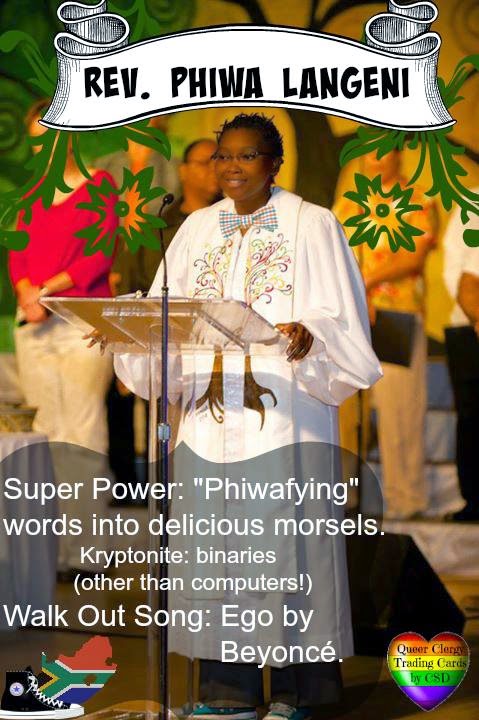
Queer clergy look cool on these virtual “trading cards.” Like the more familiar baseball trading cards, each card combines a portrait photo with written info about the individual.

Queer Clergy Trading Cards list each person’s strength (“super-power”), weakness (“kryptonite”) and their “walk-out song” for making a grand entrance. Some clergy are also given clever job titles such as “butch pastor,” ”femminster,” “renegade priest,” “spiritual directrix” and “inclusivator.”

Flipping through the pack of cards gives a welcome overview of the diversity and carefree spirit among today’s queer clergy. The multiracial group includes people of many ages and denominations. The cards showcase a huge variety of identities, including old-school butch dykes and liturgy queens; bisexual, transgender and genderqueer identities; and people who identify on other spectrums of gender.


“A friend was having a rough day and I wanted to help make them feel like a super hero. So I made a card! And then thought it would be fun to just... keep going,” says Rev. Chris Davies, creator of Queer Clergy Trading Cards. “The cards make queer clergy feel affirmed, and special. And it's networking us in an incredible way!”

Davies is a United Church of Christ minister who is working on her Doctor in Ministry degree in queer theology at Andover Newton Theological School in Massachusetts. Her ministry spills out over the church and into coffee shops, Pride celebrations, bars, queer spaces and the Internet.

Creator Chris Davies made a Queer Clergy Trading Card for herself too.

Queer Clergy Trading Cards are shared on their Facebook, Instagram and Twitter accounts. “While not in print-- YET-- the possibility seems firmer that they will be with each passing day,” according to their Facebook page.

“I've heard people who are not religious say that this has opened their eyes up to ministry in totally different ways than they imagined ministry could be... from youth to adults inside queer spaces and out. And for that I'm so grateful,” Davies told the Jesus in Love Blog.

New cards will continue to come out sporadically, and the project may move to an interfaith expansion in the future.

Queer Clergy Trading Card’s Facebook page addresses one more burning question:

Oh you want to be a card?
1.) Be Queer
2.) Be Christian clergy-- licensed/ordained
3.) Message us!

Other recent projects have taken a serious look at queer clergy, such as “We Have Faith,” a museum-quality traveling exhibit with photos of well-known LGBT and allied clergy, and the 2014 book “Queer Clergy: A History of Gay and Lesbian Ministry in American Protestantism” by R.W. Holmen.

But nobody has ever made our lives look as fun as the Queer Clergy Trading Cards!

Take a moment to view the following examples and go to the Queer Clergy Trading Cards Facebook page to see them all.


___
Related links:
Queer Clergy Trading Cards Give LGBTQ Faith Leaders Superhero Status (Hartford Courant)

___
Special thanks for the news tip to Kyle Lovett, “chaplain to the rainbow people."

Copyright © Kittredge Cherry. All rights reserved.
http://www.jesusinlove.blogspot.com/
Jesus in Love Blog on LGBT spirituality and the arts
___
This post is part of the Artists series by Kittredge Cherry at the Jesus in Love Blog. The series profiles artists who use lesbian, gay, bisexual, transgender (LGBT) and queer spiritual and religious imagery. It also highlights great queer artists from history, with an emphasis on their spiritual lives.

Saturday, February 23, 2013

Esther, Vashti and eunuchs on Purim: Queer models for such a time as this

Queen Esther by Jim Padgett, Distant Shores Media/Sweet Publishing (Wikimedia Commons)

Queen Esther, a role model for LGBTQ people, helped save the Jews from destruction in ancient Persia, an event commemorated today in the Jewish festival of Purim (March 4-5 this year). LGBT Jews see her as an inspiration for coming out. A possible lesbian love story between Biblical queens Esther and Vashi has fired the imagination of a lesbian playwright, while a scholar says both queens are role models for gay and lesbians in ministry.

Esther hid her Jewish identity in order to become the next queen of Persia. Later she "came out" as Jewish to the king, thereby saving her people from a planned massacre. Their story is told in the Book of Esther in the Hebrew scriptures (Old Testament). Vashti was a Persian queen who refused to obey a summons from her drunken husband, the king.

Queer characters fill the Book of Esther. Every chapter includes at least one eunuch -- an ancient term for gender nonconformists who today would be called LGBTQI. There are a dozen eunuchs in the Book of Esther: Mehuman, Biztha, Harbona, Bigtha, Abagtha, Zethar, Carcas, Hegai, Shassshagaz, Teresh, Bigthana and Hathach. They play a variety of roles, including messengers, advisors, guards, assassins and soldiers.

The Washington Post article Gay Jews Connect Their Experience To Story of Purim reports that some see Purim as an unofficial LGBT Pride Day. Esther is traditionally considered the heroine of the story, but independent-minded Vashti has been reclaimed by feminists and now LGBT people.

Lesbian playwright Carolyn Gage imagined a love story between the two queens in her play “Esther and Vashti.” Gage describes her play as “a fast-paced, high-action drama where the love story of two women of different cultures and class backgrounds plays itself out against a backdrop of anti-Semitism and the sexual colonization of women.” Her “radical feminist retelling” fills in the blanks of scripture. In her version, Esther, a radical Jewish lesbian living in exile, and Vashti, a Persian woman of privilege, were lovers before Vashti married the king. The plight of the two women coincides with their successful effort to stop the impending massacre of the Jews.

Rev. David Bahr applies the strategies of the two queens to contemporary challenges in “Openly Gay and Lesbian Pastors Called by Predominantly Straight UCC Congregations,” a research project for his Doctor of Ministry degree at Wesley Theological Seminary in 2006. His theological reflection states, “As Esther and Vashti wrestle with their callings, I believe they can be instructive for gay men and lesbians called to ordained ministry. When should we wait, wondering if we are being prepared for something bigger? And when is enough, enough? What gives us the greatest sense of integrity? Or perhaps, who is best served? Both Esther and Vashti also present ‘models of resistance to wrong’ – one of direct dissent and one of working within the system.” Bahr went on to become pastor of Park Hill Congregational Church UCC in Denver, Colorado.

In a famous quote from the Book of Esther, the man who had urged her to hide her Jewish identity changes his advice when their people are about to be massacred: “Perhaps you were made queen for just such a time as this.” (Esther 4:14) Now is a good time to reflect what Esther and Vashti mean to queer people and our allies today.

___
Related links:
The Proudest Queen of Purim (Human Rights Campaign)

Eunuch-Inclusive Esther–Queer Theology 101 by Peterson Toscano

Closets (Esther 4:13-14) (The Bible in Drag Blog)

Esther: The Queen Who Came Out (Talking Dog)

Mona West also writes about Esther in The Queer Bible Commentary

Carolyn Gage page at Amazon.com
____
This post is part of the GLBT Saints series by Kittredge Cherry at the Jesus in Love Blog. Saints, martyrs, mystics, heroes, holy people, deities and religious figures of special interest to lesbian, gay, bisexual and transgender (LGBT) and queer people and our allies are covered on appropriate dates throughout the year.

Copyright © Kittredge Cherry. All rights reserved.
http://www.jesusinlove.blogspot.com/
Jesus in Love Blog on LGBT spirituality and the arts

The traditional view of Esther is presented in the following:


Wednesday, January 23, 2013

First openly LGBT clergy ever helps lead Inaugural Prayer Service


A lesbian minister, Nancy Wilson of Metropolitan Community Churches, became the first openly gay or lesbian clergy member in history to participate as a worship leader a Presidential Inaugural Prayer Service.

She read the scripture at President Obama’s Inaugural Prayer Service yesterday morning (Jan. 22) at the National Cathedral in Washington.

You can see her reading the Bible passage (Isaiah 55:6-11) there on video at this link:
http://www.youtube.com/watch?v=rIrhAh-ApYg

I worked closely with Nancy in the 1990s when I was MCC’s National Ecumenical Officer and she was Chief Ecumenical Officer. Since then she went on to become moderator of the whole Metropolitan Community Churches denomination, which was founded in 1968 as a LGBT-affirming church and now has ministries in 40 countries. Nancy was part of the first LGBT delegation to meet with a sitting president in 1979. Almost 35 years later she is serving on President Obama's Advisory Council on Faith-Based and Neighborhood Partnerships.

Rev. Nancy Wilson at President Obama’s Inaugural Prayer Service (mccchurch.org)

Nancy read a scripture that includes one of my favorite lines: "My word... will not return to me empty; but it will accomplish that which I have purposed, and prosper in that for which I sent it."

How often I turned to that scripture in the early days of my LGBT ministry! It helped me through the emptiness of the AIDS crisis and the rejections that Nancy and I faced in trying to do "dialogue on homosexuality" at the World Council of Churches and National Council of Churches. It is amazing to see that the seeds we planted are bearing fruit now. God's purpose is being accomplished, although the journey is far from over.

Nancy stood for many queer people when read the Bible at the Inaugural Prayer service. Before the event, she wrote about what is means in a blog post for Believe Out Loud: “When I stand in the presence of President Barack Obama and Vice President Joseph Biden to read the Hebrew Bible under the soaring arches of the National Cathedral on Tuesday, I will be exalting. This exaltation is not for myself but for the millions of lesbian, gay, bisexual and transgender (LGBT) people who have longed for a safe place to call home,” she wrote.

The Inaugural Prayer Service was the final event on the inauguration schedule. The inclusion of an openly lesbian minister was a suitable ending for an inauguration with many breakthroughs for LGBT people. No president had ever even mentioned LGBT people before in an Inauguration speech, but Obama set a new precedent with a strong affirmation of LGBT equality:

We, the people, declare today that the most evident of truths – that all of us are created equal – is the star that guides us still; just as it guided our forebears through Seneca Falls, and Selma, and Stonewall; just as it guided all those men and women, sung and unsung, who left footprints along this great Mall, to hear a preacher say that we cannot walk alone; to hear a King proclaim that our individual freedom is inextricably bound to the freedom of every soul on Earth.

It is now our generation’s task to carry on what those pioneers began. For our journey is not complete until our wives, our mothers, and daughters can earn a living equal to their efforts. Our journey is not complete until our gay brothers and sisters are treated like anyone else under the law – for if we are truly created equal, then surely the love we commit to one another must be equal as well. Our journey is not complete until… click here for full text.

___
Related links:

Inaugural Prayer Service Includes First Out Gay Clergy Member (Advocate)

A Lesbian, a Bible and an Inauguration Service: In Search of Safe Homes by Nancy Wilson (Believe Out Loud)

Copyright © Kittredge Cherry. All rights reserved.
http://www.jesusinlove.blogspot.com/
Jesus in Love Blog on LGBT spirituality and the arts

Thursday, May 31, 2012

Cartoon: Jesus saves LGBT kids from jaws of clergy hat

“Life Savior” by Mr. Fish (clowncrack.com)

Carrying a gay child, Jesus walks on dangerous waters above the shark-like jaws of a clergy hat in a new cartoon by Mr. Fish.

Artist Dwayne Booth, who uses the pen name Mr. Fish, drew the cartoon to illustrate “The War on Gays” by Chris Hedges this week at truthdig.com. The article points out religious threats to LGBT youth through an extensive interview with Mel White, author of “Holy Terror: Lies the Christian Right Tell Us to Deny Gay Equality.”

Detail from Life Savior
by Mr. Fish
The cartoon shows Jesus carrying a gay child, signified by the rainbow flag on the child’s shirt. Lurking in the water below them is a gigantic mitre -- the tall, pointy cap worn by Popes, bishops and other clergy. The hat has two shield-shaped halves that open like the toothy jaws of a shark. Will Jesus save the child, or will they both be swallowed up by the holy terror of anti-LGBT religious oppression?

Booth is a cartoonist and freelance writer whose work can be seen most regularly on Harpers.org and Truthdig.com. Over the last 20 years his work has been published by many of the nation’s most prestigious magazines and newspapers, including The Los Angeles Times, The Village Voice and the Advocate. A debut volume of his collected cartoons titled Go Fish: How to Win Contempt and Influence People was published in 2011.

___
Special thanks to Mr. Fish for permission to share his cartoon here at Jesus in Love. And thanks to Paul Hartman for alerting me to this powerful cartoon.
___
Related links:
Jesus and Freddie Mercury: Marriage Made in Heaven cartoon supports equality

Cartoon shows Pope mad at nuns and Jesus for not condemning homosexuality

Cartoon shows GLBT religious rights on the cross

Holy Terror: Lies the Christian Right Tells Us to Deny Gay Equality by Mel White

Thursday, March 08, 2012

Esther, Vashti and eunuchs on Purim: Queer models for such a time as this

Queen Esther by Jim Padgett, Distant Shores Media/Sweet Publishing (Wikimedia Commons)

Queen Esther, a role model for LGBTQ people, helped save the Jews from destruction in ancient Persia, an event commemorated today in the Jewish festival of Purim (March 4-5 this year). LGBT Jews see her as an inspiration for coming out. A possible lesbian love story between Biblical queens Esther and Vashi has fired the imagination of a lesbian playwright, while a scholar says both queens are role models for gay and lesbians in ministry.

Esther hid her Jewish identity in order to become the next queen of Persia. Later she "came out" as Jewish to the king, thereby saving her people from a planned massacre. Their story is told in the Book of Esther in the Hebrew scriptures (Old Testament). Vashti was a Persian queen who refused to obey a summons from her drunken husband, the king.

Queer characters fill the Book of Esther. Every chapter includes at least one eunuch -- an ancient term for gender nonconformists who today would be called LGBTQI. There are a dozen eunuchs in the Book of Esther: Mehuman, Biztha, Harbona, Bigtha, Abagtha, Zethar, Carcas, Hegai, Shassshagaz, Teresh, Bigthana and Hathach. They play a variety of roles, including messengers, advisors, guards, assassins and soldiers.

The Washington Post article Gay Jews Connect Their Experience To Story of Purim reports that some see Purim as an unofficial LGBT Pride Day. Esther is traditionally considered the heroine of the story, but independent-minded Vashti has been reclaimed by feminists and now LGBT people.

Lesbian playwright Carolyn Gage imagined a love story between the two queens in her play “Esther and Vashti.” Gage describes her play as “a fast-paced, high-action drama where the love story of two women of different cultures and class backgrounds plays itself out against a backdrop of anti-Semitism and the sexual colonization of women.” Her “radical feminist retelling” fills in the blanks of scripture. In her version, Esther, a radical Jewish lesbian living in exile, and Vashti, a Persian woman of privilege, were lovers before Vashti married the king. The plight of the two women coincides with their successful effort to stop the impending massacre of the Jews.

Rev. David Bahr applies the strategies of the two queens to contemporary challenges in “Openly Gay and Lesbian Pastors Called by Predominantly Straight UCC Congregations,” a research project for his Doctor of Ministry degree at Wesley Theological Seminary in 2006. His theological reflection states, “As Esther and Vashti wrestle with their callings, I believe they can be instructive for gay men and lesbians called to ordained ministry. When should we wait, wondering if we are being prepared for something bigger? And when is enough, enough? What gives us the greatest sense of integrity? Or perhaps, who is best served? Both Esther and Vashti also present ‘models of resistance to wrong’ – one of direct dissent and one of working within the system.” Bahr went on to become pastor of Park Hill Congregational Church UCC in Denver, Colorado.

In a famous quote from the Book of Esther, the man who had urged her to hide her Jewish identity changes his advice when their people are about to be massacred: “Perhaps you were made queen for just such a time as this.” (Esther 4:14) Now is a good time to reflect what Esther and Vashti mean to queer people and our allies today.

___
Related links:
The Proudest Queen of Purim (Human Rights Campaign)

Eunuch-Inclusive Esther–Queer Theology 101 by Peterson Toscano

Closets (Esther 4:13-14) (The Bible in Drag Blog)

Esther: The Queen Who Came Out (Talking Dog)

Mona West also writes about Esther in The Queer Bible Commentary

Carolyn Gage page at Amazon.com
____
This post is part of the GLBT Saints series by Kittredge Cherry at the Jesus in Love Blog. Saints, martyrs, mystics, heroes, holy people, deities and religious figures of special interest to lesbian, gay, bisexual and transgender (LGBT) and queer people and our allies are covered on appropriate dates throughout the year.

Copyright © Kittredge Cherry. All rights reserved.
http://www.jesusinlove.blogspot.com/
Jesus in Love Blog on LGBT spirituality and the arts

The traditional view of Esther is presented in the following:


Wednesday, June 08, 2011

Update: Gay priest McNeill’s premiere moves crowds despite rain in Rome at EuroPride

John McNeill and his partner Charles Chiarelli meet Paola Concia, member of the Italian Parliament, at the June 6 premiere. Andrea Rubera translates.  Photo By Bill Wilson © 2011, photojournalist for SanFranciscoSentinel.com

Rain couldn’t dampen the spirit of the crowd that joined pioneering gay priest John McNeill at the world premiere of a film on his life at EuroPride in Rome June 6.

(Update: Click here for info on the U.S. premiere Sept. 24 in Woodstock, NY.)

Rain forced organizers to move the premiere of “Taking a Chance on God” from an outdoor location to a tented site in Europride Park at Rome’s Piazza Vittorio Emanuele, according to a news report in the San Francisco Sentinel.

Andrea Rubera, president of Nuova Proposta: Christian Homosexual Women and Men, and Paolo Patane, president of Arcigay, introduced and welcomed McNeill. They praised his courage in coming out and promoting LGBT rights in the church and society since the 1970s. McNeill’s work inspired queer people all over the world, but he was silenced by the Roman Catholic Church and expelled from the Jesuit order for expressing God’s love for LGBT people.

McNeill himself spoke before the screening of the documentary, which was directed by Brendan Fay. Diane Xuereb of Malta posted a moving first-person account on her blog “I am Gay and I am BLESSED.” Here are a few highlights:

I thought that I would get there to find that it was all over, however in true Italian fashion (practically always late ;)) it had only just started. It was 10.45pm. I arrived just in time to hear Fr. John introduce himself as well as the documentary.

The tent was packed, all the chairs were taken, there was barely a place to stand and everyone was listening attentively. Listening to this charismatic 85 year old legendary, gay Jesuit priest, hanging on to his every word….

I couldnt help but cry whilst watching the documentary and when I went to meet him I could see that he too was very emotional. I am grateful for having been able to meet this humble and whole man and for having been able to thank him personally for paving the way for the LGBT world and for making our life more possible.

While in Rome, McNeill will also advocate for LGBT justice at the Vatican -- leading to a possible showdown with his longtime opponent, who now serves as Pope. The order to silence McNeill for his LGBT activism was issued in Rome in 1977 by Cardinal Joseph Ratzinger, the current Pope Benedict XVI.  McNeill’s landmark 1976 book,  “The Church and the Homosexual,” had just been published.

Now McNeill plans to deliver a letter to the Vatican urging the Church to speak out against violence and discrimination experienced by lesbian, gay, bisexual and transgender (LGBT) people around the world.

Simply delivering the pro-LGBT letter to the Vatican may prove to be a challenge, but as the saying goes, Rome wasn’t built (or unbuilt!) in a day.

(Update on June 15: Click here for photos and a report on McNeill and LGBT groups presenting the letter to the Pope asking him to end homophobia.)

Paolo Patane, president of Arcigay, welcomes John McNeill at the premiere
Photo By Bill Wilson © 201l

Crowd watches the world premiere of “Taking a Chance on God” at EuroPride in Rome on June 6
Photo By Bill Wilson © 201l

___
Special thanks to Bill Wilson for permission to post his photos of the premiere. See lots more photos at:
billwilsonphotos.com

For more info, go to:
UPDATE on Oct. 16:
John McNeill has posted his own personal thoughts on the U.S. film debut at this link:
Reflections on the playing of Taking a Chance on God at the Woodstock Film Festival

UPDATE:
Gay priest McNeill film has U.S. premiere Sept. 24 in Woodstock, NY

NEW on June 15: LGBT Christians to Pope: Stop homophobia! (plus photos of EuroPride &  John McNeill) at the Jesus in Love Blog

Gay priest McNeill shakes up Rome with new moves and new movie at the Jesus in Love Blog

Taking a Chance on God at Europride Premiere - On Scene with Bill Wilson at SanFranciscoSentinel.com