Showing posts with label Christian. Show all posts

Thursday, May 30, 2013

Joan of Arc: Cross-dressing warrior-saint

Saint Joan of Arc by Brother Robert Lentz, OFM trinitystores.com

Joan of Arc was a tough cross-dressing teenage warrior who led the medieval French army to victory when she was 17. She is a queer icon, girl-power hero and patron saint of France. Her feast day is today (May 30).

Smart and courageous, Joan of Arc (c. 1412-1431) had visions of saints and angels who told her to cut her hair, put on men’s clothes and go to war. At age 18 she helped crown a king and at 19 she was killed by the church that later made her a saint. She died for her God-given right to wear men’s clothing, the crime for which she was executed 581 years ago today.

For a new version of this article, click this link to Qspirit.net:
Joan of Arc: Cross-dressing warrior-saint and LGBTQ role model

Joan of Arc portrait, c. 1485
Wikimedia Commons
Contemporary LGBT people recognize a kindred spirit in her stubborn defiance of gender rules. Queer writers tend to downplay Joan’s Christian faith, while the church covers up the importance of her cross-dressing. In truth, Joan believed strongly in God AND in cross-dressing. She insisted that God wanted her to wear men’s clothes, making her what today can be called “queer” or “transgender.” She fits the medieval archetype known as the “holy transvestite.” Cross-dressing was illegal, but what really upset the church authorities, then as now, was the audacity of someone being both proudly queer AND devoutly Christian. Her belief that God was the source of her gender-bending queerness makes her an especially inspiring role model for LGBT Christians and our allies.

Joan’s extraordinary life continues to fascinate all kinds of people. Many are eager to claim her as a symbol, from LGBT people and feminists to the Catholic Church and French nationalists. Joan is the subject of more than 10,000 books, plays, paintings and films, including recent works by transgender author Leslie Feinberg and lesbian playwright Carolyn Gage.

Gage’s one-woman show “The Second Coming of Joan of Arc” is an underground classic with Joan as “a cross-dressing, teenaged, runaway lesbian” confronting male-dominated institutions. Feinberg has a chapter on Joan as “a brilliant transgender peasant teenager leading an army of laborers into battle” in her history book “Transgender Warriors: Making History from Joan of Arc to Dennis Rodman.”

The extensive records of her trials by the Inquisition make Joan of Arc the best-documented person of 15th century. There are only hints that she may have been a lesbian, but the evidence is absolutely clear about her trans expression as a cross-dresser.

Joan of Arc, also known as Jeanne d’Arc, was born to peasants in an obscure village in eastern France around 1412, toward the end of the Hundred Years War. Much of France was occupied by England, so that Charles, the heir to the French throne, did not dare to be crowned. When Joan was 13, she began hearing voices that told her to help France drive out the English.

The visions continued for years, becoming more detailed and frequent. Once or twice a week she had visions of Michael the Archangel and two virgin saints: Catherine of Alexandria and Margaret of Antioch (another transvestite saint who refused to marry a man). They told her that God wanted her to meet Charles and lead an army to Reims for his coronation.

Joan’s family tried to convince her that her visions weren’t real, and her first attempt to visit the royal court was rejected. When she was 17 she put on male clothing and succeeded in meeting Charles. He agreed to outfit her as a knight and allowed her to lead a 5,000-man army against the English.

On Charles’ order, a full suit of armor was created to fit Joan. He had a banner made for her and assigned an entourage to help her: a squire, a page, two heralds, a chaplain and other servants.

Joan of Arc on Horseback, 1505
Wikimedia Commons
Joan’s appearance awed the soldiers and peasants when she traveled with the army. Mounted on a fine warhorse, she rode past cheering crowds in a suit of armor. Her hair was “cropped short and round in the fashion of young men.” She carried an ancient sword in one hand and her banner in the other. Her sword was found, as Joan predicted, buried at the church of St. Catherine at Fierbois. The banner showed Christ sitting on a rainbow against a background of white with gold lilies and the motto “Jhesus-Maria.” Legend says that white butterflies followed Joan wherever she rode with her banner unfurled.

With Joan leading the way, the army won the battle at Orleans and continued to defeat English and pro-English troops until they reached Reims. She proudly stood beside Charles VII at his coronation there on July 17, 1429.

Joan soon resumed leading military campaigns. Even during her lifetime the peasants adored her as a saint, flocking around her to touch her body or clothing. Her cross-dressing didn’t disturb them. In fact, they seemed to honor her for her transgender expression. Perhaps, as some scholars say, the peasants saw Joan as part of a tradition that linked transvestites and priests in pre-modern Europe.

One of the first modern writers to raise the possibility of Joan’s lesbianism was English author Vita Sackville-West. She implied that Joan was a lesbian in her 1936 biography “Saint Joan of Arc.” The primary source for this idea was the fact, documented in her trials, that Joan shared her bed with other girls and young women. She followed the medieval custom of lodging each night in a local home. Joan always slept with the hostess or the girls of the household instead of with the men.

Nobody knows for sure whether Joan of Arc was sexually attracted to women or had lesbian encounters, but her abstinence from sex with men is well documented. Her physical virginity was confirmed by official examinations at least twice during her lifetime. Joan herself liked to be called La Pucelle, French for “the Maid,” a nickname that emphasized her virginity. Witnesses at her trial testified that Joan was chaste rather than sexually active.

Joan’s illustrious military career ended in May 1430. She was captured in battle by the Burgundians, the French allies of the English. During her captivity they called her “hommase,” a slur meaning “man-woman” or “masculine woman.”

In a stunning betrayal, Charles VII did nothing to rescue the warrior who helped win him the crown. It was normal to pay ransom for the release of knights and nobles caught in battle, but he abandoned Joan to her fate. Historians speculate that French aristocrats felt threatened by the peasant girl with such uncanny power to move the masses.

The Burgundians transferred Joan to the English, who then gave her to the Inquisition. She spent four torturous months in prison before her church trial began on Jan. 9, 1431 in Rouen, the seat of the English occupation government. She was charged with witchcraft and heresy.

The politically motivated church trial was rigged against her, and yet Joan was able to display her full intelligence as she answered the Inquisitors’ questions. Her subtle, witty answers and detailed memory even forced them to stop holding the trial in public.

Witchcraft was hard to prove, so the church dropped the charge. (Many of today’s Wiccans and pagans still honor Joan as one of their own.) The Inquisitors began to focus exclusively on the “heresy” of Joan’s claim that she was following God’s will when she dressed as a man. The judges told her that cross-dressing was “an abomination before God” according to church law and the Bible. (See Deuteronomy 22:5.)

They accused Joan of “leaving off the dress and clothing of the feminine sex, a thing contrary to divine law and abominable before God, and forbidden by all laws” and instead dressing in “clothing and armor such as is worn by man.”

Joan swore that God wanted her to wear men’s clothing. “For nothing in the world will I swear not to arm myself and put on a man’s dress; I must obey the orders of Our Lord,” she testified. She outraged the judges by continuing to appear in court wearing what they called “difformitate habitus” (“monstrous dress” or “degenerate apparel.”)

Today Joan’s conservative admirers claim that she wore men’s clothes only as way to avoid rape, but she said that it meant much more to her. Joan of Arc saw cross-dressing as a sacred duty.

The judges summarized Joan’s testimony by saying, “You have said that, by God’s command, you have continually worn man’s dress, wearing the short robe, doublet, and hose attached by points; that you have also worn your hair short, cut ‘en rond’ above your ears with nothing left that could show you to be a woman; and that on many occasions you received the Body of our Lord dressed in this fashion, although you have been frequently admonished to leave it off, which you have refused to do, saying that you would rather die than leave it off, save by God’s command.”

Joan refused to back down on the visions she received from God, and she was sentenced to death. She was burned at the stake on May 30, 1431 in Rouen. Twenty five years later she was retried and her conviction was overturned. Joan was declared innocent.

Her armor, that “monstrous dress,” became an object of veneration, sought after like the Holy Grail with various churches claiming to possess her true armor. Joan of Arc was canonized as a saint in 1920. Famous writers and composers who have done works about her include Shakespeare, Voltaire, Verdi, Tchaikovsky, Mark Twain, Bertolt Brecht and George Bernard Shaw. A stunning portrait of Joan kissing her sword (below) was painted by Pre-Raphaelite artist Dante Gabriel Rossetti, whose sister Christina Rossetti is also part of the LGBT Saints series at the Jesus in Love Blog.

“Joan of Arc Kisses the Sword of Liberation” by Dante Gabriel Rossetti, 1863 (WikiPaintings)

This post features contemporary portraits of Joan by Rowan Lewgalon, Robert Lentz and Tobias Haller. Lewgalon is a spiritual artist based in Germany and also a cleric in the Old Catholic Apostolic Church. Her work is online at tir-anam.weebly.com. Lentz is a Franciscan friar known for his innovative and LGBT-positive icons. He is stationed at Holy Name College in Silver Spring, Maryland. His icons are available at Trinitystores.com.

“Jeanne d’Arc” by Tobias Haller

“Jeanne d’Arc” was sketched by Tobias Haller, an iconographer, author, composer, and vicar of Saint James Episcopal Church in the Bronx. He is the author of “Reasonable and Holy: Engaging Same-Sexuality.” Haller enjoys expanding the diversity of icons available by creating icons of LGBTQ people and other progressive holy figures as well as traditional saints. He and his husband were united in a church wedding more than 30 years ago and a civil ceremony after same-sex marriage became legal in New York.

A widely used prayer to Saint Joan of Arc makes a powerful statement that can inspire those who believe in equality for LGBT people, despite rejection by religion and society:


“In the face of your enemies, in the face of harassment, ridicule, and doubt, you held firm in your faith. Even in your abandonment, alone and without friends, you held firm in your faith. Even as you faced your own mortality, you held firm in your faith. I pray that I may be as bold in my beliefs as you, St. Joan. I ask that you ride alongside me in my own battles. Help me be mindful that what is worthwhile can be won when I persist. Help me hold firm in my faith. Help me believe in my ability to act well and wisely. Amen.”

Joan has a dialogue with the fire that is about to consume her in a haunting song written by award-winning Canandian poet Leonard Cohen and sung on July Collins video .


___
Related links:

Wikipedia article on Cross-dressing, sexuality, and gender identity of Joan of Arc

Joan of Arc trial transcript online

Joan of Arc: Cross-dressing martyr at Queering the Church Blog

Jeanne-darc.info

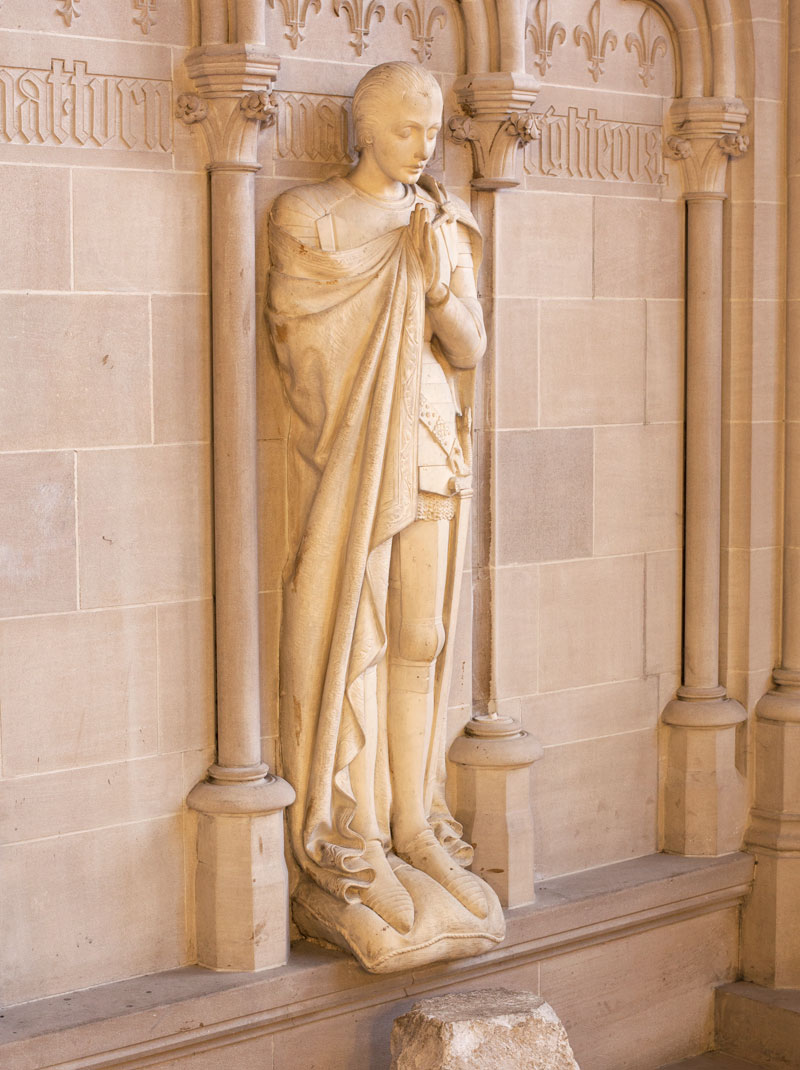
Joan of Arc sculpture by Anna Hyatt Huntington at the Cathedral of Saint John the Divine in New York City

To read this post in Spanish / en español, go to Santos Queer:
Juana de Arco: Santa Travesti

________
This post is part of the GLBT Saints series by Kittredge Cherry at the Jesus in Love Blog. Saints, martyrs, heroes and holy people of special interest to gay, lesbian, bisexual and transgender (GLBT) people and our allies are covered on appropriate dates throughout the year.

Copyright © Kittredge Cherry. All rights reserved.
http://www.jesusinlove.blogspot.com/
Jesus in Love Blog on LGBT spirituality and the arts

Icons of Joan of Arc and many others are available on cards, plaques, T-shirts, mugs, candles, mugs, and more at Trinity Stores


Wednesday, May 08, 2013

Julian of Norwich: Celebrating Mother Jesus

“Julian of Norwich” by Brother Robert Lentz, OFM, TrinityStores.com

Julian of Norwich is a medieval English mystic who celebrated “Mother Jesus.” It’s not known if Julian herself was queer, but her ideas were. Julian is often listed with LGBT saints because of her genderbending visions of Jesus and God. Her feast day (May 8) always falls near Mother’s Day (May 12, 2013).

Her discussions of Jesus as a mother sound radical even now, more than 600 years later. In today’s understanding, Julian’s Jesus seems to be transgender! Her omnigendered vision of the Trinity fits with contemporary feminist and queer theology.


For a new version of this article, click this link to Qspirit.net:
Julian of Norwich: Celebrating Mother Jesus

Mother’s Day is also a great time to honor mothers whose love for their gay children helped launch LGBT organizations, including: Jeanne Manford and Adele Starr, founders of Parents, Families, and Friends of Lesbians and Gays (PFLAG); and Edith “Mom” Perry of Metropolitan Community Churches (MCC).

Julian of Norwich (c.1342-1416) is the first woman to write a book in English. The book, “Revelations of Divine Love,” recounts a series of 16 visions that she experienced from May 8-13, 1373 during a severe illness when she was 30 years old. The book includes Julian’s most famous saying, “All shall be well and all shall be well and all manner of things shall be well” -- words spoken to her by God in one of Julian’s visions.

Julian of Norwich
from Wikimedia Commons

Later Julian went on to become an anchoress, a type of recluse who lives in a cell attached to a church and does contemplative prayer. Her hermit’s cell was at the Church of St. Julian in Norwich. The cell had two windows, one opening to the church and the other opening to the street. She became known throughout England for the spiritual counseling that she gave there.

Julian is considered the first Catholic to write at length about God as mother. Her profound ideas speak powerfully today to women and queer people of faith. “As truly as God is our Father, so truly is God our Mother,” Julian wrote.

Here are a few short quotes from Julian’s extensive writings about “Mother Jesus”:


“So Jesus Christ who sets good against evil is our real Mother. We owe our being to him--and this is the essence of motherhood! --and all the delightful, loving protection which ever follows. God is as really our Mother as he is our Father.“ (Chapter 59)

“So Jesus is our true Mother by nature at our first creation, and he is our true Mother in grace by taking on our created nature.” (Chapter 59)

“A mother can give her child milk to suck, but our dear mother Jesus can feed us with himself, and he does so most courteously and most tenderly with the holy sacrament, which is the precious food of life itself… The mother can lay the child tenderly to her breast, but our tender mother Jesus, he can familiarly lead us to his blessed breast through his sweet open side….” (Chapter 60)


These quotes come from modern English translations of “Revelations of Divine Love” by Elizabeth Spearing and Clifton Wolters. For longer quotations Click here.

The sacred feminine is just one of the many revelations that have endeared Julian to the public. She also uses objects from ordinary life to illustrate God’s loving, forgiving nature. For example, in one vision God shows Julian a small object like a hazel-nut in the palm of her hand. Julian writes:


“I looked at it and thought, 'What can this be?' And the answer came to me, 'It is all that is made.' I wondered how it could last, for it was so small I thought it might suddenly disappear. And the answer in my mind was, 'It lasts and will last forever because God loves it; and in the same way everything exists through the love of God'.” (Chapter 5)


In the icon at the top of this post, Julian looks out the window of her cell with her beloved cat. As an anchoress, she probably lived alone. It is said that the only other being to share her room was a cat -- for the practical purpose of keeping it free from rats and mice. A longstanding legend tells of Julian’s friendship with her cat companion. The icon was painted by Robert Lentz, a Franciscan friar based in New York. Known for his innovative icons, he was rebuked by the church for painting LGBT saints and God as female.

Julian lived a long life. The date of her death is unknown, but records show that she was still alive at age 73 to receive an inheritance. She was never formally canonized, but Julian is considered a saint by popular devotion. The Episcopal and Lutheran Churches keep her feast day on May 8.

___
Related link:
Juliana de Norwich: Celebración de la Madre Jesús (Santos Queer)
___
Related links for Mother's Day:
Jeanne Manford: PFLAG founder loved her gay son

Adele Starr and others: Patron saints for straight allies of LGBT people

Edith “Mom” Perry, mother of Troy Perry and first heterosexual member of the Metropolitan Community Churches
___
This post is part of the LGBT Saints series at the Jesus in Love Blog. Saints, martyrs, heroes and holy people of special interest to gay, lesbian, bisexual and transgender (GLBT) people and our allies are covered on appropriate dates throughout the year.
___

Icons of Julian of Norwich and many others are available on cards, plaques, T-shirts, mugs, candles, mugs, and more at TrinityStores.com


___

Wednesday, April 17, 2013

Sor Juana de la Cruz: Nun who loved a countess in 17th-century Mexico City

Sor Juana Inés de la Cruz by Miguel Cabrera, 1750 (Wikimedia Commons)

Sor Juana Inés de la Cruz was a 17th-century Mexican nun whose critically acclaimed writings include lesbian love poetry. She is considered one of the greatest Latin American poets, an early advocate of women’s rights, and some say, North America's first lesbian feminist writer. Her feast day is today (April 17).

For a new version of this article, click this link to Qspirit.net:
Sor Juana Inés de la Cruz: Nun who loved a countess in 17th-century Mexico City

Sor Juana (Nov. 12, 1648 - April 17, 1695) was born out of wedlock near Mexico City in what was then New Spain. She was a witty, intellectually gifted girl who loved learning. Girls of her time were rarely educated, but she learned to read in her grandfather’s book-filled house.

When she was 16, she asked for her parents’ permission to disguise herself as a male student in order to attend university, which did not accept women. They refused, and instead she entered the convent in 1667. In her world, the convent was the only place where a woman could pursue education.

Sor Juana’s convent cell became Mexico City’s intellectual hub. Instead of an ascetic room, Sor Juana had a suite that was like a modern apartment. Her library contained an estimated 4,000 books, the largest collection in Mexico. The portrait from 1750 shows her in her amazing library, surrounded by her many books.


Sor Juana Inés de la Cruz
By Lewis Williams, SFO trinitystores.com

She turned her nun’s quarters into a salon, visited by the city’s intellectual elite. Among them was Countess Maria Luisa de Paredes, vicereine of Mexico. The two women became passionate friends. It’s unclear whether they were lesbians by today’s definition, but Maria Luisa inspired Sor Juana to write amorous love poems, such as:

That you’re a woman far away
is no hindrance to my love:
for the soul, as you well know,
distance and sex don’t count.

Click here for more of Sor Juana’s lesbian poems in English and Spanish.

The romance between Sor Juana and Maria Luisa has long been an inspiration for authors and film makers. Poet and Chicano studies scholar Alicia Gaspar de Alba writes about it vividly in her novel “Sor Juana’s Second Dream.” The novel became the basis for the play “The Nun and the Countess” by Odalys Nanín.

Gaspar de Alba also writes about Sor Juana in her new book “[Un]framing the ‘Bad Woman’: Sor Juana, Malinche, Coyolxauhqui, and Other Rebels with a Cause.” It was published in 2014 by the University of Texas.

María Luisa Bemberg, one of Latin America’s foremost female directors, explored the love between the nun and the countess in “I, the Worst of All” (Spanish: Yo, la peor de todas). The 1990 film was Argentina’s Academy Award entry for Best Foreign Language Film that year. The DVD cover uses a quote from the Boston Globe to describe the film: “Lesbian passion seething behind convent walls.” It includes woman-to-woman eroticism without objectifying the women. The movie is based on “Sor Juana: Or, the Traps of Faith” by Nobel Prize winner Octavio Paz of Mexico.

Production began in fall 2014 on a movie based on Gaspar de Alba's novel. Mexican actress Ana de La Reguera will play Sor Juana in "Juana de Asbaje," the film adaptation of Gaspar de Alba’s novel. She co-wrote the screenplay with the film's director, Rene Bueno.

Church authorities cracked down on Sor Juana, not because of her lesbian poetry, but for “La Respuesta,” her classic defense of women’s rights in response to opposition from the clergy. Threatened by the Inquisition, Sor Juana was silenced for the final three years of her life. At age 46, she died after taking care of her sisters in an outbreak of plague.

She is not recognized as a saint by the male-dominated church hierarchy that she criticized, but Sor Juana holds a place in the informal communion of saints honored by lesbian, gay, bisexual and transgender people of faith and our allies.  She is especially revered as a role model by Latina feminists.

The icon that appears with this post was painted by Colorado artist Lewis Williams of the Secular Franciscan Order (SFO). Sor Juana sits between Mexico City’s two volcanoes, the male Popocatépetl and the female Iztaccíhuatl, symbolizing the conflict between men and women that she experienced in trying to get an education. She holds a book with a quote from her writings: “The most unforgivable crime is to place people’s stature in doubt.”

___
Related links:

Sor Juana Ines de la Cruz at the Legacy Project

Sor Juana de la Cruz: La monja le encantó la Condesa en la Cidade do México en el siglo 17 (Santos Queer)

___
Related books:

Sor Juana Inés de la Cruz: Feminist Reconstruction of Biography” (2014) by Theresa A. Yugar with a foreword by Rosemary Radford Ruether

Sor Juana Inés de la Cruz: Selected Works” (2015), translated by Edith Grossman with an introduction by Julia Alvarez

___
This post is part of the LGBTQ Saints series by Kittredge Cherry. Traditional and alternative saints, people in the Bible, LGBTQ martyrs, authors, theologians, religious leaders, artists, deities and other figures of special interest to lesbian, gay, bisexual and transgender and queer (LGBTQ) people and our allies are covered.

Copyright © Kittredge Cherry. All rights reserved.
Qspirit.net presents the Jesus in Love Blog on LGBTQ spirituality.


Icons of Sor Juana de la Cruz and many others are available on cards, plaques, T-shirts, mugs, candles, mugs, and more at Trinity Stores


Thursday, March 07, 2013

Perpetua and Felicity: Patron saints of same-sex couples

“Perpetua and Felicity” by Angela Yarber

Saints Perpetua and Felicity were brave North African woman friends who were executed for their Christian faith in the third century. Some consider them lesbian saints or patrons of same-sex couples. Their feast day is March 7.

Perpetua and Felicity were arrested for being Christian, imprisoned together, and held onto each other in the last moments before they died together on March 7, 203.


For a new version of this article, click this link to Qspirit.net:
Perpetua and Felicity: Patron saints of same-sex couples

Perpetua and Felicity are still revered both inside and outside the church. For example, they are named together in the Roman Catholic Canon of the Mass. They are often included in lists of LGBTQ saints because they demonstrate the power of love between two women.

The details of their imprisonment are known because Perpetua kept a journal, the first known written document by a woman in Christian history. In fact, her "Passion of St. Perpetua, St. Felicitas, and their Companions” was so revered in North Africa that St. Augustine warned people not to treat it like the Bible. People loved the story of the two women comforting each other in jail and giving each other the kiss of peace as they met their end in the amphitheater at Carthage, where they were mauled by wild animals before being beheaded.

Perpetua was a 22-year-old noblewoman and a nursing mother. Felicity, her slave, gave birth to a daughter while they were in prison. Although she was married, Perpetua's husband is conspicuously absent from her diary.

Yale history professor John Boswell names Perpetua and Felicity as one of the three primary pairs of same-sex lovers in the early church. (The others are Polyeuct and Nearchus and Sergius and Bacchus.) The love story of Felicity and Perpetua is told with historical detail in two books, “Same Sex Unions in Pre-Modern Europe” by Boswell and “Passionate Holiness” by Dennis O’Neill. He is founder of the Living Circle, the interfaith LGBT spirituality center that commissioned the following icon of the loving same-sex pair. It was painted by Brother Robert Lentz, a Franciscan friar and world-class iconographer known for his progressive icons.

Saints Perpetua and Felicity
By Brother Robert Lentz, OFM, www.trinitystores.com

The Lentz icon of Perpetua and Felicity is one of 10 Lentz icons that sparked a major controversy in 2005. Critics accused Lentz of glorifying sin and creating propaganda for a progressive sociopolitical agenda, and he temporarily gave away the copyright for the controversial images to his distributor, Trinity Stores. It is rare to see an icon about the love between women, especially two dark-skinned African women. The rich reds and heart-shaped double-halo make it look like a holy Valentine. “Perpetua and Felicity” is one of 40 icons featured in “Christ in the Margins,” an illustrated book by Robert Lentz and Edwina Gateley.

“I first learned of Perpetua and Felicity on Kittredge Cherry’s blog, Jesus in Love. Now they join my other Holy Women Icons with a folk feminist twist,” writes artist Angela Yarber at the Feminism and Religion blog. She is a painter, scholar, dancer, minister and LGBT-rights activist based in North Carolina. Nearly 50 color images of her folk feminist icons included in her book "Holy Women Icons." Yarber depicts the pair of women saints with golden warmth and an African vibe. Her icon at the top of this post shows Perpetua and Felicity hugging as their hearts unite into a single large heart. It is inscribed with the words:

Comfort, love, and a holy kiss
Bound their hearts in
The moment of death,
Embracing so that all
May embrace
“Felicity and Perpetua: Patrons of Same-Sex Couples” by Maria Cristina

A banner saying “patrons of same sex couples” hangs above Felicity and Perpetua in the colorful icon painted by Maria Cristina, an artist based in Las Cruces, New Mexico. She paints the two women holding hands in an elegant gesture. The skull of a long-horn cow, similar to paintings of famous New Mexico artist Georgia O’Keefe, adds a welcome bit of Southwestern flavor to the image.

Felicity and Perpetua by Jim Ru
Artist Jim Ru was inspired to paint Felicity and Perpetua as a kissing couple. His version was displayed in his show “Transcendent Faith: Gay, Lesbian and Transgendered Saints” in Bisbee Arizona in the 1990s.

Irish artist St. George Hare, painted an erotic, romanticized vision of Perpetua and Felicity around 1890. His painting “The Victory of Faith” shows the women as an inter-racial couple sleeping together nude on a prison floor.


Their lives are the subject of several recent historical novels, including “Perpetua: A Bride, A Martyr, A Passion” by Amy Peterson and “The Bronze Ladder” by Malcolm Lyon.

___
Related links:

"Eternal Bliss" - SS Felicity and Perpetua, March 7th (Queer Saints and Martyrs - and Others)

Suspect 3rd Century Women Put to Death in Arena: Ancient Hate Crime? (Unfinished Lives: Remembering LGBT hate crime victims)

Perpetua y Felicitas: santas patronas de parejas del mismo sexo (Santos Queer)

This post is part of the LGBTQ Saints series by Kittredge Cherry. Traditional and alternative saints, people in the Bible, LGBTQ martyrs, authors, theologians, religious leaders, artists, deities and other figures of special interest to lesbian, gay, bisexual and transgender and queer (LGBTQ) people and our allies are covered.

Copyright © Kittredge Cherry. All rights reserved.
Qspirit.net presents the Jesus in Love Blog on LGBTQ spirituality.

____

Icons of Perpetua and Felicity and many others are available on cards, plaques, T-shirts, mugs, candles, mugs, and more at Trinity Stores


Wednesday, February 13, 2013

Ash Wednesday: Queer martyrs rise from the ashes


For a new version of this article, click this link to Qspirit.net:
Ash Wednesday: Queer martyrs executed for homosexuality rise from the ashes

Dutch massacre of sodomites,
detail (Wikimedia Commons)
Today on Ash Wednesday queer martyrs rise from the ashes as we recall the thousands who were executed for homosexuality throughout history.

This is not just a historical issue. The death penalty for homosexuality continues today in 10 countries (Yemen, Iran, Iraq, Mauritania, Nigeria, Qatar, Saudi Arabia, Somalia, Sudan, and United Arab Emirates).

Christians traditionally put ashes on their foreheads as a sign of repentance on Ash Wednesday. It is an appropriate time to reflect on the sins of the church and state against queer people, including the burning of “sodomites” and thousands of executions for homosexuality over the past 800 years.

Some of the executions for sodomy were recorded by artists, either long ago or in recent times. This post features images, both new and historical, to remember and honor those whose lives were desecrated and cut short.

The whole sad history of church- or state-sanctioned executions of queer people stretches from the 13th century almost to the present. For the first 1,000 years of church history, Christianity was relatively tolerant of homoerotic relationships.

Then came campaigns of terror that started to use the terms “heresy” and “sodomy” interchangeably.  Eventually hostility began to be directed at same-sex erotic behavior in particular. Terence Weldon of Queering the Church discusses the fateful period when the atrocities began in a well researched overview titled “Lest We Forget: The Ashes of Our Martyrs”:

In 1120, the Church Council of Nablus specified burning at the stake for homosexual acts. Although this penalty may not immediately have been applied, other harsh condemnations followed rapidly. In 1212, the death penalty for sodomy was specified in in France. Before long the execution of supposed “sodomites”, often by burning at the stake, but also by other harsh means, had become regular practice in many areas.

The church contributed to the deaths of thousands for homosexuality over the next 700 years. Witch burning occurred in the same period and claimed the lives of countless lesbian women whose non-conformity was condemned as witchcraft. (Current events in Uganda and elsewhere prove that some are STILL using Christianity to justify the death penalty for homosexuality up to the present day.) As Weldon concludes:

Obviously, the Catholic Church cannot be held directly responsible for the judicial sentences handed down by secular authorities in Protestant countries. It can, however, be held responsible for its part in fanning the flames of bigotry and hatred in the early part of the persecution, using the cloak of religion to provide cover for what was in reality based not on Scripture or the teaching of the early Church, but on simple intolerance and greed.

It is important as gay men, lesbians and transgendered that we remember the examples of the many who have in earlier times been honoured by the Church as saints or martyrs for the faith. It is also important that we remember the example of the many thousands who have been martyred by the churches – Catholic and other.

Sodomy is often considered a male issue, but the facts of history make clear that queer women were persecuted under sodomy laws too. The meaning of sodomy has changed a lot over the centuries. The “sin of Sodom” in the Bible was described as arrogance and failure to care for travelers and the poor.

“Catharina Margaretha Linck, executed for sodomy in Halberstadt in 1721” by Elke R. Steiner. Steiner’s work is based on Angela Steidele’s book "In Männerkleidern. Das verwegene Leben der Catharina Margaretha Linck alias Anastasius Lagrantinus Rosenstengel, hingerichtet 1721." Biographie und Dokumentation. Cologne: Böhlau, 2004. ("In Men's Clothes: The Daring Life of Catharina Margaretha Linck alias Anastasius Rosenstengel, Executed 1721.")

German artist Elke R. Steiner illustrates the last known execution for lesbianism in Europe. Born in 1694, Catharina Margaretha Linck lived most of her life as a man under the name Anastasius. She was beheaded for sodomy on Nov. 8, 1721 in Halberstadt in present-day Germany. Linck worked at various times as a soldier, textile worker and a wandering prophet with the Pietists. She married a woman in 1717. Her mother-in-law reported her to authorities, who convicted her of sodomy with a "lifeless instrument," wearing men's clothes and multiple baptisms. The subject is grim, but Steiner adds an empowering statement: “But even were I to be done away with, those who are like me would remain.”

“Catharina aka Anastasius Linck” by Ria Brodell

Genderqueer Boston artist Ria Brodell portrays Linck and several other historical women who were killed for sodomy in her “Butch Heroes” series. They include Katherina Hetzeldorfer of Germany, drowned in 1477 for female sodomy, and Lisbetha Olsdotter aka Mats Ersson of Sweden, who was decapitated in 1679 for cross-dressing and other crimes.

“The Shameful End of Bishop Atherton and his Proctor John Childe,” hanged for sodomy in 1641 in Dublin (Wikimedia Commons)

John Atherton, Anglican bishop of Waterford and Lismore, and his lover John Childe were hanged for “buggery” in 1640 in Dublin, Ireland. The bishop was executed under a law that he helped to institute! The picture comes from an anonymous 1641 booklet titled “The Shameful End of Bishop Atherton and his Proctor John Childe.” The title tries to shame and blame the victims, but the shame belongs to the church and society who killed them for who and how they loved.

Balboa executing two-spirit Native Americans for homosexuality in 1513 in Panama -- engraving by Théodore De Bry, 1594 (Wikimedia Commons).  

The Spanish explorer Vasco Núñez de Balboa found homosexual activity among the Native American chiefs at Quarqua in Panama. He ordered 40 of these two-spirited people thrown to his war dogs to be torn apart and eaten alive to stop the “stinking abomination.” Executions for homosexuality continued during the “Mexican Inquisition,” an extension of the Spanish Inquisition into the New World. In one of the most notorious examples, 14 men were executed by public burning on Nov. 6, 1658 in Mexico City.

The knight of Hohenberg and his servant, accused of sodomy, were executed by burning in Zürich in 1482. (Wikimedia Commons)

The knight of Hohenberg and his servant, accused sodomites, were executed by burning before the walls of Zurich, Switzerland in 1482. Source: Diebold Schilling, Chronik der Burgunderkriege, Schweizer Bilderchronik, Band 3, um 1483 (Zürich, Zentralbibliothek)


Execution of sodomites in Ghent in 1578 -- drawing by Franz Hogenberg (Wikimedia Commons)

Five Catholic monks were burned to death for homosexuality on June 28, 1578, in Ghent, Belguim.


"Timely Punishment..." shows Dutch massacre of sodomites in Amsterdam in 1730-31 (Wikimedia Commons)

A total of 96 gay men were executed for sodomy in the Netherlands years 1730-31.

More recent examples include the Holocaust or "homocaust" of persecution by the Nazis, who sent an estimated 5,000 to 60,000 to concentration camps for homosexuality. Executions on homosexuality charges in Iran continued to make news multiple times since 2011.

Many more die in attacks fueled by religion-based hate, including those killed in the arson fire at the UpStairs Lounge, a gay bar in New Orleans.

Milder forms of anti-LGBT persecution continue in the church. Now it is common to freeze LGBT people out of church leadership positions. Gay pastor and author Chris Glaser writes about the exclusion from clergy roles as a “fast imposed by others” in the following prayer based on the practice of fasting during Lent, the season of individual and collective repentance and reflection between Ash Wednesday and Easter.

One: Jesus,
     our fast has been imposed by others,
     our wilderness sojourn their choice more than ours.
Many: Our fast from the sacraments,
     our fast from ordination:
     our only choice was honesty.
One: With the scapegoats of the ancient Hebrews,
     sexual sins of generations
     have been heaped upon our backs,
     and we have been sent away,
     excommunicated, into the wilderness to die.
Many: Yet we choose life,
     even in our deprivation
One: Jesus, lead us to discern our call
     parallel to your own:
     rebelling against the boundaries,
     questioning the self-righteous authorities,
     breaking the Sabbath law
     to bring healing.


This prayer comes from “Rite for Lent” by Chris Glaser, published in Equal Rites: Lesbian and Gay Worship, Ceremonies, and Celebrations. Glaser spent 30 years struggling with the Presbyterian Church for the right to ordination as an openly gay man before he was ordained to the ministry in Metropolitan Community Churches in 2005. He writes progressive Christian reflections at chrisglaser.blogspot.com.

Faggots We May Be,” a 2015 poem by Georgia poet S. Alan Fann, makes connections between gay men burned to death, global warming and the Rainbow Christ.

It is horrifying to remember the "burning times," especially for those LGBT people who consider themselves part of the Christian tradition. Let us rise from the ashes with these verses from the Bible:

Create in me a clean heart, O God, and put a new and right spirit within me.
For thou hast no delight in sacrifice; were I to give a burnt offering, thou wouldst not be pleased.
[Psalm 51: 10, 17]

Is such the fast that I choose,
a day for a you to humble yourself?
Is it to bow down your head like a rush,
and to spread sackcloth and ashes under you?
Will you call this a fast, and a day acceptable to God?
Is not this the fast that I choose:
to loose the bonds of wickedness,
to undo the thongs of the yoke,
to let the oppressed go free,
and to break every yoke?
Is it not to share your bread with the hungry,
and bring the homeless poor into your house;
when you see the naked, to cover them,
and not to hide yourself from your own flesh?
Then shall your light break forth like the dawn,
and your healing shall spring up speedily.
[Isaiah 58:5-8]

___
Related links:

“Burned for sodomy” (Queering the Church)

Lest We Forget: The Ashes of Our Martyrs (Queering the Church)

The blood-soaked thread (Wild Reed)

List of people executed for homosexuality (Wikipedia)

LGBT Victims (Gay History Wiki)

List of unlawfully killed transgender people (Wikipedia)

Victims of anti-LGBT hate crimes (Wikipedia)

Victims of Hate” gallery on Facebook

Here are the 10 countries where homosexuality may be punished by death (Washington Post, Feb. 24, 2014)

Significant acts of violence against LGBT people (Wikipedia)

BURN BABY BURN: A Knight, a Squire, a Bishop, a Steward, Five RC Monks and Millions of murders initiated by bigots at Church! (Eruptions at the Foot of the Volcano Blog)

The Gay Holocaust (Matt and Andrej Koymasky)

Catharina Margaretha Linck, Executed for Sodomy (Queering the Church)

A History of Homophobia, 3 The Later Roman Empire & The Early Middle Ages (Rictor Norton)

A History of Homophobia, 4 Gay Heretics and Witches" (Rictor Norton)

Homosexuality in Eighteenth-Century England: A Sourcebook (Rictor Norton, editor)

“Pilloried” - a poem by Andrew Craig Williams

Queering All Saints and All Souls, Celebrating the Queer Body of Christ by Adam Ackley (Huff Post) (litany also suitable for Ash Wednesday)

Blessing the Dust: A Blessing for Ash Wednesday by Jan Richardson

Iran's New Gay Executions (Daily Beast, 8/12/2014)
"Two men, Abdullah Ghavami Chahzanjiru and Salman Ghanbari Chahzanjiri, were hanged in southern Iran on August 6, possibly for consensual sodomy..."

Four Iranian men due to be hanged for sodomy (Pink News, 5/12/2012)
"Iran court sentenced four men… to death by hanging for sodomy… named ‘Saadat Arefi’, ‘Vahid Akbari’, ‘Javid Akbari’ and ‘Houshmand Akbari.’"

Iran executes three men on homosexuality charges (guardian.com 9/7/2011)

International Holocaust Remembrance Day: We all wear the triangle (Jesus in Love)

Ex-gay movement as genocide (Jesus in Love)

Book: Homosexuality and Civilization by Louis Crompton
____
This post is part of the LGBT Holidays series by Kittredge Cherry at the Jesus in Love Blog. The series celebrates religious and spiritual holidays, holy days, feast days, festivals, anniversaries, liturgical seasons and other occasions of special interest to LGBT and queer people of faith and our allies.

Tuesday, February 12, 2013

Brothers by affection: Saints Polyeuct and Nearchus


For a new version of this article, click this link to Qspirit.net:
Saints Polyeuct and Nearchus: Brothers by affection

Saints Polyeuct and Nearchus
By Brother Robert Lentz, OFM. © 1995, trinitystores.com

Saints Polyeuct and Nearchus were Roman soldiers in 3rd-century Armenia and “brothers by affection.” They are a prime example of same-sex lovers in the early church. Polyeuct’s feast day is Feb. 13.

The earliest account of Polyeuct’s martyrdom, a 4th-century Armenian biography, says that they were “brothers, not by birth, but by affection” and enjoyed “the closest possible relationship, being both comrades and fellow soldiers.”

St. Polyeuctus (Wikimedia Commons)
Nearchus was Christian, but Polyeuct was not. The men had a strong desire to spend eternity together, so Polyeuct converted from paganism to Christianity, the faith of his beloved Nearchus. With a convert’s zeal he attacked a pagan procession.  He was beheaded for his crime in the year 259 in the western Armenian city of Militene. Shortly before he was executed, he spoke his last words to Nearchus: “Remember our secret vow.” Thus Polyeuct is known as a protector of vows and avenger of broken promises, in addition to his role as a probable “gay saint.”

Yale history professor John Boswell names Polyeuct and Nearchus as one of the three primary pairs of same-sex lovers in the early church. (The others are Perpetua and Felicity and Sergius and Bacchus.) The love story of Polyeuct and Nearchus is told with extensive historical detail in two books, “Same Sex Unions in Pre-Modern Europe” by Boswell and “Passionate Holiness” by Dennis O’Neill. He is founder of the Living Circle, the interfaith LGBT spirituality center that commissioned the above icon of the loving same-sex pair.

The icon is by Brother Robert Lentz, a Franciscan friar and world-class iconographer known for his innovative icons. It is one of 10 Lentz icons that sparked a major controversy in 2005. Critics accused Lentz of glorifying sin and creating propaganda for a progressive sociopolitical agenda, and he temporarily gave away the copyright for the controversial images to his distributor, Trinity Stores.

Polyeuctus and Nearchus by Jim Ru
Artist Jim Ru was also inspired to paint Polyeuct and Nearchus. His version was displayed in his show “Transcendent Faith: Gay, Lesbian and Transgendered Saints” in Bisbee Arizona in the 1990s.

O’Neill reports that French writer Robert Dartois recently took the story of Polyeuct and Nearchus from “Passionate Holiness” and turned it into a libretto, which was then set by the Swiss composer Thierry Chatelain as the oratorio “Polyeucte et Nearchus.”

There are many variations in the spellings of their names, such as Polyeuctus, Polyeuctes, Polyeuktos and Nearchos and Nearch. Polyeuct’s feast day is Feb.13 in the Catholic calendar, but falls on Jan. 9 in the Eastern Orthodox tradition and Jan. 7 in ancient Armenian calendars. The feast day for Nearchus is April 22.

___
Related links:

Saints Polyeuct and Nearchos, 3rd Century Lovers and Martyrs (Queer Saints and Martyrs -- And Others)

Hermanos de afecto: Santos Polieucto y Nearco (Santos Queer)

___
This post is part of the LGBTQ Saints series by Kittredge Cherry. Traditional and alternative saints, people in the Bible, LGBTQ martyrs, authors, theologians, religious leaders, artists, deities and other figures of special interest to lesbian, gay, bisexual and transgender and queer (LGBTQ) people and our allies are covered.

Copyright © Kittredge Cherry. All rights reserved.
Qspirit.net presents the Jesus in Love Blog on LGBTQ spirituality.

___

Icons of Polyeuct and Nearchus and many others are available on cards, plaques, T-shirts, mugs, candles, mugs, and more at Trinity Stores


___