Showing posts with label crucifixion. Show all posts

Friday, March 25, 2016

Day 6B: Jesus dies (Gay Passion of Christ series)

15. Jesus Dies (from The Passion of Christ: A Gay Vision) by Douglas Blanchard

“While the sun’s light failed… he breathed his last.” -- Luke 23:44-46

“Jesus Dies” places Christ’s crucifixion against a 21st-century city skyline in “The Passion of Christ: A Gay Vision,” a series of 24 paintings by Douglas Blanchard. Jesus hangs on modern scaffolding that forms a cross behind him. He dies an outcast’s death in pain and humiliation. Jesus stayed true to his vision, even when it brought him into conflict with authorities, even to the point of death. Head bowed, Jesus looks like a corpse. Storm clouds blot out the sun in the sky above. The body of Christ dwarfs the crowd in the background. Some jeer at the dead martyr while others pray. Many, including a few priests, watch grimly. Once again Jesus has brought together an unlikely group. These spectators look like ordinary people today, becoming a visual counterpart to the African American spiritual that asks, “Were you there?”

The crucifixion could be taking place on top of a building, or on some kind of terrace. The silhouette of a skyscraper like the Empire State Building stands tall in the distance. Its presence hints at a subtext of Blanchard’s Passion: the 9/11 terrorist attacks happened near Blanchard’s art studio while he was working on the series. The World Trade Center is missing from the skyline in this painting. It has gone up in smoke like the dark clouds gathering above Jesus.

Here the cross regains its uncomfortable power to disrupt lives. The crucifixion of Jesus is so important and widespread in Western culture that it is in danger of losing its impact from deadening over-repetition. Blanchard brings it back to life by updating the image, defying attempts to downplay the significance of the cross or turn it into an oversimplified test of faith. Even non-believers are moved by the story of the martyr who poured out his life for others. For Christians it proves that the Immortal loved people to the point of becoming mortal. Some see the crucifixion as an atonement required by God to redeem the world from human sins. Others view it as God suffering with humanity, longing to stop the cycle of violence. The mystery of the cross is remembered by the faithful through the bread and cup of the Eucharist, the central sacrament of church life.

All four gospels describe the events of the crucifixion in detail. Darkness fell over the land for three hours as the crowds mocked Jesus. One might hope that a gay vision of the Passion would show Jesus speaking from the cross to the man he loved, but the viewer is denied such comfort here. The unnamed “disciple whom Jesus loved” is referenced five times in the gospel of John (John 13:23, 19:26, 20:22, 21:7, 20). He reclined next to Jesus at the Last Supper, resting his head on Jesus’ chest. He was the only male disciple present at the crucifixion. Speaking from the cross, Jesus entrusted his mother and his Beloved Disciple into each other’s care. Christ created an unconventional family by telling them, “Woman, here is your son” and “Here is your mother.” The scene was even included in the new Scriptural Stations of the Cross instituted by the Pope in 1991. The Scriptural Stations also flesh out the crucifixion by adding the conversation between Jesus and the two thieves crucified beside him. But in Blanchard’s vision, there are neither thieves nor family to talk with Jesus. He hangs alone.

The very name of Blanchard’s crucifixion -- “Jesus Dies” -- expresses the modern spirit of the image. The dying Jesus was not depicted at all in Christianity’s millennium. The cross is one of the world’s most common symbols now, but crucifixion images are not the only or even the original way to worship Jesus. Christians drew strength from the crucifixion story in the era of early Christian martyrs, but back then artists had to disguise crosses as anchors or tridents to avoid Roman persecution. After Christianity gained legal status in 313, a few images began to appear with the Christ on the cross, but he was vibrantly alive, head held high in victory over death. The Passion was always depicted with the resurrection as one unified triumph. But mostly the cross was absent until the 10th century. The way Jesus died was not very important to his followers. For a thousand years Christian art usually celebrated Jesus as the Good Shepherd or the ruler of God’s bountiful creation. The risen Christ brought life and abundance. The church was also relatively tolerant of homosexuality in this period.

A shift began when the church joined forces with political and military powers near the end of Christianity’s first millennium. (An especially enlightening and helpful book on the evolution of Christian imagery is “Saving Paradise: How Christianity Traded Love of This World for Crucifixion and Empire” by Rita Nakashima Brock and Rebecca Ann Parker.) The Pope crowned Charlemagne in 800 as Holy Roman Emperor. He began forcing Christianity upon the native cultures of Europe. In present-day Germany Charlemagne’s armies killed or deported thousands of Saxons and chopped down the sacred tree of their religion. Descendants of the surviving Saxons carved the Gero Cross from wood around 970. It is the oldest surviving depiction of a dead Jesus on the cross. As the centuries passed, Jesus’ death on the cross was portrayed with increasing intensity and realism. Crucifixion scenes spread across Europe, along with a new theology of atonement. Christians were urged to imagine themselves at the foot of the cross and contemplate Christ’s agony as he was killed to atone for their particular sins. People who felt guilty for killing Jesus were less likely to resist domination. The Gero Cross expressed the anguish of a conquered people, but it also served to normalize violence. Christian leaders began using religion to justify bloodshed with the first Crusade in 1095. Eventually the death scene was enshrined as the 12th Station on the Way of the Cross.

As crucifixion art proliferated, hostility began to be directed specifically at same-sex erotic behavior. In 1120 the Council of Nablus established punishments for sodomy, setting a new precedent in medieval church law. Then came campaigns against heresy, which often used the terms “heresy” and “sodomy” interchangeably. The church directly or indirectly caused the execution of thousands for homosexuality over the next 700 years. Witch burning occurred in the same period and claimed the lives of countless lesbian women whose non-conformity was condemned as witchcraft. Blanchard says that their modern counterparts -- LGBT people murdered in gay bashings, driven to suicide, or killed by AIDS -- were on his mind as he painted “Jesus Dies.”

The crucifixion of Christ became so crucial that it was portrayed by virtually every artist in the Renaissance and Baroque eras, including Michelangelo, Da Vinci, and Rembrandt. One of the most influential versions may also be the most horrific: the Isenheim Altarpiece. German artist Matthias Grünewald created it around 1505. He portrays a ghastly, emaciated Jesus writhing in pain, his body covered with oozing sores. Like it or not, such graphic crucifixions still fascinate 21st-centuries sensibilities, as shown by the popularity of director Mel Gibson’s brutally violent 2004 film “The Passion of the Christ.”

Christian art has been largely eclipsed by secular imagery in the modern era, with important exceptions. Some famous 20th-century artists still used the crucifixion motif to symbolize cruelty and sacrifice, convey emotion, and critique society. Russian avant-garde painter Marc Chagall emphasized Jesus’ Jewish identity to call attention to Nazi persecution in his expressionist “White Crucifixion.” Picasso painted a cubist crucifixion and surrealist Salvador Dali hung Jesus on a multi-dimensional cross in “Crucifixion (Corpus Hypercubus).” Others made political statements by changing the setting or substituting the standard Jesus with a variety of different figures. For example, German artist George Grosz was tried for blasphemy in the 1920s over his anti-military drawing of the crucified Christ in a gas mask, captioned, “Shut up and obey!” British artist Edwina Sandys caused an international uproar by sculpting a female “Christa” in 1975. Blanchard’s gay Passion series has also been attacked by conservatives as “perverted” and “blasphemous.”

The horrors of the cross resonate with LGBT experience. The crucifixion naturally became the most common subject in contemporary queer Christian art because queer people have been scapegoated, abused, and killed, often in the name of God. Some contemporary artists have made the crucified Christ explicitly gay, confirming that God identifies totally with queer suffering. They have photographed the crucifixion with contemporary LGBT models. They have changed the location to gay cruising areas or AIDS wards, showing how the marginalization of gay men led them to literally die for their sexuality. Atlanta painter Becki Jayne Harrelson and New Mexico iconographer William Hart McNichols placed a “faggot” sign on the cross over his head. Brazilian cartoonist Carlos Latuff wrapped him in a rainbow loincloth. Photographers Elisabeth Ohlson Wallin of Sweden and Fernando Bayona Gonzalez of Spain, working separately, each did a Life of Christ series where the crucifixion scene shows Jesus lying spread-eagle on the ground after a gay bashing. Mary Button of Tennessee pairs the crucifixion of Christ with the murder of a transgender woman. Blanchard takes a more subtle approach. There are no overt gay references in his crucifixion. The viewer needs to look at the subtitle and other paintings in the series to know that this is a “gay vision.”

Blanchard shows the crucifixion for what it was -- one man’s violent death. Like prophets and freedom fighters of every age, Jesus was killed for challenging the status quo. The man who loves too much must die. By witnessing the crucifixion with compassion, viewers can stand symbolically beside all who suffer. They can face their own suffering without losing hope by seeing it in a larger context. The body of Christ represents the Oneness that goes by many names. The god-man dies and God’s identification with humanity, and in this case gay humanity, is complete.


“He said, ‘It is finished’; and he bowed his head and gave up his spirit.” -- John 19:30 (RSV)

Jesus knows the worst human suffering from his own personal experience. As Jesus hung dying on the cross, a few of his supporters watched. Among them were his mother and the man he loved. One of Jesus’ last wishes was to make them into a new kind of family. He called to his mother, Woman, behold your son! And to his beloved, he said, Behold your mother! After about three hours on the cross, Jesus shouted, My God, my God, why have you forsaken me? All the misery of a broken world seemed to come together at the crossroads of that awful moment. Nothing left, he emptied himself completely. The death of Jesus was unique, and yet it was also terribly common. His execution was one link in a long chain of human violence. Whenever anyone commits violence against another, Christ is crucified.

My God, don’t you care?! Why have you forsaken us?

___
Related link:
Gay Jesus on the cross brings new life to Christ’s story by Kittredge Cherry (Believe Out Loud, April 2, 2015)


"When believers open to the possibility of a queer Christ, it becomes easier to see the God within the LGBT community." -Rev. Kittredge Cherry
Posted by Believe Out Loud on Friday, April 3, 2015

___
This is part of a series based on “The Passion of Christ: A Gay Vision,” a set of 24 paintings by Douglas Blanchard, with text by Kittredge Cherry.  For the whole series, click here.

Good Friday offering: Give now to support LGBT spirituality and art at the Jesus in Love Blog

The book version of “The Passion of Christ: A Gay Vision” was published in 2014 by Apocryphile Press.

Reproductions of the Passion paintings are available as greeting cards and prints in a variety of sizes and formats online at Fine Art America.

This post is part of the Queer Christ series series by Kittredge Cherry at the Jesus in Love Blog. The series gathers together visions of the queer Christ as presented by artists, writers, theologians and others.

Scripture quotations are from Revised Standard Version of the Bible, copyright © 1946, 1952, and 1971 National Council of the Churches of Christ in the United States of America. Used by permission. All rights reserved.

Saturday, June 27, 2015

Poem: "Faggots We May Be"


A new poem weaves together LGBT spiritual themes, making connections between gay men burned to death, global warming and the Rainbow Christ. Georgia poet S. Alan Fann evokes Stonewall-style empowerment in the face of the UpStairs Lounge Fire and the thousands who were executed for homosexuality throughout history.

Faggots We May Be
By S. Alan Fann ©

Faggots We May Be
- standing strong despite at times being strewn about like broken wood,

- though burned by society’s condemnation, homophobia and persecution,

- together we rise to reclaim the livelihood of purposeful living with the planetary elemental solution.

Where sacred mutual respect abounds, where the Lupus Dei, Corporis Leo Deus and gravity laden Earth walkers surround the living while remembering and honoring all who have come before us, and all beginning to begin the journey and chances at choosing, yet again.

“Today is the first day of the rest of your life.”

With that knowledge, we - empowered, look forward without the shackles of the past holding us back. Co-creating space for regeneration, transformation and liberating fulfillment with sustainable communication.

We faggots advocate - nay demand, a reversal of the global warming trend.

We transform fear of being burned as faggots by refusing to be consumed with convention,
by leading and enjoining ourselves and others into harmonious, sustainable living,
by educating ourselves and others as to our impact, dependency and interrelatedness to our Mother Earth and Rainbow Christ on this glorious, eternal reincarnation journey.

___
Georgia poet S. Alan Fann identifies as a mystic and has master’s degrees in clinical psychology and project management. Part of his journey is described at http://gentlefeminist.tumblr.com. Fann has a deep, abiding commitment to his same-sex life partner of over 11 years. He occasionally writes poems and meditations on http://alanfann.tumblr.com and shares LGBTQ items of interest, including some political opinion pieces also on Twitter and Facebook @salanfann.


“The Crucifixion of Christ” by Becki Jayne Harrelson

Painter Becki Jayne Harrelson also lives in Georgia and uses LGBT Christian imagery to re-interpret a common anti-gay slur. She explains the painting sometimes known as “Faggot Crucifixion” this way on her website:

“I chose the word FAGGOT because today, gays are socially-acceptable and religiously-justifiable targets for hate. And, just like gays, Jesus was made a hate target in his time because he dared to be different, to tell his understanding of the truth even though his words and his position defied the religious establishment. We all are created by God to be who we are, including gays and lesbians.”

A chapter about Harrelson is included in “Art That Dares: Gay Jesus, Woman Christ, and More” by Kittredge Cherry.

___
Related links:

Ash Wednesday: Queer martyrs rise from the ashes

Earth Day: LGBTQ theologians join in protecting the environment

Faggot: slang (Wikipedia)

____
This post is part of the Queer Christ series by Kittredge Cherry at the Jesus in Love Blog. The series gathers together visions of the queer Christ as presented by artists, writers, theologians and others.

Friday, April 18, 2014

Day 6: Jesus dies (Gay Passion of Christ series)

15. Jesus Dies (from The Passion of Christ: A Gay Vision) by Douglas Blanchard

“While the sun’s light failed… he breathed his last.” -- Luke 23:44-46

“Jesus Dies” places Christ’s crucifixion against a 21st-century city skyline in “The Passion of Christ: A Gay Vision,” a series of 24 paintings by Douglas Blanchard. Jesus hangs on modern scaffolding that forms a cross behind him. He dies an outcast’s death in pain and humiliation. Jesus stayed true to his vision, even when it brought him into conflict with authorities, even to the point of death. Head bowed, Jesus looks like a corpse. Storm clouds blot out the sun in the sky above. The body of Christ dwarfs the crowd in the background. Some jeer at the dead martyr while others pray. Many, including a few priests, watch grimly. Once again Jesus has brought together an unlikely group. These spectators look like ordinary people today, becoming a visual counterpart to the African American spiritual that asks, “Were you there?”

The crucifixion could be taking place on top of a building, or on some kind of terrace. The silhouette of a skyscraper like the Empire State Building stands tall in the distance. Its presence hints at a subtext of Blanchard’s Passion: the 9/11 terrorist attacks happened near Blanchard’s art studio while he was working on the series. The World Trade Center is missing from the skyline in this painting. It has gone up in smoke like the dark clouds gathering above Jesus.

Here the cross regains its uncomfortable power to disrupt lives. The crucifixion of Jesus is so important and widespread in Western culture that it is in danger of losing its impact from deadening over-repetition. Blanchard brings it back to life by updating the image, defying attempts to downplay the significance of the cross or turn it into an oversimplified test of faith. Even non-believers are moved by the story of the martyr who poured out his life for others. For Christians it proves that the Immortal loved people to the point of becoming mortal. Some see the crucifixion as an atonement required by God to redeem the world from human sins. Others view it as God suffering with humanity, longing to stop the cycle of violence. The mystery of the cross is remembered by the faithful through the bread and cup of the Eucharist, the central sacrament of church life.

All four gospels describe the events of the crucifixion in detail. Darkness fell over the land for three hours as the crowds mocked Jesus. One might hope that a gay vision of the Passion would show Jesus speaking from the cross to the man he loved, but the viewer is denied such comfort here. The unnamed “disciple whom Jesus loved” is referenced five times in the gospel of John (John 13:23, 19:26, 20:22, 21:7, 20). He reclined next to Jesus at the Last Supper, resting his head on Jesus’ chest. He was the only male disciple present at the crucifixion. Speaking from the cross, Jesus entrusted his mother and his Beloved Disciple into each other’s care. Christ created an unconventional family by telling them, “Woman, here is your son” and “Here is your mother.” The scene was even included in the new Scriptural Stations of the Cross instituted by the Pope in 1991. The Scriptural Stations also flesh out the crucifixion by adding the conversation between Jesus and the two thieves crucified beside him. But in Blanchard’s vision, there are neither thieves nor family to talk with Jesus. He hangs alone.

The very name of Blanchard’s crucifixion -- “Jesus Dies” -- expresses the modern spirit of the image. The dying Jesus was not depicted at all in Christianity’s millennium. The cross is one of the world’s most common symbols now, but crucifixion images are not the only or even the original way to worship Jesus. Christians drew strength from the crucifixion story in the era of early Christian martyrs, but back then artists had to disguise crosses as anchors or tridents to avoid Roman persecution. After Christianity gained legal status in 313, a few images began to appear with the Christ on the cross, but he was vibrantly alive, head held high in victory over death. The Passion was always depicted with the resurrection as one unified triumph. But mostly the cross was absent until the 10th century. The way Jesus died was not very important to his followers. For a thousand years Christian art usually celebrated Jesus as the Good Shepherd or the ruler of God’s bountiful creation. The risen Christ brought life and abundance. The church was also relatively tolerant of homosexuality in this period.

A shift began when the church joined forces with political and military powers near the end of Christianity’s first millennium. (An especially enlightening and helpful book on the evolution of Christian imagery is “Saving Paradise: How Christianity Traded Love of This World for Crucifixion and Empire” by Rita Nakashima Brock and Rebecca Ann Parker.) The Pope crowned Charlemagne in 800 as Holy Roman Emperor. He began forcing Christianity upon the native cultures of Europe. In present-day Germany Charlemagne’s armies killed or deported thousands of Saxons and chopped down the sacred tree of their religion. Descendants of the surviving Saxons carved the Gero Cross from wood around 970. It is the oldest surviving depiction of a dead Jesus on the cross. As the centuries passed, Jesus’ death on the cross was portrayed with increasing intensity and realism. Crucifixion scenes spread across Europe, along with a new theology of atonement. Christians were urged to imagine themselves at the foot of the cross and contemplate Christ’s agony as he was killed to atone for their particular sins. People who felt guilty for killing Jesus were less likely to resist domination. The Gero Cross expressed the anguish of a conquered people, but it also served to normalize violence. Christian leaders began using religion to justify bloodshed with the first Crusade in 1095. Eventually the death scene was enshrined as the 12th Station on the Way of the Cross.

As crucifixion art proliferated, hostility began to be directed specifically at same-sex erotic behavior. In 1120 the Council of Nablus established punishments for sodomy, setting a new precedent in medieval church law. Then came campaigns against heresy, which often used the terms “heresy” and “sodomy” interchangeably. The church directly or indirectly caused the execution of thousands for homosexuality over the next 700 years. Witch burning occurred in the same period and claimed the lives of countless lesbian women whose non-conformity was condemned as witchcraft. Blanchard says that their modern counterparts -- LGBT people murdered in gay bashings, driven to suicide, or killed by AIDS -- were on his mind as he painted “Jesus Dies.”

The crucifixion of Christ became so crucial that it was portrayed by virtually every artist in the Renaissance and Baroque eras, including Michelangelo, Da Vinci, and Rembrandt. One of the most influential versions may also be the most horrific: the Isenheim Altarpiece. German artist Matthias Grünewald created it around 1505. He portrays a ghastly, emaciated Jesus writhing in pain, his body covered with oozing sores. Like it or not, such graphic crucifixions still fascinate 21st-centuries sensibilities, as shown by the popularity of director Mel Gibson’s brutally violent 2004 film “The Passion of the Christ.”

Christian art has been largely eclipsed by secular imagery in the modern era, with important exceptions. Some famous 20th-century artists still used the crucifixion motif to symbolize cruelty and sacrifice, convey emotion, and critique society. Russian avant-garde painter Marc Chagall emphasized Jesus’ Jewish identity to call attention to Nazi persecution in his expressionist “White Crucifixion.” Picasso painted a cubist crucifixion and surrealist Salvador Dali hung Jesus on a multi-dimensional cross in “Crucifixion (Corpus Hypercubus).” Others made political statements by changing the setting or substituting the standard Jesus with a variety of different figures. For example, German artist George Grosz was tried for blasphemy in the 1920s over his anti-military drawing of the crucified Christ in a gas mask, captioned, “Shut up and obey!” British artist Edwina Sandys caused an international uproar by sculpting a female “Christa” in 1975. Blanchard’s gay Passion series has also been attacked by conservatives as “perverted” and “blasphemous.”

The horrors of the cross resonate with LGBT experience. The crucifixion naturally became the most common subject in contemporary queer Christian art because queer people have been scapegoated, abused, and killed, often in the name of God. Some contemporary artists have made the crucified Christ explicitly gay, confirming that God identifies totally with queer suffering. They have photographed the crucifixion with contemporary LGBT models. They have changed the location to gay cruising areas or AIDS wards, showing how the marginalization of gay men led them to literally die for their sexuality. Atlanta painter Becki Jayne Harrelson and New Mexico iconographer William Hart McNichols placed a “faggot” sign on the cross over his head. Brazilian cartoonist Carlos Latuff wrapped him in a rainbow loincloth. Photographers Elisabeth Ohlson Wallin of Sweden and Fernando Bayona Gonzalez of Spain, working separately, each did a Life of Christ series where the crucifixion scene shows Jesus lying spread-eagle on the ground after a gay bashing. Mary Button of Tennessee pairs the crucifixion of Christ with the murder of a transgender woman. Blanchard takes a more subtle approach. There are no overt gay references in his crucifixion. The viewer needs to look at the subtitle and other paintings in the series to know that this is a “gay vision.”

Blanchard shows the crucifixion for what it was -- one man’s violent death. Like prophets and freedom fighters of every age, Jesus was killed for challenging the status quo. The man who loves too much must die. By witnessing the crucifixion with compassion, viewers can stand symbolically beside all who suffer. They can face their own suffering without losing hope by seeing it in a larger context. The body of Christ represents the Oneness that goes by many names. The god-man dies and God’s identification with humanity, and in this case gay humanity, is complete.


“He said, ‘It is finished’; and he bowed his head and gave up his spirit.” -- John 19:30 (RSV)

Jesus knows the worst human suffering from his own personal experience. As Jesus hung dying on the cross, a few of his supporters watched. Among them were his mother and the man he loved. One of Jesus’ last wishes was to make them into a new kind of family. He called to his mother, Woman, behold your son! And to his beloved, he said, Behold your mother! After about three hours on the cross, Jesus shouted, My God, my God, why have you forsaken me? All the misery of a broken world seemed to come together at the crossroads of that awful moment. Nothing left, he emptied himself completely. The death of Jesus was unique, and yet it was also terribly common. His execution was one link in a long chain of human violence. Whenever anyone commits violence against another, Christ is crucified.

My God, don’t you care?! Why have you forsaken us?


___
This is part of a series based on “The Passion of Christ: A Gay Vision,” a set of 24 paintings by Douglas Blanchard, with text by Kittredge Cherry.  For the whole series, click here.

The book version of “The Passion of Christ: A Gay Vision” was published in 2014 by Apocryphile Press.

Holy Week offering: Give now to support LGBT spirituality and art at the Jesus in Love Blog

Reproductions of the Passion paintings are available as greeting cards and prints in a variety of sizes and formats online at Fine Art America.

This post is part of the Queer Christ series series by Kittredge Cherry at the Jesus in Love Blog. The series gathers together visions of the queer Christ as presented by artists, writers, theologians and others.

Scripture quotations are from Revised Standard Version of the Bible, copyright © 1946, 1952, and 1971 National Council of the Churches of Christ in the United States of America. Used by permission. All rights reserved.


Friday, March 29, 2013

Day 6: Jesus dies (Gay Passion of Christ series)

15. Jesus Dies (from The Passion of Christ: A Gay Vision) by Douglas Blanchard

“While the sun’s light failed… he breathed his last.” -- Luke 23:44-46

“Jesus Dies” places Christ’s crucifixion against a 21st-century city skyline in “The Passion of Christ: A Gay Vision,” a series of 24 paintings by Douglas Blanchard. Jesus hangs on modern scaffolding that forms a cross behind him. He dies an outcast’s death in pain and humiliation. Jesus stayed true to his vision, even when it brought him into conflict with authorities, even to the point of death. Head bowed, Jesus looks like a corpse. Storm clouds blot out the sun in the sky above. The body of Christ dwarfs the crowd in the background. Some jeer at the dead martyr while others pray. Many, including a few priests, watch grimly. Once again Jesus has brought together an unlikely group. These spectators look like ordinary people today, becoming a visual counterpart to the African American spiritual that asks, “Were you there?”

The crucifixion could be taking place on top of a building, or on some kind of terrace. The silhouette of a skyscraper like the Empire State Building stands tall in the distance. Its presence hints at a subtext of Blanchard’s Passion: the 9/11 terrorist attacks happened near Blanchard’s art studio while he was working on the series. The World Trade Center is missing from the skyline in this painting. It has gone up in smoke like the dark clouds gathering above Jesus.

Here the cross regains its uncomfortable power to disrupt lives. The crucifixion of Jesus is so important and widespread in Western culture that it is in danger of losing its impact from deadening over-repetition. Blanchard brings it back to life by updating the image, defying attempts to downplay the significance of the cross or turn it into an oversimplified test of faith. Even non-believers are moved by the story of the martyr who poured out his life for others. For Christians it proves that the Immortal loved people to the point of becoming mortal. Some see the crucifixion as an atonement required by God to redeem the world from human sins. Others view it as God suffering with humanity, longing to stop the cycle of violence. The mystery of the cross is remembered by the faithful through the bread and cup of the Eucharist, the central sacrament of church life.

All four gospels describe the events of the crucifixion in detail. Darkness fell over the land for three hours as the crowds mocked Jesus. One might hope that a gay vision of the Passion would show Jesus speaking from the cross to the man he loved, but the viewer is denied such comfort here. The unnamed “disciple whom Jesus loved” is referenced five times in the gospel of John (John 13:23, 19:26, 20:22, 21:7, 20). He reclined next to Jesus at the Last Supper, resting his head on Jesus’ chest. He was the only male disciple present at the crucifixion. Speaking from the cross, Jesus entrusted his mother and his Beloved Disciple into each other’s care. Christ created an unconventional family by telling them, “Woman, here is your son” and “Here is your mother.” The scene was even included in the new Scriptural Stations of the Cross instituted by the Pope in 1991. The Scriptural Stations also flesh out the crucifixion by adding the conversation between Jesus and the two thieves crucified beside him. But in Blanchard’s vision, there are neither thieves nor family to talk with Jesus. He hangs alone.

The very name of Blanchard’s crucifixion -- “Jesus Dies” -- expresses the modern spirit of the image. The dying Jesus was not depicted at all in Christianity’s millennium. The cross is one of the world’s most common symbols now, but crucifixion images are not the only or even the original way to worship Jesus. Christians drew strength from the crucifixion story in the era of early Christian martyrs, but back then artists had to disguise crosses as anchors or tridents to avoid Roman persecution. After Christianity gained legal status in 313, a few images began to appear with the Christ on the cross, but he was vibrantly alive, head held high in victory over death. The Passion was always depicted with the resurrection as one unified triumph. But mostly the cross was absent until the 10th century. The way Jesus died was not very important to his followers. For a thousand years Christian art usually celebrated Jesus as the Good Shepherd or the ruler of God’s bountiful creation. The risen Christ brought life and abundance. The church was also relatively tolerant of homosexuality in this period.

A shift began when the church joined forces with political and military powers near the end of Christianity’s first millennium. (An especially enlightening and helpful book on the evolution of Christian imagery is “Saving Paradise: How Christianity Traded Love of This World for Crucifixion and Empire” by Rita Nakashima Brock and Rebecca Ann Parker.) The Pope crowned Charlemagne in 800 as Holy Roman Emperor. He began forcing Christianity upon the native cultures of Europe. In present-day Germany Charlemagne’s armies killed or deported thousands of Saxons and chopped down the sacred tree of their religion. Descendants of the surviving Saxons carved the Gero Cross from wood around 970. It is the oldest surviving depiction of a dead Jesus on the cross. As the centuries passed, Jesus’ death on the cross was portrayed with increasing intensity and realism. Crucifixion scenes spread across Europe, along with a new theology of atonement. Christians were urged to imagine themselves at the foot of the cross and contemplate Christ’s agony as he was killed to atone for their particular sins. People who felt guilty for killing Jesus were less likely to resist domination. The Gero Cross expressed the anguish of a conquered people, but it also served to normalize violence. Christian leaders began using religion to justify bloodshed with the first Crusade in 1095. Eventually the death scene was enshrined as the 12th Station on the Way of the Cross.

As crucifixion art proliferated, hostility began to be directed specifically at same-sex erotic behavior. In 1120 the Council of Nablus established punishments for sodomy, setting a new precedent in medieval church law. Then came campaigns against heresy, which often used the terms “heresy” and “sodomy” interchangeably. The church directly or indirectly caused the execution of thousands for homosexuality over the next 700 years. Witch burning occurred in the same period and claimed the lives of countless lesbian women whose non-conformity was condemned as witchcraft. Blanchard says that their modern counterparts -- LGBT people murdered in gay bashings, driven to suicide, or killed by AIDS -- were on his mind as he painted “Jesus Dies.”

The crucifixion of Christ became so crucial that it was portrayed by virtually every artist in the Renaissance and Baroque eras, including Michelangelo, Da Vinci, and Rembrandt. One of the most influential versions may also be the most horrific: the Isenheim Altarpiece. German artist Matthias Grünewald created it around 1505. He portrays a ghastly, emaciated Jesus writhing in pain, his body covered with oozing sores. Like it or not, such graphic crucifixions still fascinate 21st-centuries sensibilities, as shown by the popularity of director Mel Gibson’s brutally violent 2004 film “The Passion of the Christ.”

Christian art has been largely eclipsed by secular imagery in the modern era, with important exceptions. Some famous 20th-century artists still used the crucifixion motif to symbolize cruelty and sacrifice, convey emotion, and critique society. Russian avant-garde painter Marc Chagall emphasized Jesus’ Jewish identity to call attention to Nazi persecution in his expressionist “White Crucifixion.” Picasso painted a cubist crucifixion and surrealist Salvador Dali hung Jesus on a multi-dimensional cross in “Crucifixion (Corpus Hypercubus).” Others made political statements by changing the setting or substituting the standard Jesus with a variety of different figures. For example, German artist George Grosz was tried for blasphemy in the 1920s over his anti-military drawing of the crucified Christ in a gas mask, captioned, “Shut up and obey!” British artist Edwina Sandys caused an international uproar by sculpting a female “Christa” in 1975. Blanchard’s gay Passion series has also been attacked by conservatives as “perverted” and “blasphemous.”

The horrors of the cross resonate with LGBT experience. The crucifixion naturally became the most common subject in contemporary queer Christian art because queer people have been scapegoated, abused, and killed, often in the name of God. Some contemporary artists have made the crucified Christ explicitly gay, confirming that God identifies totally with queer suffering. They have photographed the crucifixion with contemporary LGBT models. They have changed the location to gay cruising areas or AIDS wards, showing how the marginalization of gay men led them to literally die for their sexuality. Atlanta painter Becki Jayne Harrelson and New Mexico iconographer William Hart McNichols placed a “faggot” sign on the cross over his head. Brazilian cartoonist Carlos Latuff wrapped him in a rainbow loincloth. Photographers Elisabeth Ohlson Wallin of Sweden and Fernando Bayona Gonzalez of Spain, working separately, each did a Life of Christ series where the crucifixion scene shows Jesus lying spread-eagle on the ground after a gay bashing. Mary Button of Tennessee pairs the crucifixion of Christ with the murder of a transgender woman. Blanchard takes a more subtle approach. There are no overt gay references in his crucifixion. The viewer needs to look at the subtitle and other paintings in the series to know that this is a “gay vision.”

Blanchard shows the crucifixion for what it was -- one man’s violent death. Like prophets and freedom fighters of every age, Jesus was killed for challenging the status quo. The man who loves too much must die. By witnessing the crucifixion with compassion, viewers can stand symbolically beside all who suffer. They can face their own suffering without losing hope by seeing it in a larger context. The body of Christ represents the Oneness that goes by many names. The god-man dies and God’s identification with humanity, and in this case gay humanity, is complete.


“He said, ‘It is finished’; and he bowed his head and gave up his spirit.” -- John 19:30 (RSV)

Jesus knows the worst human suffering from his own personal experience. As Jesus hung dying on the cross, a few of his supporters watched. Among them were his mother and the man he loved. One of Jesus’ last wishes was to make them into a new kind of family. He called to his mother, Woman, behold your son! And to his beloved, he said, Behold your mother! After about three hours on the cross, Jesus shouted, My God, my God, why have you forsaken me? All the misery of a broken world seemed to come together at the crossroads of that awful moment. Nothing left, he emptied himself completely. The death of Jesus was unique, and yet it was also terribly common. His execution was one link in a long chain of human violence. Whenever anyone commits violence against another, Christ is crucified.

My God, don’t you care?! Why have you forsaken us?


___
This is part of a series based on “The Passion of Christ: A Gay Vision,” a set of 24 paintings by Douglas Blanchard, with text by Kittredge Cherry.  For the whole series, click here.

This is part of a series based on “The Passion of Christ: A Gay Vision,” a set of 24 paintings by Douglas Blanchard, with text by Kittredge Cherry.  For the whole series, click here.

The book version of “The Passion of Christ: A Gay Vision” will be published in 2014 by Apocryphile Press. Click here to get updates on the gay Passion book.

Reproductions of the Passion paintings are available as greeting cards and prints in a variety of sizes and formats online at Fine Art America.


Scripture quotation is from Revised Standard Version of the Bible, copyright © 1946, 1952, and 1971 National Council of the Churches of Christ in the United States of America. Used by permission. All rights reserved.


Friday, April 06, 2012

Day 6: Jesus goes to his execution, is nailed to the cross, and dies (Gay Passion of Christ series)

13. Jesus Goes to His Execution (from The Passion of Christ: A Gay Vision) by Douglas Blanchard

A modern Christ figure carries a wooden crossbeam through the city in “Jesus Goes to His Execution” from “The Passion of Christ: A Gay Vision,” a series of 24 paintings by Douglas Blanchard. The bleeding Jesus is surrounded by guards with guns and men who aim news cameras at him.

The Bible records that Jesus was forced to walk to the execution grounds carrying the cross on which he would be crucified. The story emphasizes that people play a role in their own oppression. For LGBT people, it is a solemn reminder that persecution includes being forced to carry our own crosses by internalizing homophobia as self-hatred and guilt.


“So they took Jesus, and he went out, bearing his own cross, to the place called the place of a skull, which is called in Hebrew Golgotha.” -- John 19:17 (RSV)

The soldiers made Jesus walk to the execution grounds. They forced him to carry the cross on which he would be crucified. It was big news and crowds gathered along the road. They had watched Jesus rise to mass popularity, and now they wanted to see his fall. Almost everyone jeered at him. Surely some of the hecklers had been among his followers. Maybe they shouted louder than the rest to prove that they were not associated with Jesus -- like closeted lawmakers who loudly oppose LGBT rights. The crowd also included some women who wailed in grief. Jesus turned to them and said, don’t weep for me, but weep for yourselves.

God, my heart breaks when I remember how Jesus died. Create in me a new heart with greater ability to love.


14. Jesus is Nailed to the Cross (from The Passion of Christ: A Gay Vision) by Douglas Blanchard

Bruised and bleeding, a condemned man cries out in agony as a spike is hammered through his wrist in “Jesus is Nailed to the Cross.” The guard shows no emotion as he pounds a cruel spike through human flesh and bone. A shadowy guard in sunglasses keeps people away with a rifle while paparazzi eagerly record the horror from behind. Even the frame appears to be spattered with blood.


“There they crucified him.” -- Luke 23:33 (RSV)

The soldiers nailed Jesus to the cross. It was high noon on Friday. The pounding of the hammer left no room for neutrality. People were forced to choose sides, us versus them. If you didn’t want to be a victim, you had to join the perpetrators. The psychic terror extended to everyone who watched. By abusing one person, the authorities intimidated everyone like him, everyone who was different in any way… religion, race, gender, sexual orientation, whatever. And what about the men who nailed him to the cross? Their actions were monstrous, but Jesus still saw their humanity. He prayed, God, forgive them, for they don’t know what they’re doing.

God, help me channel my outrage at wrongdoing into a creative force for good.


15. Jesus Dies (from The Passion of Christ: A Gay Vision) by Douglas Blanchard

“While the sun’s light failed… he breathed his last.” -- Luke 23:44-46

“Jesus Dies” places Christ’s crucifixion against a 21st-century city skyline. Some spectators cheer while others pray. Many, including some priests, watch grimly. Dark clouds gather in the sky above. Jesus looks dead.

Until now the images in this Passion series mostly seem plausible, but as Jesus dies the series enters a different realm, a soulscape of faith and symbolism. Public crucifixions do not happen in contemporary New York City in a literal sense. Crucifixions happen every day in a metaphoric way -- every time anyone does violence to another. Many queer people have died in circumstances of abuse and humiliation.

After an almost suffocating close-up focus on the torture of Jesus in the last four images, this Good Friday painting takes a step back. We get the big picture, seeing the crowd, the horizon, and the open sky.

The crucifixion could be taking place on top of a building, or on some kind of terrace. The scaffolding for the cross is an old sign frame, like the one on top of the red brick building in the back right. The outline of a skyscraper like the Empire State Building stands tall in the distance. Its presence hints at a subtext of this Passion: the 9/11 terrorist attacks that happened near Blanchard’s art studio while he was painting the series. The World Trade Center is missing from the skyline; it has gone up in smoke like the dark clouds gathering above Jesus.


“He said, ‘It is finished’; and he bowed his head and gave up his spirit.” -- John 19:30 (RSV)

As Jesus hung dying on the cross, the crowd mocked him. A few of his supporters watched from the distance. Among them were his mother and the man he loved. One of Jesus’ last wishes was to make them into a new kind of family. When he saw his mother and his beloved standing together at the cross, he used some of his last breath to call to his mother, Woman, behold your son! And to his beloved, he said, Behold your mother! They were helpless to stop the tragedy, but they chose to be present and keep on loving. All the suffering of a broken world seemed to come together at the crossroads of those terrible hours. After about three hours on the cross, Jesus shouted, My God, my God, why have you forsaken me? Nothing left, he emptied himself completely. With another loud cry, he died. His loving heart stopped beating. The death of Jesus was unique, and yet it was also terribly common. Whenever anyone commits violence against another, Christ is crucified.

God, help me find meaning in the brutal death of Jesus.


___
This is part of a series based on “The Passion of Christ: A Gay Vision,” a set of 24 paintings by Douglas Blanchard, with text by Kittredge Cherry.  For the whole series, click here.

Scripture quotation is from Revised Standard Version of the Bible, copyright © 1946, 1952, and 1971 National Council of the Churches of Christ in the United States of America. Used by permission. All rights reserved.

Wednesday, July 20, 2011

Saint Wilgefortis: Bearded woman

Saint Wilgefortis statue in the Church of Saint Nicholas in Pas-de-Calais, near Wissant, France (Wikimedia Commons)

Santa Wilgefortis” from “Queer Santas” series by Alma Lopez

Saint Wilgefortis prayed to avoid marriage to a pagan king -- and her prayers were answered when she grew a beard! This gender-bending virgin martyr has natural appeal for LGBT people. Her feast day was July 20 (tomorrow) until she was removed from the Vatican calendar in 1969.

For a new version of this article, click this link to Qspirit.net:
Saint Wilgefortis: Holy bearded woman fascinates for centuries


Wilgefortis remains in standard Catholic reference works, and images of her as a bearded woman on a cross are plentiful across Europe and in Latin American folk retablos.

She probably originates more in popular imagination than in history, but Wilgefortis continues to be an object of devotion in folk religion, a favorite character in pop culture and an inspiration in queer art.

Contemporary readers have come up with many theories about Wilgefortis. She has been interpreted as the patron saint of intersex people, an asexual person, a transgender person, a person with Polycystic Ovary Syndrome or a lesbian virgin.

Legend says that Wilgefortis was the teenage Christian daughter of a king in medieval Portugal. She had taken a vow of chastity, but her father ordered her to marry a pagan king. She resisted the unwelcome marriage by praying to be made repulsive to her fiancé. God answered her prayers when she grew a beard.

Unfortunately her father got so angry that he had her crucified and Wilgefortis joined the ranks of virgin martyrs. The church has promoted “virgin martyrs” as examples of chastity and faith, but lesbians and other queer people recognize them as kindred spirits who do not engage in heterosexual activity.

Saint Wilgefortis in the Museum of the Diocese Graz-Seckau in Graz, Austria, 18th century (Wikimedia Commons)

Her veneration began in 14th century Europe and grew until the 16th century, when her story was debunked as fiction. People continued to worship her despite frequent opposition by church officials. She was honored all across Europe, and in some places her popularity rivaled the Virgin Mary. Wilgefortis stayed on the official Vatican calendar until 1969. Scholars suggest that her legend arose to explain the Volto Santo of Lucca, a famous Italian sculpture of the crucified Christ in a long tunic that medieval viewers thought was a woman’s dress.

The history is explored in the book “The Female Crucifix: Images of St. Wilgefortis Since the Middle Ages” by Ilse E. Friesen., professor of art history at Wilfrid Laurier University in Canada. She traces the emergences of increasingly female crucifixes over the centuries, focusing on the he German-speaking regions of Bavaria and Tyrol, where the veneration of Wilgefortis reached its peak.

The name Wilgefortis may come from the Latin “virgo fortis” (strong virgin). In Spanish she is Librada -- meaning “liberated” -- from hardship and/or husbands. She also goes by a bewildering variety of other names. Her alternate English name Uncumber means escaper. In addition, she is known as Liberata, Livrade, Kummernis, Komina, Comera, Cumerana, Ulfe, Ontcommen, Dignefortis, Europia, and Reginfledis. In Barcelona (Spain), local people honor Múnia de Barcelona, a legendary saint who is similar to Wilgefortis. Her feast day day is Feb. 28.

The saint speaks for herself in singer-songwriter-pianist Rebecca Clamp's song, “St. Wilgefortis.” Clamp is originally from Cambridge, England, and moved to Helsinki, Finland. She engages in a sweetly quirky dialogue with the saint in a song and concludes:
I won’t marry a heathen
And I won’t marry a saint
I won’t marry at all
Just grow me a beard
And find me a cave
I’ll be a happy little hermit
And I’ll build a little shrine
To my dear St. Wilgefortis
Oh ridiculous
To my dear St. Wilgefortis
The patron saint of bearded ladies
To my dear St. Wilgefortis
So sublime, so sublime


The saint is presented in two incarnations -- as Wilgefortis and as Liberata -- in the “Queer Santas” series by Chicana artist Alma Lopez. The series grew out of the artist’s insight that female martyrs may have protected their virginity to the death not so much out of faith, but because they were lesbians. Lopez paints Wilgefortis/Liberata as masculine women in crucifixion poses. They look like butch lesbians, liberating themselves by rejecting feminine appearance and traditional gender roles.

Saint Liberata” from “Queer Santas” series by Alma Lopez

Wilgefortis also makes various appearances in modern literature. The critically acclaimed 1970 novel “Fifth Business” by Robertson Davies concerns a scholar researching Wilgefortis. Castle Waiting, a graphic novel by Linda Medley, features a nun from the order of St. Wilgefortis, an entire convent full of bearded women!

St. Wilgefortis in the Chapel of Our Lady of Sorrows at the Loreta Sanctuary in Prague, Czech Republic. Photo by Curious Expeditions.

___
Related links:

Uncumber or Wilgefortis (Queering the Church)

To read this post in Spanish / en español, go to Santos Queer:
Santa Librada (Wilgefortis): Una santa Barbuda

___
This post is part of the LGBTQ Saints series by Kittredge Cherry. Traditional and alternative saints, people in the Bible, LGBTQ martyrs, authors, theologians, religious leaders, artists, deities and other figures of special interest to lesbian, gay, bisexual and transgender and queer (LGBTQ) people and our allies are covered.

Copyright © Kittredge Cherry. All rights reserved.
Qspirit.net presents the Jesus in Love Blog on LGBTQ spirituality.


Friday, April 22, 2011

15. Jesus Dies (Gay Passion of Christ series)

15. Jesus Dies (from The Passion of Christ: A Gay Vision) by Douglas Blanchard

“He said, ‘It is finished’; and he bowed his head and gave up his spirit.” -- John 19:30 (RSV)

As Jesus hung dying on the cross, the crowd mocked him. A few of his supporters watched from the distance. Among them were his mother and the man he loved. One of Jesus’ last wishes was to make them into a new kind of family. When he saw his mother and his beloved standing together at the cross, he used some of his last breath to call to his mother, Woman, behold your son! And to his beloved, he said, Behold your mother! They were helpless to stop the tragedy, but they chose to be present and keep on loving. All the suffering of a broken world seemed to come together at the crossroads of those terrible hours. After about three hours on the cross, Jesus shouted, My God, my God, why have you forsaken me? Nothing left, he emptied himself completely. With another loud cry, he died. His loving heart stopped beating. The death of Jesus was unique, and yet it was also terribly common. Whenever anyone commits violence against another, Christ is crucified.

God, help me find meaning in the brutal death of Jesus.
___
Bible background
John 19:26-27: “When Jesus saw his mother, and the disciple whom he loved standing near…”

More resources
The Crucifixion of Christ” painting and narrative by Becki Jayne Harrelson

Jesus dies on the cross (excerpt from “At the Cross” by Kittredge Cherry)

Next: 16. Jesus Is Buried
___
This is part of a series based on “The Passion of Christ: A Gay Vision,” a set of 24 paintings by Douglas Blanchard, with text by Kittredge Cherry

Click here for the whole Gay Passion series or click the titles below to view individual posts in the series.

Introduction
1. The Human One (Son of Man) with Job and Isaiah
2. Jesus Enters the City 
3. Jesus Drives Out the Money Changers
4. Jesus Preaches in the Temple
5. The Last Supper
6. Jesus Prays Alone
7. Jesus Is Arrested
8. Jesus Before the Priests
9. Jesus Before the Magistrate
10. Jesus Before the People
11. Jesus Before the Soldiers
12. Jesus Is Beaten
13. Jesus Goes to His Execution
14. Jesus Is Nailed to the Cross
15. Jesus Dies
16. Jesus Is Buried
17. Jesus Among the Dead
18. Jesus Rises
19. Jesus Appears to Mary
20. Jesus Appears at Emmaus
21. Jesus Appears to His Friends
22. Jesus Returns to God
23. The Holy Spirit Arrives
24. The Trinity

Please support the Gay Passion series by giving to our Easter offering.

Click here for more info about the Easter offering.

Scripture quotation is from Revised Standard Version of the Bible, copyright © 1946, 1952, and 1971 National Council of the Churches of Christ in the United States of America. Used by permission. All rights reserved.

Bookmark and Share

Thursday, April 21, 2011

14. Jesus is Nailed to the Cross (Gay Passion of Christ series)

14. Jesus is Nailed to the Cross (from The Passion of Christ: A Gay Vision) by Douglas Blanchard

“There they crucified him.” -- Luke 23:33 (RSV)

The soldiers nailed Jesus to the cross. It was high noon on Friday. The pounding of the hammer left no room for neutrality. People were forced to choose sides, us versus them. If you didn’t want to be a victim, you had to join the perpetrators. The psychic terror extended to everyone who watched. By abusing one person, the authorities intimidated everyone like him, everyone who was different in any way… religion, race, gender, sexual orientation, whatever. And what about the men who nailed him to the cross? Their actions were monstrous, but Jesus still saw their humanity. He prayed, God, forgive them, for they don’t know what they’re doing.

God, help me channel my outrage at wrongdoing into a creative force for good.
___
Next: 15. Jesus Dies

This is part of a series based on “The Passion of Christ: A Gay Vision,” a set of 24 paintings by Douglas Blanchard, with text by Kittredge Cherry

Click to go to the beginning
or view the whole series.

Scripture quotation is from Revised Standard Version of the Bible, copyright © 1946, 1952, and 1971 National Council of the Churches of Christ in the United States of America. Used by permission. All rights reserved.

Bookmark and Share

Wednesday, March 30, 2011

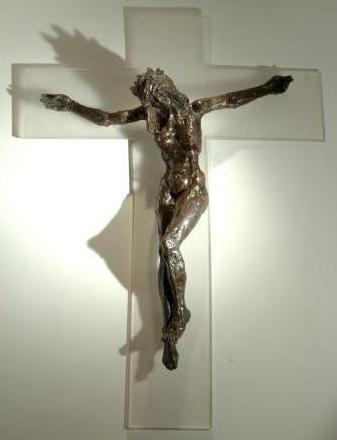
Crucified Christa embodies female Christ

“Christa” by © Edwina Sandys

Christa, the female Christ, is the theme of the following address by Nicola Slee, a feminist theologian and poet based at the Queen’s Foundation in Birmingham, England. She is the author of the new book “Seeking the Risen Christa.”

___
If you are anything like me, you will be conscious of an ambivalence about Good Friday. I can’t imagine being anywhere other than in church, yet I wonder what I’m doing here, fixing my attention and prayer on the horrible death of a man two thousand years ago. I’m both drawn to the cross yet repelled by it Somehow we are here, however we’ve got here and whoever we are, gathered around the cross, with all its strange fascination and its horror – with some kind of a sense that it is important to be here, that we need to be here, that we are doing something that is significant, even essential.

Yet we do well to proceed with care as we approach the cross, to bring what theologians call a hermeneutics of suspicion to bear on this place of violent death where Christians claim we see the love of God most powerfully at work. The cross can be, and has been used, as a tool of oppression to justify violence, bloodshed and abuse. The suffering of Jesus, the innocent, has been preached as a means of encouraging those who suffer to accept their burdens meekly, without complaint, as Jesus did – even when that suffering is unjust and cries out to heaven for restitution. Mary Daly, that arch feminist whose death this year marks a milestone in feminist theology, described Christianity as necrophiliac, death-fixated, addicted to violence. Mary Grey, a more moderate critic, ponders: ‘as Christianity has now had two thousand years of death symbolism, it is at least possible that the slaughter perpetrated in the name of Christendom is related to its symbols of death, blood-guilt and sacrifice’.  A number of feminist theologians argue that the cross should be displaced from the centre of Christianity and an entirely new (or perhaps old) religion of natality (birthing) and flourishing replace the death-fixation of patriarchal religion.

It is important to take such critiques seriously, and I for one have found such work both challenging and liberating, helping me to recognise ways in which I have succumbed to an unhealthy valorization of suffering in my own life – and, perhaps more importantly, helping me to see the ways in which the church uses the symbolism of the cross to shore up its own patriarchal power and to keep abusive systems in place.

So I can go a long way with those who want to deconstruct and decentre the cross. A long way, but not the whole way, because even if we try to remove all references to suffering, violence and death from our faith, these are daily realities for many in our world and can’t be easily airbrushed out. It’s not so much that we need to remove the cross from the centre of Christianity as find better ways of understanding it. And this is possible because the cross is capable of multiple readings and re-interpretations. As Elisabeth Moltmann-Wendell has said, ‘In the last analysis, the cross is a paradoxical symbol. It is not simply the guillotine or the gallows. It is also subconsciously the symbol of wholeness and life and it probably could only survive as a central Christian symbol because of this simultaneous subconscious meaning.’

In these addresses, then, I want to consider some different ways of ‘reading’ the cross, some different angles or perspectives on the cross, particularly some that have been developed by feminist and womanist theologians – some that don’t often find their way into churches, particularly on Good Friday, though if they do, it’s places like St James where I’d expect that to be happening – and I’m grateful for places like this, rare as they are, where it is possible to bring our critique, our ambivalence and our efforts to find new theologies.

One of the ‘fresh readings’ of the cross feminists offer us is the image or symbol of the female Christ, the so-called ‘Christa’. I say ‘fresh’, though in fact, it’s almost forty years old in its recent manifestation, and has roots that go way back into the ancient mystical tradition of Christianity. You have a few examples of artists’ depictions of a female Christ on your service sheet, although these represent just the tip of the iceberg, as there are literally dozens of such images to be found once one starts searching (and that in itself tells us something about the need for images of a feminine divine in a religion which has suppressed the feminine).

When presenting such images to Christians who have never seen them before, I can expect reactions of shock, confusion, even horror – though I imagine that at least some of you at St James will be familiar with such images and, even if you are not, will have a more sympathetic reaction. The Christa is not in any way a denial of the historical reality of Jesus’ masculinity, it is not an attempt to rewrite history and pretend that Jesus might have been a woman. Such images are trying to do something more profound. They are making a positive and visceral identification between the bodies and sufferings of women and the body and suffering of God. In doing so, they have the power to shock us into recognizing just how patriarchal and male our assumptions about God and Christ still are – and in that sense, as Marcella Althaus-Reid puts it, such images ‘undress’ or reveal, our own blasphemous idols of God. She speaks about the ‘obscene Christ’ – a black, or female, or lesbian or transgendered image of Christ – not that such a notion in itself is obscene, but it reveals to us our own obscenity when we recognize that we had assumed Christ to be white, male, heterosexual or whatever.

Nevertheless, the female Christ figure is, itself, controversial amongst feminist theologians. Some consider it merely reinforces, rather than challenges, the stereotype of women as powerless victims of abuse. Others find it immensely healing, enabling them to realize their own bodies as the site of the divine, even in their mortality, pain and abuse. I leave you to make your own response, as I share with you something of my own, in a poem I have written exploring the identity of the crucified Christa with us today:

Who is the Christa?

Every woman forced to have sex who didn’t want it
Every girl trafficked out of her own home country
trapped in some anonymous bedsit in someone else’s city
working all the hours men want to have her body
making a fast buck for her pimp

The woman you meet in the street with bruises all up her arm
which you don’t see because she covers them up in long sleeved blouses
and thick sweaters
(Harder to hide the gash on her face but make-up has its uses)
Every woman who is too frightened to go out alone because of what has happened to her in the past or what she imagines might happen to her

The woman sleeping in the underpass
in her makeshift room of cardboard
who wards off the unwanted attentions from the drunk two streets up

The smart young graduate climbing the career ladder
who can’t get through the day without shooting up
The anorexic teenager starving her young body
that is strange to her and she cannot seem to love
The classrooms of self-harming girls

The nine-year old orphan caring for three siblings all under five
in a shanty town in any African city
Her parents dead from AIDs

Every street girl and boy scavenging on rubbish tips
Every child working in sweatshops making cheap tee-shirts for Primark
All the women raped in war or, worse, forced to watch their daughters raped
Husbands shot in front of their eyes

Women who walk a thousand miles through a war-zone
with babies on their hips and children dragging along beside them
Desperate to make it to a refugee camp
where they might find food and shelter

Christa, our sister,
have mercy
Christa, God’s beloved,
show us your face
where we have not wanted to see it
where we resist your presence among us

___
The above reflection by Nicola Slee is the first of three addresses on Christa that she delivered on Good Friday in 2010 at St. James Piccadilly Church in London. Her other addresses look at the Corporate Christa and the Cosmic Christa. Click here for the full text of all three addresses.

Slee’s new book “Seeking the Risen Christa” was just released by SPCK Publishing, an Anglican press and Britain’s third oldest publisher. For more info on Slee, see our previous post “Female Christ conference planned.”

We usually focus on LGBT spirituality here at the Jesus in Love Blog, but the idea of Christ being female seems queer in the best sense of the word. We are also focusing on the woman Christ now in order to help balance the many gay male Christ figures that will appear here soon in a new series for Lent/Easter.

The illustration for this post is “Christa” by Edwina Sandys -- the most famous artwork of a female Christ. Sculpted in 1975, the magnificent bronze crucifix has graced the pages of the London Times, Time, Newsweek, Life, and other major publications. It has appeared at respected galleries and churches throughout Europe and North America, notably a controversial 1984 showing at the Episcopal Cathedral of St. John the Divine in New York City. Wherever Christa goes, the sculpture triggers debate about the nature of God and the role of women. Sandy’s “Christa” sculpture and the story behind it are included in “Art That Dares: Gay Jesus, Woman Christ, and More” by Kittredge Cherry.

Bookmark and Share