Tuesday, May 08, 2012

Julian of Norwich: Celebrating Mother Jesus

“Julian of Norwich” by Brother Robert Lentz, OFM, TrinityStores.com

Julian of Norwich is a medieval English mystic who celebrated “Mother Jesus.” It’s not known if Julian herself was queer, but her ideas were. Julian is often listed with LGBT saints because of her genderbending visions of Jesus and God. Her feast day (May 8) always falls near Mother’s Day.

Mother’s Day is also a great time to honor mothers whose love for their LGBT children helped launch LGBT organizations, including: Jeanne Manford and Adele Starr, founders of Parents, Families, and Friends of Lesbians and Gays (PFLAG); and Edith “Mom” Perry of Metropolitan Community Churches (MCC).

Her discussions of Jesus as a mother sound radical even now, more than 600 years later. In today’s understanding, Julian’s Jesus seems to be transgender! Her omnigendered vision of the Trinity fits with contemporary feminist and queer theology.


For a new version of this article, click this link to Qspirit.net:
Julian of Norwich: Celebrating Mother Jesus

Julian (c.1342-1416) is the first woman to write a book in English. The book, “Revelations of Divine Love,” recounts a series of 16 visions that she experienced from May 8-13, 1373 during a severe illness when she was 30 years old. The book includes Julian’s most famous saying, “All shall be well and all shall be well and all manner of things shall be well” -- words spoken to her by God in one of Julian’s visions.

Julian of Norwich
from Wikimedia Commons

Later Julian went on to become an anchoress, a type of recluse who lives in a cell attached to a church and does contemplative prayer. Her hermit’s cell was at the Church of St. Julian in Norwich. It had two windows, one opening to the church and the other opening to the street. She became known throughout England for the spiritual counseling that she gave there.

Julian is considered the first Catholic to write at length about God as mother. Her profound ideas speak powerfully today to women and queer people of faith. “As truly as God is our Father, so truly is God our Mother,” Julian wrote.

Here are a few short quotes from Julian’s extensive writings about “Mother Jesus”:


“So Jesus Christ who sets good against evil is our real Mother. We owe our being to him--and this is the essence of motherhood! --and all the delightful, loving protection which ever follows. God is as really our Mother as he is our Father.“ (Chapter 59)

“So Jesus is our true Mother by nature at our first creation, and he is our true Mother in grace by taking on our created nature.” (Chapter 59)

“A mother can give her child milk to suck, but our dear mother Jesus can feed us with himself, and he does so most courteously and most tenderly with the holy sacrament, which is the precious food of life itself… The mother can lay the child tenderly to her breast, but our tender mother Jesus, he can familiarly lead us to his blessed breast through his sweet open side….” (Chapter 60)


These quotes come from modern English translations of “Revelations of Divine Love” by Elizabeth Spearing and Clifton Wolters. Click here for some longer quotations.

The sacred feminine is just one of the many revelations that have endeared Julian to the public. She uses objects from ordinary life to illustrate God’s loving, forgiving nature. For example, in one vision God shows Julian a small object like a hazel-nut in the palm of her hand. Julian writes:


“I looked at it and thought, 'What can this be?' And the answer came to me, 'It is all that is made.' I wondered how it could last, for it was so small I thought it might suddenly disappear. And the answer in my mind was, 'It lasts and will last forever because God loves it; and in the same way everything exists through the love of God'.” (Chapter 5)


In the icon at the top of this post, Julian looks out the window of her cell with her beloved cat. As an anchoress, she probably lived alone. The only other being said to share her room was a cat -- for the practical purpose of keeping it free from rats and mice. A longstanding legend tells of Julian’s friendship with her cat companion. The icon was painted by Robert Lentz, a Franciscan friar based in New York. Known for his innovative icons, he was rebuked by the church for painting LGBT saints and God as female.

Julian lived a long life. The date of her death is unknown, but records show that she was still alive at age 73 to receive an inheritance. She was never formally canonized, but Julian is considered a saint by popular devotion. The Episcopal and Lutheran Churches keep her feast day on May 8.

___
Related links for Mother's Day:
Jeanne Manford: PFLAG founder loved her gay son

Adele Starr and others: Patron saints for straight allies of LGBT people

Edith “Mom” Perry, mother of Troy Perry and first heterosexual member of the Metropolitan Community Churches
___
This post is part of the LGBT Saints series at the Jesus in Love Blog. Saints, martyrs, heroes and holy people of special interest to gay, lesbian, bisexual and transgender (GLBT) people and our allies are covered on appropriate dates throughout the year.
___

Icons of Julian of Norwich and many others are available on cards, plaques, T-shirts, mugs, candles, mugs, and more at TrinityStores.com


___


Thursday, May 03, 2012

Ethiopian eunuch: Early church welcomed queers

Philip and the Ethiopian Eunuch, detail from 11th-century illuminated manuscript (Wikimedia Commons)

A queer black man was the first non-Jewish convert to Christianity, according to progressive interpretations of the Ethiopian eunuch’s story in the Bible. The term translated as “eunuch” probably included a variety of sexual minorities that today would be called LGBT or queer. The account of the eunuch’s conversion in Acts 8:26-40 will be read in many churches this Sunday.

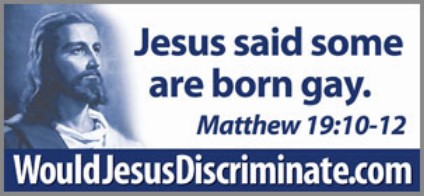
Billboard by
WouldJesusDiscriminate.org
The nameless Ethiopian eunuch was a triple outsider -- a gender-variant foreigner from a racial minority -- and his experience shows that the early Christians welcomed all kinds of outcasts, regardless of race, gender identity or other differences.

Divine intervention plays a big role in the eunuch’s story from the start. It begins when an angel gives some surprising advice to Philip the deacon. He is in the midst of a successful evangelistic campaign in Samaria, but the angel interrupts with an order to leave and take a lonely desert road through the wilderness from Jerusalem to Gaza.

On the road Philip meets a stranger in a chariot reading aloud from the Book of Isaiah on his way home from worshiping in Jerusalem. The man is described as an Ethiopian eunuch (“eunouchos” in Greek), an important official in charge of all the treasury of Candace, queen of the Ethiopians.

Philip and the Ethiopian Eunuch from the Menologion of Basil II, an 11th-century illuminated manuscript (Wikimedia Commons)

In contemporary usage a “eunuch” is a castrated man, but it had a broader definition in ancient times. Literally meaning “the keepers of the bed,” the eunuchs served and guarded the women in royal palaces and wealthy households. Their employers had to be certain that the eunuchs would not get sexually involved with the women they were supposed to protect, so many eunuchs were castrated men, homosexual men, and intersex folk. Many, but not all, were both castrated and homosexual. Eunuchs were trusted officials who often rose to senior posts in government.

Billboard by
WouldJesusDiscriminate.org
Jesus himself used eunuch as an ancient term for LGBTQ people when he declared in Matthew 19:12: “There are eunuchs who were born that way.” (The traditional interpretation of this scripture is that Jesus was speaking of voluntary celibacy.)

When Philip sees the eunuch on the road to Gaza, the Holy Spirit again takes the initiative, urging him to run to join him in his chariot. Soon the two men are absorbed in conversation about the scripture that the eunuch was reading: Isaiah 53:7-8. The passage describes the humiliation and injustice experienced by God’s suffering servant.

The eunuch probably chose this scripture because he had just faced rejection from religious leaders when he worshiped at the temple in Jerusalem. Eunuchs were sexual outcasts in Jewish religious society, much like LGBT people in the church today. First-century Jewish law condemned homosexual acts and forbid converting eunuchs to Judaism. Deuteronomy 23:1 says bluntly, “No one whose testicles are crushed or whose penis is cut off shall be admitted to the assembly of the Lord.”

Philip used the prophecy of God’s rejected servant to tell the eunuch about Jesus as they traveled together in the chariot. Maybe he pointed out Isaiah’s prophecy that comes a few chapters later:


  To the eunuchs who keep my Sabbaths,
  who choose what pleases me
  and hold fast to my covenant —
  to them I will give within my temple and its walls
  a memorial and a name
  better than sons and daughters;
  I will give them an everlasting name
  that will endure forever.
     --Isaiah 56-4-5


As the chariot passes by some water, the eunuch raises a question that LGBT people today ask as well: “What can stand in the way of my being baptized?”

There was no reason to prevent the eunuch from receiving full membership rights in the church. Philip shows no concern about the eunuch’s sexual orientation or race. Philip simply replies, “If you believe with all your heart, you may.”

The pair goes down into the water and Philip baptizes the eunuch then and there. Mission accomplished, the Holy Spirit suddenly takes Philip away. The men did not see each other again after that, but the Bible reports that the eunuch “went on his way rejoicing.”

“The Baptism of the Eunuch” by Rembrandt, 1626 (Wikimedia Commons)

Many authors explore the implications of the Ethiopian eunuch for LGBT people today in books such as:

Queering the Ethiopian Eunuch: Strategies of Ambiguity in Acts” (book) by Sean D. Burke

Sex Difference in Christian Theology: Male, Female, and Intersex in the Image of God” by Megan K. DeFranza.

The Children Are Free: Reexamining the Biblical Evidence on Same-sex Relationships by Jeff Miner and John Tyler Connoley

Jesus, the Bible, and Homosexuality, Revised and Expanded Edition: Explode the Myths, Heal the Church by Jack Rogers

The Man Jesus Loved: Homoerotic Narratives from the New Testament by Theodore Jennings

Outing the Bible: Queer Folks, God, Jesus, and the Christian Scriptures by Nancy Wilson

Freedom, Glorious Freedom: The Spiritual Journey to the Fullness of Life for Gays, Lesbians, and Everybody Else by John McNeill

The Queer Bible Commentary by Deryn Guest, Robert E. Goss, Mona West and Thomas Bohache

A literary look at the life of a gay eunuch in Biblical times is provided in “The Persian Boy,” a historical novel by Mary Renault.

Over the centuries many artists, including Rembrandt, have painted the Ethiopian eunuch’s conversion and baptism. The image of of Philip and the Ethiopian eunuch at the top of this post is from the Menologion of Basil II, an 11th-century Byzantine illuminated calendar manuscript now in the Vatican library.  It presents a beautiful image of harmony between men of different races and sexual orientations. Unfortunately a lot of other historical paintings of the Ethiopian eunuch have an undertone of racism, showing the Ethiopian as exotic or childlike.

Philip, the deacon in the story, is often confused with the apostle Philip whose feast day falls on May 1 or May 3. However St. Philip the Deacon (sometimes called Protodeacon) is honored on Oct. 11 in the Catholic and Episcopal churches and on June 6 in the Orthodox Church. Whatever the day, his example of unlimited welcome for a queer black man is an inspiration for today.
__
Related links:

The early church welcomed a gay man (WouldJesusDiscriminate.org)

The Ethiopian Eunuch - Did You Know God Saved A Gay Man In Acts 8:26-40? (GayChristian101)

A Reflection on the Story of the Ethiopian Eunuch in Acts (John McNeill)

Queer Eye for the Lectionary on Acts 8:26-40 (Louie Crew)

Sermon on Philip and the Ethiopian Eunuch (Queeremergent)

Can Size 14 Heels Keep You Out of Heaven? (Kathy Canyonwalker)

"Born Eunuchs": Homosexual Identity in the Ancient World (Faris Malik)
____
This post is part of the GLBT Saints series by Kittredge Cherry at the Jesus in Love Blog. Saints, martyrs, mystics, prophets, witnesses, heroes, holy people, deities and religious figures of special interest to lesbian, gay, bisexual and transgender (LGBT) and queer people and our allies are covered on appropriate dates throughout the year.

Copyright © Kittredge Cherry. All rights reserved.
http://www.jesusinlove.blogspot.com/
Jesus in Love Blog on LGBT spirituality and the arts

Tuesday, May 01, 2012

Cartoon shows Pope mad at nuns and Jesus for not condemning homosexuality

“Vatican crackdown” by Steve Sack, Minneapolis Star Tribune

A new cartoon uses humor to shed light on the latest controversy pitting the church against homosexuality.

“Vatican Crackdown” by Steve Sack shows a grouchy Pope warning a nun, “I’m very upset with you for not speaking out against homosexuality.”

In the next panel, Jesus appears beside the nun. “Same goes for your friend,” the Pope hisses.

So true! Jesus said nothing against homosexuality in the Bible. It’s a maddeningly inconvenient truth for conservatives like the Pope.

Vatican officials are cracking down on U.S. nuns for supporting LGBT rights, women’s ordination and healthcare reform. The Vatican recently issued a harsh report criticizing the Leadership Conference of Women Religious, which represents the majority of the 57,000 Roman Catholic nuns in the United States.

Thanks, Steve, for permission to share your cartoon here! Thanks, Trudie, for alerting me to this cartoon!
__
Related link:

Vatican Crackdown On Nuns Over Social Justice Issues, Women Ordination (Huffington Post)

Friday, April 27, 2012

Christina Rossetti: Queer writer of Christmas carols and lesbian poetry

Cover illustration for Christina Rossetti’s “Goblin Market and Other Poems” (1862) by Dante Gabriel Rossetti)

Portrait of Christina Rossetti
by Dante Gabriel Rossetti

Christina Georgina Rossetti was a 19th-century English poet whose work ranged from Christmas carols to sensuous lesbian love poetry. A devout Christian who never married, she has been called a “queer virgin” and “gay mystic.” Her feast day is today (April 27) on the Episcopal and Church of England calendars.

For a new version of this article, click this link to Qspirit.net:
Christina Rossetti: Queer writer of Christmas carols and lesbian poetry


Many consider her to be one of Britain’s greatest Victorian poets. Rossetti’s best-known works are the Christmas carol “In the Bleak Midwinter” and “Goblin Market,” a surprisingly erotic poem about the redemptive love between two sisters who overcome temptation by goblins. The homoeroticism is unmistakable in verses such as these:

She cried, “...Did you miss me?
Come and kiss me.
Never mind my bruises,
Hug me, kiss me, suck my juices
Squeez’d from goblin fruits for you,
Goblin pulp and goblin dew.
Eat me, drink me, love me…”

She clung about her sister,
Kiss’d and kiss’d and kiss’d her…
She kiss’d and kiss’d her with a hungry mouth.

Some of these verses were set to music in a choral piece commissioned by the Sydney Gay and Lesbian Choir: “Heartland” by Matthew Hindson.

There is no direct evidence that Rossetti was sexually involved with another woman, but historian Rictor Norton reports that her brother destroyed her love poems addressed to women when he edited her poetry for publication. Rossetti is included in “Essential Gay Mystics” by Andrew Harvey.  A comprehensive chapter titled “Christina Rossetti: The Female Queer Virgin” appears in “Same Sex Desire in Victorian Religious Culture” by Frederick S. Roden. Rossetti is also important to feminist scholars who reclaimed her in the 1980s and 1990s as they sought women’s voices hidden in the church’s patriarchal past.

Rossetti (Dec. 5, 1830 - Dec. 29, 1894) was born in London as the youngest child in an artistic family. Her brother Dante Gabriel Rossetti became a famous Pre-Raphaelite poet and artist. Encouraged by her family, she began writing and dating her poems starting at age 12.

When Rossetti was 14 she started experiencing bouts of illness and depression and became deeply involved in the Anglo-Catholic Movement of the Church of England. The rest of her life would be shaped by prolonged illness and passionate religious devotion. She broke off marriage engagements with two different men on religious grounds. She stayed single, living with her mother and aunt for most of her life.

Christina posed
for this Annunciation
by Dante Gabriel Rossetti
During this period she served as the model for the Virgin Mary in a couple of her brother’s most famous paintings, including his 1850 vision of the Annunciation, “Ecce Ancilla Domini” (“Behold the Handmaid of God.”)

Starting in 1859, Rossetti worked for 10 years as a volunteer at the St. Mary Magdalene “house of charity” in Highgate, a shelter for unwed mothers and former prostitutes run by Anglican nuns. Some suggest that “Goblin Market” was inspired by and/or written for the “fallen women” she met there.

Goblin Market” was published in 1862, when Rossetti was 31. The poem is about Laura and Lizzie, two sisters who live alone together and share one bed. They sleep as a couple, in Rossetti’s vivid words:

Cheek to cheek and breast to breast
Lock’d together in one nest.

But “goblin men” tempt them with luscious forbidden fruit and Laura succumbs. After one night of indulgence she can no longer find the goblins and begins wasting away. Desperate to help her sister, Lizzie tries to buy fruit from the goblins, but they refuse and try to make her eat the fruit. She resists even when they attack and try to force the fruit into her mouth. Lizzie, drenched in fruit juice and pulp, returns home and invites Laura to lick the juices from her in the verses quoted earlier. The juicy kisses revive Laura and the two sisters go on to lead long lives as wives and mothers.

“Goblin Market” can be read as an innocent childhood nursery rhyme, a warning about the dangers of sexuality, a feminist critique of marriage or a Christian allegory. Lizzie becomes a Christ figure who sacrifices to save her sister from sin and gives life with her Eucharistic invitation to “Eat me, drink me, love me…” The two sisters of “Goblin Market” are often interpreted as lesbian lovers, which means that Lizzie can justifiably be interpreted as a lesbian Christ.

In 1872 Rossetti was diagnosed with Graves Disease, an auto-immune thyroid disorder, which caused her to spend her last 15 years as a recluse in her home. She died of cancer on Dec. 29, 1894 at age 64.

She wrote the words to “In the Bleak Midwinter” in 1872 in response to a request from Scribner’s Magazine for a Christmas poem. It was published posthumously in 1904 and became a popular carol after composer Gustav Holst set it to music in 1906. Her poem “Love Came Down at Christmas” (1885) is also a well known carol.  “In the Bleak Midwinter” continues to be sung frequently in churches, by choirs, and on recordings by artists such as Julie Andrews (video below), Sarah McLaughlin, Loreena McKennitt and James Taylor. The haunting song includes these verses:


In the bleak mid-winter
Frosty wind made moan,
Earth stood hard as iron,
Water like a stone;
Snow had fallen, snow on snow,
Snow on snow,
In the bleak mid-winter
Long ago.

Our God, Heaven cannot hold Him
Nor earth sustain;
Heaven and earth shall flee away
When He comes to reign:
In the bleak mid-winter
A stable-place sufficed
The Lord God Almighty,
Jesus Christ....

Enough for Him, whom cherubim
Worship night and day,
A breastful of milk,
And a mangerful of hay;
Enough for Him, whom angels
Fall down before,
The ox and ass and camel
Which adore.

Angels and archangels
May have gathered there,
Cherubim and seraphim
Thronged the air -
But only His mother
In her maiden bliss
Worshipped the Beloved
With a kiss.

What can I give Him,
Poor as I am?
If I were a shepherd
I would bring a lamb,
If I were a wise man
I would do my part,
Yet what I can I give Him,
Give my heart.


The Episcopal Church devotes a feast day to Christina Rossetti on April 27 with this official prayer:

O God, whom heaven cannot hold, you inspired Christina Rossetti to express the mystery of the Incarnation through her poems: Help us to follow her example in giving our hearts to Christ, who is love; and who is alive and reigns with you and the Holy Spirit, one God, in glory everlasting. Amen.

Rossetti herself may well have felt ambivalent about being honored by the church or outed as a queer. She shared her own thoughts for posterity in her poem “When I am dead, my dearest” (1862):


When I am dead, my dearest,
Sing no sad songs for me;
Plant thou no roses at my head,
Nor shady cypress tree:
Be the green grass above me
With showers and dewdrops wet;
And if thou wilt, remember,
And if thou wilt, forget.

I shall not see the shadows,
I shall not feel the rain;
I shall not hear the nightingale
Sing on, as if in pain:
And dreaming through the twilight
That doth not rise nor set,
Haply I may remember,
And haply may forget.


___
Related links:

The Many Weird and Wonderful Illustrations for Christina Rossetti's Goblin Market (Unpretentious Blabberings)


___
This post is part of the LGBTQ Saints series by Kittredge Cherry. Traditional and alternative saints, people in the Bible, LGBTQ martyrs, authors, theologians, religious leaders, artists, deities and other figures of special interest to lesbian, gay, bisexual and transgender and queer (LGBTQ) people and our allies are covered.

Copyright © Kittredge Cherry. All rights reserved.
Qspirit.net presents the Jesus in Love Blog on LGBTQ spirituality.


Wednesday, April 25, 2012

Gay Jesus makes news in the Guardian

“Queer Jesus” by Andrew Craig Williams

“Was Jesus gay? Probably,” a major article at the Guardian by an Anglican priest, is getting a lot of attention this week.

Paul Oestreicher, a chaplain at the University of Sussex in England, wrote that Jesus was most likely gay, based on his relationship with his disciple John.

Here’s a quote from the original article posted on April 20 at the Guardian, one of the most popular British news sites:


After much reflection and with certainly no wish to shock, I felt I was left with no option but to suggest, for the first time in half a century of my Anglican priesthood, that Jesus may well have been homosexual. Had he been devoid of sexuality, he would not have been truly human. To believe that would be heretical.

Heterosexual, bisexual, homosexual: Jesus could have been any of these. There can be no certainty which. The homosexual option simply seems the most likely. The intimate relationship with the beloved disciple points in that direction. It would be so interpreted in any person today.


Oestreicher goes on to say that Jesus’ sexual orientation doesn’t matter, except to remind the church to openly accept gay and lesbian Christians today.

I am glad to see one more important church leader acknowledging the likelihood that Jesus was homosexual. When more people welcome the possibility of a queer Christ, then more people will also be able to see the Christ within us queers.

Jesus appears as a silhouette on the cross against a fractured rainbow sky in “Queer Jesus,” the image at the top of this post. It was created by Andrew Craig Williams, a queer artist, writer and music maker based in Wales who blogs at andrewcraigwilliams.blogspot.com.

Special thanks to Colin and Paul Hartman for the tip about the Guardian article!
____
This post is part of the Queer Christ series series by Kittredge Cherry at the Jesus in Love Blog. The series gathers together visions of the queer Christ as presented by artists, writers, theologians and others.