Monday, November 17, 2014

Dance of the 41 Queers: Police raid on Mexican drag ball remembered


For a new version of this article, click this link to Qspirit.net:
Dance of the 41 Queers: Police raid on Mexican drag ball remembered

“Los 41 Maricones” (The 41 Queers) by Jose Guadalupe Posada, 1901 (Wikipedia)

One of the world’s most notorious police raids on a queer gathering occurred on this date (Nov. 17-18) in 1901, when police arrested 41 men at a drag ball in Mexico City.

The raid on the “Dance of the 41” caused a huge scandal with lasting repercussions against LGBT people. The incident was widely reported and was used thereafter to justify years of police harassment, including more raids, blackmail, beatings and imprisonment. The number 41 entered popular culture in Mexico and continues to be used as a negative way to refer to gay men, evoking shame.

About half of the men at the Dance of the 41 were dressed as women, with silk and satin dresses, elegant wigs, jewelry and make-up. Police raided the private house where the “transvestite ball” was underway. They never released the names of those arrested because they came from the upper class of Mexican society.

As punishment the 41 detainees were humiliated in jail and then forced into the army, where they dug ditches and cleaned latrines in the Yucatan. A lesbian gathering in Santa Maria was raided soon after on Dec. 4, 1901, but it received much less publicity.

The vivid reports of the Dance of the 41 included a famous series of caricatures by popular Mexican artist Jose Guadalupe Posada. These mocking images stand in contrast to the LGBT Stations of the Cross by Mary Button, whose paintings connect police raids of queer bars with the suffering of Jesus. The raid on the Dance of the 41 is an example of police harassment that happened in many countries and continues in some.

Today same-sex marriage is legal in Mexico City and the Dance of the 41 is being reclaimed and reinterpreted by LGBT activists and scholars. A non-profit organization called “Honor 41” honors and celebrates Latina/o LGBTQ individuals who are role models. Their English-language video on the Dance of the 41 gives an accessible overview of the history.

The event is known in Spanish as simply as “el baile de los cuarenta y uno” (the dance of the forty-one) or with an added anti-gay insult “el baile de los cuarenta y uno maricones” (the dance of the forty-one fags).

All the facts and the full context concerning the Dance of the 41 are examined in the scholarly book “The Famous 41: Sexuality and Social Control in Mexico” by Robert McKee Irwin, Edward J. McCaughan and Michelle Rocio Nasser.


___
Related links:

Dance of the 41 (Wikipedia English)

Baile de invertidos (Homosexual balls) (Wikipedia Spanish)

To read this post in Spanish / en español, go to Santos Queer:
El baile de los cuarenta y uno: Recordando el momento en que la policía allanó un baile queer en México

___
This post is part of the LGBTQ Calendar series by Kittredge Cherry. The series celebrates religious and spiritual holidays, events in LGBTQ history, holy days, feast days, festivals, anniversaries, liturgical seasons and other occasions of special interest to lesbian, gay, bisexual, transgender and queer people of faith and our allies.

Copyright © Kittredge Cherry. All rights reserved.
Qspirit.net presents the Jesus in Love Blog on LGBTQ spirituality.


Tuesday, November 11, 2014

Poem: Battle at First Holy Communion

Lesbian poet Audrey Lockwood was forced to wear a frilly veil and dress at her first communion in 1966

Nations around the globe mark the end of World War I today, but another battle is still being fought -- the struggle for LGBT equality in the church.

"Battle at First Holy Communion" by lesbian poet Audrey Lockwood is posted here today, which is Veterans Day in the United States. Many LGBT people get caught in the conflict between religion and queer identity. This poem comes from the front lines of a new kind of holy war.

Battle at First Holy Communion
By Audrey Lockwood

Battle at first holy communion,
Date May 1, 1966.

Rigid gender roles rewarded and fawned
over. My Waterloo was the prayer book.
Girls were required to carry white prayer books
boys got black ones.

Humiliation over having to wear the frilly
White dress was just too much for me; the
battle over the missalette was one I thought
I could win.

Older, I was a bit older than the other girls
different from the other girls, more athletic
hating sex roles of that era.

Mom got me a black missalette; I was adamant!
This little butch girl was not going to give in
on this point. It was a book, it would last forever,
the white dress would be lost to oblivion later.

The battle over the white dress was long lost;
the book worth fighting for.

My Mom, ever the diplomat, compromised and
made a white cover out of a pillow case.
I marched down the aisle with my “white” book
knowing that the black prayer book was hidden
underneath; protective coloration.

May 1, 1966, black was beautiful that year.

Now Audrey wears a top hat whenever she wants

____________

Audrey Lockwood's poetry has been featured at Homocentric, Writers at Work, and the My Life is Poetry events of the Los Angeles Gay and Lesbian Center. Her inspirations include butch identity, mermaids and ambivalent church attendance. She and Kittredge Cherry were united in a "Holy Union" wedding in 1987 at Metropolitan Community Church of San Francisco.

Related links:

December poem: What if the Sea Told Us by Audrey Lockwood (Jesus in Love)

Monday, November 03, 2014

Malachy of Armagh: Same-sex soulmate to Bernard of Clairvaux

“Malachy of Armagh” by Rowan Lewgalon

Malachy of Armagh is an 11th-century Irish saint who died in the arms of his more famous soulmate, Saint Bernard of Clairvaux. Bernard showered Malachy with kisses during his lifetime and they are buried together, wearing each other’s clothes. Malachy’s feast day is today (Nov. 3).

Malachy is also the attributed author for the “Prophecy of the Popes,” which predicted that there would be 112 more popes before the Last Judgment. Most scholars dismiss the document as an elaborate 16th-century hoax. Still it’s sobering that the 112th and final pope in the prophecy is the current pontiff, Pope Francis. The prophecy remains popular with doomsday fanatics.

Malachy (1094 - Nov. 2, 1148) was born in Armagh in northern Ireland and rose to become archbishop.In Middle Irish his name is Máel Máedóc Ua Morgair. He became Ireland’s first native-born saint to be canonized.

He was primate of all Ireland when he first visited the French monastery at Clairvaux around 1139. The abbott in charge was Bernard (1090-1153), a mystical author, advisor to five Popes and a monastic reformer who built the Cistercian order of monks and nuns. Bernard is considered to be the last of the Church Fathers. They soon became devoted, passionate friends. Malachy even asked the Pope for permission to become a Cistercian, but the Pope refused.

Malachy traveled to see Bernard again in 1142. They were so close that Bernard covered him with kisses in a scene that is described well by Orthodox priest Richard Cleaver in “Know My Name: A Gay Liberation Theology”: “Bernard's account makes deeply romantic reading for a modern gay man. “Oscula rui,” Bernard says of their reunion: “I showered him with kisses.”

Their relationship had lasted almost a decade when Malachy reunited with Bernard for the third and final time. Malachy fell sick when he arrived in Clairvaux in 1148. He died in Bernard’s arms on All Soul’s Day, Nov. 2. Again Cleaver tells the details based on accounts by Geoffrey, Bernard’s secretary and traveling companion:

“Geoffrey of Auxerre tells us what happened later. Bernard put on the habit taken from Malachy's body as it was being prepared for burial at Clairvaux, and he wore it to celebrate the funeral mass. He chose to sing not a requiem mass but the mass of a confessor bishop: a personal canonization and, incidentally, an example of using liturgy to do theology. Bernard himself was later buried next to Malachy, in Malachy’s habit. For Bernard, as for us today, this kind of passionate love for another human being was an indispensable channel for experiencing the God of love.”

After Malachy’s death Bernard lived on for another five years. During this time he wrote “Life of Saint Malachy of Armagh,” which is his idealized tribute to the man he loved.

Bernard forbid sculptures and paintings at the monastery during his lifetime, but by the late 15th century the altarpiece at the Clairvaux Abbey had a painting of Christ’s baptism -- being jointly witnessed by Bernard and Malachy.

The Irish archbishop comes back to life in the striking contemporary portrait of Saint Malachy as a young man at the top of this post. It was created by Rowan Lewgalon, a spiritual artist based in Germany and a cleric in the Old Catholic Apostolic Church.

Malachy and Bernard were men of their time who supported church teachings on celibacy. People today might say that they had a homosexual orientation while abstaining from sexual contact. Medieval mystics created alternative forms of sexuality that defy contemporary categories, but might be encompassed by the term “queer.” They directed their sexuality toward God and experienced God’s love through deep friendship with another human being... such as the relationship between Malachy and Bernard.

A prayer written by Bernard’s secretary Geoffrey shows how the community at Clairvaux understood and celebrated the man-to-man love between Bernard and Malachy. He thanks God for these “two stars of such surpassing brightness” and “twofold treasure.”
___

Related links:
Saints Bernard of Clairvaux and Malachy: Honey-tongued abbot and the archbishop he loved

To read this post in Spanish / en español, go to Santos Queer:
San Malaquías de Armagh: El alma gemela de Bernardo de Claraval

____
This post is part of the GLBT Saints series by Kittredge Cherry at the Jesus in Love Blog. Saints, martyrs, mystics, prophets, witnesses, heroes, holy people, humanitarians, deities and religious figures of special interest to lesbian, gay, bisexual and transgender (LGBT) and queer people and our allies are covered on appropriate dates throughout the year.

Copyright © Kittredge Cherry. All rights reserved.
http://www.jesusinlove.blogspot.com/
Jesus in Love Blog on LGBT spirituality and the arts


Sunday, November 02, 2014

Video: Imagine if the queer martyrs had lived


Imagine what would have happened if modern queer martyrs like Harvey Milk and Matthew Shepard were not killed before their time?

A moving video shows the headlines they might have made. In this beautiful world without hate, Harvey and Matthew lived long, productive lives -- and so did Martin Luther King, Anne Frank and many other martyrs for justice.

I'm posting it here for All Saints Day, All Souls Day and Day of the Dead (Dia de los Muertos).

The video “Imagine a World Without Hate” was produced by the Anti-Defamation League, a civil-rights group fighting anti-Semitism and all forms of bigotry.

____
This post is part of the GLBT Saints series by Kittredge Cherry at the Jesus in Love Blog. Saints, martyrs, mystics, prophets, witnesses, heroes, holy people, humanitarians, deities and religious figures of special interest to lesbian, gay, bisexual and transgender (LGBT) and queer people and our allies are covered on appropriate dates throughout the year.

Saturday, November 01, 2014

Icons honor queer saints for All Saints Day

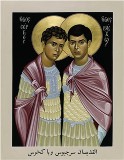
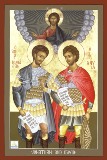
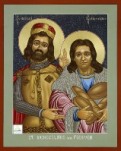
“Saints Polyeuct and Nearchus” by Robert Lentz

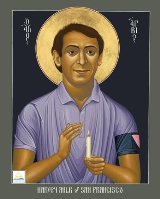
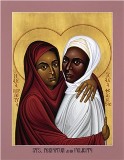
   Harvey Milk icon by Robert Lentz    Saints Perpetua and Felicity by Robert Lentz  

Innovative Religious Art
Buy now at TrinityStores.com
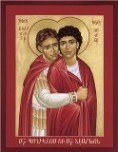
Icons of queer saints are available from TrinityStores.com. Favorites of Jesus in Love readers are pictured here for All Saints Day.

Click the images to browse and buy cards, plaques, T-shirts, mugs, candles, and framed prints with these images and many more at TrinityStores.com.  New icons by the same artists are listed at the end of this post.


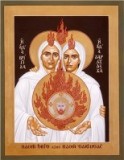
       Sts. Polyeuct and Nearchus by Robert Lentz    Sts. Brigid & Darlughdach by Robert Lentz    St. Boris and George by Robert Lentz  

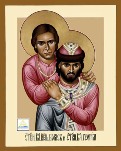
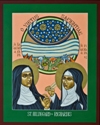
       Jonathan & David by Robert Lentz    Hildegard of Bingen and Richardis by Lewis Williams    St. Wencelaus and Podiven by Lewis Williams
All icons from TrinityStores.com by Robert Lentz or Lewis Williams

"Daniel in the Lion's Den"
by Lewis Williams

Robert Lentz is a Franciscan friar based in New York. Known for his innovative icons, he was rebuked by the church for making icons of LGBT saints and God as female. Colorado artist Lewis Williams of the Secular Franciscan Order (SFO) studied with Lentz and has made social justice a theme of his icons.

Lentz and Williams artists created a variety of new icons over the past year, including at least one queer saint: the Biblical prophet Daniel, a eunuch famous for surviving the lion's den. (Click here for more on the queer side of Daniel).

The following icons are so new that I haven't had time to look into whether they qualify as queer. But they do represent the diversity of God's people, so explore for yourself:

New icons by Brother Robert Lentz, OFM

Click the names or visit TrinityStores.com to view:

Josephine Bakhita (19th century, Sudan)

Katharine Drexel (1858-1935, American)

Faustina Kowalska (20th century, Poland)

Andrew Dung-Lac (1785-1839, Vietnam)

Martin de Porres (1579-1639, Peru)

Pedro Betancur

Toribio Romo

Pio of Pietrelcina (1887 -1968

Simone Weil (1909 -1943, France)

New icons by Lewis Williams, SFO

Daniel in the Lion's Den

Peruvian Nativity

Columba and Ernan (521-597, Ireland)

Christmas Scene: Montrose, Colorado